
Bible on Gossip: What Scripture Says
Gossip is sinful speech that destroys trust; speak less, speak with care, and refuse to pass along others' private stories.
The Bible treats gossip as sin, not small talk. If I had to sum up the article in one line, it would be this: even true words can become wrong words when I share them with the wrong people, for the wrong reason, or without need.
Here’s the short version:
- Gossip is hidden, harmful speech
- It breaks trust and splits people apart
- It points to heart issues like pride, envy, or bitterness
- Not every hard conversation is gossip
- Direct help, wise counsel, abuse reporting, and safety warnings are different
- A simple filter helps: Is it true? Is it needed? Is it loving? Would I say it in front of the person?
- The right response is simple: pause, stay quiet, speak directly, and repent when I fail
A few Bible anchors shape the whole piece:
- Romans 1:29–32 puts gossip in a dark list of sins
- Matthew 12:34 says my mouth shows what is in my heart
- Proverbs 26:20 says quarrels die when gossip stops
- James 3:5–6 compares the tongue to a fire
- Matthew 18:15 points me to private, direct correction
The article also brings this into daily life: family talk, church prayer chains, friend groups, and workplace rumor. In each case, the same pattern shows up: one comment can damage trust fast, while a quiet refusal to join in can stop the spread.
If I want a plain takeaway, it’s this: speak less, speak with care, and do not pass along someone else’s story unless there is a clear, loving reason to do it.
Taming the Tongue: Gossip, Slander & Respectable Sins That Destroy Your Witness – Jonny Ardavanis
What Is Gossip in the Bible?
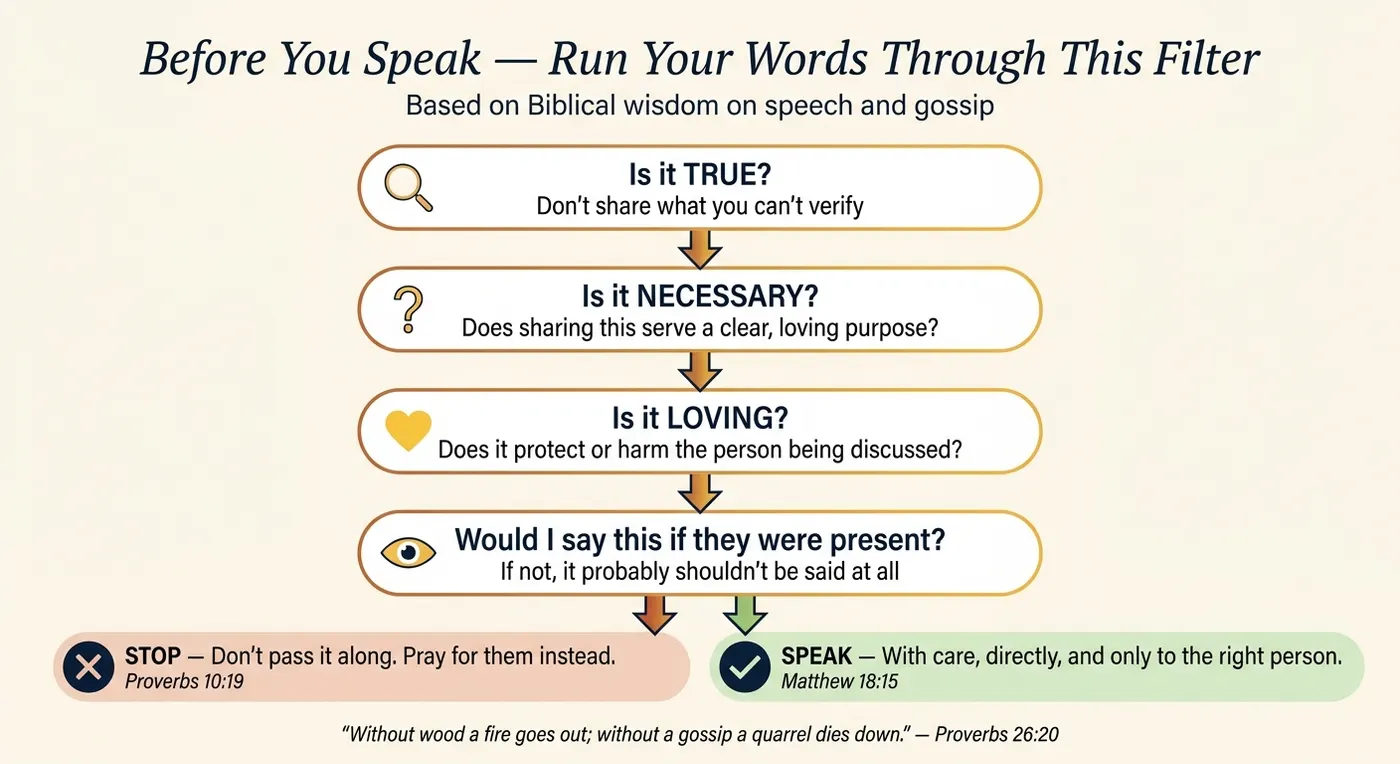
How to Filter Your Words: A Biblical Gossip Test
Scripture uses a few words for gossip, and they all point in the same direction: hidden, harmful speech. At its core, gossip is secretive talk that shows a divided heart.
Biblical Words Used for Gossip
The Hebrew word often translated as "talebearer" or "gossip" means "one who reveals secrets." Proverbs 11:13 says that a whisperer reveals secrets, and Proverbs 16:28 says a whisperer separates close friends. Put those together, and the picture is clear: gossip leaks private information and breaks trust.
That matters because not every conversation about another person is gossip.
How Gossip Differs From Honest, Caring Communication
The New Testament makes the same point. In Romans 1:29, Paul uses a term for hidden, harmful talk to describe people who spread damaging speech quietly, and in 2 Corinthians 12:20 he lists gossip and slander among sins he fears finding in the Corinthian church. Slander is false or stretched speech meant to damage a reputation. Gossip can involve true information shared without permission or good reason.
Scripture does make room for direct, needed speech. That includes going to the person first, seeking counsel from a pastor or mature Christian, reporting abuse or crime to authorities, or warning others about someone who poses real danger. Paul even named Alexander the coppersmith in 2 Timothy 4:14–15 to protect Timothy, not to entertain other people.
So the issue is not just whether something is true. Truth by itself does not make speech wise. Even accurate information can turn into gossip when it is shared without need, without charity, or with the wrong audience.
A Simple Test for Everyday Conversations
Before you speak, slow down and run your words through four simple questions:
- Is it true?
- Is it necessary?
- Is it loving?
- Would I say this if the person were present?
That test also helps with gossip that shows up wearing nicer clothes, like a prayer request, venting, or concern. If you don’t have permission to share the information, pause. If the answer to these questions is no, don’t pass it along.
"The words of a whisperer are like delicious morsels; they go down into the inner parts of the body."
Why God Warns Against Gossip
God warns against gossip because it tears up trust, splits people apart, and weakens spiritual life. It often happens out of sight, which makes it easy to excuse. But Scripture treats it as harmful speech with real fallout.
Scriptures That Show Gossip Destroys Trust and Unity
Proverbs 26:20 says it plainly: "Without wood a fire goes out; without a gossip a quarrel dies down." The picture is simple. Gossip feeds conflict. Take it away, and many arguments start to lose steam.
James 3:5–6 pushes that idea even further. It compares the tongue to a small spark that can set a whole forest on fire. Small words can do major damage. One quiet comment can slowly eat away at trust between two people, and before long, the damage spreads far beyond that first conversation.
That kind of harm isn’t just about bad manners or social tension. It points to something deeper in the person speaking.
What Gossip Reveals About the Heart
Jesus said in Matthew 12:34 that the mouth speaks from the overflow of the heart. In other words, gossip doesn’t come out of nowhere. It’s not just a slip of the tongue or a careless habit. It can expose pride, envy, bitterness, or spite hiding underneath the words.
That’s why dealing with gossip takes more than trying to talk less. James 1:26 warns that anyone who doesn’t keep a tight rein on their tongue has a religion that is worthless. That’s strong language, and it makes the point hard to miss. Gossip is not only sinful speech; it can show desires and attitudes that are out of order.
And the damage doesn’t stay with the speaker. It spreads anywhere people depend on trust.
Where Gossip Does the Most Damage
You can see this most clearly in places built on confidence and close relationships. A church small group may share personal struggles in private, but once those details slip into side conversations, the group can start to crack. In families, talk about relatives can move fast from harmless updates to hurtful rumor. At work, the same pattern shows up when talk about a coworker’s character or job performance spreads and chips away at that person’s credibility.
Romans 1:29 places gossip alongside sins like murder, strife, and deceit, which shows how seriously God views its power to corrupt communities. That leads straight into the next issue: how to resist gossip and respond well when it shows up.
How to Resist Gossip and Respond in a Godly Way
Knowing gossip damages trust, unity, and spiritual growth is one thing. Handling it in the moment is another. The steps below are practical and rooted in Scripture.
What to Do When You Are Tempted to Gossip
Temptation often has a certain feel to it: lowered voices, quick glances, and that urge to lean in and share. Take that instinct as a warning sign.
Pause. Pray. Then stay silent unless what you’re about to say is both needed and loving. If it fails even one of those tests, don’t pass it along. Proverbs 10:19 says the same thing: "the one who controls his lips is prudent".
It also helps to ask yourself why you want to share it. Gossip often comes from pride, jealousy, anger, or the desire to seem informed or righteous. As author Kathy Collard Miller puts it:
"Gossip is a symptom of deeper things in the heart – the motives."
If you catch yourself replaying someone else’s story in your mind, turn that habit into prayer for that person instead. That small shift can stop gossip before it ever leaves your mouth.
How to Respond When Others Gossip Around You
Once gossip starts, your next choice is whether you’ll join in. Listening to gossip makes you part of it. You don’t have to speak to take part. Hearing it and receiving it is enough.
A simple response can change the whole direction of the conversation. Ask, "Have you spoken to them directly?" If someone frames it as a prayer request, ask, "Did they give you permission to share this?" And if you need to be more direct, say calmly: "I’m not comfortable talking about someone who isn’t here to speak for themselves."
You don’t need to lecture or make a scene. Just don’t feed it. Proverbs 26:20 makes the point plainly: gossip dies when it loses its audience.
How to Respond If You Have Been Gossiped About
When gossip is aimed at you instead of coming from you, the situation feels different. It hurts to learn that someone has spread a story about you. Even so, fight the urge to defend yourself on the spot or strike back. That usually makes things worse, not better.
Matthew 18:15 gives a better way: go to the person in private and seek reconciliation. That kind of direct talk protects trust and leaves room for peace, which is where Scripture keeps pointing.
Beyond that, guard against bitterness. Colossians 3:13 calls believers to forgive as the Lord forgave you. Entrust your name to God, and keep your mind on what is true, honorable, and lovely in Philippians 4:8 instead of rehearsing what was said about you.
Conclusion: Speak Truth, Speak Less, Build Others Up
The Bible calls believers to speak what is true, needed, and loving. Scripture treats gossip as sinful speech that breaks trust and harms people.
But knowing gossip is wrong isn’t enough. You have to train your speech so you don’t drift into it. Gossip has no place in a believer’s life because it stirs up discord and tears at trust.
That means dealing with what’s under the surface too. Pride, envy, and bitterness often sit behind loose words. The aim is to build others up and guard trust through honest self-examination and quick repentance when you slip.
A big part of that change is simple: use fewer words, and choose them with care. Wise speech begins with restraint. James 1:19 calls believers to be "slow to speak", and Proverbs 20:19 warns against people who talk too much. Fewer words, spoken with care, do far more good than careless ones.
One simple way to live this out is a short review at the end of each day. Set aside 10 to 15 minutes each evening and think through your conversations. Ask yourself if you repeated something that should have stayed private, confess it, and pray over what you said. You can also use Psalmlog‘s private voice journaling and Scripture prompts to review your words through a biblical lens and ask whether your speech protected trust or weakened it.
FAQs
Is gossip always false?
No. Gossip isn’t always false.
Slander means spreading lies to damage someone’s reputation. Gossip is different. It can include information that’s true, but shared when it doesn’t need to be, shared for the wrong reasons, or told behind someone’s back.
That’s why the Bible speaks against gossip. The problem isn’t only whether the words are false. The problem is that gossip can break trust, expose private matters, and pull people down instead of helping them.
When is sharing concern not gossip?
Sharing a concern isn’t gossip when it comes from love, a desire for justice, or a need for godly counsel, not from curiosity or a wish to damage someone’s name.
That kind of sharing can make sense in a few cases. For example, it may be right to report a crime, ask for wisdom about a hard relationship, or warn someone about danger. Even then, the goal should be care, not talk for the sake of talk.
One clear sign of true concern: it moves toward a direct, private conversation with the person involved instead of spreading personal information to other people.
How should I respond to gossip?
Say no to it. You can speak up, say you don’t want to take part, or just walk away. If it fits the moment, talk to the person sharing it, and don’t pass it along yourself.
If you’re concerned, steer the conversation toward something helpful or speak straight to the person involved to check the facts. In church or at work, handle it in private first, then bring in a trusted leader if needed.