
Bible View on Gambling: A Christian Guide
Examines biblical warnings about greed, stewardship, and contentment to help Christians evaluate gambling.
Short answer: the Bible does not directly ban gambling, but its teaching points Christians away from it.
If I boil the article down, the case is simple: gambling often feeds greed, weakens self-control, works against contentment, and puts stewardship at risk. It also leans on one person losing so another person can win. That is hard to square with biblical teaching on money, work, and love for other people.
Here’s the article in plain terms:
- The Bible does not say, “Do not gamble” in those exact words.
- But it does warn against coveting, the love of money, and chasing quick wealth.
- It teaches that money is something I manage before God, not just something I spend however I want.
- It calls me to contentment, honest work, and care for my neighbor.
- Modern gambling – lotteries, sports betting, casinos, and betting apps – can turn those heart issues into habits.
- The risk is not just financial. It can become a spiritual and personal problem too.
A few facts show why this matters. Americans spent $105 billion on state lotteries in 2021, U.S. sports wagering revenue hit $13.7 billion in 2024, and about 4% of U.S. adults deal with gambling disorder. Even a small habit like $25 per week adds up to $1,300 per year.
If I were asking whether gambling is “allowed,” the article’s answer is: that is the wrong main question. The better question is this: does it train my heart toward trust in God, contentment, and wise use of money – or away from them?
Is Gambling a Sin in Christianity? What the Bible REALLY Says
Biblical principles that shape the answer
Scripture speaks to desire, money, stewardship, contentment, work, and love for other people. When you apply those themes to gambling, the pattern is hard to miss. The clearest warning starts with greed and the pull of easy gain.
Greed, coveting, and the love of money
The Bible is blunt about money and desire. The Tenth Commandment warns against wanting what belongs to someone else (Exodus 20:17). Jesus says it even more directly in Luke 12:15:
"Be on your guard against all kinds of greed; life does not consist in an abundance of possessions."
Paul pulls the same thread in 1 Timothy 6:9–10:
"For the love of money is a root of all kinds of evil. Some people, eager for money, have wandered from the faith and pierced themselves with many griefs."
Gambling doesn’t just put money at risk. It often feeds the hunger for more money. Proverbs 13:11 gives a plain warning about wealth gained too fast, and Colossians 3:5 goes even further by linking greed with idolatry. In other words, the issue isn’t only the dollars lost or won. It’s what sits at the center of a person’s heart. The get-rich-quick mindset points to a deeper problem than bad budgeting.
Stewardship, contentment, and trust in God
In the Parable of the Talents (Matthew 25:14–30), Jesus presents money as something entrusted to us. It is not just ours to use however we want. We answer for how we handle it. That changes how a Christian should think about a $5 or $20 lottery ticket or a sports bet. The main question is not only, “Can I afford to lose this?” It’s also, “Does putting this money on chance show care with what God has placed in my hands?” That leads straight into contentment.
Philippians 4:11–13 shows Paul learning contentment in every kind of financial state. Hebrews 13:5 says, "Keep your life free from love of money, and be content with what you have." Gambling runs on the opposite impulse. It leans on the feeling that what you have right now is not enough. Before any bet is placed, that tension deserves honest thought. The same line of thought shapes how Christians view work and the well-being of other people.
Work, self-control, and care for others
Biblical wisdom ties provision to honest work. Second Thessalonians 3:10–12 is plain: people who refuse to work should not expect to eat. Gambling offers the lure of gain without labor. It can also wear down self-control by training the heart toward compulsion.
There is also a problem of love for neighbor. Gambling is a zero-sum activity. One person’s win comes from another person’s loss. Philippians 2:4 calls believers to look to the interests of others, not only their own.
How to think about common forms of gambling
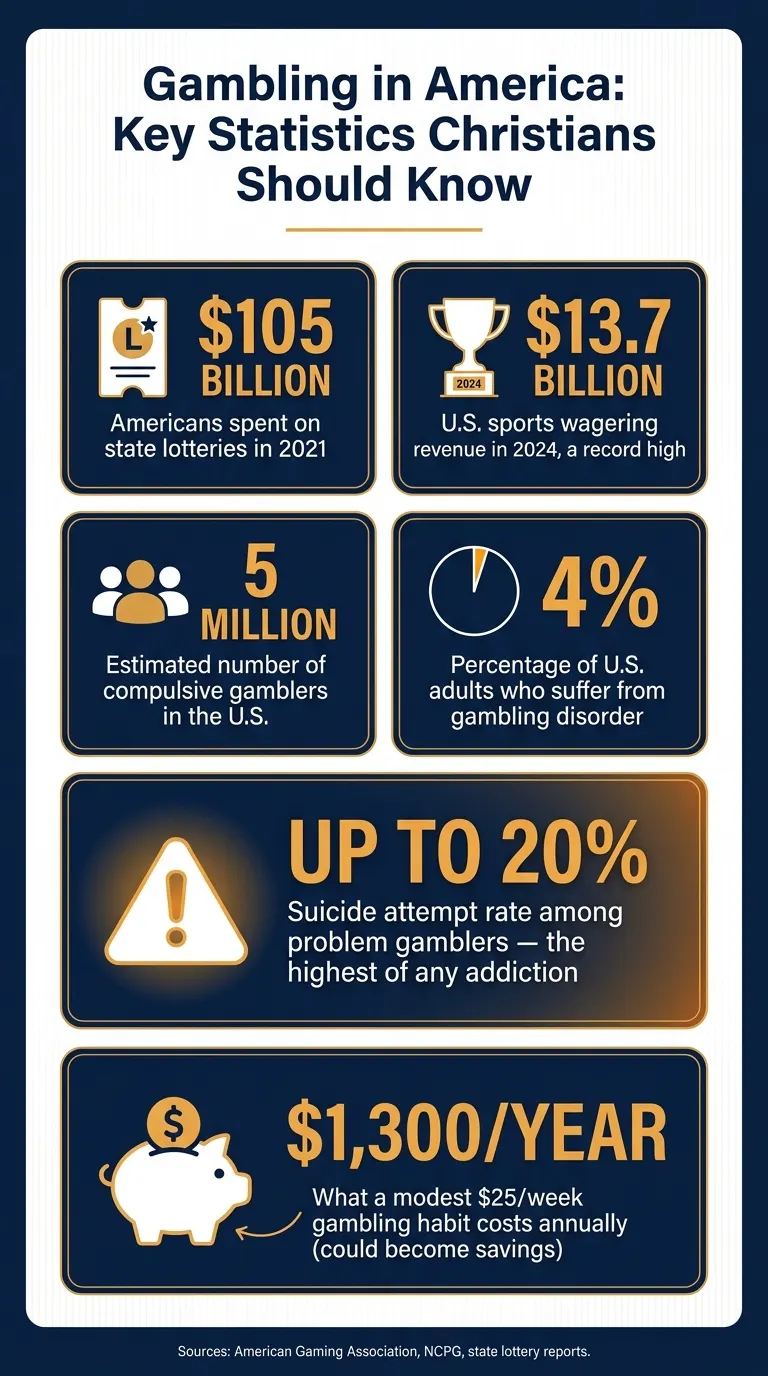
Gambling in America: Key Statistics Christians Should Know
Those principles apply straight to the gambling choices people face today. The formats may look different, and they move at different speeds, but they all press on the same weak spots: greed, stewardship, and self-control.
Lottery, sports betting, casino gambling, and online betting
The lottery can seem harmless at first. A small ticket. A slim chance. No big deal, right? But it sells the idea of easy money and often pulls hardest on people who can least afford to lose. Americans spent $105 billion on state lotteries in 2021 alone.
Sports betting makes gambling feel more normal by dressing it up as fandom, knowledge, and skill. For many Christians, that can lower their guard. It stops feeling like gambling and starts feeling like “I know this team” or “I’m just making the game more fun.” U.S. sports wagering revenue reached a record $13.7 billion in 2024. And because fan loyalty runs deep, the money can feel justified instead of risky.
Online betting pushes the same problem even further because it removes friction. There’s no drive to a casino, no line, no closing time. It’s built to keep people locked in. Algorithms use colors, sounds, and win-loss patterns to trigger dopamine responses and push past the brain’s normal braking system. There is no casino floor to walk out of, just 24/7 access.
When occasional play becomes a pattern
Most of the time, this shift doesn’t happen all at once. It creeps in. A couple of extra lottery tickets. A sports bet that turns into a weekly habit. A casino trip that becomes a monthly escape. What looks small in the moment can stack up fast into hundreds or even thousands of dollars over a year.
Some warning signs are hard to miss once you know what to look for:
- Chasing losses
- Hiding spending
- Gambling to cope with stress, pain, or disappointment
That pattern can lead somewhere dark. About 5 million Americans are compulsive gamblers. Roughly 4% of U.S. adults suffer from gambling disorder. Problem gambling also has the highest suicide attempt rate of any addiction, reaching up to 20%. Those outcomes don’t usually start with chaos. They start with something ordinary that slowly takes root.
Next steps for Christians who are questioning or struggling with gambling
If this brings conviction, answer it with clarity, not shame.
Once the biblical principles are plain, the next step is simple: what does obedience look like in daily life?
Questions to ask before spending money on gambling
Pause and ask yourself a few direct questions. Why am I doing this? What am I hoping to gain? Would I be at ease explaining this expense to a spouse, pastor, or trusted friend? Could this money do more good if it went toward giving, saving, or paying down debt?
"All things are lawful, but not all things are profitable." – 1 Corinthians 10:23
If those answers expose mixed motives, stop there.
When your motives are divided, don’t just sit in that tension. Move from discernment to action.
Steps for breaking a gambling habit
A habit that has taken hold usually doesn’t break just because you finally see it clearly. Insight helps. But by itself, it’s often not enough.
Start by ending secrecy. Confess the struggle to God, and tell one trusted person. Bringing it into the light is part of refusing to be mastered by the habit.
Then make gambling harder to reach. Delete betting apps. Block gambling sites on your devices. Go through your bank statements so you can see what the habit is costing and when it tends to spike. If you use a journal or some kind of reflection tool, track the emotional triggers behind it. Stress, loneliness, and boredom often tell the real story, and those patterns can slip past willpower.
A few simple actions can help replace the habit:
- Confession
- App limits
- Bank statement reviews
- Trigger tracking
- Healthier routines
"All things are lawful for me, but I will not be mastered by anything." – 1 Corinthians 6:12
If the habit feels compulsive – if stopping feels honestly impossible – pastoral counseling or professional addiction support is a wise next step, not some last-ditch option. The aim here isn’t shame. It’s repentance, wisdom, and support.
Better uses for the money and time spent on gambling
Stopping matters. Replacing the habit matters too.
Even a small weekly gambling pattern can chip away at money that should be going toward savings, debt, giving, or basic stability. Redirecting even a modest gambling budget – say, $25 a week – adds up to $1,300 a year. That could become a starter emergency fund, steady debt payoff, or a year of faithful giving to a local church or a cause you care about.
The alternative to gambling is faithful stewardship.
Conclusion: A biblical answer built on wisdom, not loopholes
Taken together, these principles point in one direction: Scripture’s warnings about greed, money, stewardship, and harm to others lead away from gambling.
The main issue isn’t just whether gambling can be called allowed. The deeper issue is whether it trains the heart toward Christlike desires.
That’s why this goes beyond dollars and cents. Gambling is spiritually risky because it reshapes desire, trust, and stewardship. It stirs discontent, tries to skip honest work, and rests on one person’s gain coming from another person’s loss. The standard isn’t a technical loophole. It’s a clear conscience before God.
The aim is faithfulness – with money, with time, and with the heart. Contentment, honest work, and generosity aren’t burdens on a good life; they’re what give it form.
FAQs
Is gambling always a sin for Christians?
The Bible does not directly call gambling a sin or spell out a direct ban on it. But silence in Scripture isn’t the same as a green light.
So the better approach is to measure gambling against biblical principles like stewardship, greed, contentment, the love of money, and love of neighbor. It turns into a spiritual issue when it’s fueled by covetousness, get-rich-quick thinking, or when it hurts other people.
What about casual betting for fun?
The Bible does not directly ban casual betting. But for Christians, the better question is often not “Is there a rule against it?” It’s whether it lines up with biblical ideas like good stewardship, contentment, and avoiding the love of money.
Even if it looks harmless, it’s worth slowing down and asking a few hard questions. Does it stir up greed or covetousness? Does it train your heart to lean on luck instead of trust in God? And could it affect your witness, your handling of money, or the state of your heart before God?
How can I tell if gambling is controlling me?
Ask yourself whether gambling is starting to run the show instead of staying under self-control.
A few warning signs tend to stand out: growing greed, a stronger pull toward money, or a desperate urge to get rich fast. That’s often when a pastime starts turning into something heavier.
If you’re lying about it, hiding it, or it’s causing strain in your relationships, finances, or spiritual life, take that seriously. Those are strong signs it may be controlling you.