
Bible and AI: A Christian Ethics Guide
Christian guidelines for using AI: verify outputs, protect human dignity, stay accountable, and never replace Scripture.
The short answer: the Bible does not mention AI, but it does give clear rules for how I should use it. If I use AI in a way that protects truth, respects people, keeps me responsible, and stays under God’s authority, I’m on safer ground. If I let it replace judgment, prayer, or honesty, I’ve gone too far.
Here’s the article in plain terms:
- AI is a tool, not a voice of final wisdom
- People still bear God’s image, so no system should treat them like numbers
- Truth matters more than convenience, because AI can make up facts, quotes, and even Bible verses
- I am still responsible for anything I approve, post, teach, or submit
- Good use depends on context: work, school, home, ministry, publishing, and prayer all need limits
- A simple 6-point test can help me judge whether a tool is wise to use
- Spiritual prayer apps can help with reflection, but they must never replace Scripture, prayer, conscience, or church community
A few facts shape the issue fast:
- Large language models are known to produce false statements with confident wording
- In schools and workplaces, AI use has grown fast since 2023, which means questions about cheating, review, and disclosure now affect more people
- One bad output can spread to hundreds or thousands of people in minutes if no one checks it first
10 Warnings About Using AI In Bible Study & Ethical AI Practices
What I’d take away first
If I wanted the whole article in a few lines, it would be this:
- Check AI output before I trust it
- Never present AI work as my own
- Never treat AI like spiritual authority
- Use it to support people, not sideline them
- If it conflicts with Scripture, I should not use it
Quick comparison
| Area | Wise use | Wrong turn |
|---|---|---|
| Work | Drafting or sorting with review | Sending unchecked output |
| School | Brainstorming or study help | Turning in AI-written work as mine |
| Home | Planning and prompts | Letting a tool replace presence |
| Ministry | Admin help or background research | Letting software shape doctrine or preach for me, considering the ethics of AI in digital discipleship |
| Spiritual reflection apps | Journaling help and verse tagging | Treating app output like God’s guidance |
Bottom line: I’d sum up the article this way: use AI with honesty, limits, and human review - but never let it take a place that belongs to God alone.
What biblical principles should guide how Christians think about AI?
Starting from those core ideas, five biblical principles can guide how Christians use AI: human dignity, wisdom and truth, stewardship, accountability, and love of neighbor. These are the lenses Christians can use to judge AI in daily life.
Human dignity means AI should serve people, not reduce them to data
Every person bears the image of God, and that gives each life deep worth. That changes the way Christians should look at AI. Saving time matters, but it should never outrank love of neighbor.
So AI should serve people, not flatten them into metrics, profiles, or data points. It should support human flourishing and leave room for care, presence, and personal connection. If an automated system saves a few minutes but harms workers, students, or people who are already at risk, it misses the mark.
Wisdom and truth matter more than speed and convenience
Speed is useful. Truth matters more.
One of the biggest risks with AI tools is fabricated output. A system can sound sure of itself while giving false citations, made-up facts, or even Scripture that does not exist. That’s why Christians should check AI output before sharing it, especially in ministry, teaching, counseling, or any setting where someone may act on the information.
A simple rule helps here: verify first, share second. Check claims against Scripture and trusted sources. Christians should also be open about when and how they use AI.
Christians remain accountable for every result they approve or share
Using AI does not hand off moral responsibility. Christians are still responsible for the words, decisions, and outcomes they approve, share, or act on.
If a tool produces an error or reflects bias, the person who signs off on it still carries that responsibility before God. You can’t shrug and say, “the software did it.” Human oversight still matters. Final approval still matters.
Love of neighbor also shapes this part of the issue. It means refusing deceptive AI use and staying away from tools that harm people who are easy to overlook or exploit.
The chart below sums up the main risks and faithful responses.
| Biblical Principle | AI-Related Risk | Faithful Response |
|---|---|---|
| Human Dignity | Dehumanizing automation; treating people as data points. | Use AI to serve people, not replace them. |
| Wisdom & Truth | Fabricated output; shallow theology. | Verify outputs against Scripture and reliable sources. |
| Stewardship | Wasting time on digital distractions; poor data security. | Use AI to save time and protect sensitive data. |
| Accountability | Blaming software for errors; spiritual hypocrisy. | Keep human oversight and final approval. |
| Love of Neighbor | Deceptive use of AI; perpetuating algorithmic bias. | Be transparent and avoid harm. |
These principles help show the line between wise use and unwise use of AI.
Where can AI be used wisely, and where does it become unwise?
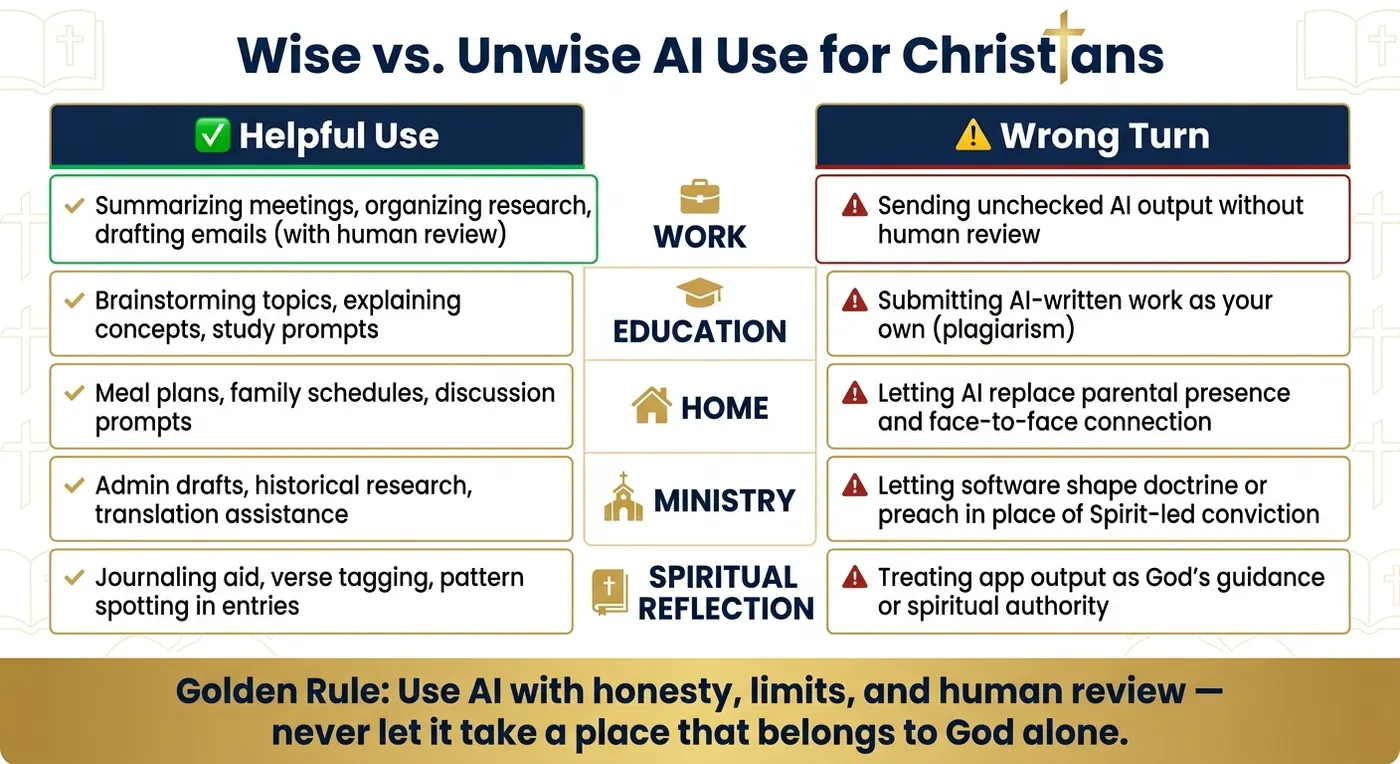
These principles show up in daily life - your inbox, your classroom, your kitchen table, and your ministry. The main issue isn't whether AI exists. It's whether a given use supports honesty, oversight, and accountability before God. The examples below show what that looks like in plain, everyday choices.
Work, education, and content creation
At work, AI can be useful for routine tasks. It can summarize a long meeting, organize research notes, or draft a first email. Those are fair uses, as long as a person checks the final version. The danger starts when AI output gets shared without review. Proverbs 11:1 warns against dishonest scales, and that warning fits digital work too.
In school, AI can help a student brainstorm paper topics, explain a hard concept, or point out gaps in an argument. That's different from letting it do the assignment for you. When AI becomes the author instead of the helper, you've crossed a line. Submitting AI-generated writing as your own is plagiarism. Use it as a study prompt, not as the finished draft. 2 Timothy 2:15 reminds believers to handle the word of truth correctly, which includes doing the work of learning for yourself.
For content creators and publishers, AI can help with editing, formatting, and making content easier to access for people with disabilities. The key issue here is transparency. Readers and audiences should know when AI played a major part in what they're reading or hearing. Hidden AI use chips away at trust.
Parenting, ministry, and decision-making
The same pattern carries over at home and in church: AI can help, but it should not take the lead.
AI can help parents with family schedules, meal plans, or discussion prompts. That's fine. But it can't replace a parent's presence or personal connection. Use it to spark ideas, then keep the real conversation face-to-face and center it in prayer.
In ministry, AI has a narrow role. Scripture - not software - sets the standard. AI can draft admin emails, gather historical background for a passage, or draft a translation for review. But it cannot preach with Spirit-led conviction. It also cannot replace careful theological judgment. Every output should be checked against Scripture and pastoral wisdom. AI may help with preparation, but it should never carry the authority of the message itself.
Faithful versus unwise AI use: a side-by-side comparison
The table below condenses that same pattern for quick reference.
| Context | Helpful Use | Guardrail |
|---|---|---|
| Work | Summarizing meetings, organizing research, drafting emails | Human review for honesty and fairness (Proverbs 11:1) |
| Education | Brainstorming paper topics, explaining complex concepts | Use as a study prompt, not the final draft (2 Timothy 2:15) |
| Home | Meal plans, family schedules, discussion prompts | Prioritize face-to-face time and prayer |
| Ministry | Administrative drafts, translation, historical research | Verify all outputs against Scripture and pastoral wisdom |
| Publishing | Editing, formatting, and accessibility support | Transparency about AI involvement to maintain trust |
How can Christians test an AI tool before using it?
Before you use AI, stop for a moment. Not every tool works the same way, and not every use is wise. A simple set of six Scripture-based checks can help you judge whether a tool serves truth, stewardship, healthy digital habits, and accountability.
6 questions for biblical discernment
Use these six checks as a quick filter.
| Principle | Question to Ask | Biblical Anchor |
|---|---|---|
| Human Dignity | Does this tool treat people as more than data points? | Genesis 1:26–28 |
| Truth | Is the output accurate and verifiable? | Ephesians 4:25 |
| Wisdom | Am I still making the judgment call? | Proverbs 3:5–7 |
| Stewardship | Does this free up time for what matters most? | 1 Corinthians 4:2 |
| Love of Neighbor | Does it protect privacy and trust? | Matthew 22:37–40 |
| Accountability | Am I willing to own the final result? | Romans 14:12 |
Romans 14:12 says each of us will give an account to God. So the test isn't just, Does this tool work? It's also, Can I use it with a clear conscience? Check whether the tool identifies itself as AI, avoids making up Scripture or personal facts, and guards human relationships.
That same filter applies to voice-first spiritual reflection tools.
Applying the framework to voice-first spiritual reflection tools
When you apply this framework to a voice-first spiritual reflection tool, the same questions still matter. Psalmlog is an AI-powered, voice-first mobile app for personal spiritual reflection. You speak your situation, and the app helps you record thoughts, tag relevant Scripture, and spot patterns across your entries. That is a legitimate use.
Still, the six questions don't go away. Any AI-generated insight must be tested against Scripture. An app may surface a verse that seems to fit, but it cannot replace prayer, conscience, or biblical discernment. It can sort and organize your reflections, but it cannot replace the accountability of a church community or your own responsibility before God. Psalmlog's AI is a journaling aid - not a spiritual authority.
Used within those limits, a voice-first reflection tool can support your walk with God. Without those limits, it can start to displace prayer and discernment.
Conclusion: Use AI as a tool, not a master
Scripture gives Christians a clear way to judge AI with wisdom. These principles aren't abstract ideas sitting on a shelf. They're practical guardrails for every tool you use, including this one.
AI helps only when it supports your judgment instead of taking its place. Once a tool starts making choices you should be making, or starts crowding out prayerful discernment, the line has been crossed. At that point, it is no longer acting like a servant. It is acting like a master.
That applies to voice-based journaling tools too. They may help organize your reflections, but they cannot guide your conscience.
The same standard applies whether AI is drafting an email or shaping a prayer journal entry. Before you trust or share AI output, run it through this final filter:
| Check | Key Question |
|---|---|
| Truth | Does this align with Scripture and core Christian doctrine? |
| Accountability | Am I being transparent, and has a person with discernment reviewed this? |
| Authority | Is this tool serving my faith, or quietly replacing it? |
If it conflicts with Scripture, do not use it.
Use AI, but never let it replace discernment.
FAQs
Is using AI a sin?
No. AI is not sinful by itself. It’s a tool, much like a library, a calculator, or a study guide. The main issue isn’t the tool. It’s how people use it.
It becomes unwise or sinful when people turn it into an idol, use it to mislead others, or let it take the place of prayer, personal reflection, and life with other believers. Christians should use AI with wisdom, good stewardship, discernment, and human oversight. Its output should be tested against Scripture.
How can I tell when AI is replacing my judgment?
AI starts to replace your judgment when you hand it work that calls for spiritual discernment, prayer, or honest personal reflection.
That’s the line to watch.
If you lean on AI for moral choices, spiritual advice, or the meaning of Scripture - and then accept what it says without weighing it against Scripture, prayer, and wise counsel from trusted Christians - you’re probably letting it move past its proper place.
Should Christians disclose when they use AI?
Yes. Christians should disclose when they use AI because transparency builds trust, protects honesty, and supports pastoral integrity.
God is truth. So when believers use tools like AI, they should be open about it. That doesn’t mean treating AI as something scary or off-limits. It means being plainspoken about how it’s being used.
For ministries, that can look simple:
- Clearly label AI-generated content
- Tell people when they’re interacting with AI
- Make sure AI stays a tool, not a stand-in for human care and spiritual leadership
That kind of openness matters. People come to churches and ministries looking for truth, care, and real connection. If a sermon outline, devotional, chatbot, or email was shaped by AI, saying so helps keep trust intact.
AI can help with drafts, admin work, and communication. But it shouldn’t blur the line between a machine’s output and a pastor’s personal guidance. Human presence still matters. So does honesty about where words come from.