
Bible on Drinking Alcohol: Guidance
Scripture permits alcohol but condemns drunkenness; five biblical filters guide wise, loving, sober choices.
The short answer: the Bible does not call all drinking a sin, but it does clearly call drunkenness sin. If I boil the whole article down, the message is simple: drink only if you can do it with self-control, a clear conscience, love for other people, and for God’s glory.
Here’s the article in plain terms:
- Drinking and drunkenness are not the same thing
- Wine appears in the Bible as part of normal life
- Drunkenness is condemned many times
- Christian freedom has limits
- Conscience matters
- Other people matter too
- For some people, abstinence is the wisest choice
- The main test is not “Can I drink?” but “Should I?”
The article leans on 5 main filters for any alcohol choice:
- Self-control – Am I being mastered by this?
- Love for others – Could this harm or tempt someone else?
- Conscience – Can I do this before God without guilt?
- God’s glory – Does this fit a life that honors Him?
- Sobriety – Will this dull my judgment?
A few facts stand out in the piece:
- 0 verses say all alcohol use is always sinful
- Many passages warn against drunkenness, loss of control, and being ruled by drink
- 1 Corinthians 10:31 gives the big rule: whether you eat or drink, do it all for the glory of God
- Ephesians 5:18 gives the clearest warning: do not get drunk with wine
If I put the article’s point in one line, it would be this: the Bible allows alcohol, forbids drunkenness, and calls Christians to wisdom, restraint, and love in every setting.
That gives you a clear frame for reading the rest of the piece.
Can Christians Drink Alcohol? The Biblical Truth
Does the Bible Say All Drinking Is a Sin?
No. Scripture permits alcohol, but it consistently forbids drunkenness. In the Bible, alcohol appears as part of ordinary life. It is not presented as a sin in itself.
Bible Passages Where Alcohol Appears in Ordinary Life
Alcohol shows up in everyday settings throughout Scripture. Psalm 104:14–15 describes wine as something that gladdens the human heart, and Deuteronomy 7:13 lists wine among the blessings God promises his people.
Jesus’ first recorded miracle was turning water into wine at the wedding in Cana. The master of the banquet even said the later wine was better than what had been served first (John 2:1–11). Paul also told Timothy:
"Stop drinking only water, and use a little wine because of your stomach and your frequent illnesses." – Apostle Paul, 1 Timothy 5:23
Taken together, these passages show that Scripture does not treat alcohol as inherently sinful.
Bible Passages That Condemn Drunkenness
At the same time, the Bible is clear about drunkenness: it condemns it again and again. That’s the main warning.
Ephesians 5:18 tells believers not to get drunk with wine but to be filled with the Spirit. Proverbs 23:29–35 paints a blunt picture of what drunkenness brings – woe, sorrow, strife, and impaired thinking. Proverbs 20:1 adds that wine and beer can lead the unwise astray.
The New Testament says the same thing in direct terms. Galatians 5:19–21 lists drunkenness among the works of the flesh, and 1 Corinthians 6:10 says drunkards will not inherit the kingdom of God. Scripture treats drunkenness as sin because it damages judgment and self-control. So the Bible’s pattern is plain: permission is there, but the warnings grow sharp when drinking turns into excess, enslavement, and poor judgment.
What Key Scriptures Teach About Wine, Strong Drink, and Self-Control
Scripture treats alcohol as a gift that comes with limits. It can be received with gratitude, but it can also cloud judgment and weaken self-control. Isaiah 25:6 even shows aged wine as part of God’s promised abundance. At the same time, the Bible doesn’t gloss over what happens when that gift is misused.
Warnings Against Excess, Enslavement, and Poor Judgment
The warnings in Scripture are blunt. Proverbs 23:32 says wine "bites like a serpent", and Proverbs 23:29–35 lays out the damage that can follow excessive drinking: woe, sorrow, strife, impaired judgment, and a cycle of dependence. Titus 2:3 gives a similar warning, telling believers not to be enslaved to wine.
Scripture also ties drunkenness to bad judgment, especially for people in positions of authority. Proverbs 31:4–5 warns leaders and rulers that strong drink can make them forget what has been decreed and pervert justice. That’s not a small issue. If a person’s mind is dulled, other people often pay the price.
The stories of Noah and Lot make the danger even plainer. In both cases, drunkenness strips away restraint and leads to shame (Genesis 9:21; Genesis 19:30–36). The point isn’t hard to miss: alcohol doesn’t just affect the body. It can expose weakness and open the door to choices a sober person would never make.
Commands to Practice Sobriety and Self-Control
The New Testament gives the positive side just as plainly. Ephesians 5:18 says, "Do not get drunk with wine, for that is debauchery, but be filled with the Spirit." Galatians 5:22–23 lists self-control as a fruit of the Spirit, which means intoxication pushes in the other direction. One leads to clear-minded obedience; the other gives control away.
That’s why church leaders must be sober-minded and not a drunkard in 1 Timothy 3:2–3. This isn’t only about public image. It’s about who, or what, is shaping a person’s mind, judgment, and habits. Scripture’s question is simple: what is controlling you?
That leads to the next question: when drinking is permitted, how should conscience and love shape the choice?
How Christians Should Think About Liberty, Conscience, and Love When It Comes to Alcohol
Scripture gives real freedom, but that freedom is guided by love. Romans 14 and 1 Corinthians 8–10 make it clear that choices about alcohol should take conscience, witness, and the people around you into account. Since drunkenness is already forbidden, the question isn’t whether anything goes. The question is how Christian freedom works inside those limits.
Romans 14 adds another key point: if a person acts against a sincere conviction, that act becomes sin for them, even if the act itself is allowed. So two Christians may reach different conclusions about drinking and still be walking faithfully, so long as each is acting from a sincere conviction before God. That moves the focus away from bare permission and toward wise judgment.
When Moderate Drinking Falls Within Biblical Freedom
Once drunkenness is off the table, the issue becomes self-control. Moderate drinking can fall within biblical freedom when it is done with a clear conscience, without loss of self-control, and without leading another believer into trouble. First Corinthians 6:12 sets a hard limit here: even if something is lawful, it is not always helpful, and believers must not be ruled by it. If drinking starts to feel hard to limit or hard to leave alone, that’s a warning sign.
The other limits have to do with people around you. Before drinking, consider who’s present. Is someone there in recovery? Does someone have a tender conscience about alcohol? Is this the kind of setting where restraint is likely, or where things could slide in the wrong direction? When the setting is fitting and the choice is marked by restraint, moderate drinking can stay within Christian liberty.
When Choosing Not to Drink Is the Wiser Decision
Sometimes love means saying no, even when you have the freedom to say yes. Paul’s warning in 1 Corinthians 8:9 is direct: believers must not let their freedom become a stumbling block to a weaker believer. If someone present has a history of addiction, a sensitive conscience, or is young in the faith, abstaining is the more loving path.
This lands right in everyday situations like social drinking, temptation, and past addiction. That’s where these choices stop being abstract and start carrying weight. In those moments, let love, conscience, and witness guide the decision – not appetite, pressure, or pride.
How to Make Wise Alcohol Decisions in Real Life
Once biblical freedom is clear, the next step is using it in day-to-day life. Principles tend to come into focus when they meet actual choices.
A Simple Framework for Social Drinking, Temptation, and Past Addiction
Before you reach for a drink, slow down and ask four plain questions: Why do I want this? Can I stop after one without strain? Will this affect someone else’s conscience or recovery? Will this glorify God? First Corinthians 10:31 sets the standard: "So whether you eat or drink, or whatever you do, do it all for the glory of God."
That gets to the heart of it. If alcohol is being used to cover stress, loneliness, or anxiety, then it is no longer working as a gift.
These questions play out in different ways depending on the setting:
- Social event: drink only if it doesn’t violate your conscience or affect others.
- Home alone and tempted: abstain if the motive is escape or if control feels shaky.
- With someone in recovery: abstain out of love.
- In leadership: lean toward sobriety and public restraint.
For someone with a history of alcohol misuse, or a strong family pattern of addiction, the wisest biblical path is often full abstinence. Not because Scripture gives a blanket command for every person, but because 1 Corinthians 6:12 warns believers not to be mastered by anything. If past patterns make control uncertain, abstaining is usually the clearest path of love for yourself and for others.
Using Psalmlog to Work Through Alcohol Choices With Scripture
A voice journal can help you test those questions honestly before God. Most people need a clear place to sort out what is driving a choice. Psalmlog can help you talk through the situation, tag the relevant Scriptures, and review patterns over time.
Conclusion: A Scripture-Based Framework for Deciding About Alcohol
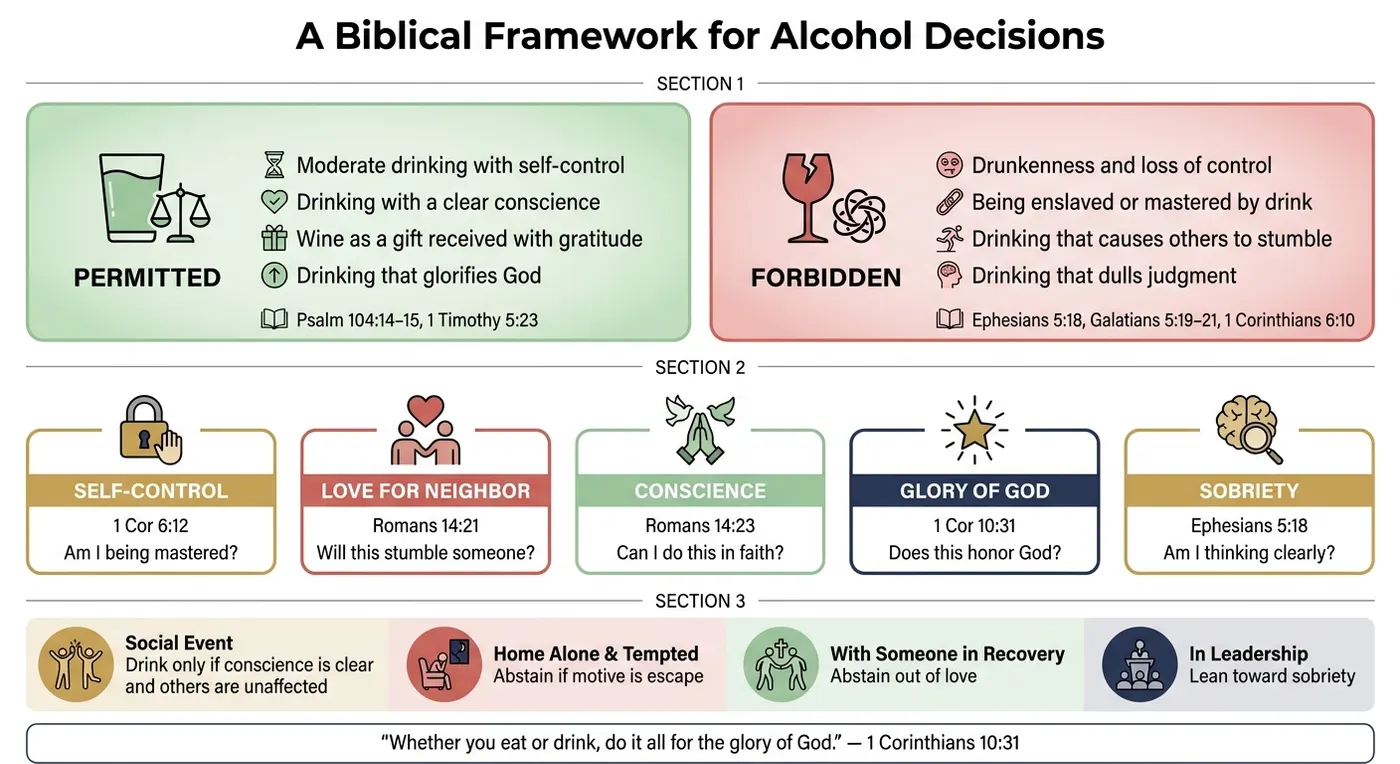
What the Bible Says About Alcohol: Permitted vs. Forbidden
Scripture does not ban all drinking. It does, however, ban drunkenness and the loss of self-control. That difference matters. It gives believers five plain filters to use when making a wise choice.
| Biblical Filter | Scripture Reference | Key Question for the Believer |
|---|---|---|
| Self-Control | 1 Corinthians 6:12 | Am I being mastered? |
| Love for Neighbor | Romans 14:21 | Will this stumble someone? |
| Conscience | Romans 14:23 | Can I do this in faith? |
| Glory of God | 1 Corinthians 10:31 | Does this honor God? |
| Sobriety | Ephesians 5:18 | Am I thinking clearly? |
"Do not get drunk with wine, for that is debauchery, but be filled with the Spirit." – Apostle Paul, Ephesians 5:18
The pattern in Scripture is clear: the Spirit leads believers toward self-control, not life driven by appetite. With those filters in view, the choice gets more concrete. Whether you drink or abstain, bring the matter before God in prayer, not out of pressure, habit, or impulse.
FAQs
How can I tell if drinking is controlling me?
Ask yourself if drinking is still a choice, or if it has turned into something you can’t easily put down. If you drink every day to take the edge off, or you lean on alcohol to deal with your emotions, there’s a good chance it’s starting to control you.
Other signs can show up in plain sight: poor judgment, impaired thinking, lowered restraint, confusion, instability, or becoming unavailable to the people who count on you. If alcohol is pulling you away from God, then it’s mastering you instead of serving your freedom.
Should Christians ever choose not to drink at all?
Whether a Christian chooses total abstinence is a personal decision, not a biblical command. The Bible doesn’t ban all alcohol use. At the same time, it does call believers to look honestly at their own story, their family background, and the effect their choices may have on other people.
For some, abstinence may be the wisest path. That can include people facing addiction, people who’ve been hurt by alcohol’s effects, or leaders who want to avoid causing others to stumble. In cases like these, love for God and neighbor should come before personal freedom.
What if my conscience feels uneasy about alcohol?
If alcohol leaves your conscience uneasy, take that seriously and lean into it with joy. For you, drinking becomes sin if it goes against your conscience, even if other believers feel at peace with it.
So don’t brush that feeling aside. Take it to God in prayer. Ask Him to fill you with the Holy Spirit and give you wisdom, putting your walk with God ahead of personal freedom.