
Bible & Cremation: Burial vs Ashes
Scripture doesn't forbid cremation; burial is the biblical norm, and cremation doesn't prevent resurrection.
The short answer: the Bible does not command burial and does not forbid cremation. If you’re making this choice, the main Bible points are simple: burial is the usual pattern in Scripture, cremation is never given as a normal funeral model, and cremation does not stop God from bringing the dead back to life.
Here’s the plain takeaway:
- Burial is the main pattern in the Bible, from the patriarchs to Jesus.
- Cremation is not called a sin in any direct command.
- Passages about burning bodies are rare and usually tied to judgment, war, or dishonor.
- Resurrection depends on God’s power, not on the condition of a body.
- Cost can matter: burial often runs $7,000 to $12,000+, while direct cremation is often $1,000 to $4,000.
- Your conscience matters: if Scripture does not give a direct rule, you should act in faith, peace, and reverence.
If I were to sum up the article in one line, it would be this: Christians can choose burial or cremation, but they should make that choice with respect for the body, trust in the resurrection, and care for their family.
| Question | Short Answer |
|---|---|
| Does the Bible forbid cremation? | No |
| Is burial more common in Scripture? | Yes |
| Does cremation hurt resurrection hope? | No |
| Should the body be treated with honor? | Yes |
| Can cost and family needs matter? | Yes |
So if you’re looking for a plain Bible answer, this is it: burial has the stronger scriptural pattern, but cremation can still be a faithful choice.
What Does the Bible Say About Cremation?
What the Bible Does and Does Not Say About Cremation
Scripture does not give a direct command that says Christians must bury the dead or must not cremate them. So the issue is a little more narrow: does the Bible’s repeated burial pattern work like a command, or is it simply a record of what God’s people usually did?
Burial as the Main Pattern in Scripture
That pattern matters. But it also has to be read with care.
Burial shows up again and again in Scripture, from the patriarchs to Jesus. The patriarchs, Moses, and Jesus were buried. That gives burial a clear and steady place across both Testaments. Still, a pattern is not always the same thing as a command.
That distinction matters here. Scripture often tells us what happened without turning every example into a rule for every believer in every age. So yes, burial is the main biblical pattern. But no, the text does not state it as a rule that always binds every Christian.
Bible Passages That Mention Burning Bodies
The small number of passages that mention burning bodies do not describe normal funeral practice. Only three passages refer to bodies being burned, and each one stands out as an unusual case rather than a model for ordinary burial.
- Joshua 7:25 – Achan’s body was burned after he was stoned for disobeying God at Jericho. This was an act of divine judgment, not an instruction about burial.
- 1 Samuel 31:11–13 – The men of Jabesh-gilead recovered the mutilated bodies of King Saul and his sons from the Philistines and burned them. The text presents this as an act of loyalty and honor meant to stop any further abuse of the king’s remains.
- Amos 2:1 – God condemned Moab for burning the bones of Edom’s king into lime. The problem was not simply fire itself, but the fact that the act treated an enemy’s remains with contempt and desecration.
These passages point to judgment, crisis, or dishonor. They do not set a funeral rule.
So the main point stays the same: Scripture presents burial as the norm, but it does not label cremation as sin. Christian tradition has leaned toward burial, yet the Bible does not directly condemn cremation. That frame helps shape the next part of the discussion, especially when Christians think about bodily dignity and the hope of resurrection.
Burial, Cremation, and Treating the Body with Dignity
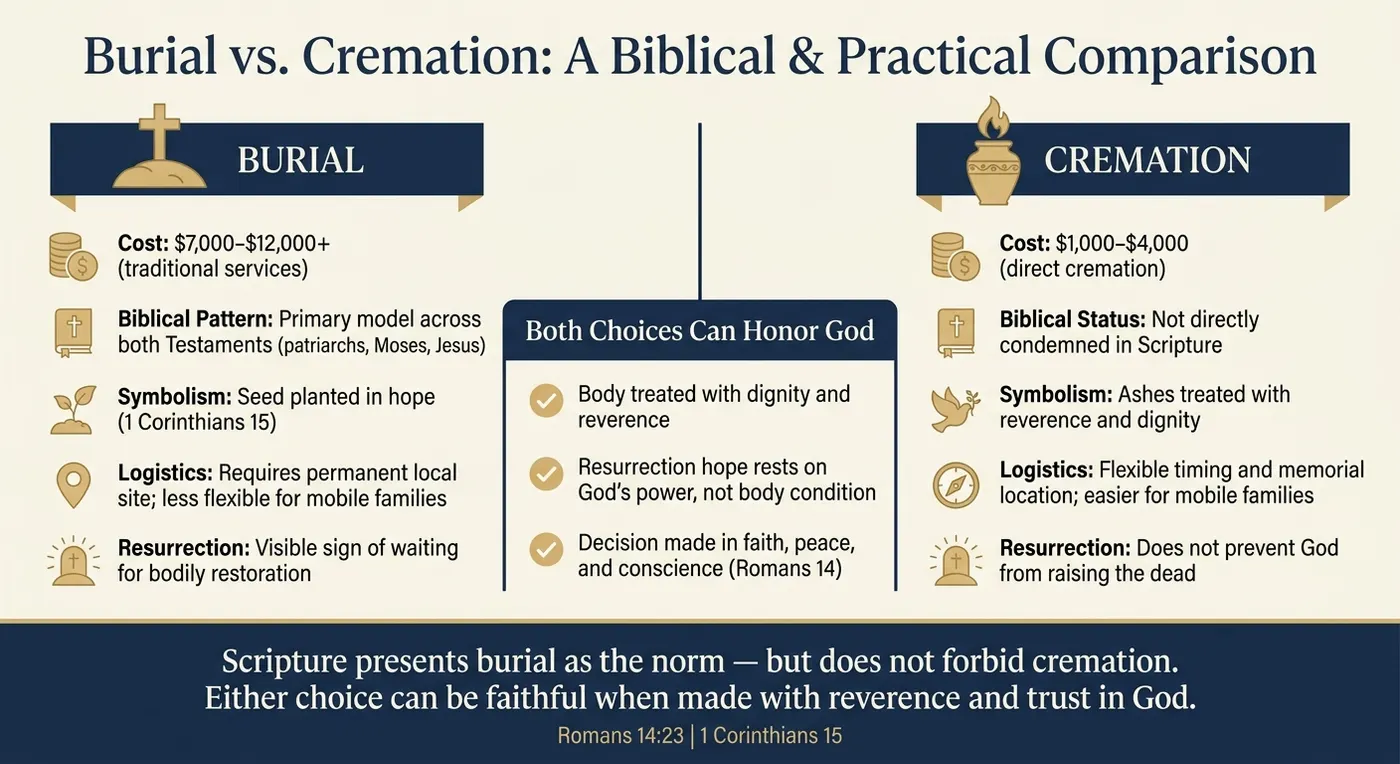
Burial vs. Cremation: A Biblical & Practical Comparison
Scripture speaks of the body as God’s creation and, for believers, as meant for resurrection. That shapes how many Christians think about funerals. The tension is simple: how do you honor the body without turning a custom into a rule?
Why Many Christians Choose Burial
Many Christians choose burial because it lines up with the seed picture in 1 Corinthians 15. The body is laid down in hope, like a seed planted with the expectation of new life. Burial also ties believers to a long line of faithful people – the patriarchs, the prophets, and Jesus himself – who were laid in the ground as an act of honor.
That said, burial is a preference rooted in biblical pattern, not a command rooted in biblical law. And that matters. A strong symbol is still not the same as a direct command. So the next question naturally follows: does cremation clash with resurrection hope?
When Cremation Can Still Be a Faithful Choice
Cremation is not automatically disrespectful. The bigger issue is whether the choice is made with reverence and whether the remains are treated with dignity.
Since Scripture does not require one method, practical concerns can matter too. A burial often costs $7,000 to $12,000 or more, while direct cremation usually falls between $1,000 and $4,000. For families spread across different states, cremation may also make it easier to plan a memorial service at a time and place that works for everyone. Those are valid Christian concerns, not signs of weak faith.
Burial vs. Cremation: A Side-by-Side Comparison
| Feature | Burial | Cremation |
|---|---|---|
| Treatment of Body | Preserves the body’s integrity symbolically | Ashes should be handled with reverence to maintain dignity |
| Resurrection | Visible sign of waiting for bodily restoration | Does not prevent God from raising the dead |
| Cost (USD) | Generally $7,000–$12,000+ for traditional services | Generally $1,000–$4,000 for direct cremation |
| Family Logistics | Requires a permanent local site; harder for mobile families | Flexible timing and memorial location; easier for mobile families |
The deeper issue isn’t just symbolism. It’s whether cremation stands against the Christian hope of resurrection.
Resurrection Hope and Making a Decision in Good Conscience
The next question is whether cremation conflicts with resurrection hope.
Why Cremation Does Not Prevent Resurrection
A common fear behind cremation questions is simple: What if God can’t raise me? Scripture speaks to that fear head-on. Resurrection rests on God’s power, not on the state of human remains. The Bible points to a transformed body, not one rebuilt from unchanged physical material.
God created all things out of nothing. Ash, scattering, and the passage of time do not limit him. Put simply, cremation does not limit God’s power to raise the dead. Paul describes the resurrection body as changed and no longer subject to decay. God makes it new; he is not just putting earthly matter back together.
Once that point is settled, the issue moves away from fear and toward conscience.
How to Make This Decision Without Violating Conscience
Because Scripture does not command one method, this falls under Christian freedom. Romans 14 gives the clearest path: act in faith, not fear, and do not do anything that goes against your conscience before God.
Pastor Tim Augustyn puts it this way:
"Where God has not spoken about a matter, we have freedom, in Christ, to decide."
So don’t make this choice out of fear, pressure, or guilt. Churches differ on custom and practice, which means it helps to speak with your pastor and weigh the matter before God. The aim is simple: make a choice that shows honor to the deceased and care for the living.
Questions to Ask Before Choosing Cremation or Burial
These questions can help you think through the decision with Scripture, peace, and practical wisdom.
| Category | Questions to Consider | Biblical Anchor |
|---|---|---|
| Biblical Principles | Does this choice reflect that the body is God’s creation and meant for resurrection? | 1 Corinthians 6:19–20 |
| Conscience | Am I acting from faith and peace, or from guilt, fear, or financial pressure alone? | Romans 14:23 |
| Family & Church | Will this decision create unnecessary conflict? Does my church have specific guidelines? | Romans 14:19 |
| Practical Factors | What is the long-term plan for the remains – cemetery, columbarium, or elsewhere? | 1 Corinthians 10:31 |
| Resurrection Hope | Do I genuinely trust that God can raise this person regardless of the body’s condition? | John 5:28–29 |
The final step is to make the choice with reverence, clarity, and trust in God’s resurrection power. That leads to the final question: how should Christians make this decision faithfully and without fear?
Conclusion: How to Make a Biblically Grounded Decision
With Scripture, the hope of resurrection, and conscience in view, the choice comes down to reverence and peace. Scripture does not command burial or forbid cremation. Burial is the main pattern in the Bible, but cremation is not clearly condemned, and it does not limit God’s power to raise the dead.
The best path is to make a choice with reverence for the body, Scripture in view, and care for the people left behind, not out of guilt, pressure, or fear.
Using Psalmlog to Work Through Grief and Funeral Decisions

Grief can make funeral decisions feel heavy and hard to sort through. When you’re trying to think clearly in the middle of loss, even simple choices can feel like a lot.
For Christians walking through that kind of grief, a voice journal can help turn scattered thoughts into prayer and reflection. Psalmlog is a voice-first app built for moments like these.
You can speak your situation out loud, and Psalmlog responds with Scripture, biblical insight, and next steps. It includes voice journaling, scripture tagging, automated transcripts, and a personal insights dashboard to help you process grief at your own pace. In plain terms, it gives you a private space to pray, journal, and come back to Scripture when you need it most. For anyone facing a funeral decision while grieving, it’s a practical place to start.