
What Does the Bible Say About Burnout and Finding Rest in a Hustle Culture?
Explores Scripture on burnout and rest—Sabbath, Jesus' invitation, warning signs, and practical steps like boundaries and prayer for spiritual renewal.
Burnout is a widespread issue, especially in a world that glorifies constant productivity. The Bible offers a different perspective, emphasizing the importance of rest as a gift from God, not something we earn. Here’s what you need to know:
- Hustle culture conflicts with biblical principles: It ties self-worth to productivity, leading to exhaustion and spiritual disconnection.
- God designed rest as essential: The Sabbath (Genesis 2:2–3) and Jesus’ invitation to the weary (Matthew 11:28–30) highlight rest as a divine rhythm for renewal.
- Burnout’s warning signs: Emotional, physical, and spiritual exhaustion can stem from overwork and neglecting God’s boundaries.
- Practical steps for biblical rest: Honor the Sabbath, set work boundaries, and build daily habits of prayer and reflection.
Tools like Psalmlog (built with founders and high-output professionals in mind) can help you track your spiritual journey and reconnect with God’s design for rest. Rest isn’t laziness – it’s faith in God’s care and a way to restore your soul.
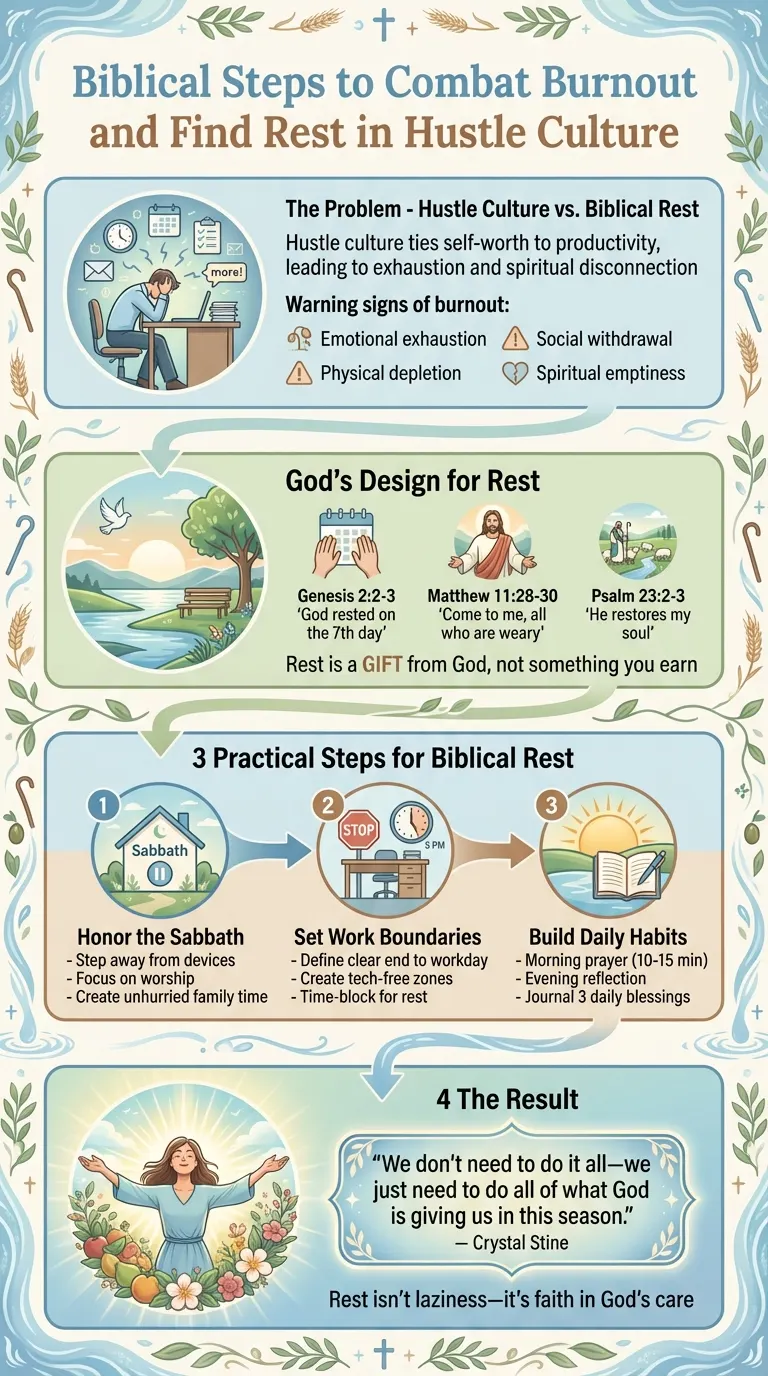
Biblical Steps to Combat Burnout and Find Rest in Hustle Culture
The Problem: How Hustle Culture Affects Your Spiritual and Emotional Health
What Is Hustle Culture?
Hustle culture is all about constant work, where your value is measured by what you produce. In this mindset, taking a break feels like failure, and your worth becomes tied to productivity instead of embracing who God created you to be.
This outlook clashes directly with biblical principles, often leading Christians to put work above their relationship with God. When productivity defines your identity, spiritual practices like prayer or quiet time with God can fall by the wayside. Over time, this can make you feel disconnected from God’s purpose for your life. The relentless drive to achieve also undermines trust in God, leaving you feeling as though His grace isn’t enough or that you need to "earn" His love through your performance.
The result? Burnout – a condition we’ll dive into next.
Common Signs of Burnout
Burnout is a state of complete emotional, physical, social, and spiritual exhaustion. It often shows up as declining health, pulling away from others, depression, and a sense of spiritual emptiness. You might feel emotionally drained, spiritually disconnected, or even cynical about things that once brought you joy. Relationships can start to crumble, ministry feels hollow, and you’re just going through the motions without any real connection.
"Burnout is a state of emotional, physical, social, and spiritual exhaustion. It can lead to diminished health, social withdrawal, depression, and a spiritual malaise." – GotQuestions.org
Recognizing burnout early is essential. It gives you the chance to reconnect with Christ and realign your life within the boundaries God designed. Knowing these signs prepares you to understand how rest, as defined by culture, differs from the rest God calls us to embrace.
Cultural Expectations vs. God’s Design for Rest
In today’s culture, rest is often seen as just another tool to help you work harder later. But God’s perspective on rest couldn’t be more different. While hustle culture leaves you drained, God’s design for rest brings genuine renewal. Rest isn’t something you earn after working hard – it’s a gift, a rhythm God built into creation itself.
When you buy into hustle culture, you start relying on yourself instead of trusting God. You take on burdens He never intended for you to carry, believing you have to accomplish it all on your own. This self-reliance is a fast track to burnout because humans weren’t created to live that way. God’s rhythm invites you to rest in Him, to see your worth as separate from your work, and to find renewal not in grinding harder but in trusting Him completely.
BURNOUT Isn’t Biblical | How to Stop Striving & Start Resting in God
What Scripture Says About Rest and Renewal
Scripture provides a clear guide for finding rest and renewal, offering timeless wisdom that contrasts sharply with the relentless pace of hustle culture.
The Sabbath: God’s Blueprint for Rest
In the creation story, God rested on the seventh day, setting a divine example for rest. Genesis 2:2–3 tells us that God not only rested but also blessed and sanctified the seventh day. This wasn’t just a pause; it was a foundational act that underscored the importance of rest in the rhythm of life. Later, this principle was codified in the fourth commandment.
The Sabbath is portrayed as a gift from God – a time for renewal and grounding, not a reward for hard work. Humanity, created after six days of divine labor, was meant to begin life with rest as its foundation. The Sabbath invites us to step away from the grind and embrace a restorative pause that refreshes both body and soul.
Jesus’ Invitation to the Weary (Matthew 11:28–30)
Jesus extended a heartfelt invitation when He said:
"Come to me, all you who are weary and burdened, and I will give you rest. Take my yoke upon you and learn from me, for I am gentle and humble in heart, and you will find rest for your souls. For my yoke is easy and my burden is light."
This invitation goes beyond physical rest. Jesus calls us to a life where rest is rooted in a relationship with Him, one that prioritizes inner peace over relentless activity. His words encourage us to set healthy boundaries and lean on God’s strength rather than relying solely on our own efforts.
Jesus Himself modeled the importance of stepping away to rest and recharge, showing that true rest isn’t about simply clearing our schedules. It’s about aligning our lives with God’s rhythm, finding renewal in His presence, and trusting in His care.
The Lord Restores Your Soul (Psalm 23:2–3)
Psalm 23 offers a vivid image of God’s nurturing care, especially in times of weariness. It reads:
"He makes me lie down in green pastures, he leads me beside quiet waters, he restores my soul."
Here, God is likened to a shepherd who ensures His flock is rested and nourished. The imagery of green pastures and still waters represents a place of peace and restoration. Just as a shepherd tends to the needs of his sheep, God invites us into moments of stillness, where He can replenish our strength and renew our spirits. This promise of restoration is a reminder that even in the midst of life’s chaos, God provides the rest our souls crave.
How to Practice Biblical Rest in Daily Life
Understanding biblical rest is one thing – living it out in the middle of jam-packed schedules, constant notifications, and the pressure to always stay productive is another. True rest starts with small, intentional choices that align with God’s design. These little steps can grow into deeper, more meaningful habits that bring lasting peace.
How to Honor the Sabbath Today
The Sabbath isn’t about rigid rule-following – it’s about trusting God enough to pause and rest. Jesus emphasized this when He said, "The Sabbath was made for man, not man for the Sabbath. So the Son of Man is Lord even of the Sabbath."
If the idea of a full day of rest feels daunting, start small. Deaconess Whitney R. Simpson, a spiritual director and campus minister, shared that one of her most meaningful meditation practices happened during 30 minutes spent waiting in her car to pick up her child from school. She explained, "It can be a five‐minute meditation and doesn’t have to be in a perfect, blissful ideal place, but rather what works in your life." Similarly, Bill Gaultiere, author at Soul Shepherding, began his Sabbath journey with one- or two-day retreats every few months before gradually committing to a full day of rest each week.
To honor the Sabbath, consider stepping away from devices to escape the endless stream of emails, notifications, and social media. Focus on worship – this might mean attending church, listening to uplifting music, or taking time to read Scripture at a slower pace. Create space for unhurried family time, whether through shared meals or simply being present together. Activities like walking in nature, enjoying a hobby, or savoring a quiet cup of coffee can also help renew your spirit and counteract burnout.
Setting Boundaries Around Work and Time
Boundaries aren’t selfish – they’re biblical. Jesus often withdrew to solitary places to pray, setting limits on His time and ministry. As Finds.Life.Church notes, "you can only be as helpful as you are healthy, so He set boundaries on His time and purposely slowed down."
Without boundaries, work can easily take over your entire day. Start by defining a clear end to your workday and stick to it. Treat your rest time as non-negotiable, just like an important meeting. The Rev. Dr. Ron Bell, director of healing and resilience at The Upper Room, shared how his family uses time-blocking to make space for rest. For example, they schedule 30 minutes of reading together before bedtime and 30 minutes for breakfast to begin their day on the right note.
Carve out time for your family by creating tech-free zones during meals or evenings. Dedicate moments to spiritual growth through prayer, reading Scripture, or participating in church activities. Daniel Darnell from Austin Stone Creative suggests identifying what refreshes you versus what drains you. For him, restorative activities include listening to music, enjoying coffee, sharing meals with his wife, reading, and exercising. On the other hand, tasks like writing music, checking emails, doing housework, or binge-watching Netflix leave him feeling depleted. Making a similar list can help you focus on what truly restores your energy.
Building Daily Habits of Prayer and Reflection
Once you’ve set boundaries, daily habits of prayer and reflection can help you stay grounded in God’s rest. Rest isn’t just about stopping – it’s about refocusing on God. These practices can anchor you, even when life feels chaotic.
Start your day by surrendering your plans to God with a simple morning prayer. Ask for His guidance and strength to handle the challenges ahead. Dedicate 10–15 minutes to quiet time, whether through Scripture reading, breath prayer, or simply sitting in stillness. Before making major decisions, pause to pray for wisdom and bring your choices to God.
Evening reflections can help you unwind and process the day. Journaling your prayers, thoughts, or reflections can be a powerful way to connect with God, and listing three blessings each day can cultivate gratitude. If you’re feeling rushed, even a brief five-minute meditation before prayer can help you center yourself and reset your focus. These small habits can make a big difference in keeping your heart aligned with God’s peace.
Using Psalmlog for Rest and Spiritual Renewal

When the demands of daily life make it hard to keep up with prayer and reflection, a digital tool designed for spiritual rest can make a big difference. Psalmlog is a voice-first mobile app that helps Christians embrace biblical rest through voice journaling and personalized Scripture guidance. Instead of typing out your thoughts, you simply speak from the heart. The app then provides relevant Bible verses, practical advice, and actionable steps tailored to your situation. Here’s how Psalmlog can guide you toward spiritual renewal.
How Psalmlog Supports Spiritual Rest
Psalmlog is packed with features that make reflecting on your emotional and spiritual state effortless. With voice journaling, you can release your burdens by simply speaking. The app’s scripture tagging links your experiences to biblical truths, while sentiment analysis uncovers patterns in your emotional and spiritual journey over time. This makes it easier to set boundaries, honor the Sabbath, and protect your time for reflection. Plus, all your entries are private and secure, giving you a safe space to process feelings like burnout, anxiety, or the pressures of hustle culture.
The personal insights dashboard offers a clear picture of your spiritual growth, highlighting how God is working in your life – even during tough times. Through structured reflection analysis, recurring themes, such as work-related stress or moments of peace, become evident. These insights help you identify areas where you need more rest and recognize where God is already renewing your spirit.
Ways to Use Psalmlog in Your Daily Routine
Start your day by recording a short prayer in Psalmlog, surrendering your plans to God. If you’re feeling overwhelmed, take five minutes to share your struggles. The app’s scripture assistant will guide you to Bible passages that speak directly to your situation, helping you reconnect with God’s promises of peace and rest.
In the evening, reflect on your day by recording your emotions and moments of gratitude. Psalmlog makes it easy to track your efforts to honor the Sabbath and set healthy boundaries. Over time, you can review patterns – like when you felt most rested versus when burnout crept in. You can even create shareable insights from your journal entries to uplift friends or family members who might be navigating similar challenges.
Faith Builder Plan: Features and Pricing
The Faith Builder plan is designed to help you grow spiritually while prioritizing rest. For $19.99 per month, it includes 300 minutes of recording time each month – perfect for daily voice journaling and prayer. Annual subscriptions come with discounts, and there’s a free trial to help you get started.
This plan also features personalized 6-point AI journal insights, which analyze your spiritual and emotional patterns. You’ll have access to all Bible translations, allowing you to engage with Scripture in the version that resonates most with you. Other perks include Psalmstory access, full transcripts of your voice entries for easy review, and a calendar view to track your spiritual progress day by day.
For Christians looking for a structured way to grow closer to God or an alternative to traditional therapy, the Faith Builder plan offers practical tools rooted in biblical principles. It’s a way to stay grounded and find peace amidst life’s demands.
How Psalmlog Can Help You Find Rest in a Hustle Culture
Burnout doesn’t get fixed in a single Sabbath – it takes ongoing reflection, sustained Sabbath discipline, and someone to process the exhaustion with. Psalmlog is an AI-powered Christian journaling app built with founders, ministry leaders, and other high-output professionals in mind – the people most at risk of confusing hustle for faithfulness. Every entry – written or spoken – receives 6-point AI biblical guidance: Scripture-anchored interpretation, prayer prompts, and a practical “Walking it out” application step that turns conviction into rhythm.
For burnout specifically, voice journaling matters. You can process the exhaustion of a hard week on a walk – no extra screen time, no more typing – and the AI surfaces the relevant Scripture on rest, Sabbath, and trust. Over weeks, the contextual memory tracks how you’re actually doing so it’s easier to spot the drift before you crash.
Start free with 3 lifetime entries (no credit card), or upgrade to Seeker ($9.99/month) for the full 6-point AI guidance and mobile app. Faith Builder ($19.99/month) adds 300 min/mo of voice journaling and a 30-day contextual AI memory. All paid plans include a 7-day free trial.
Conclusion: Choosing Rest as God’s Gift in a Hustle Culture
Hustle culture often tells us that rest is something to be earned, but God’s design turns that idea upside down. From the very beginning, God established rest as a part of life. Your value isn’t tied to how much you accomplish or how productive you are – it comes from simply being His cherished child.
Embracing biblical rest means placing your trust in God rather than in your own efforts. It’s about setting boundaries, confidently saying "no" when necessary, and making space for prayer, reflection, and genuine Sabbath rest. As Crystal Stine, author of Holy Hustle: Embracing a Work-Hard, Rest-Well Life, beautifully explains:
"We don’t need to do it all – we just need to do all of what God is giving us in this season."
When you align your life with God’s rhythm, rest transforms from being a sign of idleness to an act of faith and worship. It’s a shift that moves you from constant striving to purposeful renewal.
If you’re unsure where to start, begin small. Dedicate 10–15 minutes a day to stillness and reflection, and aim to set aside one day a week for complete rest. Tools like Psalmlog can help you stay intentional – use it to journal your thoughts and track your journey toward renewal.
Rest is not a luxury; it’s a gift from God meant to restore your soul. When you embrace it, you’ll find yourself better equipped for a life of balance and purpose. Rest isn’t just a pause – it’s part of the divine rhythm created for you.
FAQs
How can I make time for Sabbath rest in a busy, fast-paced life?
To bring the practice of Sabbath rest into your weekly routine, dedicate one day to completely pause from work and focus on spiritual renewal. Make it a point to unplug from digital distractions and set firm boundaries to guard this sacred time. Use the day to recharge – whether that’s through prayer, worship, or simply enjoying moments of peace. Activities like spending time outdoors, reflecting on your blessings, or meditating quietly can help restore your physical, emotional, and spiritual energy. Embracing this rhythm of rest can bring a sense of balance and renewal to your life, as intended by God’s design.
What are some common signs that you might be experiencing burnout?
Burnout can manifest in various ways, impacting your physical health, mental well-being, and emotional balance. Some common signs include persistent exhaustion, feeling emotionally depleted, losing interest in activities that once brought you joy, and having difficulty concentrating. You might also experience heightened irritability, an overwhelming sense of pressure, or even feelings of emptiness or disconnection on a deeper level.
If these symptoms resonate with you, it’s essential to acknowledge them and prioritize rest and recovery. Even during life’s most hectic moments, finding peace and renewal is crucial – and it’s a reminder to seek solace and restoration in faith.
What does the Bible teach about rest, and how does it challenge hustle culture?
The Bible highlights rest as a gift from God, woven into the fabric of His plan for our lives. In contrast, the relentless push of hustle culture – focused on constant productivity and self-reliance – often pulls us away from this divine principle, promoting overwork and leaving little room for spiritual renewal.
Scripture offers a different perspective. Verses like Matthew 11:28-30 and Genesis 2:2-3 emphasize that rest isn’t just a suggestion; it’s both a command and an invitation to trust in God’s provision. By honoring practices such as observing the Sabbath, setting firm boundaries, and prioritizing spiritual refreshment, we can align ourselves with God’s intended balance of work and rest. This alignment brings a deep sense of peace, even in the midst of today’s fast-paced and demanding world.