
Pricing Conversations for Entrepreneurs
Faith-centered pricing: calculate fair rates, state prices with confidence, handle objections, and use voice journaling.
Talking about pricing can feel overwhelming, but it doesn’t have to be. If you’ve ever hesitated before stating your rates, you’re not alone. Many entrepreneurs, especially those with faith-driven missions, struggle with pricing due to fears of rejection, undervaluing their work, or being seen as overly focused on money.
Here’s the key takeaway: Fair pricing is not about greed – it’s about being a good steward of your skills and resources. Underpricing leads to burnout, undervalued work, and limits your ability to serve effectively. By grounding your pricing in clear strategies and biblical principles, you can approach these conversations with confidence and integrity.
Key Insights:
- Why pricing feels uncomfortable: Fear of rejection, guilt, and undervaluing your work are common challenges.
- Biblical perspective on pricing: Verses like Luke 10:7 remind us that fair wages honor both God and your work.
- How to calculate fair rates: Start with your minimum financial needs, then factor in the value you provide to clients.
- Avoid common mistakes: Don’t preemptively discount or over-explain your rates. Instead, focus on the transformation your services deliver.
- Tools to help: Apps like Psalmlog can guide you through pricing decisions by combining voice journaling with scripture-based insights.
By shifting your mindset and using practical tools, you can handle pricing discussions with clarity, confidence, and grace.
Setting Prices That Reflect Fair Value and Biblical Integrity
Understanding that fair pricing aligns with good stewardship is one thing, but actually creating a pricing structure that feels right and stands up to scrutiny is another. The encouraging part? Pricing doesn’t have to be a guessing game. There’s a practical, faith-centered way to approach it.
How to Define Fair and Workable Pricing
Start by identifying your Minimum Viable Price – the absolute lowest rate you can charge and still meet your needs. To calculate this, add up your personal expenses, business costs, taxes, and savings goals. Divide that total by your realistic monthly billable hours. For example, if you need $8,300 a month and expect to work 50 billable hours, your base rate would be $166/hour. This figure isn’t your final price but a foundation to ensure your rates are grounded in reality and align with biblical stewardship principles.
Next, incorporate value-based pricing. Ask yourself: What transformation does your client experience as a result of your work? For instance, if you’re a business coach helping a client secure a $50,000 contract, charging 10%–15% of that outcome is reasonable. Alyssa Avant, a Christian Business Strategist, puts it perfectly:
"Underpricing is not humility; it can be poor stewardship."
This approach resonates with Proverbs 11:1: "A false balance is an abomination to the LORD, but a just weight is His delight". Setting honest prices – not inflating or undervaluing your worth – becomes an act of integrity.
Common Pricing Mistakes and How to Avoid Them
One frequent error is basing your prices on what you’d personally spend instead of focusing on the value you deliver. Offering free extras – like extended sessions or bonus materials – can also chip away at your rates without the client even asking, which may indicate a lack of confidence in your offering.
Another misstep is preemptively discounting before a client raises any concerns. Instead of dropping your price, state your rate with clarity and let the discussion unfold. If you serve ministry clients or those with financial challenges, consider implementing a formal scholarship or sliding-scale program rather than making spur-of-the-moment exceptions. Remember, pricing too low can mean neglecting the proper stewardship of your skills.
With a clear pricing strategy and an awareness of common pitfalls, you can further refine your decisions using Psalmlog.
Using Psalmlog to Work Through Pricing Decisions

Pricing isn’t always just a numbers game – it often carries emotional and spiritual weight. That’s where Psalmlog can be a valuable tool. Its voice journaling feature allows you to process your pricing dilemmas – whether it’s fear, uncertainty, or hesitation. By sharing your thoughts, the app identifies relevant Scripture and personalized insights to guide you toward clarity.
For instance, if you’re debating whether to raise your rates, you can voice your concerns in Psalmlog. It might highlight passages about stewardship or integrity, helping you approach the decision with renewed confidence. Over time, your personal insights dashboard will compile a record of your reflections, offering a faith-based roadmap of your growth as a business owner and steward.
How to State Your Price With Confidence and Compassion
Once you’ve established a solid pricing structure, the next step is presenting your price confidently – without over-explaining or second-guessing yourself.
Preparing Before the Pricing Conversation
Preparation is key, both mentally and emotionally. Before entering a pricing discussion, take a moment to center yourself. For some, this might mean prayer – not just for a "yes", but for the wisdom to serve the client well and the clarity to determine if they’re a good match for your services. This mindset shifts the conversation from a mere transaction to an opportunity for service.
Next, practice stating your price out loud. Whether it’s to a mirror, a trusted friend, or even your spouse, rehearse until the words feel natural and steady. This step helps eliminate hesitation, which can unintentionally signal insecurity. Sandra Mosley, Founder of The Fempreneur Chronicles, offers a poignant reminder:
"Pricing from fear is not generosity. It is panic dressed up as grace."
By grounding yourself spiritually and practicing your delivery, you can approach pricing discussions with calm confidence, which clients will notice and appreciate.
How to State Your Price Directly
When it’s time to share your price, keep your delivery simple and straightforward. For example, you might say: "For [specific service], the investment is [specific number]. This includes [brief value summary]. Would you like me to send you a detailed proposal?".
State your price clearly, then stop talking. Avoid the temptation to immediately follow up with qualifiers like "but I’m flexible" or "we can work something out." These phrases can undermine your position before the client has even responded.
This approach aligns with the principle in Matthew 5:37: "Let your ‘Yes’ be ‘Yes,’ and your ‘No,’ ‘No’". Emilio Nicola of Nicola Collective emphasizes that being upfront about pricing builds trust with clients. Alyssa Avant echoes this sentiment:
"Confidence in pricing communicates confidence in the process, in the transformation that you provide."
If a client asks about your price before you’ve had a chance to understand their needs, it’s okay to redirect the conversation. Start by exploring their goals and discussing the cost of leaving their problem unresolved. Then, present your pricing as the solution.
Using Psalmlog to Practice Price Delivery
Psalmlog offers a helpful tool for refining your pricing delivery: its voice journaling feature. By regularly speaking through your pricing concerns, you can uncover the root of your hesitation. The app provides Scripture-based guidance tailored to your emotional patterns, helping you address those underlying fears.
Over time, Psalmlog’s personal insights dashboard can reveal recurring tendencies – like discounting under pressure or over-explaining your rates. Recognizing these habits is the first step to breaking them. The Faith Builder plan ($19.99/month) includes 300 minutes of voice journaling each month, giving you plenty of opportunities to work through your anxieties and track your progress as pricing conversations become second nature.
How to Handle Objections and Discount Requests With Grace
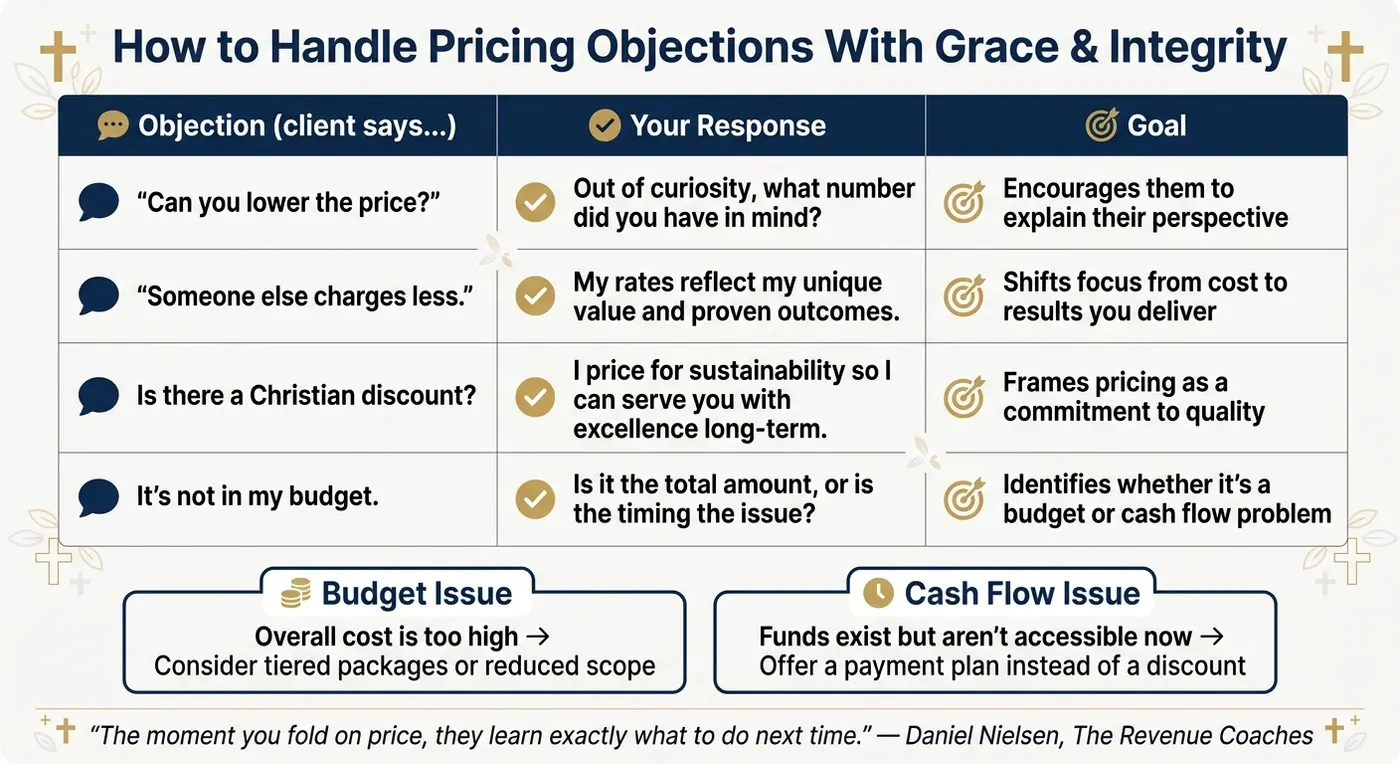
How to Handle Pricing Objections as a Faith-Based Entrepreneur
Even when you deliver your pricing with confidence, objections like "too expensive" are common. Often, these remarks are less about the price itself and more about testing your conviction.
Common Pricing Objections and How to Respond
How you handle objections can make or break the conversation. Staying calm and curious – not defensive – helps shift the tone from confrontation to collaboration.
| Objection | Response | Goal |
|---|---|---|
| "Can you lower the price?" | "Out of curiosity, what number did you have in mind?" | Encourages them to explain their perspective |
| "Someone else charges less." | "My rates reflect my unique value and proven outcomes." | Shifts focus from cost to the results you deliver |
| "Is there a Christian discount?" | "I price for sustainability so I can serve you with excellence long-term." | Frames pricing as a commitment to quality |
| "It’s not in my budget." | "Is it the total amount, or is the timing the issue?" | Helps identify whether it’s a budget or cash flow problem |
Understanding the difference between budget issues and cash flow issues is key. A budget issue means the overall cost is too high, while a cash flow problem suggests the funds exist but aren’t immediately accessible. For cash flow concerns, consider offering a payment plan instead of a discount. This maintains your pricing integrity while addressing the client’s needs.
"The moment you fold on price, they learn exactly what to do next time. And there will be a next time." – Daniel Nielsen, Founder & Partner, The Revenue Coaches
Setting Clear Boundaries Around Discounts and Negotiation
Discounting isn’t inherently wrong, but dropping your price at the first objection can undermine your value. As Proverbs 11:1 reminds us, "Dishonest scales are an abomination to the Lord, but a just weight is His delight." Holding firm on fair pricing reflects integrity and commitment.
Instead of discounting, consider offering tiered packages. This approach allows you to scale down the scope of work for budget-conscious clients without devaluing your premium services. Another option is a formal scholarship program for clients in financial difficulty, which ensures discounts are intentional and aligned with your values.
"Underpricing isn’t humility; it’s poor stewardship. If your pricing keeps you stuck, it limits the very people that you’re called to serve." – Alyssa Avant, Author and Speaker
Reflecting on Hard Conversations Using Psalmlog
After navigating objections, take time to reflect and refine your approach. Psalmlog’s voice journaling feature provides a private space to process these moments – what was said, how you felt, and where you might improve. Its insights dashboard helps track recurring patterns, while scripture tagging connects your experiences to biblical principles, turning challenges into lessons.
The Faith Builder plan ($19.99/month) offers 300 minutes of recording time each month, giving you room to analyze your responses and grow in confidence and stewardship. Over time, these reflections can help you align your pricing strategies with your values and faith.
Building Pricing Courage Through Voice Journaling and Scripture
One successful pricing conversation can feel like a victory, but building lasting confidence comes from consistent spiritual habits.
Why Voice Journaling Helps With Business Decisions
Pricing anxiety often isn’t about the numbers themselves – it’s the endless loop of “What if they say no?” Voice journaling can disrupt this cycle by helping you express and examine your fears out loud. This process allows you to step back and identify whether your hesitation stems from a pricing issue or a fear issue. Asking yourself questions like, “Is this a pricing problem or a fear problem?” helps separate the emotional weight from the practical decision-making. More often than not, you’ll find that spiritual courage is what’s truly needed, not a recalculation of your rates. By making this a regular practice, you create space for deeper spiritual clarity in your business decisions.
How Psalmlog Supports Spiritual Growth in Business
Psalmlog is designed specifically for reflective practices like these. After you record your thoughts, the app uses AI to analyze your emotions and the context of your entry. It then suggests Bible verses tailored to your situation, offering personalized guidance instead of generic scripture.
"The biblical guidance and insights shared are based on what you’re actually going through from your journal entries, not just generic guidance or lessons." – Nina Wooten
This sentiment analysis is especially helpful when dealing with pricing challenges. It can reveal if your decisions are being influenced by fear, peace, or a mix of emotions – patterns that might otherwise go unnoticed. The app’s insights dashboard tracks these emotional trends over time, giving you a clear view of how your confidence and mindset evolve.
The Faith Builder plan ($19.99/month) offers 300 minutes of voice recording, a spiritual insights dashboard, and access to over 20 premium templates, including ones specifically designed for "Financial Struggles" and "Major Decisions." This feedback naturally fits into your daily routine, helping you build the mindset needed for confident pricing discussions.
Building a Regular Spiritual Practice Around Pricing
Studies show that engaging with scripture four or more times a week can boost confidence in faith-based decisions by 228% while reducing spiritual stagnation by 60%. This kind of transformation can reshape how you approach difficult conversations.
Here’s an example of a weekly routine: Before a pricing conversation, record a short voice entry naming your fears and grounding yourself in a verse like 2 Timothy 1:7 – “God has not given us a spirit of fear, but of power, love, and a sound mind”. After the discussion, record your reflections on what went well and where you felt uncertain. Over time, these entries become a powerful record of your progress and a source of encouragement for future challenges.
Consistency is key. Each entry, scripture, and honest reflection builds the quiet strength you need when clients question your pricing. This practice reinforces the biblical principles of stewardship and integrity, helping you approach every conversation with confidence and grace.
Conclusion: Handling Pricing Conversations With Faith and Integrity
Talking about pricing doesn’t have to feel uncomfortable – it can become a meaningful moment when approached with fairness and care. By clearly communicating what you bring to the table and addressing concerns with understanding, the tone of the conversation changes entirely. As Alyssa Avant wisely says:
"Sustainable pricing allows you to have a long-term impact. Being a financial steward honors the calling that God has given you."
The Bible supports the idea of fair and honest compensation, offering a solid foundation for the rates you set and the discussions you have.
Success in business often requires the bravery to charge what reflects your true worth. Tools like Psalmlog can help you discern whether your hesitation comes from fear or thoughtful reasoning, guiding you to Scripture that aligns with your situation. This kind of reflection not only sharpens your approach to pricing but also deepens your spiritual journey.
FAQs
How do I know my rates are fair and biblical?
Fair pricing, rooted in biblical principles, begins by discarding the notion that undercharging is a mark of humility. Instead, think of pricing as an act of stewardship – ensuring the longevity of your mission. Your rates should not only cover your expenses but also provide a sustainable income and reflect the worth of your skills and the impact you deliver. Embrace the concept of honest scales by steering clear of exploitation. Seek divine guidance, maintain transparency, and trust that fair compensation respects both your work and your calling.
What should I say when a client asks for a discount?
When a client requests a discount, keep your composure and respond with something like, "Out of curiosity, what number did you have in mind?" This simple question helps you understand their perspective without immediately jumping into negotiation.
If the issue is a tight budget, consider alternatives like offering payment plans instead of reducing your price. On the other hand, if they’re seeking a better deal, hold firm on your pricing but look for ways to add value – such as including an extra deliverable in exchange for a longer-term commitment.
How can Psalmlog help me feel confident about pricing?
Psalmlog provides a way to approach pricing decisions with greater confidence by combining personalized, Scripture-based insights with practical advice. Whether you prefer to share your challenges through voice or text, Psalmlog delivers relevant Bible verses and actionable steps rooted in spiritual guidance. By addressing common struggles like fear and doubt, it helps you tackle pricing conversations with clarity, faith, and a sense of purpose, making it a reliable partner in navigating these often tricky discussions.