
Biblical Wisdom for Business Decisions
Scripture-based guidance—prayer, counsel, integrity, and stewardship—to help entrepreneurs make clear, faith-led high-stakes business decisions.
Entrepreneurs often face tough decisions – choosing investors, reorganizing teams, or shifting strategies. These moments can feel overwhelming, especially when financial risks are high. But biblical principles offer practical guidance to navigate uncertainty with clarity and purpose. Here’s how scripture can help:
- Pray for wisdom: Seek clarity and discernment (James 1:5).
- Trust God’s plan: Let go of control and align decisions with faith (Proverbs 3:5-6).
- Act with integrity: Operate honestly and build trust (Proverbs 11:1).
- Plan carefully: Count the cost before making moves (Luke 14:28).
- Seek counsel: Surround yourself with advisors for diverse perspectives (Proverbs 15:22).
- Practice stewardship: Manage resources as if entrusted by God (Psalm 20:7).
Biblical Business advice from a 7-figure Christian business owner
Seeking God’s Direction in Business Decisions
When you’re faced with big decisions, it’s tempting to rely solely on data and past experiences. However, divine guidance can reveal risks and opportunities that numbers and logic might miss. Prayer isn’t meant to replace thorough research – it should be the foundation that supports it. These timeless biblical principles can help you navigate your next move with confidence.
Pray for Wisdom and Clarity (James 1:5)
God promises to provide wisdom generously to those who ask. This isn’t just a comforting idea – it’s a practical approach to handling the stress and uncertainty that often accompany entrepreneurial decisions. For example, when a deal seems perfect on paper but something doesn’t feel right, take a moment to pray for discernment before committing.
"If any of you lacks wisdom, you should ask God, who gives generously to all without finding fault, and it will be given to you." – James 1:5
Prayer works best when paired with action. Seek advice from trusted mentors who share your faith, and take time to reflect on your decisions in a journal. If the pressure of high-stakes choices starts to overwhelm you, turn to prayer with gratitude – it can help restore clarity and peace of mind.
Trust God’s Plan Over Your Own Logic (Proverbs 3:5-6)
Stefanie Gass, a Christian entrepreneur, learned this lesson firsthand. After seven years of running her business based on market trends and logic, she decided to surrender her plans to God in April 2025. By shifting her focus from social media to podcasting, she grew her business to seven figures while reducing her workweek to under 20 hours.
"Running a kingdom business is the same… if you’re not doing this with God as your CEO and partner, it will be hard. And you may even end up shipwrecked." – Stefanie Gass, 7-Figure Christian Business Owner
Her breakthrough came when she stopped relying solely on her own reasoning and waited for God’s confirmation before making decisions. Keep your plans flexible so God can guide you, even if it means going against conventional wisdom. Before making big moves – like hiring a key team member, launching a new product, or changing your strategy – take time to pray and present your plans to God. If something doesn’t feel aligned with His purpose or isn’t yielding results, don’t hesitate to let it go. Additionally, practicing a Sabbath rest each week is a powerful reminder that success comes not from endless effort but from God’s provision and blessing.
Biblical Principles for Making Business Decisions
Once you’ve decided to seek God’s guidance, the next step is applying specific biblical principles to your business decisions. These principles aren’t just theoretical – they offer practical ways to evaluate opportunities, manage resources, and move forward with clarity and trust.
Use Scripture to Guide Your Discernment (Psalm 119:105)
Scripture provides a reliable guide when facing uncertainty. Instead of relying only on market trends or competitor strategies, let the Bible serve as your primary lens for evaluating decisions. Ask yourself: Does this align with biblical values like honesty, fairness, and stewardship?
One helpful approach is the ANCHOR Method: associate a Bible verse with your situation, note it, study its context, recite it regularly, look for opportunities to apply it, and track how it shapes your results. For instance, if you’re considering a partnership that seems profitable but involves questionable practices, Proverbs 13:11 offers wisdom: "Wealth from get-rich-quick schemes quickly disappears; wealth from hard work grows over time".
Scriptural principles can also help you assess the broader costs of major decisions. Whether you’re launching a new product or entering a new market, evaluate the financial, relational, and reputational impact through a biblical lens.
Maintain Integrity and Stewardship (Proverbs 23:4; Psalm 20:7)
Integrity in business means using "honest scales" (Proverbs 11:1) in all dealings. This includes transparent pricing, truthful marketing, and refusing to compromise ethics – even under financial strain. J.C. Penney, founder of the well-known retail chain, built his business on this foundation:
"I cannot remember a time when the Golden Rule was not my motto and precept, the torch that guided my footsteps." – J.C. Penney
Stewardship means viewing yourself as a manager of resources entrusted to you by God. Ask, "What would the Owner [God] want me to do with His resources?" This mindset influences decisions on hiring, investments, and daily operations. A practical example is the 10/10/80 Rule: allocate 10% to giving, 10% to savings, and 80% to operations. This encourages disciplined financial management. Regularly review key metrics like cash flow, employee engagement, and customer satisfaction to ensure you’re managing resources wisely.
When facing a choice between short-term financial gain and safeguarding your reputation, choose the latter. Proverbs 22:1 reminds us:
"A good name is more desirable than great riches; to be esteemed is better than silver or gold." – Proverbs 22:1
Your reputation is a long-term asset that grows over time, while shortcuts often lead to setbacks that can be difficult to recover from.
Move Forward with Courage and Faith (Joshua 1:9)
Big decisions require boldness, but biblical courage is rooted in knowing God is with you. Before making a major move, consider your peace level on a scale of 1–10. A lack of peace might suggest the need for more prayer, counsel, or patience.
Courage also involves seeking advice. Proverbs 15:22 teaches, "Plans fail for lack of counsel, but with many advisers they succeed". Build a network of advisors, including industry mentors, peers, and spiritual guides, to gain diverse perspectives. Leaders who seek counsel often make better decisions and avoid costly mistakes.
Finally, commit your work to God (Proverbs 16:3) and trust Him with the outcome. This reduces the stress of leadership and allows you to act decisively without fear of failure. Incorporating prayer into key moments, like planning sessions or product launches, acknowledges God’s sovereignty and frees you from the pressure of trying to control every detail.
These principles provide a solid framework for integrating faith into every aspect of your business journey.
Practical Tools for Faith-Based Decision-Making
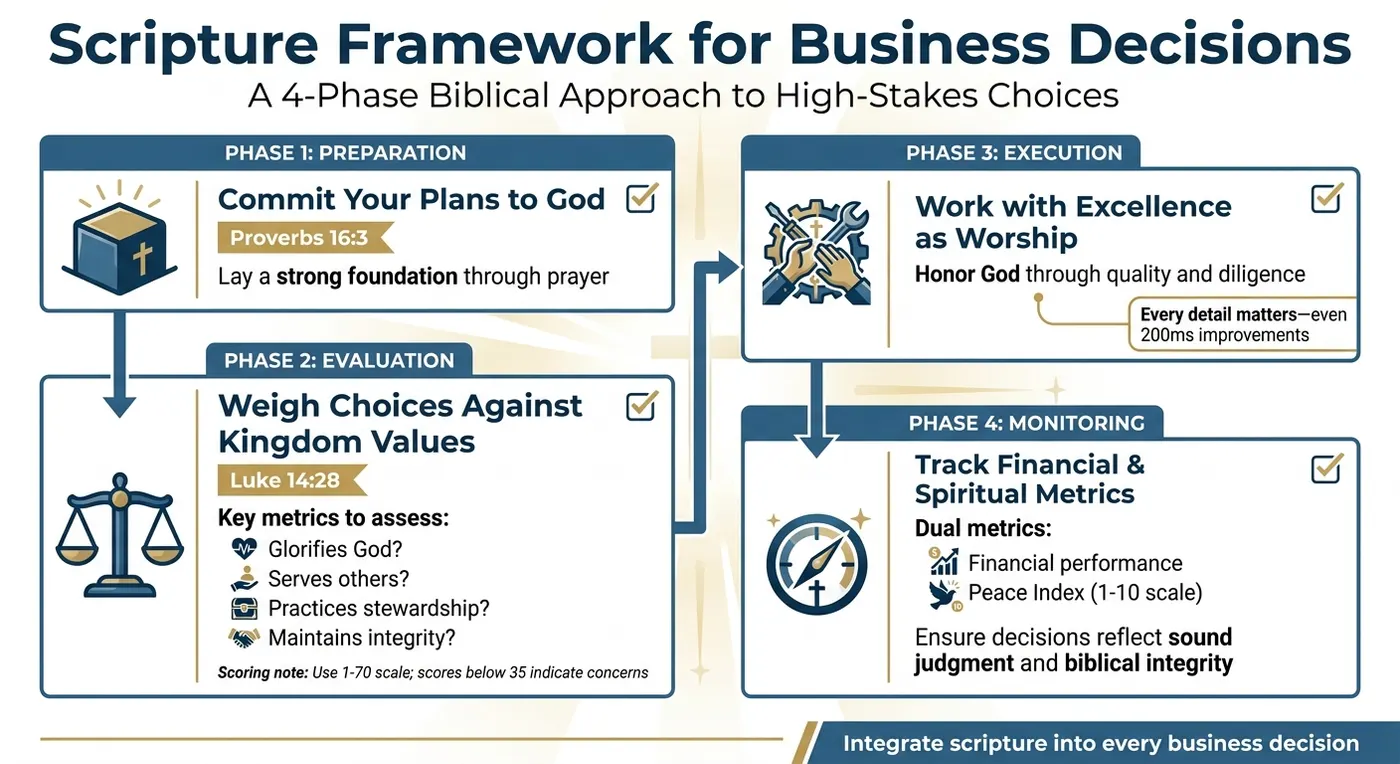
Biblical Framework for Faith-Based Business Decision Making
Bringing biblical principles into daily decisions requires practical systems. These tools help integrate scripture into your decision-making process, offering clarity and steadfast guidance.
A Scripture Framework for Each Decision Phase
Business decisions often unfold in distinct phases, each of which can be guided by biblical principles. Start with the Preparation Phase by committing your plans to God, as Proverbs 16:3 advises. This step lays a strong foundation, reminding you not to rely solely on your own understanding.
In the Evaluation Phase, a Kingdom Decision Matrix can help you weigh choices against values like glorifying God, serving others, practicing stewardship, and maintaining integrity. For more significant decisions, you can expand this matrix to a 1–70 scoring system – decisions scoring below 35 may indicate potential issues. Additionally, "count the cost" (Luke 14:28) by examining not just financial implications but also time, opportunity costs, and impacts on your reputation.
During the Execution Phase, focus on working with excellence as a way to honor God. For instance, James, the founder of SketchMyApp, once revamped his entire codebase to improve performance by just 200 milliseconds – a small but impactful change that demonstrated his commitment to "Excellence as Worship".
Finally, in the Monitoring Phase, track both financial and spiritual metrics, including a Peace Index rated on a 1–10 scale. This ongoing evaluation ensures your decisions reflect both sound judgment and biblical integrity.
These structured phases provide a clear roadmap, seamlessly connecting biblical principles with practical decision-making tools.
Using Psalmlog for voice journaling and scripture-based reflection

Psalmlog takes this framework a step further by integrating scripture into your decision-making through voice journaling. When faced with a challenging choice, you can speak your situation into the app, which then offers personalized biblical insights, relevant scriptures, and actionable steps. With its 6-point AI journal insights, Psalmlog helps you identify patterns in your decisions and track how specific scriptures address your business challenges over time.
This voice-first approach encourages a devotional pause before jumping into daily tasks. Instead of immediately checking emails or metrics, take a moment to record your thoughts, concerns, and questions about upcoming decisions. Psalmlog’s scripture tagging feature allows you to link specific verses to business scenarios, building a personal library of biblical guidance. Over time, this not only helps you navigate challenges but also highlights how God has been actively involved in your entrepreneurial journey.
Conclusion: Faith as the Foundation for Business Success
Making critical business decisions doesn’t have to feel like a solitary burden. Grounding your efforts in biblical wisdom shifts your role from one of relentless control to that of faithful stewardship. This perspective lifts the weight of feeling like you must have all the answers, reminding you that you’re managing what God has entrusted to you.
The principles shared here aren’t just theoretical – they’re actionable. Studies reveal that leaders who rely on ethical frameworks tend to make quicker decisions and experience fewer regrets when their values are clearly defined. Businesses that emphasize financial planning and thoughtfully "count the cost" are more likely to weather economic storms and achieve growth. Integrity itself becomes a strength, fostering trust that attracts talented individuals and allows for premium pricing.
"Commit to the Lord whatever you do, and he will establish your plans." – Proverbs 16:3
As you navigate real-world challenges – whether it’s launching a new product, entering a partnership, or pivoting your strategy – consider this two-part approach. Seek spiritual guidance through prayer while validating decisions with the help of trusted, godly advisors. Keep a close eye on both financial performance and your inner sense of peace to measure success. Let your work reflect worship, not worry. By applying these biblical principles, you can keep your decisions rooted in faith.
When faith is paired with smart business strategies, it becomes the cornerstone of lasting success. By seeking God’s guidance, upholding integrity, and focusing on serving others, you’re doing more than building a company – you’re creating something that honors God and leaves a meaningful legacy. Aligning your decisions with these truths not only grows your business but also celebrates the true source of all success.
FAQs
How do I tell God’s guidance from my own fear or ambition?
Discerning God’s guidance involves a thoughtful process with three essential steps:
- Pray for wisdom: Lean on James 1:5, which encourages believers to ask God for wisdom, trusting that He will provide it generously.
- Evaluate your motives: Take an honest look at your intentions. Are they driven by faith, or are fear and selfish ambition creeping in? Aligning your motives with faith is key.
- Apply discernment: Proverbs 18:17 reminds us to consider all perspectives carefully. Taking time to weigh different viewpoints helps ensure decisions are made with integrity and a clear mind.
By following these steps, you can make choices grounded in faith rather than personal biases.
What should I do if a profitable opportunity conflicts with integrity?
Integrity is worth more than any profitable opportunity that challenges your values. When faced with such decisions, staying true to your principles is crucial. Turn to prayer for guidance, trusting that honest and ethical choices align with biblical teachings. Upholding your integrity not only reflects your faith but also lays the foundation for lasting success.
How can I measure success with both business metrics and spiritual peace?
Success means finding harmony between achieving measurable business goals – like increasing revenue or improving customer satisfaction – and staying true to biblical principles such as integrity, generosity, and service. Taking time to reflect through prayer and scripture, such as Matthew 6:33, helps ensure that decisions honor God and provide a sense of inner peace. This approach blends tangible achievements with spiritual fulfillment, offering a well-rounded sense of accomplishment that values both personal growth and faith.