
How to Start a Business That Honors God: A Step-by-Step Guide
Seven practical steps to build a Christ-centered business: prayer, mission, integrity, finances, workplace culture, and spiritual tools.
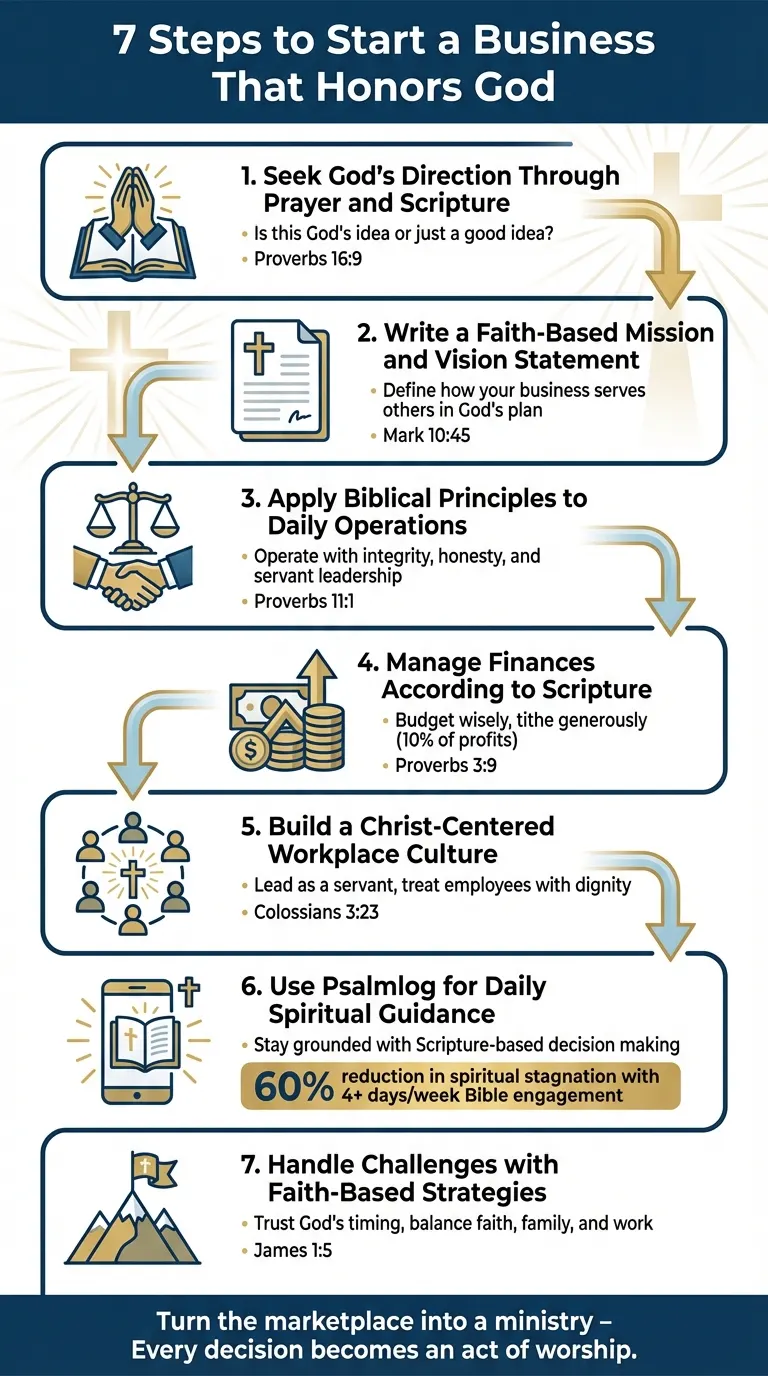
If you’re a Christian entrepreneur, starting a business isn’t just about profits – it’s about aligning your work with God’s purpose. This guide outlines seven practical steps to help you create a business that reflects biblical values, serves others, and glorifies God. Here’s a quick breakdown:
- Pray and Seek God’s Guidance: Begin with prayer and Scripture to ensure your business idea aligns with His will.
- Write a Faith-Based Mission and Vision: Define how your business serves others and fits into God’s plan.
- Apply Biblical Principles Daily: Operate with integrity, honesty, and servant leadership in every decision.
- Manage Finances Wisely: Manage money, debt, and generosity as a steward of God’s resources.
- Create a Christ-Centered Workplace: Treat employees with dignity, lead with humility, and prioritize rest and balance.
- Use Tools Like Psalmlog: Stay spiritually grounded with daily Scripture-based guidance for business decisions.
- Handle Challenges with Faith: Trust God during setbacks, seek counsel, and balance work with family and faith.
Starting a God-honoring business means turning the marketplace into a ministry. Every decision becomes an act of worship, reflecting Christ’s love and principles. Ready to take the next step? Let’s dive in.
7 Steps to Start a God-Honoring Business
Ready to Start a Kingdom Business? Here’s Exactly How
Step 1: Seek God’s Direction Through Prayer and Scripture
Before diving into tasks like drafting a business plan or registering an LLC, pause and ask yourself: "Is this just a good idea, or is it God’s idea?" This distinction is critical. A good idea might bring financial success, but a God-inspired idea transforms your venture into something with eternal purpose.
The Bible emphasizes that human plans must align with God’s guidance. Proverbs 16:9 says, "In their hearts humans plan their course, but the LORD establishes their steps." Even the most thorough market research can’t replace the clarity that comes from God’s direction. As Darnyelle Jervey Harmon, Founder of Incredible One Enterprises, explains:
"I personally stand behind the belief that businesses that have a spiritual foundation go farther faster."
How to Pray for Clarity and Direction
Prayer isn’t just a ritual – it’s a vital tool for making decisions. Start by committing your business ideas to God, asking Him to guide your thoughts and actions (Proverbs 16:3). Seek His wisdom on key aspects like your business model, target audience, and how to incorporate biblical principles into your approach.
Consider adding fasting or setting aside Sabbath moments (Psalm 46:10) to create space for hearing God’s voice. Journaling during these times can help you document insights and track His guidance over time.
Instead of letting anxiety take over, bring every concern to God in prayer, as Philippians 4:6 encourages. Over time, with gratitude and trust, you may notice your business goals aligning more closely with His will.
Pair your prayers with time spent in Scripture to confirm the direction you’re sensing.
Using Scripture to Confirm Your Calling
Once you’ve prayed, turn to Scripture for further affirmation and guidance. Different passages can help clarify various aspects of your business journey. For example, Isaiah 55 can inspire your vision, Micah 6:8 can guide your values, and Exodus 31:1-5 serves as a reminder that even practical skills are gifts from God.
When seeking wisdom, James 1:5 offers reassurance: "If any of you lacks wisdom, you should ask God, who gives generously to all without finding fault, and it will be given to you." Reflect on Jeremiah 1:5 to affirm your calling, and let Proverbs 3:5-6 remind you to trust God’s plan over your own understanding.
Write down your vision. Habakkuk 2:2 encourages you to make your vision clear and actionable: "Write the vision and make it plain on tablets, that he may run who reads it." Use scriptures like Micah 6:8 to define your guiding principles, affecting decisions on pricing, wages, and how you serve your community. Test your ideas with small, practical steps to confirm God’s direction.
Step 2: Write a Faith-Based Mission and Vision Statement
Now that you’ve sought clarity through prayer and Scripture, it’s time to translate that clarity into meaningful statements. Your mission and vision should reflect how your business serves as a steward of God’s resources. As one faith-based business resource puts it, "we don’t truly own our businesses – we manage them for their true Owner." This mindset reshapes how we define success and purpose.
Define Your Business Purpose in God’s Plan
Your mission statement should address a core question: How does this business serve others in a way that reflects God’s character? The focus should always be on serving others, not on personal gain. Mark 10:45 reminds us that Jesus "came not to be served, but to serve" – a principle that can transform how you interact with customers, employees, and vendors.
Identify both the practical and spiritual needs your business fulfills. Micah 6:8 provides a powerful framework for defining your core values: "Act justly, love mercy, and walk humbly with your God." These principles can influence decisions like fair pricing, sustainable wages, and ethical sourcing. For instance, if you’re starting a consulting firm, your mission might emphasize offering honest advice that prioritizes the client’s well-being over billable hours – an application of Proverbs 11:1, which calls for integrity in business.
You might also consider embedding a faith statement into your company’s bylaws or operating agreements. Doing so can protect your ability to make decisions rooted in faith as your business evolves, ensuring that new team members understand its spiritual foundation from the start.
While your mission guides daily operations, your vision statement looks ahead to the broader, long-term impact.
Build Your Vision on Biblical Principles
Your vision statement should outline your business’s long-term role in God’s plan. Rather than relying solely on market trends, ground your vision in Scripture. Colossians 3:23-24 encourages us to work "with all your heart, as working for the Lord" – a call to pursue excellence that can shape your vision. Similarly, Daniel 6:3, which describes having an "excellent spirit", can inspire your commitment to providing outstanding service.
Create an impact dashboard to measure more than just financial success. Include metrics like community influence, employee development, and alignment with God’s purpose. This approach acknowledges that success in God’s kingdom often looks different from worldly achievements.
Finally, consider forming an advisory board that includes both spiritual mentors and industry professionals. Their guidance and accountability can help you stay true to your vision, especially when market pressures challenge your faith-based principles.
Step 3: Apply Biblical Principles to Daily Operations
Once your mission and vision are clearly defined, the challenge lies in making them part of your day-to-day decisions. This is where faith takes shape – not just in words but in actions. From setting prices to handling mistakes, biblical principles guide every choice. Proverbs 11:1 offers a clear standard: "The Lord detests dishonest scales, but accurate weights find favor with him."
Operate with Integrity and Honesty
Integrity begins with understanding your business as a stewardship of God’s resources. It’s not just yours – it’s entrusted to you by Him. Instead of focusing solely on profit, ask yourself, "What aligns with God’s purposes?"
This perspective shapes practical decisions. For example, if you undercharge a client by mistake, send a corrected invoice with an apology, even if it costs you in the short term. Actions like these build trust and uphold your reputation, which Proverbs 22:1 highlights: "A good name is more desirable than great riches; to be esteemed is better than silver or gold."
Integrity also means going beyond mere legal compliance. It involves keeping your word to vendors, paying employees fairly as individuals created in God’s image (Colossians 4:1), and offering honest feedback, even when it’s uncomfortable. Avoid exaggerating in marketing or using manipulative tactics. The Golden Rule from Matthew 7:12 – treating others as you want to be treated – should guide every interaction, whether you’re negotiating a contract or addressing customer concerns. Leadership is key in modeling these values consistently.
Serve Customers and Employees with Love
Servant leadership isn’t just a good idea; it’s a biblical calling. Jesus exemplified this in Mark 10:45, saying, "For even the Son of Man did not come to be served, but to serve, and to give his life as a ransom for many."
This approach shapes how you manage your team. When employees make mistakes, lead with grace. Focus on mentoring and problem-solving instead of jumping to discipline. Share your own failures to foster growth and loyalty. Colossians 3:23-24 encourages this perspective: "Work with all your heart, as working for the Lord, not for human masters." When viewed this way, even routine tasks – whether it’s bookkeeping, customer service, or managing inventory – become acts of worship.
The same principle applies to customer relationships. Let your commitment to God’s purpose shine through your actions. Use relationship-based marketing that genuinely addresses customer needs. If another company can better meet a customer’s requirements, refer them – even if it means losing the sale. Offer generous return policies and prioritize serving over selling. This mindset not only strengthens your reputation but also becomes a testimony of your faith in the marketplace.
Step 4: Manage Finances According to Scripture
How you handle your business finances speaks volumes about your trust in God. The Bible reminds us, "The earth is the Lord’s, and everything in it, the world, and all who live in it" (Psalm 24:1). This verse shifts the focus from ownership to stewardship – acknowledging that everything we manage ultimately belongs to God. By viewing finances through this lens, your decisions can reflect a commitment to honoring Him.
Budget and Manage Finances Wisely
Budgeting, from a biblical perspective, emphasizes careful planning rather than strict limitations. Proverbs 21:5 highlights this principle: "The plans of the diligent lead surely to abundance, but everyone who is hasty comes only to poverty." Similarly, Luke 14:28 encourages thoughtful preparation: "Suppose one of you wants to build a tower. Won’t you first sit down and estimate the cost to see if you have enough money to complete it?"
Start by tracking every dollar your business spends over a 30-day period. This will help you uncover spending habits and pinpoint areas where you can cut back. Once you have a clear picture, divide your expenses into four key categories:
- Giving: Tithes and offerings.
- Saving: Building an emergency fund and planning for future investments.
- Needs: Essential operating costs like rent, payroll, and utilities.
- Wants: Optional expenses such as growth initiatives or employee perks.
Aim to establish an emergency fund that covers three to six months of business expenses. Living below your means creates flexibility for generosity and prepares you for unexpected opportunities. Regularly review your finances to ensure they align with your faith-driven goals.
If your business has debt, create a structured repayment plan. Proverbs 22:7 warns, "The borrower is slave to the lender," reminding us that debt can restrict generosity and limit your ability to follow God’s direction. Start by paying off high-interest loans and avoid taking on unnecessary new debt. Romans 13:8 reinforces this mindset: "Let no debt remain outstanding, except the continuing debt to love one another."
Give Generously and Tithe
Generosity is a cornerstone of faith-based financial management. Second Corinthians 9:6 teaches, "Whoever sows sparingly will also reap sparingly, and whoever sows generously will also reap generously." Make tithing a priority in your budget, treating it as your first expense rather than an afterthought. Proverbs 3:9 instructs, "Honor the Lord with your wealth, with the firstfruits of all your crops."
Traditionally, a tithe represents 10% of your business profits. Malachi 3:10 invites us to trust in God’s provision: "Bring the whole tithe into the storehouse, that there may be food in my house. Test me in this… and see if I will not throw open the floodgates of heaven and pour out so much blessing that there will not be room enough to store it." Tithing isn’t about expecting material rewards – it’s an act of faith, recognizing God as the ultimate provider.
Generosity extends beyond financial giving. Share your expertise with peers, mentor aspiring entrepreneurs, and create opportunities for others, such as offering employees paid time to volunteer. Proverbs 11:25 assures, "A generous person will prosper; whoever refreshes others will be refreshed." And as Matthew 6:33 reminds us, "Seek ye first the kingdom of God, and His righteousness; and all these things shall be added unto you."
When your financial practices reflect God’s principles, they lay the groundwork for a workplace culture rooted in faith, preparing you for the next step in creating a Christ-centered business.
Step 5: Build a Christ-Centered Workplace Culture
Once you’ve established strong financial stewardship, the next step is shaping a workplace culture that mirrors God’s character. A Christ-centered workplace isn’t about decorations or slogans – it’s about how you treat people, resolve conflicts, and make decisions. When faith is woven into daily actions, it creates an environment where employees feel valued and inspired. As a leader, focus on serving others rather than seeking status.
Lead as a Servant Leader
Jesus redefined leadership by prioritizing service over authority. In Mark 10:45, He said, "For even the Son of man came not to be ministered unto, but to minister, and to give his life a ransom for many." This wasn’t a sign of weakness – it was an act of strength rooted in humility and love. Chioma Oparadike, founder of The Set-Apart Woman, captures this beautifully:
"The fact that we are entrepreneurs and leading others does not make us better, but gives us a vantage position to lead by serving."
Servant leadership starts with seeing yourself as a steward, not just an owner. Your business belongs to God, and you are entrusted to manage His resources, time, and people. This perspective helps you lead with humility, letting go of the need for total control. When mistakes happen, focus on grace-based correction. Instead of punishment, use collaboration and mentorship to guide your team, fostering loyalty and improving their performance.
Take a "foot-washing" approach to leadership by embracing humility. This could mean handling small tasks, sharing credit for successes, admitting mistakes quickly, and being open to feedback. Seek guidance from mentors who can provide both spiritual and business wisdom. Moses serves as a powerful example of this type of leadership – his humility and reliance on God’s guidance (Numbers 12:3) made him a true servant leader.
Create a Respectful and Faith-Driven Workplace
A workplace rooted in faith treats every employee with dignity, recognizing them as created in God’s image. This means offering fair pay, providing honest feedback, and creating opportunities for both professional and personal growth. When making decisions, ask yourself: How does this help my team grow in skill and character?
Start team meetings by celebrating wins, expressing gratitude, and acknowledging milestones. For example, at Walker Manufacturing in October 2013, employees were encouraged to approach their work as if every product were made for Christ. This mindset inspired a commitment to excellence and integrity. Encourage your team to adopt a similar perspective, reminding them of Colossians 3:23: “Whatever you do, work at it with all your heart, as working for the Lord, not for human masters.”
Honor the principle of rest by setting clear boundaries for downtime. Prioritize family time and avoid fostering a culture of overwork. Create safe spaces where employees can voice concerns without fear, ensuring fairness and justice in the workplace. Support their generosity by offering paid time off for volunteering or creating programs that encourage giving back. As your business grows, document your faith-driven values and decision-making processes so new hires can embrace the culture you’ve built. When your workplace reflects Christ’s love, it creates an environment where both faith and productivity can thrive.
Step 6: Use Psalmlog for Daily Spiritual Guidance

Establishing a Christ-centered workplace goes beyond good intentions – it calls for daily spiritual grounding to ensure your actions align with biblical principles. When you’re navigating tough decisions about hiring, finances, or the direction of your business, having quick access to Scripture that speaks to your situation can make all the difference. That’s where Psalmlog comes in. This tool provides real-time biblical wisdom, helping you discern God’s will as you tackle the challenges of running a faith-driven business.
Use Psalmlog for Decision-Making and Reflection
Psalmlog delivers personalized Scripture tailored to your specific business challenges. Instead of spending hours searching for relevant Bible passages, you can articulate your concerns – whether it’s a tricky partnership, a tough conversation with an employee, or uncertainty about expanding your services. The app uses local transcription to process your thoughts and provides actionable, Scripture-based guidance, saving you valuable time.
Take Sarah M., a marketing executive, as an example:
"I was torn about whether to take a new job offer. Psalmlog gave me Scripture about trusting God’s plans and seeking wise counsel. The biblical insight helped me make the decision with confidence and peace."
The voice journaling feature is another way Psalmlog supports you. Whether you’re reflecting during your commute, over lunch, or before a meeting, this tool helps you stay connected to Scripture. Research indicates that engaging with the Bible at least four days a week can reduce spiritual stagnation by 60% and increase confidence by 228%.
Stay Spiritually Grounded During Challenges
Psalmlog isn’t just for decision-making – it’s also a source of strength during difficult times. Business setbacks like cash flow issues, lost clients, or team conflicts can shake your faith. Psalmlog helps you stay rooted in biblical truth by offering Scripture-based encouragement and practical wisdom tailored to your struggles.
Your reflections and prayers are kept completely private, thanks to secure local transcription. None of your entries are sold or used to train AI models, so you can be honest about your doubts and challenges. Consistent engagement with Scripture has been shown to increase generosity by 218% while reducing feelings of discouragement and loneliness by 31% and 30%, respectively.
Psalmlog offers a 7-day free trial, giving you the opportunity to experience how daily spiritual guidance can strengthen your decision-making and resilience as a faith-driven business leader.
Step 7: Handle Challenges with Faith-Based Strategies
When running a business, challenges are inevitable – whether it’s cash flow problems, losing clients, or unexpected setbacks. What sets faith-driven entrepreneurs apart is not the absence of these struggles but how they respond to them. By grounding your actions in Scripture and biblical principles, you can turn obstacles into moments that reflect humility, perseverance, and the Gospel.
Trust God During Business Setbacks
Financial struggles can feel overwhelming, but Scripture reminds us to shift our mindset from ownership to stewardship. As Psalm 24:1 says, "The earth is the Lord’s, and everything in it." Your business ultimately belongs to God, and you are entrusted to manage His resources. When faced with tough decisions under pressure, lean on the promise from James 1:5: "If any of you lacks wisdom, you should ask God, who gives generously to all without finding fault, and it will be given to you."
Larry G. Locke, Professor and Associate Dean at the University of Mary Hardin-Baylor, highlights the importance of humility and transparency during difficult times:
"The Christian identity of an entrepreneur is based on his willingness to be held to a standard he will never consistently achieve and to exercise the necessary humility to be transparent about that condition".
Acknowledging mistakes and seeking guidance not only strengthens your leadership but also serves as a testimony of faith. Redefine success during tough seasons by looking beyond profits – consider how your business impacts the community and fosters growth within your team. Proverbs 21:5 encourages patience: "The plans of the diligent lead to profit as surely as haste leads to poverty." Avoid rushing decisions and instead trust in God’s timing. Surround yourself with a network of godly mentors and advisors, as Proverbs 15:22 reminds us that "plans fail for lack of counsel, but with many advisers they succeed."
Balance Faith, Family, and Work
Scripture doesn’t just provide guidance for managing finances or business; it also speaks to balancing work with personal life. Entrepreneurs often face the temptation to prioritize business growth at the expense of their families. However, 1 Timothy 5:8 emphasizes that providing for your household involves more than financial support – it includes being emotionally present and available.
Interestingly, while only 16% of pastors rate their work–life balance as "excellent", entrepreneurs are nearly three times more likely to feel satisfied with their balance. A key part of achieving this balance is honoring the Sabbath, which acknowledges human limits and demonstrates trust in God’s provision. Psalm 127:2 reminds us: "In vain you rise early and stay up late, toiling for food to eat – for he grants sleep to those he loves."
Incorporate small but meaningful practices into your routine, like scheduling prayer breaks or reflecting on Scripture during the day. Set firm boundaries by defining specific work hours and disconnecting from digital devices afterward to protect family time. Follow Jesus’ example in Mark 1:35: "Very early in the morning, while it was still dark, Jesus got up, left the house and went off to a solitary place, where he prayed." Regular prayer and quiet time with God are essential, especially during demanding seasons.
Finally, remember the encouragement from Colossians 3:23–24: "Whatever you do, work at it with all your heart, as working for the Lord, not for human masters." Viewing your work as a service to God, rather than an endless grind, brings peace and purpose, even in challenging times. Balancing faith, family, and work allows you to honor God through your business and every decision you make.
Conclusion
By blending prayer, biblical principles, and practical strategies, you’ve laid the groundwork for a business that reflects God’s purpose. Starting a business that honors God isn’t just about profits – it’s a calling to turn the marketplace into a ministry. This guide has shown you how to seek God’s guidance through prayer, establish a mission rooted in faith, apply biblical values to daily operations, manage finances with wisdom, foster a Christ-centered workplace, and face challenges with steadfast trust. At the heart of it all is this truth: "The earth is the Lord’s, and everything in it, the world, and all who live in it" (Psalm 24:1). This understanding shifts the burden of control and transforms each decision into an act of worship.
Dennis Peacocke captures this calling perfectly: "If you are in Christ, you are called to extend His Kingdom franchise on earth as a junior partner". You’re not alone in this mission – there are around 180 million Christ-following entrepreneurs worldwide. Yet, strikingly, about 99.7% lack access to the communities and resources designed to integrate faith with business. By building your business on principles like honesty, generosity, and servant leadership, you establish a legacy that embodies Proverbs 22:1: "A good name is more desirable than great riches; to be esteemed is better than silver or gold". These truths not only shape your vision today but serve as a foundation for enduring success.
Challenges are inevitable, but Scripture, the Holy Spirit, and tools like Psalmlog can help you stay spiritually anchored. Embrace the Sabbath principle, seek godly advice, and treat every customer interaction and employee relationship as an opportunity to reflect Christ’s character. Your biblical foundation isn’t just a part of your business – it’s the cornerstone that will sustain you through difficulties and keep your focus on eternal impact alongside earthly success.
Trust in God’s timing, remain faithful to His calling, and let your business be a living testament to His glory. Proverbs 16:9 reminds us: "In their hearts humans plan their course, but the LORD establishes their steps". While your plans are important, God’s direction is what ultimately ensures success. Let this truth guide you as you implement these principles daily and build a business that honors Him in every way.
FAQs
How do I know my business idea is God’s idea?
To determine if your business idea aligns with God’s will, begin with prayer and thoughtful reflection on biblical teachings. Consider whether the idea supports God’s purpose, benefits others, and addresses real needs. Reflect on whether it upholds values such as honesty, responsible management, and a heart for serving others. Above all, seek wisdom through prayer and rely on the Holy Spirit’s guidance to affirm His direction.
Can I be profitable and still honor God in business?
Yes, running a profitable business while honoring God is absolutely possible. Principles such as stewardship, diligence, integrity, and serving others provide a strong foundation for building a business that aligns with both faith and purpose. By staying rooted in these values, you can create a venture that not only thrives financially but also reflects your commitment to a God-centered approach.
How do I share my faith at work without forcing it?
Living out your faith at work starts with demonstrating biblical principles in your daily actions – integrity, service, and diligence. When you consistently show a Christ-like attitude, it naturally opens the door for others to notice and inquire about your beliefs.
Instead of pushing conversations about faith, let them happen organically. If someone brings it up, respond honestly and with kindness. This approach not only reflects biblical teachings but also helps build respectful and positive relationships with your coworkers and clients.