
Business Prayer During a Tough Quarter
Lament, surrender, and discernment prayers plus Scripture and voice journaling to find clarity and peace during a difficult business quarter.
When business struggles hit hard, it’s easy to feel overwhelmed, isolated, and spiritually disconnected. This article explores how prayer and scripture can help you navigate tough financial quarters with clarity and peace. Key takeaways include:
- Why prayer matters during business challenges: It shifts focus from metrics to faith, reminding you of your worth beyond results.
- Barriers to prayer: Internal struggles like exhaustion and external distractions like notifications often push prayer aside.
- Practical prayer types: Lament (expressing struggles), surrender (releasing control), and discernment (seeking wisdom).
- Scripture to anchor your prayers: Verses like Philippians 4:6–7 and Proverbs 16:3 offer guidance and reassurance.
- Tools for spiritual clarity: Apps like Psalmlog help structure prayer, track themes, and connect reflections to scripture.
What Gets in the Way of Prayer During a Business Crisis
When a quarter takes a downturn, prayer often gets pushed aside. Business crises demand constant attention, and as priorities shift, prayer can quickly fall off the radar. Both internal struggles and external pressures contribute to this disconnect, making it harder to stay spiritually grounded.
Internal Barriers: Exhaustion, Fear, and Feeling Out of Control
The nonstop demands of a business crisis can drain your energy. Juggling cash flow issues, renegotiating contracts, and keeping your team motivated can leave you running on empty. In those moments, prayer might feel like just another task – something you do without a true sense of connection.
Then there’s the pressure to act. When things aren’t going well, you might feel like stopping, even for a moment, could cause everything to fall apart. This relentless drive to keep moving often makes stillness feel risky, even though it’s essential.
"Peter was not unbelieving; he was divided. He was at once trusting Jesus and fearing the storm, moving forward yet hesitating at the same time." – Mark Polet, Author and Business Devotionalist
It’s easy to trust God in theory but still feel overwhelmed by the numbers in front of you. Add to that the shame of a bad quarter – the idea that failure reflects on you personally – and approaching God openly can feel even harder.
External Barriers: Notifications, Metrics, and Constant Distractions
While internal struggles drain your energy, external distractions make it nearly impossible to create space for meaningful prayer. A single Slack notification or a sudden drop on your P&L dashboard can send your mind spiraling into reactive mode, leaving no room for reflection.
"Overexposure to noise – digital, mental, social – fragments the attention, making it harder to perceive anything that arrives quietly." – Micah Yongo, Author
Starting your day by checking performance metrics can shift your mindset into one of scarcity. When you’re constantly focused on what’s missing – whether it’s revenue, leads, or conversions – it’s easy to lose sight of God’s presence. The quiet moments of scripture-based reflection can get drowned out by the constant hum of KPIs and dashboards.
How These Barriers Create Spiritual Disconnection
Together, internal exhaustion and external distractions don’t just make prayer harder – they can alter how you see yourself and your role in the business. Ryan Bailey describes this as an “orphan” mindset: the belief that your business survives solely because of your effort, leaving no room to pause or trust.
"The ‘grind’ is a dangerous drug. It starts as a tool to build your kingdom, but if you aren’t careful, it becomes the kingdom itself." – Alfred, Author/Entrepreneur, RuckTalk
When the grind becomes your focus, it’s not that God stops speaking – it’s that His voice gets harder to hear through all the noise. Recognizing these barriers is a crucial first step in reconnecting with your faith, even in the middle of business challenges.
How to Pray Through Business Losses Using Scripture
When life feels overwhelming and business challenges mount, prayer can feel like an afterthought. But it doesn’t have to be polished or perfect – honest prayers are what truly matter during tough times.
Lament, Surrender, and Discernment: 3 Types of Prayer for Difficult Seasons
Lament is often the first step. This isn’t about complaining – it’s about being truthful with God. Author Mark Vroegop describes it well:
"Lament is the honest cry of a hurting heart wrestling with the paradox of pain and the promise of God’s goodness… Lament is a prayer in pain that leads to trust."
Psalm 77 offers a guide for this kind of prayer: cry out to God, name your struggles, voice your doubts, and then choose to trust in God’s faithfulness.
Surrender comes next. It’s about releasing control over outcomes. You can still work hard – plan, market, and execute – but the results ultimately rest with God. Proverbs 16:3 reminds us: commit your work to the Lord, and your plans will be established. Surrender isn’t about giving up; it’s about focusing on today’s tasks while trusting God with tomorrow.
Discernment is the final type of prayer, and it’s often overlooked. Not every opportunity during a crisis is the right one. Rather than seeking validation for decisions already made, discernment prayer asks for wisdom upfront. It’s the type of wisdom Solomon sought in 1 Kings 3:9. As John-Bunya, a digital ministry expert, points out:
"Solomon didn’t ask for wealth. He asked for wisdom. And God gave him both."
Each type of prayer becomes even more powerful when paired with scripture. Using Bible study guides can help you dive deeper into these texts.
Bible Verses to Anchor Your Prayers During Business Struggles
Scripture provides a solid foundation for prayer, especially when facing financial or operational challenges. By using verses tailored to specific needs, you can align your prayers with God’s promises.
| Category | Scripture | What It Addresses |
|---|---|---|
| Lament | Psalm 102:1–2 | Pouring out raw feelings when you’re emotionally drained |
| Trust | Proverbs 3:5–6 | Letting go of the need to control every outcome |
| Peace | Philippians 4:6–7 | Replacing anxiety with prayer and guarding your mind |
| Wisdom | James 1:5 | Asking for guidance without hesitation or doubt |
| Provision | Philippians 4:19 | Trusting God’s provision when finances feel tight |
| Commitment | Proverbs 16:3 | Entrusting your business plans to God’s direction |
Philippians 4:6–7 is especially comforting when financial worries take over. The peace described here doesn’t depend on circumstances improving – it’s about guarding your heart and mind, no matter what the numbers say. Turning to scripture during business struggles helps bring both clarity and calm.
How to Work Spoken Prayer Into Your Daily Schedule
A study by Baylor University found that over half of entrepreneurs pray daily, and about a third pray multiple times a day. The challenge isn’t wanting to pray – it’s finding the right rhythm.
Spoken prayer can fit seamlessly into everyday transitions. Your commute is a great time for lament or surrender prayer – no distractions, just an honest conversation with God. Walking between meetings offers a moment for discernment prayer, such as asking, "Give me wisdom in this conversation, not just strategy." At the end of the day, reflect with Psalm-based prayers, applying specific verses to what unfolded.
Use simple triggers to remind yourself to pray. For instance, sitting at your desk, opening a dashboard, or finishing a call can all prompt quick, heartfelt prayers. Consistency in these moments makes a big difference. Stefanie Gass, CEO of Stefanie Gass LLC, captures this mindset perfectly:
"I am not the CEO. Even though I wear the title of CEO, God is truly the CEO of this company."
Using Psalmlog to Process Business Challenges and Find Spiritual Clarity

Continuing from our earlier discussion on maintaining prayer during challenging times, structured voice journaling can take your spiritual clarity to the next level. Once you’ve established a prayer routine, it’s crucial to keep it alive during high-pressure moments – like after reviewing your P&L statement, before addressing a tough team issue, or when the numbers feel overwhelming. This is where a structured tool can make all the difference.
How Voice Journaling Helps You Navigate Stress and Spiritual Needs
Speaking your thoughts out loud can bring clarity to even the most chaotic situations. When you name your stress, it can break the mental cycle that makes tough quarters feel unbearable.
This is the foundation of Psalmlog. With just one tap, you can speak freely about whatever is weighing on you – whether it’s a lost client, cash flow challenges, or internal team conflicts. You can record as little as 30 seconds or as long as 10 minutes. The app then transcribes your words, helping you identify recurring themes, such as repeated mentions of fear or control.
What sets Psalmlog apart are its prompts, which shift your focus away from the problem itself. For example, a question like, “Where did you sense God inviting you to trust Him more today?” encourages you to reflect on God’s presence in your situation. Over time, this practice can reveal deeper underlying struggles – like an over-reliance on performance for self-worth or the tendency to shoulder decisions alone – that no business dashboard could ever uncover. Combined with daily prayer, this approach fosters a consistent and meaningful spiritual dialogue.
Psalmlog Features That Support Faith-Based Decision-Making
Within just 60 seconds of recording, Psalmlog provides a six-point pastoral response: a relevant Bible verse, a personalized reflection, words of encouragement, a prayer, a practical next step, and a connection back to your original words. This isn’t a simple keyword search – Psalmlog’s AI analyzes the context of your reflection to surface Scripture that aligns with your unique situation.
"Psalmlog’s AI… functions as a biblical concordance that understands context – finding the verses you wouldn’t have found searching by keyword." – Psalmlog Official Site
For instance, if you record an entry about a $200,000 shortfall, the app might highlight Philippians 4:6–7, paired with a reflection tailored to your specific challenge. It might also suggest an action step, like scheduling a transparent conversation with your team or dedicating time to prayer before your next board meeting. This bridges the gap between spiritual processing and practical decision-making.
Psalmlog also tracks emotional and spiritual patterns over time, turning your prayer sessions into a record of God’s faithfulness. For example, a leader using Psalmlog throughout a challenging quarter might notice that stress spikes around monthly reports or that entries made after prayer-filled mornings show reduced anxiety.
For privacy, the app ensures that voice recordings are transcribed locally on your device and deleted immediately. Only the encrypted transcript is stored.
Unstructured Mental Processing vs. Psalmlog: A Side-by-Side Look
The benefits of structured journaling become clear when compared to unstructured mental processing. Here’s a closer look at how Psalmlog helps:
| Aspect | Unstructured Mental Processing | Voice Journaling with Psalmlog |
|---|---|---|
| Clarity of Thoughts | Thoughts often feel scattered and unresolved | Speaking clearly organizes your concerns |
| Emotional Release | Emotions stay bottled up, leaving you feeling stuck | Vocalizing emotions provides relief and reduces stress |
| Scriptural Grounding | Relying on memory often defaults to fear or self-talk | The app highlights Bible verses tied directly to your reflections |
| Pattern Recognition | Individual crises can overshadow long-term themes | Transcripts reveal recurring struggles and answered prayers |
| Decision Readiness | Decisions are reactive and anxiety-driven | Prompts ground you in Scripture, enabling intentional action |
| Consistency | Reflection is often skipped, leaving no record | The app preserves a history of prayers and insights for review |
Sarah M., a working professional, shared her experience:
"I used to spend 2–3 hours searching for relevant Scripture when facing big decisions. Psalmlog gives me biblical answers in minutes, right when I need them."
Psalmlog’s Faith Builder plan is priced at $19.99/month or $14.99/month when billed annually. It includes 300 minutes of voice journaling, with a free tier available that doesn’t require a credit card.
A Weekly Prayer and Scripture Routine for Busy Business Leaders
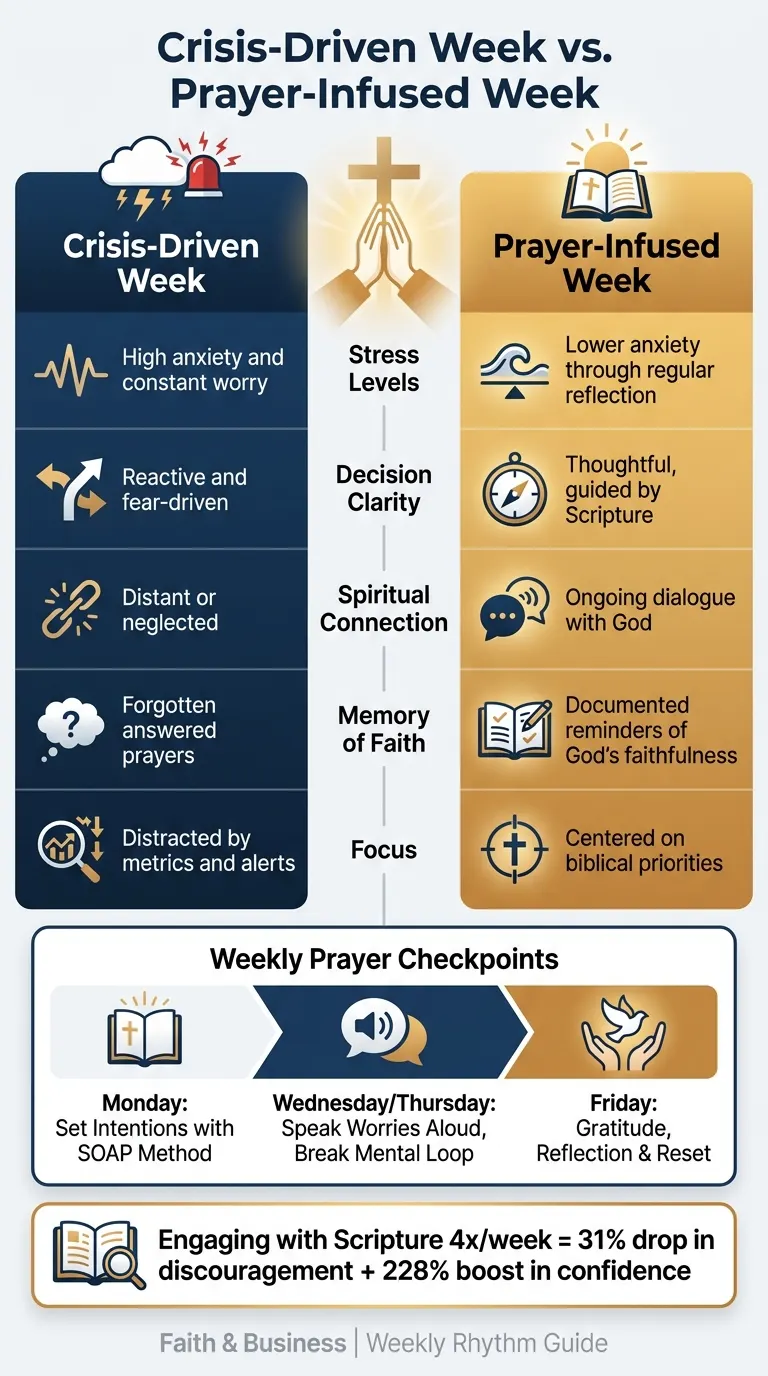
Crisis-Driven Week vs. Prayer-Infused Week: Faith in Business
For business leaders juggling endless demands, maintaining spiritual practices can feel impossible during a tough quarter. Yet, a simple weekly routine can help keep your faith steady, even when the pressure feels relentless. By building on habits like structured reflection and connecting voice journaling with Scripture, you can reinforce your spiritual resilience through a repeatable rhythm.
3 Prayer Checkpoints to Build Into Your Week
Three intentional prayer moments can help you stay spiritually connected, no matter how chaotic your week becomes.
Monday Morning: Start your week by setting intentions. Use the SOAP method – Scripture, Observation, Application, Prayer – to anchor your priorities in a specific verse. This shifts your mindset from reactive to purposeful, helping you focus on what truly matters instead of just tackling an endless to-do list.
Midweek: By Wednesday or Thursday, stress often reaches its peak. This is the perfect time to pause and release your worries. Speak your concerns out loud, even briefly, to break the mental loop of overthinking. This simple act clears your mind and restores clarity, allowing you to refocus on your goals.
Friday: End the week with gratitude and reflection. Take a moment to thank God for His presence, acknowledge the blessings you’ve experienced, and let go of anything weighing you down. This step helps you reset and prepare for a fresh start.
These three checkpoints create a framework for staying spiritually grounded and consistent, even during the busiest seasons.
How Psalmlog Helps You Stay Consistent Week After Week
Psalmlog is a powerful tool to help you maintain this weekly spiritual rhythm. Building on earlier voice journaling practices, the app keeps you accountable and engaged through features like its Calendar View, which visually tracks your spiritual check-ins. Seeing your progress at a glance can be a motivating reminder to stay consistent.
For those using the Faith Builder plan ($19.99/month), the monthly recording minutes tracker offers a tangible way to measure your engagement. With 300 minutes available each month, even short 3-minute entries – like after a challenging client call – add up to a meaningful pattern of faithfulness. Over time, Psalmlog’s AI theme tracking highlights recurring struggles, such as financial stress, while also showing how God has been present through those challenges.
"I’m an elder at my church and run a team of 40 people. When I’m facing an ethical decision at work… Psalmlog has become my go-to – it’s like having a seminary-trained advisor on call." – David R., Senior Director & Church Elder
If you’re unsure how to begin, Psalmlog offers more than 20 guided templates to help you get started immediately.
Crisis-Driven Week vs. Prayer-Infused Week: What Changes
The impact of weaving faith into your week becomes clear when comparing a crisis-driven approach to one infused with prayer.
| Aspect | Crisis-Driven Week | Prayer-Infused Week |
|---|---|---|
| Stress Levels | High anxiety and constant worry | Lower anxiety through regular reflection |
| Decision Clarity | Reactive and fear-driven | Thoughtful, guided by Scripture |
| Spiritual Connection | Distant or neglected | Ongoing dialogue with God |
| Memory of Faith | Forgotten answered prayers | Documented reminders of God’s faithfulness |
| Focus | Distracted by metrics and alerts | Centered on biblical priorities |
The changes may seem small, but they’re powerful. A Monday morning prayer, a midweek journaling session, and a Friday reflection – done consistently – can reshape even the hardest weeks, one step at a time.
Conclusion: How Faith Carries You Through Business Setbacks
A tough quarter doesn’t have to pull you away from God. As we’ve explored, weaving prayer and scripture into your everyday life can turn obstacles into moments of spiritual growth. Practices like lament prayers, anchoring in Scripture, voice journaling, and weekly prayer checkpoints remind us that faith and work are deeply connected. A challenging season in your business isn’t a statement about your worth or calling; instead, it’s an opportunity to refine your discernment, build trust, and recognize where you might be relying more on your own strength than on God’s provision.
The numbers back this up. Studies show that engaging with Scripture at least four times a week can result in a 31% drop in discouragement and a 228% boost in confidence. This kind of grounding affects how you lead, make decisions, and recover from setbacks. It highlights just how impactful faith can be when woven into leadership.
"Feast is a gift to steward; famine is a classroom, not a verdict." – Ryan Bailey, Christian Professional Coach
This mindset shift is powerful. It allows you to see every difficult quarter not as a failure but as a season of growth and learning.
Why not start today? Open Psalmlog, speak your challenges out loud for three minutes, and let the AI guide you to a verse that resonates with your current situation. One heartfelt prayer can bridge the gap between your work and your faith – and that’s where true resilience begins.
FAQs
How do I pray when I feel spiritually numb?
When you’re feeling spiritually numb, keep praying – even if your emotions haven’t caught up yet. Be honest with God about where you are: “God, I feel distant. Please guide me.” When words escape you, turn to Scripture, like Psalm 40 or Psalm 42, for guidance and comfort. The key is to keep showing up. Acknowledge your struggle, reflect on His past faithfulness, and make a conscious decision to trust Him. Faith isn’t about how you feel – emotions will ebb and flow – but staying committed is what truly matters.
What should I pray before making a hard business decision?
Before facing a challenging business decision, think of prayer as a tool for guidance, not a substitute for taking action. Offer your plans to God, asking for wisdom and clarity, as encouraged in James 1:5. Pray with intentionality by posing specific questions such as, “Lord, what do You want to accomplish through me?” or “What am I overlooking?” Trust Him by committing your plans to His care (Proverbs 16:3), and let His peace replace feelings of stress or urgency.
How can I use Psalmlog without oversharing sensitive details?
Psalmlog prioritizes your privacy with robust security features. Your journal entries are encrypted while stored, and voice recordings are transcribed directly on your device before being erased. To safeguard the confidentiality of your prayers, Psalmlog’s AI is designed not to use them for training purposes. With clear data policies and end-to-end protection, your personal reflections remain solely between you and God.