
Founder Identity: Finding Worth in Christ
Your worth isn't tied to your startup—root identity in Christ and use Scripture-based practices to navigate business setbacks.
When your business struggles, it’s easy to feel like you’re failing as a person. Many founders tie their self-worth to their company’s success, leading to emotional highs and lows based on business outcomes. This mindset isn’t just harmful – it’s exhausting.
Here’s the truth: Your identity isn’t defined by your business. Scripture reminds us that your value comes from being in Christ, not from achievements or failures. By shifting focus from performance to purpose, you can navigate tough seasons with peace and clarity.
Key Takeaways:
- 72% of entrepreneurs face mental health challenges, and nearly 90% experience major failures.
- Signs of identity struggles include tying emotions to metrics, struggling to delegate, and making ego-driven decisions.
- Your worth is rooted in being God’s creation, not in what you produce.
- Tools like Psalmlog help founders process emotions, connect with Scripture, and track spiritual growth during difficult times.
The journey from performance-driven stress to Christ-centered peace starts by grounding yourself in truth, building daily habits of reflection, and holding business outcomes with open hands.
Identity Crisis – Pastor Adrianna Baker
How Founders Lose Themselves in Their Companies
The transition from running a business to becoming inseparable from it doesn’t happen overnight. It’s a slow, almost imperceptible process that blurs the lines between your identity and your role. By the time many founders realize it, the distinction is already gone.
Signs Your Identity Is Tied to Your Startup
One of the most obvious red flags is emotional highs and lows tied to business metrics. When revenue climbs, you feel unstoppable. But a sluggish quarter? It’s like a personal failure. Christian Business Concepts sums it up perfectly:
"When success feeds identity, failure threatens existence."
Another indicator is the inability to step back, even when you need to. Delegation becomes a struggle, and you find yourself hovering over meetings or second-guessing decisions your team makes. Rest feels like a luxury you can’t afford. This isn’t about control – it’s about relevance. When your business defines you, stepping away feels like losing your sense of purpose.
A more subtle but equally telling sign is making decisions based on appearances rather than purpose. When choices are guided by how they’ll look instead of how they align with your goals, it’s a signal that your ego has taken the wheel. Therapist Annie Wright, LMFT, captures this identity crisis vividly:
"If the company died tomorrow, I do not know who would be left in this room."
These behaviors point to a deeper issue – one rooted in how we perceive our worth.
The Spiritual Roots of a Founder Identity Crisis
At its core, this crisis stems from a deeper misunderstanding of value and identity. Startup culture often whispers the same lie: "You are what you produce." It’s all about hustling harder, scaling faster, and building something that cements your legacy. Patrick Mabilog, founder of Block Ten Strategy, contrasts this mindset with the biblical narrative of Adam in Genesis 2, where work was secure and not tied to self-worth:
"Adam’s work wasn’t done to prove his worth. After all, God – the being of infinite worth – resided with them in that Garden."
Mabilog describes the shift from cultivating a "garden" – work rooted in purpose and peace – to constructing a "tower", like the builders of Babel. In this "tower" mode, every milestone becomes a way to prove you matter, to ensure you’re remembered. As CO2 Coaching puts it:
"The business stopped being what you do and became who you are."
This is the heart of the issue: work was never meant to define your worth. When it does, every setback feels catastrophic, not just professionally but personally. Recognizing that your value isn’t tied to your output is the first step toward reclaiming an identity grounded in something deeper and more enduring. Practicing voice journaling for prayer can help you process these shifts and reconnect with your true identity.
Rediscovering Your Identity in Christ When the Business Is Struggling
What the Bible Says About Failure and Calling
When business challenges shake your confidence, Scripture offers a comforting reminder: your worth isn’t tied to your achievements. The Bible clearly separates your identity from your work. Your calling – to follow Christ – remains constant, while your assignment – the roles you take on – may shift over time. Dr. Allen Tennison, Chief Theologian, explains it beautifully:
"Your identity is who you are in Christ Jesus, and that stays the same. Your assignment is just how you’re fulfilling your calling."
Take Erik Cooper’s story as an example. He transitioned from being a pastor and church planter to becoming a real estate developer. His evolving roles didn’t change his core calling. A struggling business doesn’t mean you’ve failed in your calling; it’s simply a difficult chapter in your journey.
The Bible also redefines failure. Amanda Lawson of FaithFi highlights this truth:
"Being adopted into God’s family invokes an identity that is received rather than achieved and therefore, is unconditional and unchanging."
This identity was established by God long before you hit any business milestone. Just as God declared Jesus His beloved Son at His baptism (Matthew 3:17), your value is not tied to profits or sales. Recognizing this unchanging identity allows you to move away from striving for approval and focus on resting in God’s truth.
Moving From Performance to Presence
Shifting from a performance-driven mindset to one rooted in God’s presence takes intentional effort. Start each day by dedicating your first hour to prayer and Scripture before diving into work. This habit helps ground you in truth before the demands of the day take hold.
You were never meant to carry the weight of constant self-reliance. As Daredream points out:
"The feeling of running out is not evidence that God made a mistake calling you. It’s often evidence that you’ve been trying to carry what was never yours to carry alone."
The Greek word for "sufficient" (hikanos) in 2 Corinthians 3:5, meaning "worthy of the task", serves as a reminder that God has already declared you capable. This assurance allows you to work from a place of security rather than striving for validation. With this foundation, you’re better equipped to implement practical steps to protect your sense of identity – steps that will be explored in the next sections.
Using Psalmlog for a Voice-Based Spiritual Reset
Psalmlog Plans: Faith Builder vs Shepherd – Features & Pricing
Why Voice Journaling Works for Founders Under Pressure
When your business is facing tough times, sitting down to write in a journal can feel like a chore. But when stress is high, voice journaling can be a lifesaver. Speaking at a natural pace of 120–150 words per minute allows you to process your thoughts quickly, often in just a few minutes. Plus, it organizes your emotions in ways that writing sometimes can’t. Neuroscience research from UCLA even shows that naming your emotions can lower activity in the amygdala – the part of the brain tied to fear – helping you feel calmer and more centered.
Much like David’s heartfelt psalms, voice journaling gives you a space to express fears and then turn toward trusting God. It’s a modern way to engage in spoken prayer, creating a path for deeper, Scripture-based reflections.
How Psalmlog Helps You Process Identity Crisis With Scripture
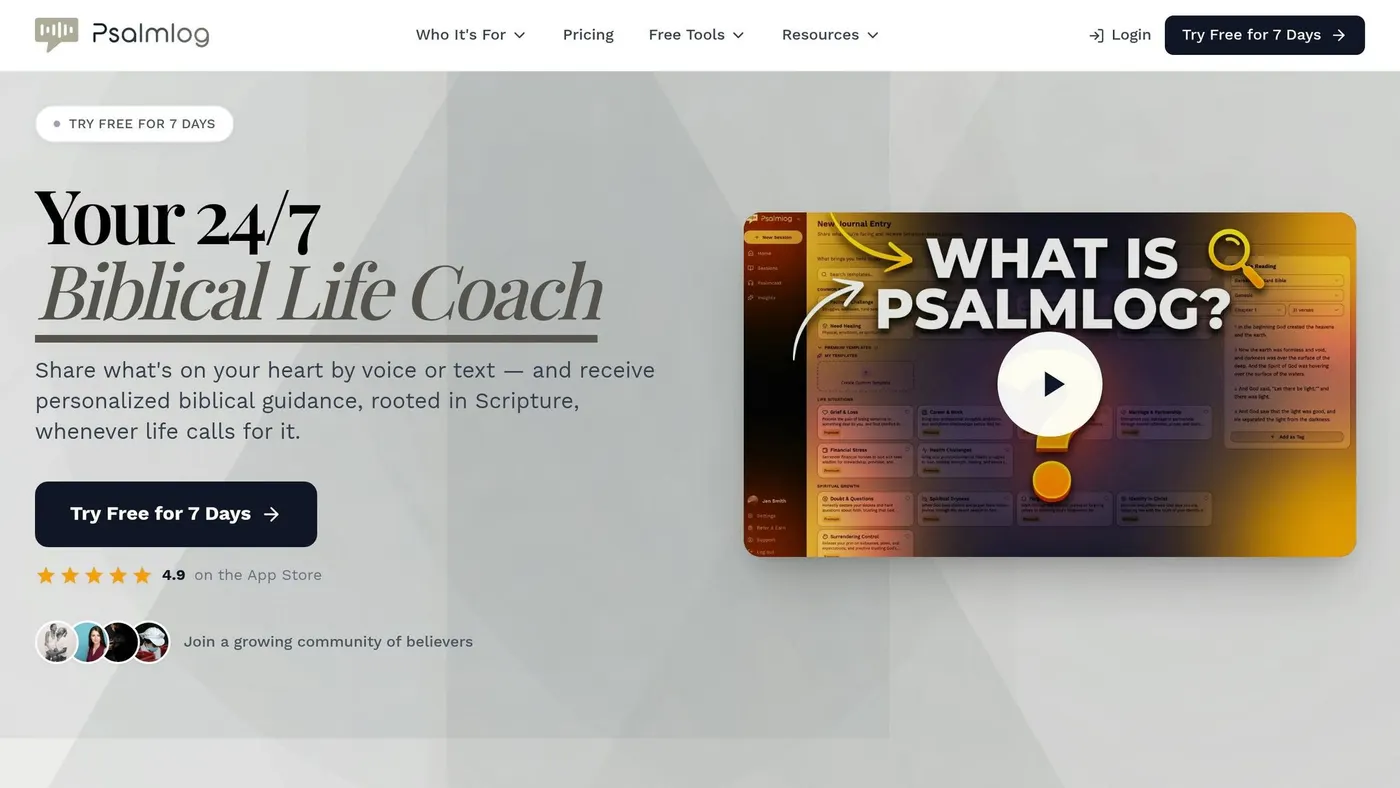
Psalmlog is designed for those moments when typing feels impossible. As the platform explains:
"Voice journaling exists for the moments when typing breaks the prayer – after stressful meetings, difficult conversations, or sleepless nights." – Psalmlog Official Site
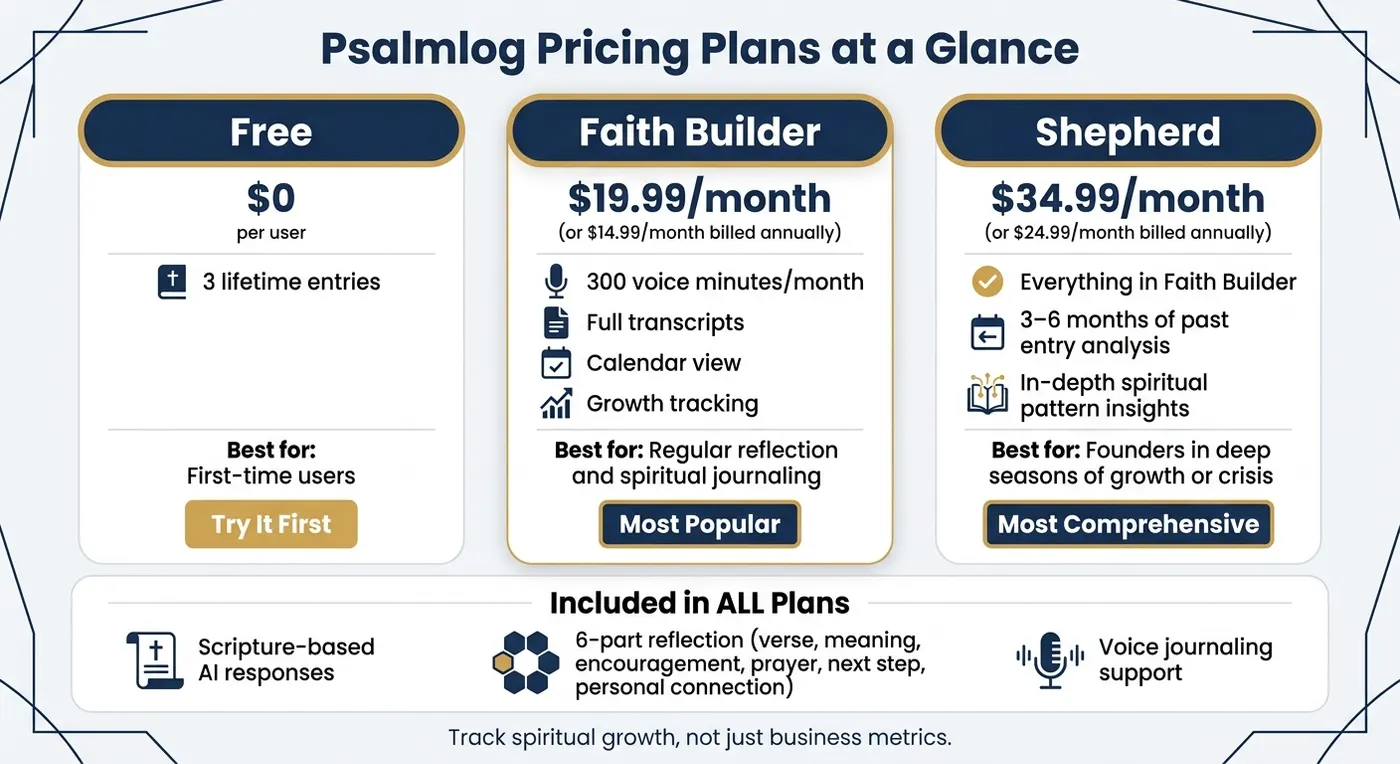
With Psalmlog, you can record anything from a quick 30-second thought to a detailed 10-minute reflection. In about 60 seconds, the platform provides a six-part Scripture-based response. This includes a relevant Bible verse, a reflection on its meaning, encouragement, a prayer, a practical next step, and a connection back to your own words. It’s a process that helps anchor your identity in Scripture, reminding founders to root their worth in Christ.
What sets Psalmlog apart is its ability to provide tailored Scripture responses. Instead of offering generic verses, the AI analyzes your recording’s context. For instance, if you express feelings of inadequacy after a failed fundraising attempt, Psalmlog might highlight verses like Ephesians 2:10 ("you are God’s workmanship") or Philippians 1:6 ("He who began a good work in you will carry it on"). This shifts your inner dialogue toward Scripture-based truths, helping you realign your perspective.
Tracking Spiritual Growth, Not Just Business Metrics
Psalmlog isn’t just about quick relief – it helps you see growth over time. In difficult seasons, progress can feel invisible. Your revenue might plateau, your team could be stressed, and your inner life might seem stuck in survival mode. But while business metrics may stagnate, spiritual growth offers a deeper, more meaningful measure of progress. This is where Psalmlog’s insights dashboard shines.
The app tracks emotional trends, recurring spiritual themes, and Scripture patterns across your entries. Over time, you might notice things you’d otherwise miss, like how often you mention fear of failure, shifts in your tone from anxiety to trust, or recurring verses that consistently ground you. These patterns offer tangible evidence of spiritual movement, even when external circumstances remain challenging.
Psalmlog offers plans to suit different needs. The Faith Builder plan costs $19.99/month (or $14.99/month billed annually) and includes 300 voice minutes per month, full transcripts, and features like calendar views and growth tracking. For more in-depth analysis, the Shepherd plan is available for $34.99/month (or $24.99/month billed annually), factoring in three to six months of past entries. If you’re curious to see how it works, there’s also a free tier with three lifetime entries to get you started.
Living as a Founder With an Identity Secure in Christ
Building Daily Founder Routines Around Identity
The goal here isn’t to cram more into your already packed schedule – it’s about adjusting the rhythm of your day to align with your core identity. Small, consistent habits can help you stay rooted in Christ, even before the daily pressures of running a business begin to mount.
One way to start is by practicing the Daily Examen, a simple evening reflection that takes less than 10 minutes. Ask yourself questions like: What was I most grateful for today? What was I least grateful for? Where did I feel God’s presence (or absence)? Is there anything I need to confess or let go of? These reflections gently shift your focus from business performance to the deeper truth of who defines your worth.
Throughout the day, you can create intentional moments to reconnect with this identity. Whether it’s during your commute after a tough meeting, a quiet pause before a challenging call, or a few calm minutes before the workday begins, these transitions are opportunities to ground yourself. Speaking your frustrations or prayers aloud during these times can be powerful. Tools like Psalmlog provide Scripture-based responses that remind you where your worth truly lies.
By weaving gratitude and reflection into your daily rhythm, you’re better prepared to release the grip on business outcomes. These habits create a foundation for approaching challenges with a Christ-centered perspective.
Holding Business Outcomes With Open Hands
Once you’ve established these daily anchors, it becomes easier to approach business setbacks with a mindset of stewardship rather than ownership. The distinction is important: stewardship is about caring for and nurturing what’s been entrusted to you, while ownership can lead to carrying burdens that were never meant to be yours alone.
Patrick Mabilog, the founder of Block Ten Strategy, shared how this played out in his own life. In February 2026, a major client canceled, resulting in a $1,200 loss and a 30% drop in monthly revenue. The setback threw him into an identity crisis because, as he put it, his peace had become "hostage to performance." His turning point came when he stopped building what he called a "tower" – work motivated by a need to prove his worth – and instead embraced a "garden" mindset, where his efforts flowed from security in God rather than a drive to earn validation.
"The cross is not just about your salvation in the afterlife. The cross is about your freedom from needing to build Babel in this life." – Patrick Mabilog, Founder, Block Ten Strategy
Success, then, becomes less about revenue or growth metrics and more about who you’re becoming – in qualities like honesty, patience, and trust. That doesn’t mean you stop caring about results; it just means those results no longer define your identity. Instead, you’re free to lead from a place of peace and purpose.
FAQs
How do I separate my worth from my company’s results?
Your value doesn’t fluctuate based on how your business performs – it’s anchored in Christ. You are cherished as a child of God, and your worth goes far beyond profits or achievements. Shift your focus from constant doing to simply being: take time to realign with your purpose, invest in meaningful relationships, and enjoy pursuits outside of work. View your business as a form of stewardship – a responsibility to manage, not the core of who you are.
What does the Bible say about failure for founders?
The Bible doesn’t see failure as a reflection of your worth. Instead, it highlights failure as a chance to grow and find new direction. It reassures founders that their true value comes from being a child of God, not from their career successes or failures. Take figures like Moses, David, and Joseph – each faced significant challenges, but those setbacks ultimately prepared them for the roles God had planned for them. Trust in God, allow yourself to grieve your losses, and lean into His greater purpose for your life.
How can Psalmlog help when I feel overwhelmed?
Psalmlog creates a welcoming space where you can navigate intense emotions through voice journaling. By simply speaking openly about your challenges, the app’s AI delivers personalized guidance rooted in Scripture in less than 60 seconds. This includes a relevant Bible verse, words of encouragement, a heartfelt prayer, and a practical action step. Plus, it tracks your spiritual progress, guiding you toward clarity, peace, and a stronger trust in God’s plan for your life.