
Imposter Syndrome for Faith-Driven Founders
Self-doubt doesn't disqualify leaders; biblical truth, journaling, community, and delegation empower founders to lead by faith.
Feel like you’re faking it as a leader? You’re not alone. Imposter syndrome – doubting your own abilities despite clear achievements – is common among founders. It can make you question your decisions, your purpose, and even your worth. But here’s the truth: self-doubt doesn’t disqualify you from leading. In fact, it can be a starting point for growth.
Key takeaways from this guide:
- Biblical examples like Moses, Gideon, and Jeremiah show how self-doubt can transform into strength when you trust in God.
- Replace negative thoughts with Scripture-based truths, like 2 Corinthians 12:9 (“My grace is sufficient for you”).
- Use tools like journaling to track progress and recognize your wins.
- Build a faith-based support network to combat isolation and stay grounded.
- Delegate tasks to empower your team and embrace shared leadership.
Your qualifications don’t come from your résumé or confidence – they come from God’s calling. Lead with faith, not fear.
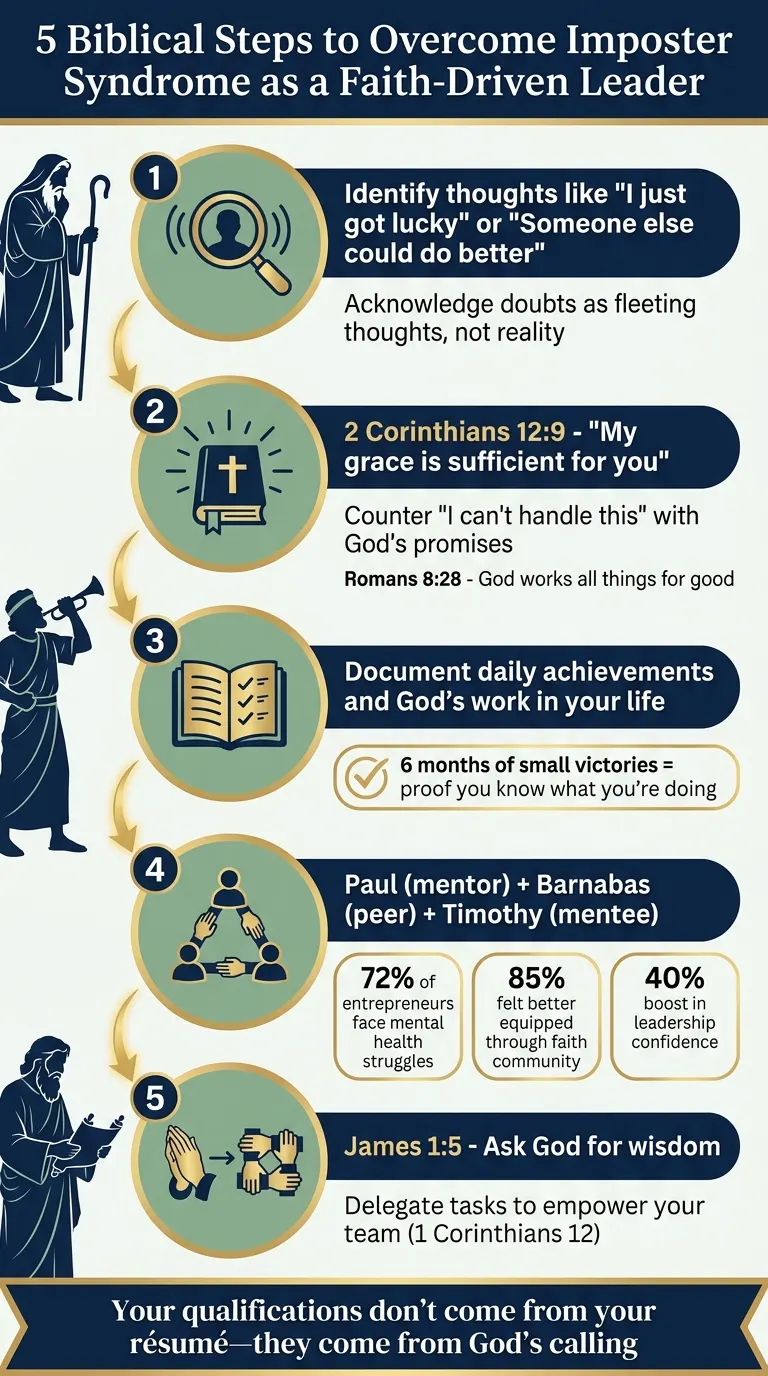
5 Biblical Steps to Overcome Imposter Syndrome as a Faith-Driven Leader
Biblical Leaders Who Faced Self-Doubt
Moses: From Reluctance to Leadership
Moses had plenty of reasons to feel unqualified. He had killed an Egyptian and spent decades in Midian, far removed from any leadership role. When God called him to lead Israel out of Egypt, Moses responded with excuses that sound a lot like modern imposter syndrome: he doubted the enormity of the task, his ability to communicate, and his overall suitability for the role. Instead of boosting Moses’ self-confidence, God responded to his question, “Who am I?” with a simple yet profound answer: “I will be with you.” As Pastor and Author Geoffrey Graff explains:
Moses didn’t get the assurance that he was good enough. Instead, Moses got the assurance that God was good enough.
To further support Moses, God provided Aaron as a partner, showing that leadership often involves collaboration. The takeaway here is powerful: your past mistakes don’t disqualify you from stepping into your purpose. Graff also points out:
Shame can be useful if it’s leading us to humility and repentance, but it’s not meant to lead us to condemnation and passiveness.
Instead of doubting your ability to lead, consider that you’ve been entrusted with your specific team, mission, or company for a reason. Just as Moses was called despite his doubts, Gideon’s story also highlights how even the least likely among us can rise to lead with God’s help.
Gideon: Overcoming Fear with God’s Help
When God called Gideon a "mighty warrior" (Judges 6:12), he was hiding in a winepress, far from any battlefield. Coming from the weakest clan and being the youngest in his family (Judges 6:15), Gideon felt utterly unqualified to lead Israel against an enemy that had oppressed them for seven years. Instead of disputing Gideon’s feelings of inadequacy, God redefined him based on his calling, not his circumstances.
In a dramatic show of divine power, God reduced Gideon’s army from 32,000 to just 300 men – a staggering 99% reduction – to ensure that the victory would clearly be attributed to God’s strength (Judges 7:2-8). Pastor John Holmes of First Baptist Church Moriarty explains this perspective:
The solution to fear is not self-confidence but God-confidence.
Gideon’s journey was marked by small, faithful steps – like dismantling idols at night and trusting God with a drastically reduced army. These actions remind leaders that even the most overwhelming challenges can be tackled through consistent, obedient steps. Limited resources, instead of being a hindrance, can become the very platform for God’s power to shine. Jeremiah’s story offers yet another example of how divine purpose outweighs personal doubts.
Jeremiah: Called Despite His Youth
When God called Jeremiah to be a prophet, his immediate reaction was to protest, citing his youth as a disqualifier (Jeremiah 1:6). But God reminded Jeremiah that he had been set apart for this role even before birth (Jeremiah 1:5). This was a clear message: the calling comes before the qualifications. God further assured Jeremiah of His support, promising to put His words in Jeremiah’s mouth and to stand with him (Jeremiah 1:9, 19).
For leaders struggling with imposter syndrome, these stories carry a clear message: it’s okay to recognize your limitations, but don’t let them define you. Your qualifications don’t come from your résumé or confidence – they come from the One who calls you to lead. Moses, Gideon, and Jeremiah show us that self-doubt doesn’t disqualify you; instead, it can be the starting point for a leadership journey rooted in faith and purpose.
How to Recognize and Address Imposter Syndrome
Identify Common Patterns of Self-Doubt
Imposter syndrome often leads to persistent feelings of inadequacy, no matter how much success you achieve. As a founder, you might find yourself questioning whether you’re truly capable of handling the challenges ahead. After landing a big client, securing funding, or hitting a major milestone, thoughts like, "I just got lucky" or "They’ll realize I don’t know what I’m doing" may creep in. You might even feel like someone else could do a better job. This inner conflict echoes the hesitance of Moses, who doubted his own abilities despite being called to lead. It’s important to recognize these thoughts for what they are – fleeting doubts, not a reflection of your actual abilities. Acknowledging them is the first step toward overcoming them. From there, tools like scriptural reflection and journaling can help bring clarity and confidence.
Use Psalms and Voice Journaling for Reflection
Psalm 139 serves as a powerful reminder that you are known and valued by God, even before you were born, and that your life has purpose. Voice journaling can be an effective way to confront your fears and separate genuine concerns from the false narratives of imposter syndrome. Instead of relying solely on self-confidence, focus on the source of your true qualifications. As Kemisola Richard points out, God’s response to Moses’ doubts was:
I am the one who makes you qualified. I am your qualification.
When journaling, challenge your thoughts by asking:
Is that really true? Or is that just imposter syndrome speaking?
By reflecting on these questions and recording your thoughts, you can start to distinguish between fear and reality. This process also sets the stage for tracking your progress and building your confidence.
Track Your Wins Through Faith Journaling
Documenting your daily achievements can serve as a powerful tool to counteract negative self-talk. By keeping a record of how God works in your life and the progress you’ve made, you create tangible proof that combats the doubts imposter syndrome tries to sow. A "daily win log" can be especially helpful for this. As Jennifer, the founder of an education platform, shared:
I started keeping a ‘founder journal’ where I wrote down one thing that went well and one thing I learned each day. Six months later, I had dozens of pages proving I wasn’t making it all up.
Similarly, Sarah, a fintech founder, noted:
Reading through six months of small victories reminds me that I know what I’m doing.
Whether it’s customer feedback, lessons learned, or moments when God’s presence felt evident in your work, consistently journaling these moments can help you see the bigger picture. Over time, this habit reinforces the idea that you’re exactly where you’re supposed to be.
Replace Negative Thoughts with Biblical Truth
Counter Lies with Scripture
When imposter syndrome whispers, "You’re not qualified", respond with the truth found in Scripture. When Moses doubted his abilities, God didn’t boost his self-confidence – He assured Moses of His presence, which was the ultimate qualification. Instead of trying to silence negative thoughts through sheer determination, replace them with God’s promises. For instance, if you catch yourself thinking, "I can’t handle this", remind yourself of 2 Corinthians 12:9: "My grace is sufficient for you, for my power is made perfect in weakness." Similarly, when setbacks shake your confidence, hold on to Romans 8:28: "In all things God works for the good of those who love him."
Kemisola Richard beautifully captures this idea:
I am the one who makes you qualified. I am your qualification. I will help you. So, go ahead; I am with you. And with me, you can do all things.
This shift – from self-reliance to relying on God – reshapes how you face challenges. Your qualifications don’t stem from your achievements or connections but from the One who called you to lead. By grounding your thoughts in Scripture, you’ll begin to see setbacks not as failures but as part of a learning process.
Adopt a Growth Mindset
Break free from self-limiting beliefs by viewing failure as a stepping stone, guided by biblical wisdom. One major contributor to imposter syndrome is perfectionism. But the Bible offers a different perspective. Proverbs 24:16 reminds us: "The righteous person may fall seven times, yet they get up again." Failure isn’t proof of inadequacy; it’s evidence of growth. Whether it’s a hiring misstep, losing a client, or missing a goal, see these moments as part of God’s refining process, not as reasons to doubt your abilities.
This doesn’t mean lowering your standards – it means understanding that setbacks are opportunities to grow, not signals of disqualification. A leader who never stumbles is either avoiding risks or not being honest about their journey. Embracing growth allows you to trust God’s plan for your leadership, even when the path feels uncertain.
Trust God’s Plan for Your Leadership
As you replace negative thoughts with Scripture and embrace a mindset of growth, remember that your identity in God goes beyond any measure of success. Imposter syndrome doesn’t target your skills as much as it attacks your sense of identity. When you root your identity in God’s calling rather than your performance, the fear of being "found out" loses its grip.
When doubt creeps in, remind yourself that God equips those He calls. If you are still seeking clarity, you can follow a Christian guide to purpose to better understand your specific assignment. Your journey as a leader is part of His greater purpose, even if the full picture isn’t visible yet. As Kemisola Richard writes:
The Christian way of overcoming impostor syndrome is to place our trust in God and His unwavering support.
This doesn’t mean challenges will disappear or decisions will suddenly become simple. But it does mean you can stand on the unshakable foundation of God’s faithfulness, knowing He’s with you every step of the way.
How to Lead with Confidence
Use Prayer and Scripture for Guidance
When you’re navigating major decisions – whether it’s setting prices, hiring new team members, or pivoting your business – prayer can be a powerful tool. James 1:5 reminds us, "If any of you lacks wisdom, you should ask God, who gives generously to all without finding fault, and it will be given to you." Instead of waiting for every detail to fall into place, focus on seeking clarity about God’s vision for the outcome and take action based on what He reveals.
This perspective reshapes how you view leadership. Whether you’re pricing services, networking, or creating content, leading from your identity in Christ transforms your decisions into acts of obedience, not arrogance. As NACWE highlights:
Authority doesn’t require arrogance. Just obedience.
By grounding your choices in prayer and Scripture, you can lead with confidence and assurance. Tools like Psalmlog, which help with voice journaling, can be useful for recording challenges and reflecting on Scripture with study guides – a practical extension of earlier journaling habits. Alongside prayer, leaning on supportive relationships can strengthen your resolve and provide encouragement.
Build a Faith-Based Support Network
Isolation can amplify feelings of inadequacy, while genuine community can help dispel them. Studies show that 72% of entrepreneurs face mental health struggles, including imposter syndrome and loneliness. Surrounding yourself with people who share your faith and understand the challenges of leadership can make a world of difference. The "Paul, Barnabas, Timothy" model is a great framework: find a mentor for wisdom, a peer for shared experiences, and someone to guide, keeping you grounded in service.
Faith Driven Entrepreneur, for example, expanded its Foundation Groups in 2023 to support over 20,000 founders worldwide. Their internal surveys revealed that 85% of participants felt better equipped to manage leadership stress through these connections. As Henry Kaestner, Co-founder of Faith Driven Entrepreneur, puts it:
Isolation is the enemy of the entrepreneur; community is the antidote. When we walk alone, the lies of imposter syndrome sound like truth. When we walk together, the truth of God’s word silences the lies.
Organizations like C12 and Convene also offer Christian CEOs structured monthly meetings. According to 2024 data, founders in these networks reported a 40% boost in leadership confidence when their identity was anchored in faith rather than quarterly performance goals.
Consider creating a vulnerability agreement with a trusted peer – someone you can openly share your struggles with, free of judgment. Regular check-ins that focus not just on achievements but also on who you are becoming in Christ can provide spiritual accountability. Building this type of community naturally leads to empowering others within your team.
Delegate and Empower Your Team
Trying to handle everything on your own is often a symptom of imposter syndrome. When doubts creep in about your qualifications, it’s tempting to micromanage instead of trusting others. But 1 Corinthians 12 reminds us that the body of Christ is made up of many parts, each with its own unique role. Delegating isn’t a sign of weakness – it’s an acknowledgment that God has distributed strengths across your team.
Start by reviewing your workload. Are you saying "yes" to every opportunity out of fear rather than genuine calling? Identify tasks that drain your energy but might excite someone else on your team. Delegating these responsibilities allows others to use their God-given talents and fosters a culture of shared leadership. Leadership, after all, isn’t a solo act – find your "Barak" by forming partnerships that complement your strengths and amplify your mission. By trusting others and sharing responsibilities, you create an environment where everyone’s gifts can thrive.
Conclusion: Lead Through Faith
Key Takeaways
Imposter syndrome isn’t about lacking skills – it’s about questioning your identity. Your ability to lead isn’t rooted in your résumé, achievements, or confidence. It comes solely from God’s grace.
Think about figures like Moses, Gideon, and Jeremiah. Their doubts didn’t disqualify them; instead, their reliance on God transformed them. When you align your leadership with God’s purpose – seeing your work as part of His plan rather than a solo mission – the focus shifts. It’s no longer about proving yourself; it’s about trusting Him and walking in obedience. Your perceived shortcomings don’t define your potential. God does.
Next Steps
Turn these reflections into action by addressing self-doubt head-on. Start by pinpointing the negative thoughts that feed your insecurities with Christian voice journaling prompts. Ask yourself: Is this fact, or is it imposter syndrome talking? Be mindful of behaviors like perfectionism or procrastination – they’re often signs you’ve lost sight of your purpose.
Consider using tools like Psalmlog for voice journaling. Record your struggles, reflect on Scripture, and pair this with a simple breathing practice: inhale deeply through your nose and exhale with a sigh to calm your nerves during anxious moments.
Let prayer and Scripture guide your decisions. Seek God’s wisdom daily, lean on a faith-centered support system, and delegate tasks to empower others around you. Leadership isn’t about being flawless – it’s about answering God’s call with obedience. Lead with faith, and allow every challenge to shape and strengthen your walk with Him.
How to Overcome Imposter Syndrome | Christian Identity & Calling in Christ
FAQs
How do I know it’s imposter syndrome and not a real skill gap?
Imposter syndrome is when you feel unqualified despite clear evidence of your abilities. On the other hand, a skill gap points to an actual lack of knowledge or expertise. The key is to reflect: Are your doubts tied to internal fears, even though you’ve achieved success before? Or do you genuinely lack the skills required for the task? If it’s fear despite past accomplishments, you’re likely dealing with imposter syndrome. If it’s truly a gap in skills, focus on learning and improving in specific areas to move forward.
What Scriptures should I use when self-doubt hits during big decisions?
When you’re grappling with self-doubt during major decisions, turning to Scripture can provide comfort and clarity. Philippians 4:13 reminds us, "I can do all things through Christ who strengthens me," offering reassurance of God’s empowering presence. Similarly, Proverbs 3:5-6 urges us to "Trust in the Lord with all your heart and lean not on your own understanding; in all your ways submit to Him, and He will make your paths straight." These verses serve as a steady reminder to rely on your faith, trusting in God’s guidance and strength to lead you through uncertainty.
How can I delegate without feeling like I’m losing control?
Delegating effectively means clearly defining roles and expectations for your team while maintaining trust in their abilities. It’s about balancing oversight without slipping into micromanagement. Trust plays a central role – release control while providing guidance with confidence. For those who draw strength from their faith, seeking wisdom through prayer can help align leadership decisions with a greater purpose, ensuring clarity and confidence in your approach.