
Hard Conversations Every Entrepreneur Faces
Five tough, faith-informed conversations entrepreneurs must navigate: investors, team conflict, family balance, finances, and mentors.
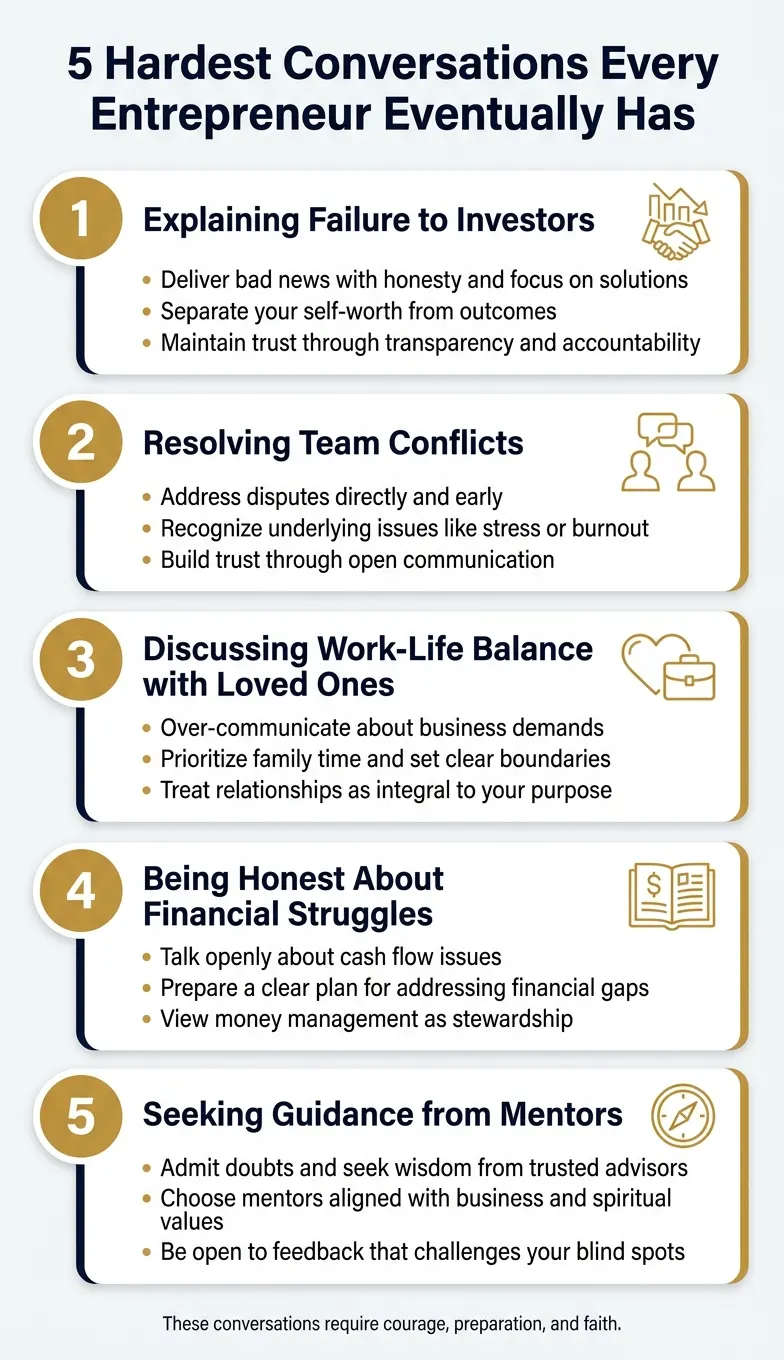
Entrepreneurs face tough conversations that are unavoidable but crucial for growth. These moments test your leadership, honesty, and ability to navigate challenges. Here are five of the hardest discussions you’ll likely encounter, along with strategies to handle them:
- Explaining Failure to Investors
- Deliver bad news with honesty and focus on solutions.
- Separate your self-worth from outcomes.
- Maintain trust by being transparent and accountable.
- Resolving Team Conflicts
- Address disputes directly and early to prevent long-term damage.
- Recognize underlying issues like stress or burnout.
- Build trust through open communication and mutual respect.
- Discussing Work-Life Balance with Loved Ones
- Over-communicate about the demands of your business.
- Prioritize family time and set boundaries.
- Treat personal relationships as integral to your purpose.
- Being Honest About Financial Struggles
- Talk openly about cash flow issues to maintain trust.
- Prepare a clear plan for addressing financial gaps.
- View money management as stewardship, not ownership.
- Seeking Guidance from Mentors
- Admit doubts and seek wisdom from trusted advisors.
- Choose mentors who align with both your business and spiritual values.
- Be open to feedback that challenges your blind spots.
These conversations require courage, preparation, and often, faith. Tools like Psalmlog can help you reflect, connect with Scripture, and approach these moments with clarity.
5 Hardest Conversations Every Entrepreneur Faces (+ How to Handle Them)
Difficult Business Conversations Made Simple
1. Telling Investors and Stakeholders About Failure
No entrepreneur enjoys delivering bad news. Whether it’s about missing revenue goals, a failed product launch, or a pivot that didn’t work out, informing the people who backed you – financially and emotionally – that things went off track is tough. But how you approach these conversations often matters more than the failure itself.
Your mindset is key. It’s natural to feel defensive or take investor feedback personally, but it’s important to remember what Aaron Dinin, PhD, Entrepreneurship Instructor at Duke, points out:
"A rejection is meant to be a business decision, not a personal attack."
Separate yourself from the outcome. Failures often stem from external circumstances beyond your control – they’re not a reflection of your personal worth or leadership abilities. When founders internalize failure, it can lead to unproductive self-blame. As startup advisor Jena Booher, Ph.D., explains:
"Founders blame themselves first and then internalize the stress and shame."
This cycle of shame can make it tempting to avoid tough conversations altogether, but avoidance only makes things worse. A better approach is to address setbacks during scheduled meetings rather than dropping them unexpectedly. For particularly tense updates, having a trusted advisor present can help maintain professionalism and balance. Taking a disciplined approach to these discussions strengthens trust, which is essential for navigating future challenges.
For Christian entrepreneurs, Scripture offers a helpful perspective. Viewing your business as an act of stewardship rather than ownership can reshape how you approach setbacks. As Grace Christian University explains:
"When you view yourself as a steward rather than an owner, you become more open to collaboration, more willing to seek godly counsel, and more focused on legacy than immediate gain."
This perspective doesn’t excuse poor performance, but it does free you from the trap of ego-driven defensiveness. It allows you to face investors with honesty, acknowledge what went wrong, and shift the focus to how you’ll move forward. By embracing accountability and transparency, you can build trust – even in the face of failure.
2. Working Through Team Conflicts and Misalignment
Team conflict is a natural part of any growing business. In fact, over 65% of employees encounter workplace conflict, but only 35% feel confident addressing it head-on. For entrepreneurs, especially those in founding teams, the stakes are even higher. The unique pressures of startup life – like constant ambiguity, rapid decision-making, and informal power structures – make these dynamics even more challenging to navigate.
What makes resolving these conflicts so tricky? Often, visible disagreements aren’t the root issue. Clinical Psychologist and Cofounder Coach Dr. Matthew Jones explains:
"Addressing any of these issues does little to change the long-term trajectory of founding teams unless the conflict’s deeper layers are identified, named, and worked through."
At the heart of many disputes, you’ll often find burnout, stress, or emotional exhaustion. Spotting these early is crucial. Look out for recurring arguments about the same topics, declining team morale, or team members jumping to conclusions about each other instead of engaging in open, honest conversations.
When conflicts arise, it’s essential to address them directly with the person involved. Venting to coworkers before having the conversation can erode trust and create unnecessary divisions within the team. Pamela Reynolds, Feature Writer and Editor at Harvard DCE, offers a cautionary note:
"If problems are left to fester, they can damage team bonds, sometimes irretrievably."
Taking a direct and honest approach not only helps resolve conflicts but also aligns with Christian values of integrity and reconciliation.
For Christian entrepreneurs, the strength of team relationships is just as important as resolving the conflict itself. Think of your team dynamics as a "relational bank account." Acts of encouragement, recognition, and genuine care are deposits that build trust. Conflict, on the other hand, acts as a withdrawal. With a strong balance, difficult conversations are more likely to be productive. As Proverbs 11:25 reminds us: "A generous person will prosper; whoever refreshes others will be refreshed". This perspective not only helps restore harmony but also aligns with the spiritual discipline that is central to your entrepreneurial journey. Building and maintaining relational equity before conflicts arise is key.
3. Talking to Loved Ones About Work-Life Balance
Once you’ve addressed your internal struggles, the next challenge is navigating personal relationships. For entrepreneurs, this can be tricky – there’s no handbook for managing the emotional dynamics with loved ones. A spouse, parent, or close family member often feels the full weight of your decisions, both professional and personal. Just as being upfront is crucial with your team or investors, it’s equally important with your family.
Entrepreneurs often throw themselves fully into their businesses, which can leave family members feeling sidelined. The solution isn’t about achieving a perfect balance between work and home – let’s face it, that’s rarely realistic. Instead, aim for what Alyssa Rhodes of RightNow Media describes as a sustainable rhythm. This means finding a pace that works for your current stage in life rather than chasing an unattainable ideal.
Apply the same intentionality to family time as you do to your business. Shirl Penney, President and CEO of Dynasty Financial Partners, shares this advice:
"Entrepreneurs should deliberately over-communicate with their families about the demands and potential impacts of their busy schedules."
Penney’s approach with his wife is a great example. He openly discussed the challenges of entrepreneurship, like stretches without income, and included her in key decisions. Together, they adopted a "Team Penney" mindset, treating the ups and downs of the business as shared experiences.
For those who draw on faith, this conversation takes on an added layer of significance. Your family isn’t a distraction from your purpose – they’re part of it. Colossians 3:23 offers a guiding principle: "Whatever you do, work at it with all your heart, as working for the Lord, not for human masters." This applies just as much at home as it does in the workplace. Setting clear boundaries – like silencing work notifications after a specific time, scheduling dedicated family time, and being honest about stress – can help create a healthier balance.
4. Being Honest About Financial Struggles and Cash Flow
After tackling tough conversations about failure and team dynamics, it’s just as important to address financial struggles head-on.
Money problems can feel incredibly isolating for entrepreneurs and are often one of the hardest issues to talk about. Running out of cash is a top reason businesses fail, and securing funding remains the number one worry for many aspiring entrepreneurs. Despite this, many founders stay quiet, hoping to fix things before anyone notices. Unfortunately, this silence often leads to deeper problems.
Open and empathetic communication is key to maintaining trust during cash flow challenges. Finance and technology expert Basesh U. Gala emphasizes this point:
"Clear, transparent, and empathetic communication builds trust and fosters collaboration."
From a faith-based perspective, honesty about financial struggles isn’t just a good strategy – it’s a matter of integrity. Proverbs 11:1 warns against "dishonest scales", which can be seen as misrepresenting your financial situation to maintain appearances. Proverbs 11:3 reinforces this idea: "The integrity of the upright guides them, but the unfaithful are destroyed by their duplicity." For entrepreneurs guided by faith, hiding money troubles risks both your business and your core values. These scriptural principles highlight the importance of transparency and accountability during difficult times.
One way to reframe this challenge is to view yourself as a steward rather than an owner. Matthew 25:23 speaks to the importance of faithfully managing what has been entrusted to you. Shifting your mindset in this way can make financial discussions feel less like admitting failure and more like demonstrating responsibility.
Before approaching investors or partners, it’s crucial to prepare. Create a clear plan that outlines your expenses, revenue gaps, and the steps you’re taking to address them. Pairing honesty with a well-thought-out plan is powerful – research shows that humility fosters trust when it’s supported by decisive actions.
5. Asking Mentors for Help with Calling and Direction
After embracing financial honesty, there’s another tough but necessary step: seeking guidance about your true calling. Many entrepreneurs wrestle with silent doubts, asking themselves questions like, "Am I building the right thing?" or "Is this still where I’m meant to be?" According to the Ewing Marion Kauffman Foundation, finding the right mentor is one of the biggest concerns for aspiring entrepreneurs, right up there with securing funding. This highlights how mentorship plays a key role in both professional and spiritual growth. Ignoring this need can come at a high cost.
Scripture offers clear advice on this. Proverbs 15:22 reminds us, "Plans fail when there is no counsel, but with many advisers they succeed". Seeking a mentor isn’t about admitting weakness – it’s about embracing wisdom. While the world often glorifies the idea of the lone visionary, scripture takes a different stance. As David Mills of Brand Disciples explains:
"The world celebrates lone visionaries while scripture celebrates wise counsel."
For faith-driven entrepreneurs, it’s important to seek mentors who can guide both your business and your spiritual journey. Ideally, you want someone with dual competency – a mentor who understands the practical challenges of running a business while also appreciating the spiritual responsibilities of leadership. This approach aligns with the transparency and accountability discussed earlier. JoiB Consulting LLC captures this balance perfectly:
"The right mentor does more than help you make better business decisions. They help you stay grounded in who you are called to be while you build what God has entrusted to you."
When choosing a mentor, focus on finding someone who embodies both fruitfulness and faithfulness – someone who delivers results while living with integrity. Before committing to a mentorship, take time to pause and pray. Don’t rush into a decision based on urgency or pressure. As JoiB Consulting LLC wisely points out, delays often serve as a form of protection.
Once you’ve identified the right mentor, approach the relationship with a willingness to grow. Be ready for them to challenge your blind spots, not just validate your ideas. This level of accountability is essential to keeping your calling on track and avoiding subtle drift.
Conclusion
The conversations discussed in this article – whether it’s sharing a setback with investors or seeking guidance from a mentor – demand honesty, humility, and a foundation in faith. These aren’t just business decisions; they’re opportunities to reflect on your spiritual journey.
Ken Gosnell, Founder of CEO Experience, puts it plainly:
"If you build a great business, but you’ve broken your family in the process, you’re not going to hear the words, ‘well done, good and faithful servant.’"
This perspective shifts the focus from profits and growth to something far more enduring: faithfulness to God, to your relationships, and to your purpose. As mentioned earlier, embracing the mindset of a steward rather than an owner invites wisdom and creates a legacy that lasts. It’s a change in perspective that can redefine how you approach even the toughest conversations.
Finding clarity in moments of pressure isn’t easy, but spiritual reflection can make all the difference. Russell McGuire, Founder of SDG Strategy, offers this advice:
"Take your questions and your concerns to Him in prayer and spend time in the Bible, listening to His voice each day and He will guide you in how to live your life and how to operate your business."
This daily practice of prayer and Scripture equips you to face challenges with confidence and grace, especially when paired with practical tools like Psalmlog.
Psalmlog, an AI-powered voice journaling app, enables you to articulate your struggles and receive tailored Scripture, actionable insights, and practical next steps. With the Faith Builder plan ($19.99/month), you get 300 minutes of recording time, a 6-point AI journal insights breakdown, and access to all Bible translations. It’s a resource designed to help you pause, seek God’s guidance, and find clarity in the midst of life’s pressures.
Difficult conversations are inevitable, but the question remains: Are you spiritually ready to face them?
FAQs
How do I tell investors bad news without losing their trust?
Being upfront about challenges demonstrates integrity and helps establish trust. Acknowledge the problem clearly and without deflection – it shows you’re taking responsibility. Then, outline a straightforward plan to address the issue, showcasing your commitment to resolving it. Consistent updates are key; they keep investors informed and reinforce transparency. By approaching the situation with honesty and a focus on solutions, you can protect and even bolster their confidence in your leadership.
What’s the first step to resolve conflict on a stressed team?
The first step is to handle the situation with kindness, empathy, and clear communication. Take inspiration from Jesus’ approach to difficult conversations – leading with love and understanding. Prioritize honest discussions that encourage patience and mutual respect. This approach can help ease tensions and open the door to working together toward solutions.
How can I know when to seek a mentor for direction?
If you’re feeling overwhelmed, uncertain, or finding it hard to connect your faith with your business ambitions, it might be time to seek out a mentor. A mentor can offer spiritual insight, practical advice, and the encouragement you need to tackle these challenges as a faith-driven entrepreneur.