
Recover After Business Failure
Faith-based steps to recover from business failure: process pain, separate identity from outcomes, learn lessons, rebuild community.
Facing a business failure can feel overwhelming, but it doesn’t define who you are. Stefanie Gass, who experienced this firsthand, rebuilt her life and created a thriving business by focusing on faith, reflection, and purposeful action. Here’s how you can recover and move forward:
- Acknowledge the Pain: Separate guilt from shame. Failure is situational, not personal.
- Reframe Your Identity: Your worth isn’t tied to business success – root it in faith and grace.
- Learn and Adjust: Reflect on what went wrong without self-blame. Focus on actionable lessons.
- Lean on Community: Avoid isolation. Seek support, mentorship, and accountability.
- Take Faith-Aligned Steps: Start small. Commit to meaningful actions while trusting God’s timing.
Use tools like voice journaling with scripture to process emotions, reflect, and realign with your purpose. Remember, failure is just a chapter, not the whole story.
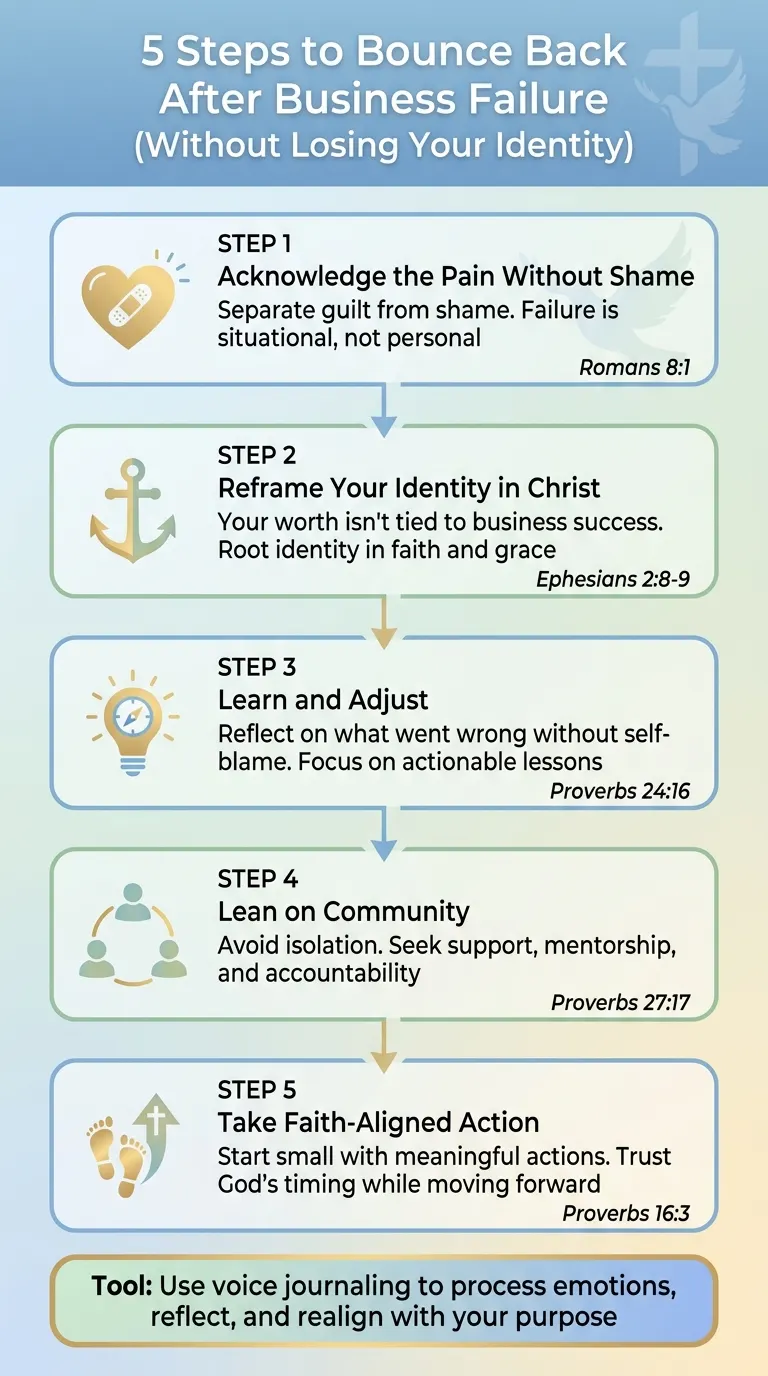
5 Steps to Recover from Business Failure with Faith
Understanding Failure Through a Biblical Perspective
Failure as Refinement, Not Identity
Experiencing failure in business – or any area of life – does not define your worth. It reflects actions, not who you are as a person. The Bible makes this distinction clear, offering hope and restoration rather than condemnation. While shame whispers, "You are the problem", Scripture reminds us that actions and identity are not the same.
God’s grace operates beyond the limits of worldly success. As Paul wrote in 2 Corinthians 12:9, "My grace is sufficient for you, for my power is made perfect in weakness". Similarly, Lamentations 3:22-23 reassures us: "The steadfast love of the Lord never ceases; his mercies never come to an end; they are new every morning; great is your faithfulness". A business failure doesn’t exhaust God’s grace – it’s an opportunity for His strength to shine. Grace isn’t a one-time gift; it renews every day, offering fresh hope and purpose.
The Bible also redefines the meaning of success. Instead of chasing worldly accolades, Scripture emphasizes spiritual fruitfulness – qualities like patience, self-control, and character that come from staying connected to Christ. As Matt Edmundson from CROWD Church explains, "A biblically successful life is characterised by self-control – the exact opposite of what most people think a successful life is". A failed venture doesn’t negate your value if your faith and character remain intact.
This perspective sets the stage for understanding how biblical figures modeled restoration through failure, offering timeless lessons for resilience and renewal.
Biblical Figures Who Overcame Loss
The Bible is filled with stories of individuals who faced failure and emerged stronger, showing that setbacks refine character rather than define destiny.
Take Peter, for example. After denying Jesus three times, he was restored when Jesus asked him to "Feed my sheep." Peter’s transformation – from an impulsive fisherman to a foundational leader of the early church – illustrates how failure can strip away pride and deepen reliance on God.
David’s story is another powerful example. Despite committing adultery and orchestrating a murder, his heartfelt prayer in Psalm 51 reveals "godly grief" and a desire for a renewed heart. His repentance led to restoration, showing how even grave mistakes can be redeemed.
Moses, too, experienced failure. After killing a man in anger, he spent 40 years in the wilderness before God called him to lead an entire nation. This time of waiting and refinement prepared him for his purpose. Even Jesus’ crucifixion, which seemed like ultimate defeat, became the foundation for the greatest victory through His resurrection.
As Proverbs 24:16 reminds us, "For though the righteous fall seven times, they rise again, but the wicked stumble when calamity strikes". The lesson is clear: failure isn’t final. What matters is the determination to rise again, trusting in God’s ability to transform setbacks into stepping stones.
Step 1: Acknowledge the Pain Without Shame
Healthy Conviction vs. Destructive Shame
When a business fails, it can feel like the ground has been pulled out from under you. The disappointment can be overwhelming, often leading to self-doubt. But there’s an important distinction to keep in mind: guilt focuses on a specific action that needs correction, while shame attacks your sense of self. Conviction asks, "What can I learn from this?" Shame, on the other hand, whispers, "What does this say about me?".
Romans 8:1 offers a reassuring truth: "There is therefore now no condemnation for those who are in Christ Jesus." This doesn’t mean ignoring what happened or avoiding responsibility. Instead, it’s about understanding that failure is situational, not a reflection of your worth. God’s grace reminds us that shortcomings are opportunities to grow, not reasons to spiral into self-blame. Matteo Grassi, Co-founder of Popup, captures this perfectly:
"Failure doesn’t define you. It’s just a part of the process. So, dust yourself off, learn from it, and keep movin’ forward".
Through a biblical lens, failure is never your identity. It’s an event – a chapter, not the whole story.
To move forward, it’s crucial to separate what you could control – like your strategy, pricing, or operations – from the elements you couldn’t, such as market trends or decisions made by others. This kind of objective reflection helps you avoid the trap of shame, which can leave you stuck. When your identity is rooted in growth, setbacks lose their ability to define you. This mindset lays the groundwork for processing emotions in a healthy way.
Using Voice Journaling to Process Emotions
Dealing with the emotional fallout of business failure requires a safe space to unpack your thoughts. Voice journaling provides that space – a private and non-judgmental way to speak your feelings out loud without worrying about how they might sound to others. Saying your emotions aloud helps transform vague anxieties into something tangible and easier to understand.
Psalmlog’s voice journaling feature is designed to help you process the vulnerability that comes with admitting failure. By verbalizing emotions like anger, fear, or disappointment, you create room for reflection. The app complements this process by offering relevant Scripture insights through sentiment analysis that align your perspective with God’s grace. Its AI-powered analysis helps you identify the difference between constructive conviction and harmful shame, providing personalized biblical guidance tailored to your emotional state. With 300 minutes of recording time each month on the Faith Builder plan, you have plenty of space to navigate your emotions at your own pace. This approach helps turn raw feelings into meaningful reflection, free from the pressure of finding immediate solutions.
Step 2: Reframe Your Identity in Christ
Grace Over Performance
When a business venture falters, it’s easy to feel like you’ve personally failed. Entrepreneurs often fall into what Hope Horner, CEO of Lemonlight, calls the "identity trap." This is the tendency to tie your self-worth to your business’s success – or lack thereof. But here’s the truth: your business is not who you are. Ephesians 2:8-9 reminds us that our value comes from grace, not from achievements or accolades. Grounding your identity in Christ allows you to see setbacks not as defeats but as opportunities for growth and better leadership. Horner sums it up perfectly:
"Success doesn’t mean you’ve made it, and failure doesn’t mean you’re done."
Take a moment to consider where you’re seeking validation. Is it through social media likes, professional awards, or investor praise? Instead, aim to anchor your worth in something deeper – your faith. Reconnect with activities and people that bring you joy and fulfillment outside of work. This shift helps you build a foundation that isn’t shaken by business outcomes, creating space for scriptural truths to replace negative thought patterns.
Scripture-Based Affirmations
To solidify this new identity, start replacing negative thoughts with truths rooted in Scripture. It’s easy to fall into mental ruts, replaying thoughts like "I’ll never catch up" or "I’m always falling short". But Scripture-based affirmations can help rewire those patterns, offering hope and perspective.
Focus on affirmations that highlight your God-given worth. For example, Psalm 139:14 reminds you that you are "fearfully and wonderfully made", while Jeremiah 29:11 assures you that God’s plans for your life extend far beyond any single setback. Speak these affirmations in the present tense to make them feel immediate and real:
- "I am loved for who I am" (Romans 5:8)
- "I am a new creation, refined for a promising future" (2 Corinthians 5:17)
For even greater impact, write these affirmations down, record yourself saying them, and listen to them regularly. Tools like voice journaling feature can help you stay consistent by providing personalized biblical guidance. This simple daily practice, inspired by Philippians 4:8, helps you focus on what is true, noble, and praiseworthy, replacing anxious thoughts with the peace and assurance found in Christ.
Step 3: Learn from the Experience and Adjust
Reflect Without Rumination
Reflection is about gaining clarity and learning from your experiences – not getting stuck in a loop of self-doubt. The goal is to extract lessons and move forward, not to endlessly replay your mistakes.
Start by breaking down your failure into specific categories. Was it due to a cash flow problem, poor understanding of your market, or operational hurdles? This approach helps you avoid broad self-blame and focus on actionable insights. Kelley Thornton, founder of Tiege Hanley, captures this mindset perfectly:
"Entrepreneurship isn’t about having all the answers. It’s about staying curious, staying calm, and finding a way through."
Instead of asking vague questions, dig deeper: Was the issue financial, strategic, or operational? Identifying the root cause is the first step toward improvement.
This idea aligns with Proverbs 24:16, which says, "the righteous person may fall seven times, yet they will rise again." The emphasis here is on rising again. Each setback is an opportunity to learn and prepare for what’s next. Focus on what you can control today. Even small, consistent improvements – just 1% daily – can lead to meaningful progress over time. This shift in focus can transform a mindset of defeat into one of growth.
Once you’ve identified these lessons, structured voice journaling can help you turn them into actionable improvements.
Structured Reflection with Voice Journaling
After the initial emotional release, structured reflection allows you to process your experiences more effectively. Voice journaling can be a powerful tool to transform raw emotions into actionable insights. It helps you see failure as a learning experience rather than a personal shortcoming. Entrepreneur and writer Danny Forest explains:
"Not only does it help you remember your mistakes so you’re less likely to repeat them, it allows you to disassociate with the emotions around your failures and discover lessons in each one."
To make voice journaling work for you, start by venting your immediate emotions – whether it’s anger, fear, or disappointment. Once you’ve cleared your mind, shift to logical analysis. Describe the event from different angles, as if you were an unbiased observer, to uncover blind spots. Then, dive deeper by asking, "What step first derailed the process, and what factors contributed?" This kind of analysis helps pinpoint where things went wrong and what can be adjusted.
For those looking to stay consistent, tools like voice journaling with AI through Psalmlog can help. It provides personalized biblical guidance and structured reflection insights, helping you track patterns and identify actionable next steps. The app’s 6-point AI journal insights are especially helpful for distinguishing between problems you can control and external factors outside your influence. This clarity allows you to focus your energy on areas where you can make a difference.
From Failure to Faith: Rebuilding Success with Richard Walsh
Step 4: Rebuild with Community and Accountability
After reflecting on your setbacks and learning from them, the next step is reconnecting with a community that supports and encourages your growth.
Avoiding Isolation After Failure
Experiencing business failure can feel deeply isolating. It impacts not only your professional identity but also your finances and how others perceive you. Many entrepreneurs respond by withdrawing, driven by shame and a sense of failure.
"Your business loss doesn’t define your entrepreneurial journey; it’s merely one chapter in a longer story."
Breaking out of this isolation is critical. Connecting with a supportive community provides the encouragement and accountability needed to move forward. Start by acknowledging your emotions – whether it’s denial, anger, or sadness – without judgment. Recognizing these feelings can help you resist the urge to isolate yourself. This connection lays the groundwork for seeking wise counsel and mentorship to guide your recovery.
Finding Godly Counsel and Mentors
Staying connected is vital, and surrounding yourself with people whose faith and wisdom can strengthen your recovery is key. Proverbs 27:17 reminds us, "As iron sharpens iron, so one person sharpens another". Consider joining Christian business groups or church ministries where you can share your struggles in a supportive, judgment-free environment. A mentor who understands the challenges of business setbacks and can guide you toward meaningful steps forward can be invaluable.
Interestingly, research shows that many churchgoers lack faith-based accountability in their lives. This highlights the importance of intentionally seeking it out. Take the example of Tom and Anna Cartwright. After a massive business loss of $600 million at Bank Summa, they turned to their local church for support. They committed to tithing and leaned on their faith community during an incredibly challenging time. This accountability helped them rebuild, eventually leading to the invention of a medical hygiene product and the launch of a coaching business for inventors. Today, Tom and his daughter Allison lead that business together.
Be open about your journey and willing to share your experiences. Vulnerability can be a strength, especially when you ask a mentor to hold you accountable. Regular check-ins with someone who understands your goals can help you stay on track and honor your commitments within your faith community.
Step 5: Take Faith-Aligned Action Toward Rebuilding
With your reflections and the support of your community in place, it’s time to move forward with intentional steps that align with both your faith and practical needs. Rebuilding after a business failure isn’t about fixing everything at once – it’s about deliberate, faith-guided actions that honor your values and help you progress.
The ‘Next Right Action’ Framework
The ‘Next Right Action’ framework encourages taking small, manageable steps instead of trying to solve everything at once. This approach recognizes that rebuilding is a gradual process.
Take, for example, Tom Cartwright. After facing a career setback, he chose not to tackle everything at once. Instead, he focused on priorities, saying: "God first, my family, and then my job". By concentrating on one step at a time, Tom stayed open to opportunities that he might have otherwise overlooked. Each small action not only helped him move forward but also reinforced his identity in Christ.
Your next step might be as simple as updating your resume, reaching out to a former colleague, or exploring a new industry. It could also mean focusing on daily spiritual practices or having an honest conversation with your spouse about finances. The size of the step doesn’t matter as much as its alignment with your values. Carl B. Johnson, an author and mentor, explains this balance well:
"Balance trust in God with purposeful action toward your goals".
These small, intentional actions not only build momentum but also create space for God to work in your life. As you take each step, remember to balance your efforts with trust in His timing.
Balancing Trust and Effort
One of the biggest challenges after a business failure is figuring out when to push forward and when to wait on God. Proverbs 16:3 provides wisdom here: "Commit to the Lord whatever you do, and he will establish your plans." This verse doesn’t suggest idleness – it calls for diligent work while surrendering the outcomes to God.
The Cartwright family modeled this balance during financial struggles by continuing to tithe. Anna Cartwright shared their perspective:
"Do you want to trust yourself for the rest of your life? Or do you want to lean on another source that is the God of the universe? When you just be obedient, you cannot out-give Him. No way".
Their daughter Allison, now a business coach, echoed this sentiment:
"What people spend their money on shows you what’s truly in their heart. And so, number one, are you tithing? Because if you’re not tithing, then that might be why you’re in a financial situation, or God is not opening doors".
This doesn’t mean ignoring practical business principles. As you rebuild, focus on strengthening your financial skills, creating resilient teams, and developing business models that reflect your purpose rather than just chasing revenue.
Stay attentive to unexpected opportunities like a buyer for an asset, shifts in the market, or doors opening in unexpected ways. These moments often signal that God’s timing for restoration is at hand. Your role is to remain faithful in the small things while staying alert to His guidance. As Tom Cartwright observed:
"I can say with assurance that when you tithe, God always provides for you. He multiplies that seed sown, and that’s a functional absolute".
Maintaining Your Identity While Moving Forward
Rebuilding after a setback can feel overwhelming, but the real challenge often lies in holding onto your sense of self. When your previous venture became a core part of your identity, its failure may have felt deeply personal. This time around, it’s crucial to establish firm "identity anchors" – aspects of yourself that remain constant, regardless of professional highs or lows.
Setting Identity Anchors
Your value isn’t tied to your business success or failure – it’s rooted in something deeper. As business coach Bob Gwassa wisely says, "Failure is an event, not an identity".
Start by broadening your life beyond work. Reconnect with hobbies, nurture personal relationships, and focus on what truly matters. A balanced life provides a sense of stability when work gets tough. Make it a priority to invest in your spiritual and personal connections.
To keep these anchors strong, build daily habits that reinforce your spiritual foundation.
Daily Spiritual Practices
Resilience grows when you commit to spiritual discipline each day. Begin your mornings with prayer and scripture study to center yourself before tackling the day’s challenges. This practice helps shift your focus from constant performance to embracing grace as you rebuild.
Another powerful tool is voice journaling. By speaking your thoughts aloud, you can better process emotions, recognize patterns, and sense where God might be guiding you. It also helps you separate healthy self-reflection from harmful shame. For a practical option, consider Psalmlog’s Faith Builder plan, which offers 300 minutes of monthly recording time for $19.99 – perfect for meaningful reflections without the need to write everything down.
Lastly, make it a habit to surrender your plans to God in prayer. Acknowledge that while you can work faithfully, the ultimate provision comes from Him. Letting go of rigid control and entrusting your future to God ensures your identity in Christ stays at the center of your journey forward.
Using Voice Journaling for Emotional and Spiritual Recovery
How Voice Journaling Supports Reflection
When a business fails, the loss is more than just financial – it’s the unraveling of something you deeply believed in. As Beth Bell, Intuitive Soul Advisor, explains:
"It’s like you’re left holding the broken pieces of something you believed in so strongly, wondering where to go next".
This kind of heartbreak can feel like a form of business PTSD, where painful memories and self-doubt make moving forward seem impossible.
Voice journaling offers a way to release these emotions. By speaking your thoughts aloud, you can confront fears and negative patterns before they spiral. Tools like Psalmlog provide features to track emotional changes and incorporate scripture-based insights into your reflections. Their Faith Builder plan, priced at $19.99 per month, gives you 300 minutes of recording time – enough space to process your emotions without the pressure of writing everything down.
This practice not only helps you understand your feelings but also reinforces your identity in Christ, deepening your prayer life and keeping your recovery grounded in biblical truths. It creates a connection between emotional healing and practical steps for moving forward.
Voice Journaling Prompts for Post-Failure Healing
To make the most of voice journaling, start with prompts that help you process the pain. For instance, ask yourself, "What am I grieving most about this loss?" or "How did my identity become tied to this business?" These questions can help you separate healthy self-reflection from harmful feelings of shame.
Next, shift toward clarity by asking, "What did I learn today that I can build on?" or "Where did I see God’s guidance in this struggle?" Kelley Thornton, CEO of Tiege Hanley, offers wise advice:
"Entrepreneurship isn’t about having all the answers. It’s about staying curious, staying calm, and finding a way through".
You could also explore prompts like, "Which of the 5 Cs – Clarity, Cash Flow, Culture, Customer Delight, or Communication – needs my focus now?" This structured approach turns overwhelming problems into manageable steps, helping you rediscover purpose and prepare for what’s next.
Conclusion: Redemption and Resilience in Action
Experiencing business failure can feel overwhelming, but it doesn’t define who you are – your identity in Christ does. By following these steps, you can reconnect with your true self, independent of professional achievements. Facing the pain without shame, grounding yourself in Christ, learning from past experiences, leaning on community, and taking faith-driven actions are not just about recovery – they’re about transformation.
This transformation is beautifully illustrated in the story of Tom and Anna Cartwright. Their journey from loss to a miraculous turnaround is a testament to the power of faith and obedience. As Anna Cartwright so powerfully states:
"Do you want to trust yourself for the rest of your life? Or do you want to lean on another source that is the God of the universe? When you just be obedient, you cannot out-give Him".
True resilience doesn’t mean ignoring the pain – it means anchoring your hope in God’s constant provision. One practical way to navigate this journey is through voice journaling. This tool can help you process emotions, reflect on spiritual growth, and recognize God’s guidance through the noise of fear and doubt. It’s a way to turn reflection into meaningful action.
With these practical tools and a renewed sense of purpose, the future holds incredible possibilities. Trust that God, who redeems and restores, is writing your next chapter. Take a step forward today, knowing that your identity is secure, your purpose is unwavering, and your story is far from over.
FAQs
How do I stop a failed business from defining me?
To ensure that a failed business doesn’t define you, start by acknowledging the failure without letting it impact your sense of self-worth. Take time to reflect on what went wrong, and use those lessons to shape a plan for moving forward. Always keep in mind that your identity isn’t tied to the success or failure of a business. Instead, it’s shaped by your resilience, the lessons you’ve gained, and your faith in Christ.
Tools like scripture-based affirmations can help reinforce your confidence, while practices like voice journaling provide a space to process emotions and rediscover your purpose.
What should I do if shame keeps pulling me back into the failure?
Failure is an inevitable part of personal growth, and it’s important to shift your focus from the setback itself to the lessons it offers. Instead of letting grief or shame consume you, recognize these emotions as natural and manageable. Tools like spiritual reflection, voice journaling, or scripture-based affirmations can be incredibly helpful. They not only strengthen your identity in Christ but also build resilience, encouraging healing through patience and self-compassion.
How can I tell what God wants me to do next?
Finding clarity about what God wants you to do often begins with intentional spiritual reflection. Start by dedicating time to prayer, asking for His guidance and wisdom. Pair this with reading scripture – specific passages can provide direction and encouragement when you’re seeking answers.
You might also try tools like voice journaling, where you record your thoughts and prayers aloud, or use scripture-based affirmations to reinforce your faith and focus. Meditating on Bible verses that resonate with your situation can help quiet distractions and bring clarity.
Above all, trust in God’s plan. By leaning into faith and staying open to His guidance, you’ll find the confidence and peace to take your next steps.