
Stop Comparing: Save Your Business
Comparison steals joy and derails leaders; use Scripture and daily reflection to reclaim your calling and steward your work.
Comparison can derail your business and faith by stealing joy, clouding judgment, and shifting focus from your unique purpose. Constantly measuring your progress against others leads to envy, poor decisions, and mismanagement of your resources. Instead, focus on your own journey, guided by biblical wisdom and intentional practices.
Key Takeaways:
- Comparison distorts perspective: It fosters envy, impatience, and insecurity, undermining trust in God’s plan.
- Poor leadership choices: Decisions driven by envy often lead to rushed changes and ineffective strategies.
- Joy and purpose suffer: Watching others succeed can trigger shame and blur your sense of identity.
- Stewardship matters: Misplaced focus can lead to neglecting the resources and opportunities God has entrusted to you.
- Practical solutions: Use scripture (e.g., Galatians 6:4–5, Philippians 4:11–12) and tools like Psalmlog for daily reflection to combat comparison.
The Comparison Trap: How to Break Free
How Comparison Distorts Thinking for Christian Founders
Comparison doesn’t just bring fleeting discouragement – it gradually warps your perspective, weakens leadership, and undermines your trust in God. Over time, envy, impatience, and insecurity can build up, creating deeper struggles.
What the Bible Says About Envy
The Bible doesn’t mince words when it comes to envy. Proverbs 14:30 states, "A heart at peace gives life to the body, but envy rots the bones." This isn’t just poetic language – it’s a warning about the profound spiritual and emotional harm envy can cause.
Envy skews how you view God’s provision. Pastor Chris Hutchinson describes it well:
"Envy treats God’s grace as one small pie which must be fought over, rather than a bountiful feast with a variety of dishes, each one perfectly prepared by our host."
When you start believing that someone else’s success limits your own opportunities, it chips away at your trust in God’s unique plan for you. The Bible addresses this directly in 2 Corinthians 10:12, where comparing yourself to others is described as being "without understanding." It’s more than just unwise – it’s spiritually disorienting.
This distorted mindset doesn’t just stay internal; it affects your leadership too. Envy not only disrupts your inner peace but also clouds your decisions and weakens your ability to lead effectively.
How Comparison Leads to Poor Leadership Decisions
The effects of comparison often show up in the choices you make. Pastor and author Rick Warren explains:
"Every time you compare, you fall prey to either pride or envy. When you find someone who’s doing a better job than you, you fill up with envy. When you realize you’re doing a better job than someone else, you become filled with pride."
Comparison creates a dangerous cycle. When you envy someone else’s success, it can lead to rushed decisions – like adjusting pricing, rebranding too soon, or abandoning a solid strategy – not because the data supports it, but because another founder’s achievements spark insecurity. James 3:16 ties this directly to leadership struggles, stating that where envy and selfish ambition exist, "disorder and every evil practice" follow.
This disorder doesn’t stay hidden – it seeps into how you lead your team, communicate with partners, and pursue your mission. Saul’s obsession with David’s success is a clear example of how comparison can derail leadership. Instead of focusing on his own calling, Saul became consumed with competition, which ultimately undermined his effectiveness.
The takeaway is simple but powerful: comparison pulls your attention away from your God-given purpose and places it on someone else’s path. And when that happens, your decisions start serving competition instead of your mission.
"You can’t focus on your own purpose while you’re focusing on other people." – Rick Warren, Pastor and Author
The Real Costs of Comparison in Business and Faith
Building on how comparison skews your thinking and leadership, let’s dive into its deeper impacts. The fallout isn’t just about making poor choices – it chips away at your happiness, clouds your sense of purpose, and pulls your attention away from the resources God has entrusted to you.
How Comparison Drains Your Joy
Spending your time and energy watching others succeed can quickly lead to discouragement. Roy Bahat, Head of Bloomberg Beta, captures this dynamic perfectly:
"Shame commands other emotions, warping your thoughts and actions, without you even being aware it’s sitting on the throne."
Comparison often triggers this kind of shame. It sets up unrealistic expectations – more revenue, more followers, more recognition. When reality doesn’t match those expectations, joy disappears. Even worse, shame isolates you from the very people who could offer support and encouragement. This emotional toll doesn’t just sap your happiness; it can also blur your sense of identity and purpose.
Losing Sight of Who You Are and What You Are Called to Do
It’s worth remembering that you are “fearfully and wonderfully made” (Psalm 139:13–14) and that your mission is uniquely yours. Jesus made this clear when He told Peter: "What is that to you? You must follow me" (John 21:22). Your calling isn’t determined by what someone else is building or achieving. Instead of comparing yourself to others, it’s far healthier to measure your progress against your own growth.
Galatians 6:4–5 reinforces this idea, urging believers to "test their own actions" and "bear their own load." The standard isn’t another person’s highlight reel. Without a grounded sense of self, it becomes harder to manage the gifts and responsibilities God has placed in your life.
How Comparison Gets in the Way of Good Stewardship
Comparison doesn’t just mess with your emotions and identity – it can also derail how you manage God’s blessings. Good stewardship demands your full attention. Patrick Mabilog, founder of Block Ten Strategy, shared a cautionary tale in February 2026. A fixation on competition led to severe anxiety, delaying projects and costing revenue. What should have been a six-month website project stretched to twelve, resulting in a $1,500 loss – nearly 30% of his monthly income.
This is a real example of how misplaced focus can have practical consequences. Comparison can also lead to financial mistakes, like underpricing your services based on a competitor’s audience size, without understanding their entirely different business model. As Arnie Cole, CEO of Back to the Bible, explains:
"Comparison turns blessings into burdens. It makes us despise what God has placed in our hands because we’re too busy reaching for what He’s given someone else."
The relationships, opportunities, and resources in front of you are your real assignment. But when you’re fixated on someone else’s results, those gifts go unmanaged. That’s not just a mindset issue – it’s a stewardship problem.
Using Biblical Wisdom to Break the Comparison Habit
Once you understand how comparison drains joy, clouds your sense of self, and disrupts your ability to manage what you’ve been given, the next step is finding a better focus. Scripture offers more than just comfort here – it provides a practical way to reset your mindset.
Scriptures That Help You Refocus
The Bible encourages replacing comparison with dedicated, faithful work. 2 Corinthians 10:12 and Proverbs 14:30 both caution against the dangers of comparison, highlighting how it can damage your motivation and relationships.
Two passages stand out as powerful tools for shifting your perspective. Colossians 3:23 reminds you to focus your efforts on a higher purpose: "Whatever you do, work at it with all your heart, as working for the Lord, not for human masters." This verse redirects your attention from competing with others to serving God. Meanwhile, Philippians 4:11–12 teaches that contentment isn’t something you’re born with – it’s a skill you can develop. Paul openly shares that he learned to find peace in all circumstances, showing that contentment is attainable even if your business or personal goals feel far from complete.
Rick Warren offers a helpful perspective:
"God’s rewards won’t be based on talent you didn’t have or opportunities you weren’t given. He will reward you based on how you lived and what you did with what you were given."
This mindset can completely change how you evaluate success in your day-to-day life. By grounding yourself in these scriptural truths, you can start building a habit of daily scripture reflection that keeps your focus where it belongs.
Using Psalmlog for Daily Scripture Reflection

To make these biblical principles part of your daily life, consider creating a routine that turns reflection into action. It’s one thing to know the right scriptures, but it’s another to internalize them when you’re stressed, comparing yourself to others, or doubting your progress. That’s where consistency – and tools like Psalmlog – can make a difference.
Psalmlog is a voice-first journaling app designed specifically for scripture-based reflection. Instead of letting moments of comparison linger – like seeing another entrepreneur secure funding while you’re still bootstrapping – you can speak your thoughts into the app in real time. Psalmlog’s AI listens to your entries, connects them to relevant Bible verses, and provides personalized insights based on your words, not just a random daily verse. Over time, the app’s analysis tools help you identify patterns: what triggers comparison, how often it happens, and how your emotions shift as you build a habit of reflection.
Beyond that, your journal becomes a tangible record of how God has been at work in your life. Looking back at entries from a few months ago can remind you of progress and blessings you might otherwise overlook. Instead of focusing on someone else’s achievements, this practice helps you stay anchored in your own journey, one thoughtful entry at a time.
A Daily Reset Routine for Christian Founders
Drawing from scripture, a daily reset routine can help Christian founders stay centered on God’s truth. It’s one thing to know the right verses, but turning to them during moments of comparison – like seeing a competitor secure funding or another founder go viral – can make all the difference.
How to Build the Reset Practice Step by Step
A quick 10-minute routine each morning can set the tone for your day before distractions take over. Here’s a simple four-step process:
- Identify your exact emotion – jealousy, anxiety, or overwhelm. Be honest and specific. Naming what you’re feeling is the first step to addressing it.
- Record a voice journal entry in Psalmlog. Speak openly about what’s on your mind. If you’re feeling discouraged after scrolling LinkedIn, say it. Psalmlog’s AI listens and connects your voice journaling with scripture tailored to your situation.
- Reflect on the scripture provided. Read the verse slowly, even aloud. For example, Galatians 6:4–5 says, "Each one should test their own actions… without comparing themselves to someone else." Take time to think about how this applies to your day.
- Declare one faith-driven action for the day. End the session by committing to one action that aligns with your calling, rather than reacting to someone else’s progress.
This reset helps you manage triggers and stay grounded in your faith.
"While gratitude is a measure of our perspective on the things we already have, contentment is a measure of our perspective on the things we don’t have." – Natasha Crain, Author and Blogger
Tracking Your Spiritual and Emotional Growth Over Time
This routine doesn’t just help you realign your focus – it also provides a way to track your growth. Journaling consistently offers valuable insights when you reflect on past entries. Psalmlog’s personal insights dashboard can reveal patterns in your emotions, triggers, and even shifts in your tone as you build this habit.
For instance, if you notice comparison tends to spike on Monday mornings, that’s a cue to make adjustments. You could add a gratitude reflection to your Sunday night or delay checking social media until after your reset. The goal isn’t perfection – it’s awareness. Spiritual drift often happens gradually, and catching it early is far easier than trying to recover months down the line.
Here’s a table to guide your reset based on your emotional state:
| Season | Best Reset Focus | Key Question |
|---|---|---|
| Comparison/Jealousy | Galatians 6:4–5; Psalm 139:14 | Am I testing my own work or measuring against someone else’s? |
| Anxiety/Stress | Philippians 4:6–7; 1 Peter 5:7 | What am I holding onto that I need to surrender? |
| Spiritual Dryness | John 15:5; Isaiah 40:31 | Where have I stopped depending on God? |
| Busy Seasons | SOAP (5-min) | What one verse speaks to me today? |
| Spiritual Growth | Any method, consistently | How am I different than I was a year ago? |
Your journal entries can become a living testimony of God’s presence in your life. They’ll not only document your struggles but also serve as a reminder of how God has supported you through them. This record can be a powerful way to combat comparison and keep your focus on your unique path.
Comparison-Driven vs. Calling-Driven Leadership
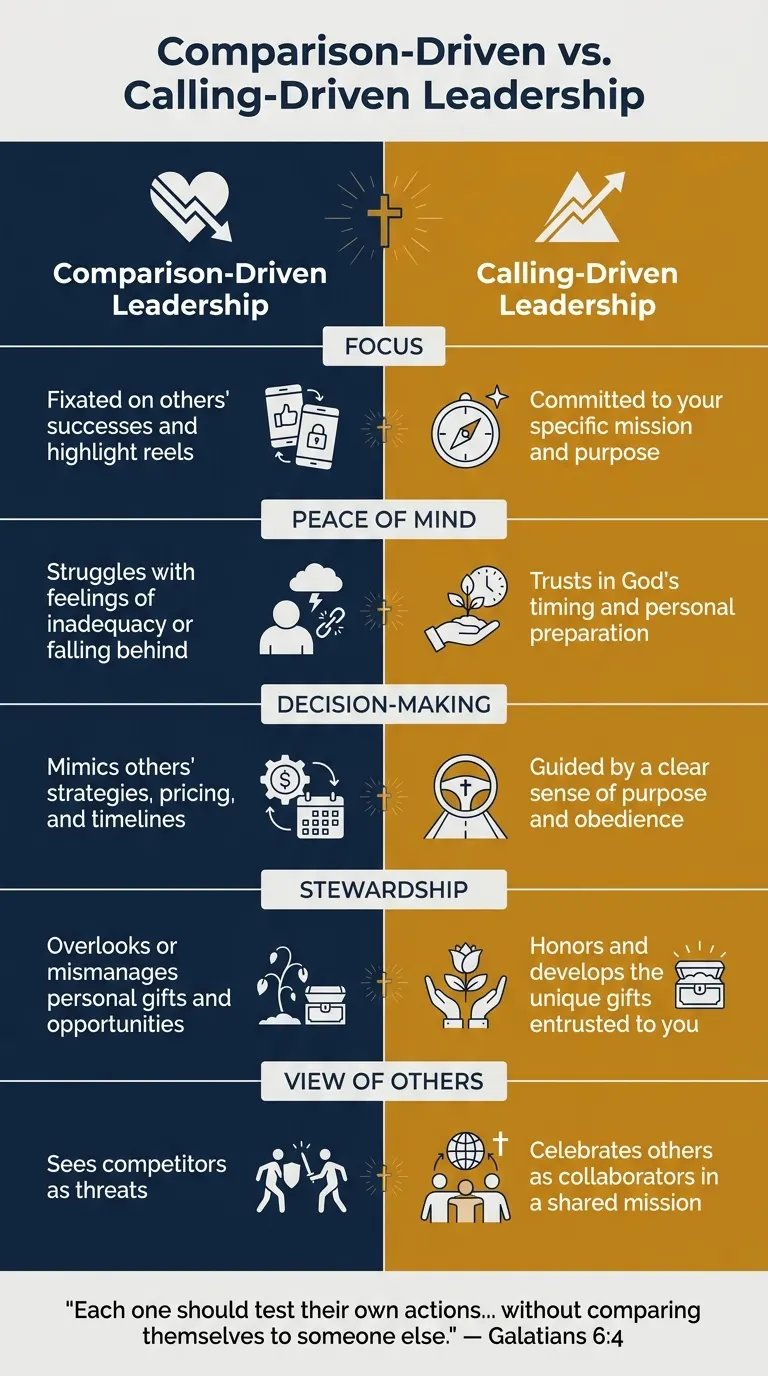
Comparison-Driven vs. Calling-Driven Leadership: Key Differences
Let’s take a closer look at how your leadership style can be shaped by comparison or guided by a deeper calling. This distinction can have a profound impact on how you approach decisions, measure success, and stay true to your unique purpose.
The difference is clear: comparison-driven leadership focuses on imitating others’ achievements, while calling-driven leadership is grounded in a sense of purpose that’s independent of someone else’s journey.
Sandra Mosley, Founder of Fempreneur Chronicles, captures this perfectly:
"The biblical answer is not to try harder to stop comparing. It is to get so clear on your specific calling that someone else’s chapter becomes irrelevant to your story."
It’s easy to fall into the trap of comparing your early steps to someone else’s polished results. You might see their thriving business or impressive achievements and assume you’re falling short. But what’s often hidden are the years of hard work, failed attempts, and unseen effort that led to their success. Comparison-driven leaders make choices based on this incomplete view, while calling-driven leaders focus on their own unique path.
Side-by-Side: Key Differences in Leadership Approach
Here’s a breakdown of how comparison-driven and calling-driven leadership differ in focus, peace, decision-making, and stewardship:
| Area | Comparison-Driven Leadership | Calling-Driven Leadership |
|---|---|---|
| Focus | Fixated on others’ successes and highlight reels | Committed to your specific mission and purpose |
| Peace of Mind | Struggles with feelings of inadequacy or falling behind | Trusts in God’s timing and personal preparation |
| Decision-Making | Mimics others’ strategies, pricing, and timelines | Guided by a clear sense of purpose and obedience |
| Stewardship | Overlooks or mismanages personal gifts and opportunities | Honors and develops the unique gifts entrusted to you |
| View of Others | Sees competitors as threats | Celebrates others as collaborators in a shared mission |
This comparison highlights why aligning your leadership with God’s purpose is so crucial. Scripture reminds us to focus on our individual calling, rather than being distracted by someone else’s journey.
The concept of stewardship is especially powerful here. Leading from comparison doesn’t just distract – it can lead to neglecting the unique gifts and opportunities you’ve been given. As Aubrey Sampson, Author and Pastor, explains:
"We measure our effectiveness by metrics that may have nothing to do with faithfulness in our context. We feel shame about gifts we don’t possess instead of stewarding the ones we do."
Being a calling-driven leader doesn’t mean ignoring the market or other leaders entirely. There’s a difference between inspiration and comparison. Inspiration draws out your own potential, while comparison can make you wish to be someone else. The key is to stay aware of the broader landscape while staying firmly anchored in your own purpose.
Conclusion: Getting Back to Faithful Stewardship
Comparison has a way of pulling your focus away from the specific work God has planned for you. Galatians 6:4 reminds us of this truth:
"Each one should test their own actions. Then they can take pride in themselves alone, without comparing themselves to someone else."
Instead of measuring yourself against others, focus on your own journey and calling. Contentment isn’t something that happens passively – it’s an intentional practice. Philippians 4:12-13 highlights this, showing that it’s a discipline to be worked on daily. This might involve writing out your personal calling statement, thoughtfully managing your social media habits, celebrating your own milestones, and turning to Scripture and study guides when feelings of comparison creep in.
Resources like Psalmlog can help make this daily practice more tangible. Studies reveal that engaging with Scripture at least four times a week can reduce spiritual stagnation by 60% and boost confidence in faith-based decisions by 228%. Voice journaling, for example, turns passive Scripture reading into an active, personal dialogue with God, fostering deeper growth. These habits can help you stay grounded in your purpose and strengthen your commitment to faithful stewardship.
Your work and business should reflect the unique gifts God has given you, the people you are called to serve, and the obedience that only you can bring to His plan.
FAQs
How can I tell the difference between healthy inspiration and sinful comparison?
Healthy inspiration encourages personal growth by highlighting your potential and allowing you to learn from others. It doesn’t involve tying your self-worth to comparisons. On the flip side, harmful comparison happens when you start measuring your value against others. This can lead to feelings like envy, pride, or even doubting the path God has set for you. When comparison starts to disrupt your sense of contentment or your ability to stay faithful, it crosses the line from being motivating to becoming a negative influence.
What should I do when social media triggers jealousy about other founders?
When social media triggers feelings of jealousy, it’s important to take intentional steps to realign with your own journey. Start by muting or unfollowing accounts that stir up envy – it’s okay to protect your peace. Set limits on how much time you spend scrolling, and consider starting or ending your sessions with prayer to center yourself.
Be honest about your feelings. Confess any envy to God and shift your focus by practicing gratitude. Take time to celebrate your own milestones, no matter how small they may seem. Incorporate spiritual practices like reading Scripture, praying for the success of others, and seeking accountability from trusted individuals. These steps can help you stay grounded in the unique purpose God has for your life.
How can I measure success in my business without copying someone else?
Focus on the purpose you’ve been entrusted with, rather than measuring yourself against others. Success isn’t about keeping up with someone else’s accomplishments – it’s about staying true to your path and recognizing the progress you’ve made. Whether it’s growing your revenue, building confidence, or improving the quality of your work, these personal milestones tell the story of your journey. Your identity and purpose are entirely your own – no one else can replicate them.