
What to Do When You Lose Your Job: A Biblical Survival Guide
Scripture-based steps for handling job loss: prayer, grief processing, financial stewardship, job search strategies, and trusting God's provision.
Losing your job is tough – financial stress, emotional turmoil, and uncertainty about the future can feel overwhelming. But here’s the key takeaway: your worth isn’t tied to your job. The Bible offers guidance to help you navigate this season with faith and practical wisdom.
Key Steps to Take Immediately:
- Turn to Prayer and Scripture: Seek comfort and clarity through verses like Philippians 4:19 and Psalm 46:1.
- Process Your Emotions: Grieve the loss, but trust God’s plan.
- Follow biblical guidance on finances: Budget carefully, cut unnecessary expenses, and explore temporary income options.
- Seek Support: Lean on your church, family, and Christian counselors for both spiritual and practical help.
- Stay Active in Your Job Search: Update your resume, network, and trust God to open the right doors.
This challenging time can be an opportunity for spiritual growth and redirection. Trust that God is working behind the scenes to guide you toward a new purpose.
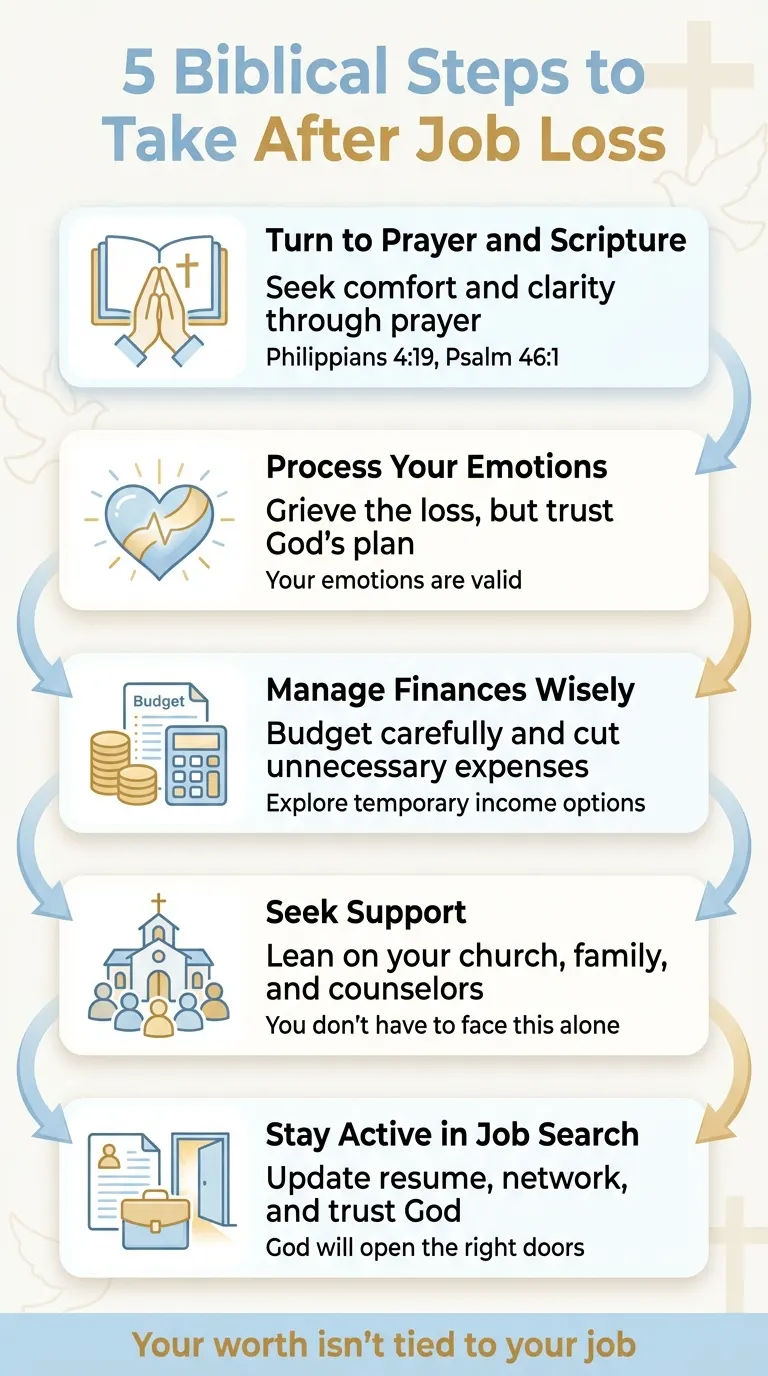
5 Biblical Steps to Take After Job Loss
God’s Faithfulness in Job Loss | What? Why? God | Steve Manley
What the Bible Says About Job Loss
Scripture often frames job loss as a chance for growth and redirection. In James 1:2-4, believers are encouraged to "consider it pure joy" when facing trials because such challenges build perseverance and maturity. Similarly, 1 Peter 1:6-7 likens hardships to a "refiner’s fire", strengthening faith and shaping character. These passages set the tone for understanding how loss can redefine your sense of identity and purpose.
This perspective changes how unemployment might be viewed. Instead of seeing it as a dead end, Scripture suggests it could be God closing one door to open another. Proverbs reminds us that while we may plan our paths, it is God who establishes our steps. What may feel like a setback could actually be a redirection toward a role that aligns with God’s greater plan for your life.
How God Uses Loss to Redirect Your Path
Losing a job can reveal the ways you’ve tied your worth to your work. When a professional identity is stripped away, it prompts deeper questions: "Have I been measuring my value by my paycheck? What is God inviting me to learn about myself beyond my career?" Joe Carter, Associate Pastor and Senior Writer at The Gospel Coalition, explains:
"Unemployment isn’t merely an economic hardship but a spiritual problem that often triggers a profound identity crisis."
Though painful, this experience can spark transformation. God uses such disruptions to shift your foundation from career achievements to your true identity as His child. Your worth isn’t tied to productivity or financial success – it’s rooted in being created in His image (Psalm 139:13-14). Jesus emphasized this in Matthew 6:26, reminding us that God provides even for sparrows, and we are far more valuable than they are.
Biblical Stories of Faith During Hardship
The Bible is rich with stories of individuals who endured loss and still experienced God’s faithfulness. Take Joseph, for example. After being falsely accused and spending years in prison, he lost his position and freedom. Yet, even in uncertainty, God was at work, eventually raising Joseph to a position of authority in Egypt where he fulfilled a larger purpose.
Job’s story is another powerful example. He lost his wealth, health, and family, yet he held onto his faith, even while wrestling with questions about God’s plan. His eventual restoration came after a season of lament and deep reflection. Other figures like Moses, who spent years in exile, and Naomi, who returned home empty-handed, also demonstrate how God uses seasons of emptiness to prepare His people for what’s ahead. These stories remind us that personal loss can pave the way for renewed faith and unexpected opportunities.
How to Handle the First Days After Job Loss
Losing your job can bring a whirlwind of emotions. You might feel shock, anger, confusion, and fear – sometimes all at once. In these first days, it’s important to focus on how you process these emotions and where you direct them.
Bringing Your Fears to God in Prayer
In the Garden of Gethsemane, Jesus showed us the power of honest prayer. As He faced immense suffering, He prayed in Matthew 26:39:
"My Father! If it is possible, let this cup of suffering be taken away from me. Yet I want your will to be done, not mine."
This moment teaches us that bringing raw emotions to God is an act of trust, not a sign of weak faith. Similarly, Job expressed his fears openly in Job 3:25–26:
"For the thing which I greatly feared is come upon me, and that which I was afraid of has come upon me. I am not at ease, nor am I quiet; I have no rest, for trouble comes."
If you’re struggling to find the words, start by naming your fears – whether they’re about finances, failure, or losing your sense of purpose. Then, ask God for clarity, peace, and wisdom to navigate this season. Grounding your emotions in prayer and Scripture can help you find stability during uncertain times.
Bible Verses for Fear and Uncertainty
When everything feels shaky, Scripture offers promises to hold onto. Here are a few verses to remind you of God’s presence and provision:
- Psalm 46:1: "God is our refuge and strength, an ever-present help in trouble."
- Romans 8:28: "And we know that in all things God works for the good of those who love him, who have been called according to his purpose."
- 1 Peter 5:7: "Cast all your anxiety on him because he cares for you."
- Hebrews 13:5: "Never will I leave you; never will I forsake you."
- Philippians 4:19: "And my God will meet all your needs according to the riches of his glory in Christ Jesus."
When fear creeps in, immerse yourself in these truths. Write them down, set them as reminders on your phone, or repeat them while taking a walk. These small habits can help shift your focus from fear to faith.
Processing Grief While Trusting God
After turning to prayer and Scripture, it’s important to acknowledge the grief that comes with job loss. Grieving is a natural and necessary response, and the Bible doesn’t ask us to avoid it. Job, for example, sat silently for days after his losses, allowing himself time to process the pain before taking any action. Give yourself space to feel the hurt instead of rushing to “fix” things.
At the same time, grief and trust in God can coexist. You can feel the weight of uncertainty while holding onto the truth that God is in control. James 1:2-4 reminds us that trials can build perseverance and spiritual growth. While this doesn’t erase the pain, it offers a perspective: this season is an opportunity for God to refine your faith and reshape how you see yourself. Your worth isn’t tied to a job title or paycheck – it comes from being His child.
As you navigate these emotions, lean on your church community or close friends who can pray with you and remind you of God’s promises when you feel overwhelmed. Their support can be a lifeline in moments when hope feels distant.
Finding God’s Direction for Your Next Job
After the initial shock and grief of losing a job, the next step is to seek God’s guidance for what lies ahead. Before rushing into decisions, take a moment to discern whether this might be a redirection from God.
Using Prayer and Scripture to Find Clarity
Proverbs 3:5-6 provides a guiding principle for this journey:
"Trust in the LORD with all your heart, and lean not on your own understanding; in all your ways acknowledge Him, and He will make your paths straight."
When you’re unsure about your next steps, avoid relying solely on logic or making decisions out of fear. Instead, build a habit of daily prayer, asking God to reveal His plan. For instance, before selecting His apostles, Jesus spent an entire night in prayer (Luke 6:12-13).
James 1:5 offers encouragement for those seeking wisdom:
"If any of you lacks wisdom, he should ask God, who gives generously to all without finding fault, and it will be given to him."
Pair your prayers with time in Scripture. God’s Word is described as "a lamp to my feet and a light to my path" (Psalm 119:105). If you’re debating whether to switch industries, accept a lower salary, or wait for another opportunity, immerse yourself in biblical wisdom. Verses like Romans 8:28 can anchor your thoughts when uncertainty or anxiety creeps in.
In addition to personal prayer, reach out to mature believers in your church community for counsel. Proverbs 11:14 reminds us:
"Where there is no guidance, a people falls, but in an abundance of counselors there is safety."
A mentor or pastor can help you discern whether your talents and passions are being redirected toward a new calling. They can pray with you and offer perspectives you might not see on your own.
Once you feel clarity beginning to form, it’s time to focus on practical steps that align with biblical principles.
Job Search Strategies Grounded in Biblical Principles
With spiritual clarity as your foundation, it’s essential to take action. Scripture encourages a balance between trusting God’s provision and putting in diligent effort. Ecclesiastes 11:6 illustrates this balance:
"Sow your seed in the morning and do not let your hand rest until the evening; for you do not know which will have success."
Start by letting family, friends, former colleagues, and professional contacts know you’re seeking new opportunities. Proverbs 14:23 reminds us:
"There is benefit in every kind of hard work."
If the new role you’re considering is different from your previous job, view it as a chance to serve God in a fresh way. Colossians 3:23 offers perspective:
"Whatever you do, work at it with all your heart, as working for the Lord, not for human masters."
At the same time, practice patient discernment. If you sense God is asking you to wait, resist the temptation to make decisions out of fear. Matthew 6:34 encourages us, "Never be anxious about the next day, for the next day will have its own anxieties." Keep submitting your plans to God, trusting Him to open doors at the right time.
Viewing Job Loss as a Redirection
Throughout Scripture, we see examples of God using trials to redirect His people. Your job loss might be less of a setback and more of a stepping stone to the path God has prepared for you. Ephesians 2:10 explains:
"For we are God’s workmanship, created in Christ Jesus to do good works, which God prepared in advance as our way of life."
If you felt unease in your previous role or sensed it wasn’t the right fit, this change might be God’s way of leading you to something better aligned with His plan. Psalm 37:23 offers reassurance:
"The steps of a good man are ordered by the Lord: and he delighteth in his way."
Look for signs of God’s redirection, such as a sense of peace about certain opportunities, even if they seem unconventional. Isaiah 26:3 promises "perfect peace" to those who focus on God.
Follow the example of King David in 1 Samuel 23:2, who "inquired of the Lord" before making major decisions. Ask God directly, "Is this job loss a redirection?" Then, watch for His guidance through Scripture, wise advice, and circumstances that align. Psalm 32:8 offers this assurance:
"I will instruct you and teach you the way you should go; I will give you counsel and watch over you."
This waiting period isn’t wasted time. It’s an opportunity for spiritual renewal and growth. Isaiah 40:31 offers hope:
"But they that wait upon the Lord shall renew their strength; they shall mount up with wings as eagles; they shall run, and not be weary; and they shall walk, and not faint."
Even when the future feels unclear, trust that God is working behind the scenes. When the right path becomes evident, step forward in bold faith, knowing He will guide you every step of the way.
Trusting God to Provide for Your Needs
What the Bible Says About God’s Provision
When the paychecks stop, it’s easy to feel overwhelmed by financial anxiety. But the Bible consistently reminds us that God – not our employer – is our ultimate provider. Philippians 4:19 offers this assurance:
"And my God will meet all your needs according to the riches of his glory in Christ Jesus."
God doesn’t simply drop money into our laps. Instead, He works through what we already have. As Dr. Damien Antony explains, "God is not a magician to bring forth things from the air, but a Miracle-worker who multiplies what you have." He takes what we offer and makes it enough.
In Matthew 6:25-34, Jesus tells us not to worry about food or clothing, reminding us that our heavenly Father knows exactly what we need. The key is in verse 33: seek God’s kingdom first, and all these things will be given to you. When fear starts to creep in, hold onto the promise in Psalm 46:1:
"God is our refuge and strength, an ever-present help in trouble."
Managing Your Finances During Unemployment
Trusting God to provide doesn’t mean neglecting wise financial management. Faith and stewardship go hand in hand. Dr. Damien Antony emphasizes this balance: "God can bless us naturally, through our hard work and the discipline we maintain in handling finances – by cutting short expenses, saving up a portion of your income and not borrowing money from others." Stewardship becomes even more vital when resources are tight.
Begin by creating a detailed budget that tracks every dollar. Cut out non-essential expenses like subscription services, dining out, and unnecessary purchases. Involve your family in these decisions so everyone understands the importance of reducing spending. If possible, sell items you no longer need to generate extra cash. Consider temporary or part-time work to help bridge the gap while searching for a full-time position.
Dr. Antony encourages believers to "inventory your oil" – reflect on what you already have, whether it’s a skill, a small savings account, or items you could sell. These can become the foundation for God’s provision. Even during financial struggles, continue giving generously. This act of faith acknowledges God as your ultimate source and invites His blessing.
Good financial management not only helps you navigate your current situation but also reinforces your role as God’s steward, reminding you that your identity isn’t tied to a paycheck.
Finding Your Identity in Christ, Not Your Job
While managing your finances with care is important, it’s equally vital to remember that your worth isn’t defined by your job. Losing a job can shake your confidence, especially if your identity is tied to your career. But Romans 8:28 offers this encouragement:
"In all things God works for the good of those who love him, who have been called according to his purpose."
Your true calling isn’t about a job title – it’s about being a child of God.
This season of job loss, though challenging, is an opportunity to deepen your relationship with God. Spend more time in prayer, Bible study, and serving others. Memorize Scripture that affirms your worth in God’s eyes. Use your skills to volunteer within your church or community – serving others can remind you that your value comes from being a caretaker of God’s gifts, not from an employer’s paycheck. Lean on your church family for prayer and encouragement, knowing you are part of the Body of Christ and secure in His promise to never leave or forsake you.
Getting Support During Job Loss
Working with Career Counselors and Job Resources
Job loss can feel overwhelming, but you’re not alone in this journey. Alongside seeking strength through Scripture, practical support from career experts and spiritual mentors can make a difference. Professional career counselors can guide you with tools like resume updates, LinkedIn profile optimization, and interview preparation to enhance your job search. Additionally, many state workforce agencies offer free resources, including workshops, resume reviews, and networking events, to help you get back on track.
Consider working with a Christian career counselor who combines professional guidance with biblical principles. For instance, Laurie Kane, a former Motorola engineer, successfully shifted to a Christian coaching career in 2026 with help from Mark Griffin at Christian Career Coaching. Similarly, Jamie Sipsma of Silverleaf Ministry Consulting benefited from Griffin’s mentorship. When evaluating potential counselors, faith-based podcasts like Encouragement for Work can provide insight into whether their approach aligns with your spiritual values. As Tricia Blackman, a Benefits Analyst at the Arizona Coyotes, shared:
"Mark’s guidance has made a huge difference to me, both personally and professionally."
This practical support can complement the personal and spiritual guidance you’ll explore in the next section.
Finding Christian Counseling and Mentorship
Christian counselors can help you work through emotions like grief, shame, anger, and fear, while grounding your perspective in Christ. Losing a job can challenge your sense of identity. Faith-centered mentors, blending professional expertise with spiritual wisdom, can guide you in discovering untapped talents, exploring new career paths, and ensuring your job search remains prayerful and rooted in biblical values. Some offer personalized faith-based services, such as "Faith-Driven Career Visioning." As Christian Career Coaching emphasizes:
"Your career is more than a job – it’s a calling."
Church small groups can also play a vital role by offering prayer, encouragement, and practical help. These groups provide a safe space to express grief and process emotions without rushing toward solutions. Together, professional and community support can sustain you through this challenging time.
Staying Connected to Your Church and Community
Remaining connected to your church and community can remind you that your worth is not tied to your job or income. Joe Carter, Senior Writer at The Gospel Coalition, explains:
"The church alone can address the spiritual crisis of unemployment by pointing to the truth that our ultimate worth comes from Christ’s work, not our own."
Many churches offer practical resources such as resume workshops, networking events, professional headshots, interview attire, temporary office space, and even childcare during interviews. Meghann Nickoloff from Hope Counseling and Consultation Services advises:
"Stay connected with family, friends, and church – You are not alone, and support from loved ones can bring encouragement and perspective."
This period of transition can also be an opportunity to reflect on how your talents can serve others, giving you a renewed sense of purpose even as you navigate unemployment.
Maintaining Your Faith While Waiting for a Job
As you navigate the challenges of a job search, it’s important to nurture your inner life alongside practical steps. Strengthening your spiritual foundation can provide comfort and clarity during this uncertain time.
Creating a Daily Spiritual Routine
Unemployment, while difficult, can offer a rare opportunity to deepen your connection with God. Instead of viewing this time as idle, consider it a season to establish meaningful spiritual habits that align your thoughts and actions with Jesus’ teachings. Laura Ketchum from Life.Church describes it well:
"A spiritual discipline is any activity that helps us bring our thoughts, feelings, motivations, and actions into alignment with Jesus’ way of living."
Start with small, manageable steps. Dedicate five minutes each morning to prayer in a quiet space. Use this time to worship, express gratitude, and seek guidance for your job search. Choose a book of the Bible, such as the Gospel of Mark, to read chapter by chapter, focusing on understanding God’s character. Keeping a journal can help you reflect on where you see God working in your life and how He is guiding you through this transition. Sam Larrabee from Life.Church emphasizes the importance of slowing down:
"The spiritual discipline of slowing means pushing back against an over-worked, constantly busy culture to create space for God’s presence in our lives."
At the end of each day, practice the Examen – a reflective prayer – to identify moments when you felt God’s presence. Take advantage of your flexible schedule to embrace silence and solitude. Turn off electronic distractions for an afternoon to listen for God’s voice without interruptions.
Once you’ve established a routine, you’ll find it easier to experience peace and joy, even amid uncertainty.
Finding Joy in Christ During Uncertainty
True joy and purpose come from Christ, not external circumstances. While spiritual practices like prayer and Bible study are essential, this time also invites you to rely on God’s goodness during trials. James 1:2-4 offers wisdom for these moments:
"Consider it pure joy, my brothers and sisters, whenever you face trials of many kinds, because you know that the testing of your faith produces perseverance."
This doesn’t mean ignoring the pain of your situation. As Our Daily Bread reminds us:
"The pain is real, and the terrible toll of fear, anger, confusion, and uncertainty that happens when a person’s world collapses around him or her is much more than a statistical reality."
Instead, focus on finding purpose beyond a paycheck. Engage in roles God has designed for everyone – caring for creation, practicing hospitality, and serving others. Use your time to volunteer at church, invite a neighbor to lunch, or simply connect with those around you. These acts of kindness can remind you that your worth isn’t tied to productivity. Memorizing Scripture, such as Psalm 46:1 – "God is our refuge and strength, an ever-present help in trouble" – can help combat anxiety when the job search feels overwhelming.
Waiting on God’s Timing
Trusting in God’s timing can be challenging, but His plan is always for your benefit. Romans 8:28 assures us:
"And we know that in all things God works for the good of those who love him, who have been called according to his purpose."
When the job hunt feels endless, remember that waiting can build perseverance and spiritual growth. Continue applying, networking, and learning, but trust that God is working behind the scenes. Philippians 4:19 provides reassurance:
"And my God will meet all your needs according to the riches of his glory in Christ Jesus."
Lean on your church community or trusted friends to share your struggles and pray through your frustrations. Establish a Sabbath rhythm by taking intentional breaks from job searching to rest in God’s presence. This practice reinforces the truth that your value lies not in what you do, but in who you are as God’s beloved child.
As you actively seek new opportunities, let your faith in God’s timing and provision sustain you.
Conclusion
This guide has provided insights and practical steps to help you navigate the challenges of job loss while leaning on spiritual resilience. During this difficult time, remember that God is your refuge and strength, always present in times of need. The biblical principles and actionable advice shared here are tools to help you trust in His faithfulness.
Your identity in Christ remains unshaken, no matter the circumstances. While this transition may feel uncertain, trust that God is working behind the scenes, aligning everything for your good. Every ending can lead to a new beginning, shaped by His divine purpose.
Take proactive steps: spend time meditating on Scripture, seek support from your church community, manage your finances wisely, and look for opportunities to serve others. Offering your skills and building connections not only reflects your faith but also creates opportunities that may lead to unexpected blessings.
Continue to trust God’s timing, even during periods of waiting. Stay diligent with applications, networking, and personal growth, while holding onto His promises. As Philippians 4:19 reminds us, "And my God will meet all your needs according to the riches of his glory in Christ Jesus." This season is shaping your perseverance and strengthening your faith.
Above all, remember this: God has not abandoned you. As discussed earlier, what may seem like a setback is often a setup for a new chapter in His plan. He is refining you, redirecting your path, and preparing you for what lies ahead. Keep praying, keep trusting, and take steps forward in faith. A new opportunity is on the horizon.
FAQs
How can I tell if God is redirecting my career?
Recognizing if God is steering your career in a new direction takes intentional prayer, reflection, and trust in His plans. Scripture, like Jeremiah 29:11 ("For I know the plans I have for you", declares the Lord, "plans to prosper you and not to harm you, plans to give you hope and a future"), serves as a comforting reminder of His purpose.
Sometimes, God may close certain doors to nudge you toward opportunities that align more closely with His will. Trusting His timing is key. Seek wisdom from prayer, immerse yourself in scripture, and consider seeking advice from trusted mentors or spiritual leaders. Often, a sense of peace or clarity can emerge as confirmation of His guidance.
What should I do if I feel ashamed or lost after job loss?
Losing a job can leave you feeling ashamed or uncertain, and that’s completely normal. The Bible reminds you to embrace these emotions while seeking comfort in God’s presence. Your job doesn’t define who you are – your identity is rooted in Christ, and that truth affirms your worth. Trust in God’s plan and provision, turn to scripture for encouragement, and pray for direction. By leaning into your faith, you can discover clarity, hope, and the strength to take the next steps forward.
How can I budget biblically when money is tight?
Biblical budgeting during tough financial times is about practicing good stewardship while trusting in God’s provision. Begin by crafting a spending plan that focuses on the essentials, cuts out unnecessary expenses, and demonstrates thoughtful planning – just as Proverbs 21:5 advises: "The plans of the diligent lead surely to abundance, but everyone who is hasty comes only to poverty."
Managing your resources with care and faithfulness not only honors God but also brings peace of mind. It helps you stay spiritually grounded, serving as a reminder to trust that God will provide for your needs, even in challenging seasons.