
Navigating Infertility: What the Bible Says When You're Waiting on God
Scriptural comfort for infertility: biblical examples, honest prayers, key verses, and faith-centered tools to help you wait on God.
Infertility is an emotional and spiritual struggle that can leave you feeling isolated and questioning God’s plan. The Bible offers comfort and guidance through stories of women like Hannah, Sarah, and Rebekah, who faced long periods of waiting but ultimately experienced God’s faithfulness. Their journeys highlight the power of prayer, trust in divine timing, and the importance of bringing your pain to God honestly.
Key takeaways:
- Hannah’s raw prayers , which deepen your prayer life, in 1 Samuel 1 show that God welcomes your deepest emotions.
- Sarah’s story in Genesis 18 reminds us that nothing is too difficult for God, even when hope feels lost.
- Rebekah’s experience in Genesis 25 emphasizes the importance of persistent prayer.
Scriptures like Psalm 113:9 and Lamentations 3:22-25 provide hope, reminding us of God’s compassion and perfect timing. Tools like Psalmlog can help you stay spiritually grounded, offering features like voice journaling and scripture tagging to connect Bible verses to daily reflections and navigate this season with faith. Even in heartbreak, God’s nearness and unchanging character provide strength for the journey.
Trusting God in Infertility | Revive Our Hearts Weekend Podcast
This podcast episode offers profound encouragement for those in a season of waiting, emphasizing the importance of scripture-based reflection to sustain your faith.
Bible Stories of Infertility and God’s Faithfulness
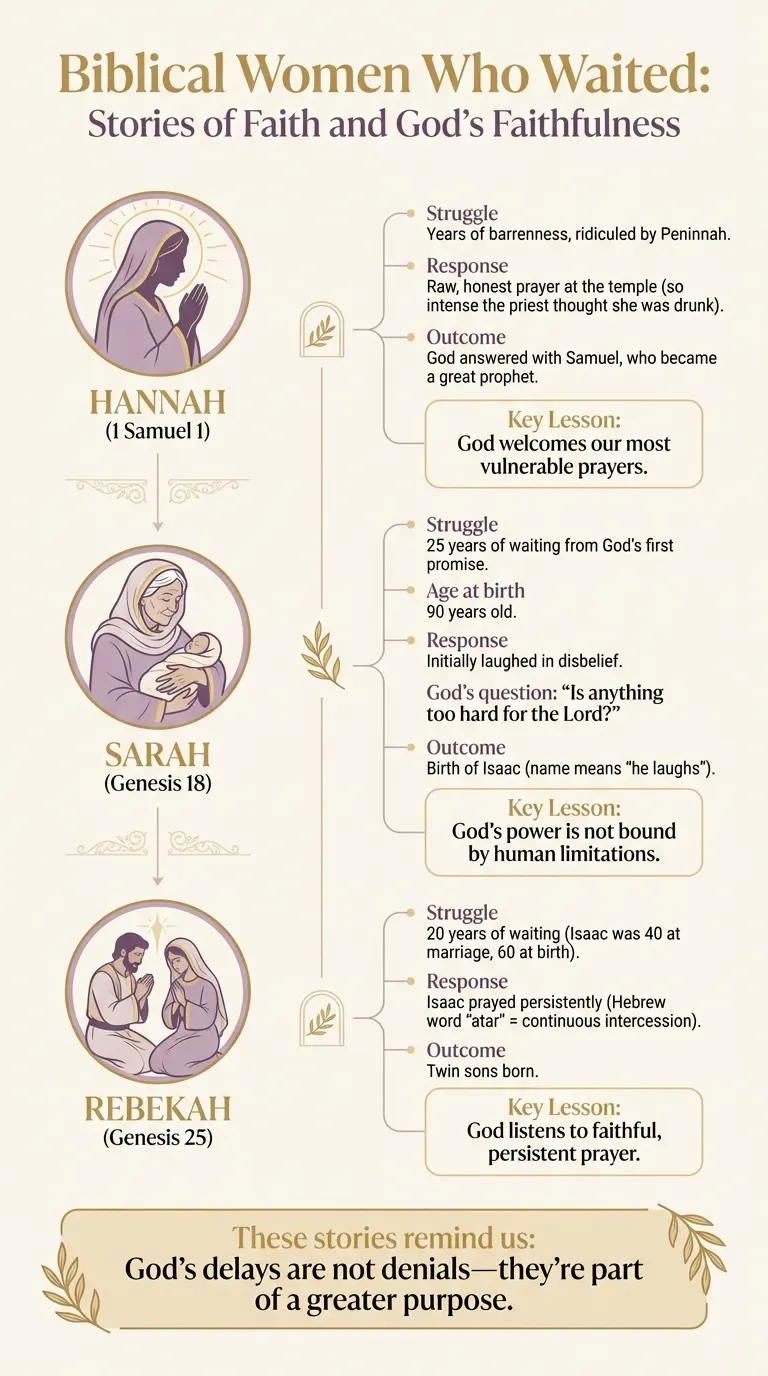
Biblical Women Who Waited: Stories of Faith Through Infertility
The Bible doesn’t shy away from the topic of infertility. It shares stories of women who endured years – even decades – of barrenness, highlighting a God who hears, intervenes, and stays present through the waiting. These stories offer encouragement, showing that faith and persistent prayer can bring hope, even in the most challenging seasons.
Hannah’s Story: Prayer and Faith in 1 Samuel 1
Hannah’s journey was marked by deep anguish, made worse by the constant ridicule from Peninnah, her husband’s other wife. Desperate and heartbroken, she brought her pain to God at the temple. Her prayer was so raw and intense that Eli, the priest, thought she was drunk. But her honesty in prayer didn’t go unnoticed – God answered her with the gift of a son, Samuel, who would grow to become one of Israel’s great prophets. Hannah’s story shows us that God welcomes our most vulnerable prayers, even when they’re filled with sorrow and desperation.
Sarah’s Journey: Trusting God’s Promise in Genesis 18 and Hebrews 11
Sarah and Abraham’s wait for a child stretched over 25 years from the time God first promised them a son. During those years, Sarah remained childless in a household bustling with activity. When God reaffirmed His promise that she would have a son within a year, Sarah – 90 years old at the time – responded with disbelief, laughing at the idea. Her doubt, captured in Genesis 18:12, is a relatable human reaction to what seemed impossible. Yet God’s response in Genesis 18:14 – “Is anything too hard for the Lord?” – reminds us that His power is not bound by human limitations. The birth of Isaac, whose name means “he laughs,” transformed Sarah’s laughter of doubt into one of joy.
Jen, Founder of Contentment + Chaos, reflects on this beautifully:
These times of waiting are also when God reveals His power to us. … We shouldn’t be focused on learning about ourselves during this waiting time, but about God.
Sarah’s story, alongside Rebekah’s, demonstrates the power of faith and prayer during long seasons of waiting.
Rebekah’s Experience: Prayer and God’s Answer in Genesis 25
Rebekah’s journey to motherhood also came after years of waiting. Isaac, her husband, was 40 when they married, but it wasn’t until he was 60 that she gave birth to twin sons. Instead of seeking human solutions, Isaac turned to God, praying persistently on her behalf. The Hebrew word “atar,” used in Genesis 25:21, reflects this idea of continuous, heartfelt intercession. Isaac’s example reminds us that even when the answer takes years, God listens to and responds to faithful, persistent prayer. Using prayer tracking apps can help you stay consistent in your intercession during these long seasons.
Bible Verses on God’s Power and Timing
When facing infertility, it can feel like an insurmountable challenge. But Scripture reminds us that God’s power goes far beyond human limitations. These verses offer hope by pointing to His strength, His compassion, and His perfect timing. Let’s explore how these truths shine through key passages.
Genesis 18:14 – Is Anything Too Hard for the Lord?
When Sarah laughed at the idea of having a child at 90 years old, God asked Abraham a powerful question: "Is anything too hard for the Lord? At the appointed time I will return to you, about this time next year, and Sarah shall have a son." This moment highlights an important truth: what seems impossible to us is never impossible for God. The phrase "appointed time" is a reminder that God’s plans unfold on His schedule, not ours. His delays are not denials – they’re part of a greater purpose that we may not fully understand right away.
Psalm 113:9 – Restoring the Childless Woman in a Family
"He settles the barren woman in her home as a joyful mother to her children. Hallelujah!" This verse reflects God’s deep compassion and His ability to transform even the most challenging situations. The stories of Sarah, Rebekah, Rachel, Hannah, and Elizabeth all show how God can bring life where there seems to be none.
But this promise isn’t limited to biological children. God’s definition of fruitfulness can include spiritual legacy, adoption, or mentorship. As one commentary explains, "The ‘barren woman’ ultimately pictures both a literal and a broader spiritual reality: God’s power reaches into the most impossible places to bring forth life, joy, and the expansion of His kingdom". Whether His answer comes as a child or in a different form, His timing is always guided by a wisdom far beyond our own.
Lamentations 3:22-25 – Mercies New Every Morning
Infertility often brings a mix of uncertainty, heartbreak, and spiritual fatigue. Failed treatments or a low chance of conception can leave you feeling helpless. In times like these, Lamentations 3:22-25 offers a lifeline: God’s mercies are new every morning, and His faithfulness provides strength for each day.
Catherine Inman, Event Coordinator at Lifeway, puts it this way: "Sometimes to understand, we must surrender the right to understand. We must surrender the right to have control over the situation, the right to make the plan ourselves, and the right to understand a sovereign God". God’s faithfulness isn’t tied to a "yes" answer to our prayers – it’s rooted in His unchanging character. As 2 Timothy 2:13 reminds us, "If we are faithless, he remains faithful, for he cannot deny himself".
This perspective allows for what some call "faithful lament" – bringing your pain and questions to God while still holding onto hope. You can process these emotions by voice journaling with Scripture to find deeper peace. Mary Schmal, author of Christ-Light Curriculum, offers this reassurance: "Within God’s plan everything fits together perfectly. Coping requires that kind of comfort. How wonderful to know that our lives are not off track". Trusting in God’s daily compassion can help you navigate the vulnerability of infertility, knowing that His plan is still unfolding, even when it’s hard to see the full picture.
Using Psalmlog to Navigate Infertility with Faith

Infertility is a deeply emotional journey, often filled with moments of doubt, frustration, and longing. It’s a time when finding a safe space to be honest with God becomes essential. Just as biblical figures leaned on their faith during seasons of waiting, Psalmlog provides tools designed to help you stay grounded in God’s promises. The Faith Builder plan ($19.99/month USD) offers practical features to nurture your spiritual connection during this challenging season.
These tools make it easier to engage with your faith and find strength in the midst of uncertainty.
Voice Journaling for Prayer and Reflection
Sitting in a waiting room before an appointment or processing tough medical news can feel overwhelming. Voice journaling offers a private outlet for prayer and reflection, even on days when you’re too drained to write it all down. With Psalmlog, you can simply speak your prayers into the app, capturing raw emotions and documenting your journey toward surrender and trust in God. Each month, you get 300 minutes of recording time, giving you plenty of space to work through the highs and lows of hope and disappointment.
Scripture Tagging for Personalized Guidance
Psalmlog allows you to tag Bible verses for quick access whenever you need encouragement. You can organize verses into categories like "Faithful", "Compassionate", or "All-Powerful", helping you focus on God’s character instead of the pain of waiting. For instance, you might tag Psalm 34:18 under "Brokenhearted" or Psalm 113:9 under "Hope." You could even create a "Refuge" category with verses like Psalm 46:1 and Nahum 1:7. As Kelley Ramsey and Jenn Hesse explain:
God is your steady companion through the relentless letdowns of infertility. Turning to him will give you a safe landing place after your dreams collapse.
By curating verses that resonate with your emotional patterns, you can build a personalized source of comfort and strength.
Sentiment Analysis for Spiritual Growth
Infertility often feels like an emotional roller coaster. Psalmlog’s sentiment analysis tool tracks your emotional trends over time, helping you recognize when you’re caught in cycles of disappointment or when feelings like shame and resentment begin to surface. These insights can gently nudge you to turn to scriptures of hope during challenging moments. Hannah’s story in the Bible, where she poured out her "anguish and resentment" to God, serves as a reminder of the healing that comes from honesty before Him. Recognizing when you’re feeling "crushed in spirit" allows you to lean on God as your refuge, trusting in the truth that, as Catherine Inman puts it:
God is big enough to sit with us in our heartbreak, but our heartbreak doesn’t change His character.
The app’s personal insights dashboard also highlights how God is working through your waiting, offering a tangible record of His faithfulness along your journey.
Conclusion: Finding Hope and Trust in God During Infertility
Infertility is an intensely personal journey, but Scripture reassures us that we are never truly alone. Many biblical figures endured long periods of waiting, only to witness God’s intervention in His perfect time. Their stories remind us that while God’s timing may differ from our own, His character remains steadfast. Whether His response is "not yet" or "no", He continues to be our refuge and source of strength during seasons of disappointment.
The experiences of Hannah, Sarah, and Rebekah illustrate how trusting God often means navigating the tension between His sovereignty and the pain of unmet desires. As Catherine Inman wisely points out, true understanding often requires surrendering our need for control. This hope from Scripture encourages us to live faithfully, even when the future feels uncertain.
In the waiting, consider the opportunities to love and serve those already in your life. Abraham and Sarah, for instance, cared for a household of at least 1,000 people during their decades of longing, witnessing numerous births among their servants while still yearning for their own child. Whether through nurturing family, mentoring others, or serving your community, these daily acts of love reflect your faith in action. By honoring others, you also honor God’s purpose for your life.
Faithful lament is another way to respond to suffering with trust. Like Jesus and Job, you can bring your raw emotions and toughest questions directly to God. Asking "Why?" is not a sign of weak faith but rather an acknowledgment that God is big enough to hold your pain. Using tools like Psalmlog to document your journey through lament can help you remember that God is present, even in your heartbreak.
Your story may not align with the miraculous births found in Scripture, but God’s nearness is unwavering. As Psalm 34:18 reminds us, He is close to the brokenhearted and saves those who are crushed in spirit. Just as the biblical figures clung to God’s promises, you can draw strength from His constant presence. Trust in the One who sustains all things, knowing that His faithfulness flows from His unchanging nature.
FAQs
How do I pray when I feel angry at God?
When you’re upset with God, it’s important to be honest in your prayers while maintaining respect. The Bible gives us examples, like Hannah, who poured out her heart about her pain and desires. You can express your feelings openly, saying something like, "God, I feel hurt and overlooked. Please help me trust in Your plan." God is ready to hear sincere prayers, even if they are filled with frustration. Using tools like voice journaling or reflective prayer can also help you work through your emotions and find comfort in His presence.
What if God’s answer is “no” to having a baby?
If God’s answer is “no,” it can feel deeply painful and confusing. The Bible gives us stories of people like Hannah, Sarah, and Rebekah, who endured long periods of waiting and faced significant challenges. These examples remind us to lean on God’s faithfulness, even when His plans don’t align with our desires. Turning to practical steps such as prayer, quiet reflection, or even journaling your thoughts aloud can provide comfort and help you discover peace in His timing.
How can Psalmlog help me stay grounded during infertility?
Psalmlog is here to walk alongside you during the difficult journey of infertility, offering support through biblical encouragement and practical tools grounded in scripture. It provides resources such as carefully selected Bible verses and reflections to help you hold onto God’s promises and feel His presence in your life.
Beyond these resources, Psalmlog introduces spiritual practices like voice journaling – a way to express your prayers and reflections aloud. This practice can nurture a deeper sense of trust, patience, and connection with God, bringing moments of hope and peace as you navigate this challenging time.