
Before You Call It Quits: 7 Bible Verses to Help Heal a Broken Marriage
Seven Bible verses and practical steps—unity, forgiveness, prayer, and mutual care—to help couples rebuild trust and restore a troubled marriage.
When your marriage feels like it’s falling apart, turning to Scripture can offer guidance, hope, and actionable steps to rebuild trust and love. The Bible provides timeless wisdom for navigating challenges, emphasizing unity, forgiveness, and commitment. Here are seven key verses to help strengthen your relationship:
- Genesis 2:24: Focus on unity by prioritizing your spouse and setting healthy boundaries with others.
- Colossians 3:19: Avoid bitterness and practice selfless, unconditional love.
- Ephesians 4:32: Embrace forgiveness as a choice, reflecting God’s grace in your relationship.
- 1 Corinthians 13:7: Commit to enduring love that perseveres through challenges.
- Ecclesiastes 4:12: Strengthen your bond by including God as the third strand in your marriage.
- Ephesians 5:28: Care for your spouse as you care for yourself, nurturing their needs with intention.
- Hebrews 10:24: Encourage each other toward love and good deeds, seeking support when needed.
These verses aren’t just for inspiration – they provide practical steps for healing and growth. Start small: pray together, set aside time for honest conversations, and reflect on one verse each week. With consistency and faith, you can work toward restoring your marriage.
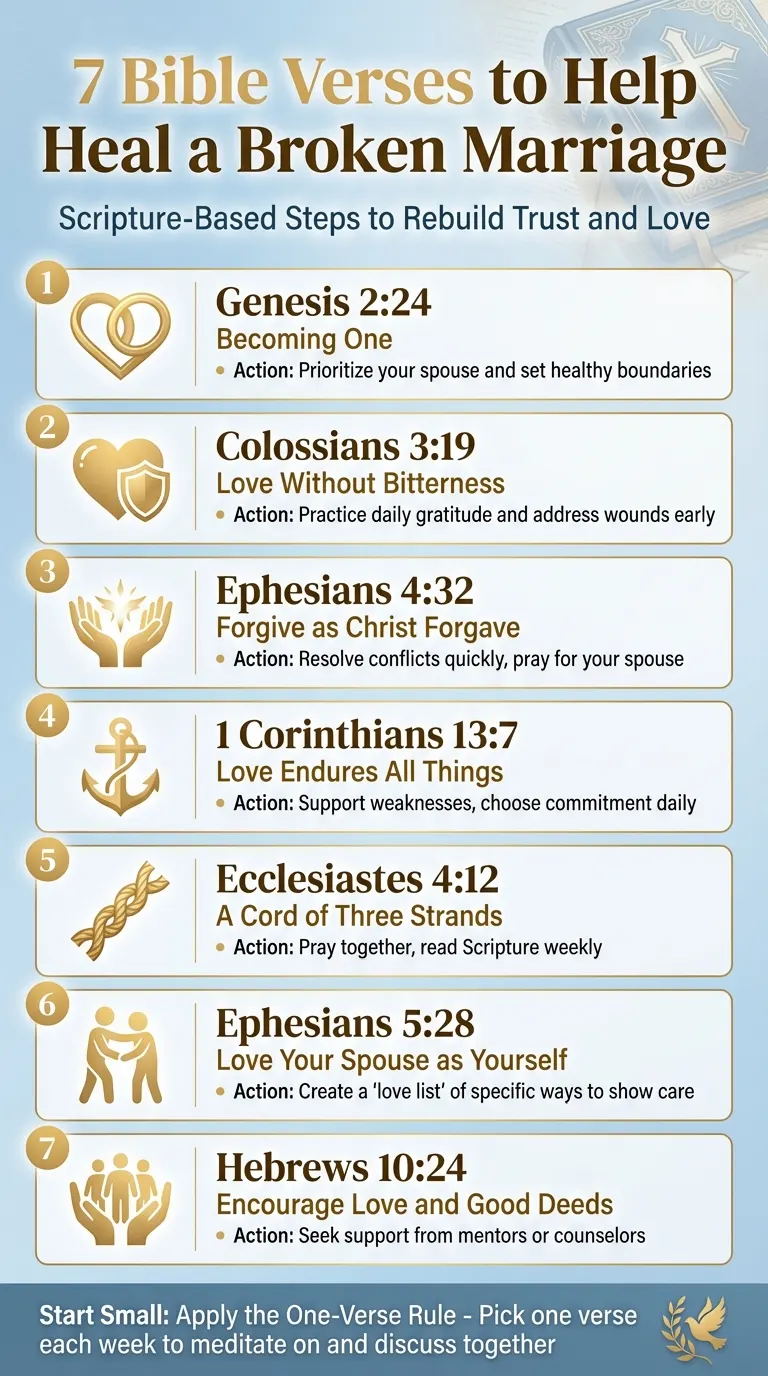
7 Bible Verses to Heal a Broken Marriage – Quick Reference Guide
10 Bible Verses To Save And Heal Your Marriage
1. Genesis 2:24 – Becoming One in Marriage
"Therefore a man shall leave his father and his mother and hold fast to his wife, and they shall become one flesh." This verse outlines the foundation for a strong and enduring marriage, even in difficult times.
The phrase "one flesh" reflects a profound union that goes beyond the physical. It signifies a connection of hearts, minds, and lives. When challenges arise, this mindset shifts the focus from "me versus you" to "us", serving as a reminder that marriage is a sacred bond brought together by God.
Genesis 2:24 highlights three key steps to building unity in marriage: leave, cleave, and become one.
- Leaving involves stepping away from emotional and financial reliance on your family of origin. Your spouse becomes your first priority. As Scott Roberts puts it, "A man’s first allegiance is no longer to his father and mother. It is to his wife." If family members are overly influencing decisions or if you find yourself seeking their support instead of your spouse’s during conflicts, this step might need attention.
- Cleaving comes from the Hebrew word dabaq, meaning "to be joined firmly." It emphasizes unwavering commitment. As GotQuestions.org explains, "Covenants are not mainly for easy times, but for the hardest." When you’re tempted to give up, remember that the covenant of marriage is designed to hold you together through trials, not just during joyful moments.
To put these principles into practice, consider setting clear boundaries with extended family, addressing conflicts directly within the marriage, and making decisions as a team. If struggles persist, consulting a mature Christian counselor can provide valuable guidance. Approach decisions with a unified perspective that aligns with God’s vision for your marriage.
Adopting this perspective creates a strong foundation for exploring other scriptural teachings on love and forgiveness.
2. Colossians 3:19 – Love Without Bitterness
"Husbands, love your wives, and do not be harsh with them."
This verse highlights the destructive nature of bitterness, which can erode trust and respect within a marriage.
The word agape refers to a selfless, unconditional love – a choice to prioritize your spouse beyond fleeting emotions. This type of love builds on the foundation of marital unity established in Genesis 2:24. Pastor Steven J. Cole captures this beautifully:
"Biblical love is not primarily a feeling. Rather, it’s a self-sacrificing, caring commitment which shows itself in seeking the highest good of the one loved".
Even when romantic feelings fade, this commitment-driven love can be rekindled through intentional effort and faithfulness.
The phrase "do not be harsh" comes from the Greek word pikrainesthe, which conveys bitterness or irritability. Cole elaborates on this, describing it as:
"a lingering anger born of unmet expectations".
Bitterness acts like a slow-acting toxin, chipping away at trust, open communication, and mutual kindness.
A powerful modern example of love without bitterness is Robertson McQuilken’s story. In February 2004, after 22 years as President of Columbia Bible College and Seminary, he stepped down to care for his wife, Muriel, who was battling Alzheimer’s. After 42 years of marriage, McQuilken chose to honor his vows over career ambitions, calling his decision a matter of integrity. His actions beautifully reflect the biblical call to love through selfless commitment.
To prevent bitterness from taking root, it’s essential to address emotional wounds as they arise through honest, open conversations. Practicing daily gratitude can also help shift focus away from frustrations. Small, intentional acts – like actively listening, pitching in with chores unprompted, or choosing to see your spouse’s strengths instead of dwelling on imperfections – are practical ways to "die to self" and nurture a love that lasts.
3. Ephesians 4:32 – Forgive as Christ Forgave You
"Be kind and compassionate to one another, forgiving one another as God forgave you."
Ephesians 4:32 takes the idea of unity and selfless love a step further, calling you to embrace forgiveness. This verse emphasizes that forgiveness isn’t just a feeling – it’s a choice to reflect the same grace God has shown you. The phrase "just as" serves as a reminder that because you’ve been given God’s boundless grace, you are expected to extend it to your spouse.
Ernie Baker, Pastor of Counseling at First Baptist Church of Jacksonville, offers a striking perspective:
"Bitterness is the poisonous pill we swallow hoping it will kill someone else."
Holding onto unforgiveness doesn’t punish your spouse – it hurts you. Kevin Wood, Co-director of The Marriage Partnership, adds, "It may not always be possible to forget the hurt caused, but the act of forgiveness is a decision that leads to the start of the process."
So, how can you live out this verse in your marriage? Start by pinpointing specific hurts and writing them down. Bring these to God in prayer, asking for His help to forgive. Commit to resolving conflicts quickly – don’t let anger fester overnight. It’s hard to stay angry with someone when you’re consistently praying for them.
You’ll know forgiveness is taking root when revisiting past wounds no longer stirs up pain. This healing often comes through the gentle work of the Holy Spirit. Choosing forgiveness daily creates the foundation for a love that endures.
4. 1 Corinthians 13:7 – Love Endures All Things
"Love bears all things, believes all things, hopes all things, endures all things."
Marriage can feel fragile at times, but this verse serves as a powerful reminder that love, as described in the Bible, is built to persevere. The Greek word hypomeno, used here, translates to perseverance – a steadfast love that doesn’t retreat when challenges arise. It’s about making a deliberate choice to stay committed, no matter the situation.
Dr. Henry Wright, founder of Be in Health, puts it plainly:
"If love ever stops loving, love never loved at all."
This underscores an important truth: enduring love isn’t driven by fleeting emotions, but by a conscious, daily effort. Julie Sanders, a contributor at Crosswalk, further explains:
"Agape love in a relationship… means coming to your partner with a ‘you before me’ attitude."
This kind of love places your spouse’s needs above your own comfort.
How can you apply this practically in your marriage? Start by supporting each other’s weaknesses. If your spouse struggles with something like managing finances or expressing emotions, use your strengths to fill in those gaps instead of pointing out their flaws. When frustration builds, turn to prayer instead of criticism, giving those irritations to God. Practice forgiveness repeatedly – think "70 x 7" – and lift your partner up when they falter, especially during difficult times.
It’s important to note that "enduring all things" doesn’t mean tolerating abuse. Setting firm boundaries is essential, and in some cases, separation may be necessary for safety, even as forgiveness is extended. Endurance in love is about staying committed to the covenant and trusting God’s process, not staying in harm’s way.
Lastly, shift your perspective to an eternal one. See today’s struggles as "light momentary afflictions" that are preparing you for something greater. With this mindset, the burdens of today feel less overwhelming. Tiffany Montgomery, author at Hope Joy in Christ, reminds us:
"Love is a choice that requires a daily commitment."
Living out this enduring love equips you to embrace the next biblical principle.
5. Ecclesiastes 4:12 – A Cord of Three Strands
"Though one may be overpowered, two can stand strong together. A cord of three strands is not quickly broken."
When marriage feels fragile, this verse paints a vivid picture of what can hold a relationship together. The "three strands" symbolize you, your spouse, and God woven into a single, unbreakable bond. Clarence L. Haynes Jr., author of The Pursuit of Purpose, explains:
"A cord of three strands speaks to the interweaving of three cords into one. This symbolism is used in some marriage ceremonies. One strand represents the bride, one represents the groom, and the other represents God."
The concept isn’t just poetic – it’s practical. Braided ropes are stronger because tension is shared across all strands. Historical evidence shows that three-strand cords were familiar to the original audience of this verse. For this image to work in your marriage, though, both partners must first be individually connected to God. Renée Gotcher, a writer and entrepreneur, emphasizes:
"The threefold cord in a Christian marriage should start with two individuals who are first tightly bound to the Lord. Then when we become one, the Lord is already present in that oneness."
This idea underscores the importance of unity with God as the foundation for healing and strengthening your relationship.
But how can you make this threefold cord a reality in your marriage? Start small. Pray together for just five minutes, twice a week. Pick a Bible verse to read and discuss weekly. When disagreements arise, focus on expressing your needs rather than assigning blame. For example, replace "You never help" with "I’m feeling overwhelmed and could use your help." This approach invites connection instead of defensiveness. Finally, avoid living separate lives with separate goals. Look for shared values, activities, and dreams – your "intersections" – to keep you aligned and moving forward with God at the center.
This principle of spiritual unity sets the stage for the next scriptural insight on rebuilding and strengthening your marriage.
6. Ephesians 5:28 – Love Your Spouse as Yourself
"In this same way, husbands ought to love their wives as their own bodies. He who loves his wife loves himself."
This verse takes the idea of unity and forgiveness in marriage a step further, calling for deep care and attentiveness toward your spouse. It emphasizes that loving your spouse is not separate from caring for yourself – it’s one and the same. The "one flesh" idea from Genesis underscores this union, where nurturing your partner is equivalent to nurturing your own well-being. As Matthew Henry explains:
"All the duties of marriage are included in unity and love."
Think about how you naturally care for your own body: when you’re hungry, you eat; when you’re hurt, you seek healing; when you’re tired, you rest. John Gill echoes this sentiment:
"He that loveth his wife loveth himself; because she is one body and flesh with him."
This means addressing your spouse’s needs – whether physical, emotional, or spiritual – with the same urgency you would your own.
Marriages often falter when one partner gives only leftover energy or attention. Amanda Idleman highlights this challenge:
"If you are offering them the scraps of your mood, time, and commitment then you are not following God’s instruction for your life."
By choosing to prioritize your spouse, even in moments of conflict or fatigue, you reinforce the bond you share.
A practical way to start is by creating a "love list." Jot down specific ways to show care – like giving your full attention during a conversation, expressing gratitude for small gestures, or pausing your tasks to focus on their concerns. Albert Barnes reminds us of the rewards of such efforts:
"A man’s kindness to his wife will be more than repaid by the happiness which she imparts; and all the real solicitude which he shows to make her happy, will come to more than it costs."
When you care for your spouse with intention, it fosters a relationship where both partners can grow and heal together. This mutual care becomes a foundation for a stronger, more fulfilling union.
7. Hebrews 10:24 – Encourage Love and Good Deeds
"And let us consider how we may spur one another on toward love and good deeds."
This verse invites couples to take an active role in cultivating love and inspiring each other to do good. The emphasis on the word "consider" highlights the importance of being intentional. Instead of passively waiting for positive changes, it encourages creating an atmosphere where both partners can grow together.
Healthy marriages don’t exist in isolation – they thrive with support. Amanda Idleman, a Christian writer, emphasizes this beautifully:
"Accountability is vital to a healthy marriage and particularly important when you are working to restore the broken spaces of your marriage."
When difficulties arise, seeking guidance from a trusted pastor, mentor couple, or professional Christian counselor shows strength, not weakness. Surround yourselves with people who can provide honest advice and spiritual encouragement. Together, take the time to learn how to love each other more deeply, and don’t hesitate to reach out for help when you need it.
Conclusion
When your marriage feels like it’s falling apart, these seven Bible verses can serve as a guide to help rebuild what’s broken. Scripture provides a solid foundation for a marriage rooted in God’s design. As Tony and Alisa DiLorenzo, founders of One Extraordinary Marriage with over 25 years of ministry experience, put it:
"Scripture provides the foundation everything else is built on."
The real challenge lies in turning these verses into daily actions. It’s not about achieving perfection but about staying consistent. A simple way to start is by applying the One-Verse Rule: pick one verse each week to meditate on and discuss. Use it to spark meaningful conversations rather than arguments. For instance, reflect on 1 Corinthians 13 as a couple and ask, “Where have we stopped being patient with each other?” This practice builds a shared spiritual vocabulary that can help reduce tension and foster understanding.
To support this journey, consider tools that promote spiritual growth. Psalmlog, for example, offers features like voice journaling and scripture reflection, allowing you to process emotions, track progress, and see how God is working in your relationship. Personalized biblical guidance from such tools can provide much-needed encouragement during difficult times.
Restoration also requires practical help alongside spiritual growth. Pair your scripture study with Christian counseling or marriage coaching to gain actionable communication skills and deeper biblical insights. With over 19,000 fathers already using biblical resources to lead their families more intentionally, it’s clear that these tools can make a tangible difference.
FAQs
How do I start using these verses with my spouse without a fight?
Approach the conversation with a calm and understanding mindset, focusing on creating a safe space for open dialogue. Pick a quiet, private moment to share the verses, highlighting your intention to work toward healing and growth together. Center the discussion on shared values like love and forgiveness, and propose reflecting on the verses as a meaningful activity you can do as a team. Speaking with patience and care helps strengthen bonds and encourages harmony.
What if my spouse won’t pray or read Scripture with me?
If your spouse isn’t open to joining you in prayer or Scripture reading, focus on nurturing your own spiritual journey. Embrace forgiveness and show kindness, as encouraged in Ephesians 4:32. Patience is key – your steadfast faith and consistent actions can serve as a quiet but powerful example. Trust that God can use your commitment to encourage healing and reconciliation, working through you to reflect His plan for love and restoration.
Do these verses mean I should stay if there’s abuse?
The Bible clearly stands against any form of abuse. If you’re facing abuse, your safety must come first. It’s important to reach out for professional help and not rely solely on scripture when deciding how to handle such situations. Your well-being is incredibly important, and seeking guidance from trusted professionals and faith leaders can provide the support you need during this challenging time.