
How to Communicate Better in Your Marriage: 5 Biblical Principles
Five Bible-based principles—uplifting speech, active listening, honest grace, quick conflict resolution, and shared prayer—transform how married couples communicate.
Communication is essential to a strong marriage, but daily stress can make it challenging. The Bible offers clear guidance to improve how couples connect. Here are five key principles to build deeper understanding and unity with your spouse:
- Speak uplifting words: Use kind, constructive language (Ephesians 4:29).
- Listen actively: Focus on understanding your spouse’s thoughts and feelings (James 1:19).
- Be honest with grace: Balance truth with sensitivity (Ephesians 4:15).
- Resolve conflicts quickly: Address issues before resentment builds (Ephesians 4:26–27).
- Pray together: Invite God into your conversations for spiritual unity.
These principles, rooted in Scripture, help couples navigate challenges and strengthen their bond. Read on for practical steps to apply them.
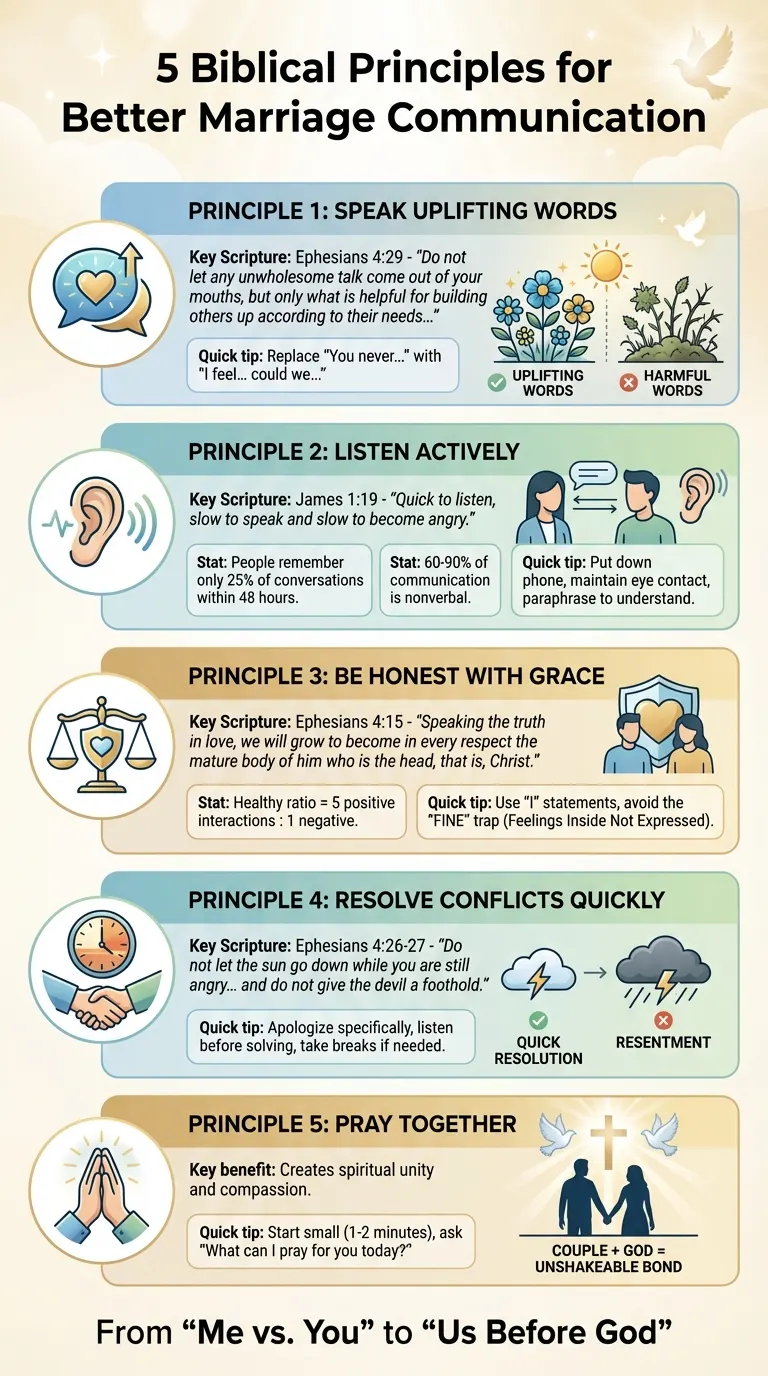
5 Biblical Principles for Better Marriage Communication
Principle 1: Use Words That Build Up Your Spouse
What the Bible Says About Uplifting Speech
The Bible emphasizes the power of your words, especially in marriage. Ephesians 4:29 advises, "Let no unwholesome talk come out of your mouths, but only what is helpful for building up the one in need and bringing grace to those who listen." The word "unwholesome" here refers to speech that causes harm rather than offering nourishment.
Proverbs often contrasts the impact of positive and negative words. Proverbs 16:24 compares kind words to a "honeycomb", offering sweetness to the soul and even physical health. On the flip side, Proverbs 15:4 warns that while a gentle tongue fosters life, harsh words can crush the spirit. Your spouse deserves words that heal and uplift, not those that cut like a "piercing sword" (Proverbs 12:18).
Replace Negative Language with Constructive Words
Improving how you communicate starts with identifying harmful speech patterns. Phrases like "always" and "never" often escalate conflict. Instead of saying, "You never help around the house", try something like, "I’m feeling overwhelmed by the housework; could we work on a plan together?"
Dennis and Barbara Rainey offer this perspective:
"Words are like seeds. Once planted in your mate’s life, your words will bring forth flowers or weeds, health or disease, healing or poison."
Replace sarcasm with sincerity. If you’re tempted to criticize, focus on communicating specific needs instead of attacking character. For example, instead of saying, "You’re lazy", you could say, "I’d really appreciate it if you could help with the dishes tonight."
Dr. David Jeremiah shared a cautionary story about a husband who publicly insulted his wife, stating:
"Nothing will destroy a marriage more quickly than public insult."
This serves as a powerful reminder to handle private matters privately. Adjusting your language in these ways opens the door to more meaningful and encouraging interactions.
Practical Ways to Encourage Your Spouse
Encouraging your spouse starts with paying attention to their efforts and expressing genuine gratitude. Reflect on "whatever is lovely" (Philippians 4:8) to shift your focus from criticism to appreciation.
Consider offering praise in public settings. Highlight your partner’s strengths, whether it’s their faith, work ethic, character, parenting, or unique qualities. These moments of affirmation not only boost your spouse but also reflect the gratitude in your heart. When you cultivate a habit of thankfulness, encouragement naturally follows.
Principle 2: Listen Actively and Seek to Understand
What the Bible Says About Listening
The Bible emphasizes listening as a profound act of love and humility. James 1:19 encourages believers to be "quick to listen, slow to speak and slow to become angry." This isn’t just practical advice – it’s a divine directive that can transform how you approach conversations within your marriage.
Proverbs 18:13 warns, "to answer before listening – that is folly and shame." When you respond without fully hearing your spouse, you not only risk being disrespectful but also miss the chance to truly understand their heart. Similarly, Proverbs 18:2 highlights that "a fool takes no pleasure in understanding, but only in expressing his opinion." Genuine listening requires setting aside your own need to speak first and focusing on your spouse’s emotions and concerns.
By listening well, you show respect and create room for a deeper, more authentic connection. Let’s explore some practical ways to bring this biblical guidance into your daily life.
How to Practice Active Listening
Active listening is more than just hearing words – it’s about being fully present and engaged. Studies reveal that people remember only about 50% of what they hear immediately after a conversation, and this drops to less than 25% within 48 hours. That’s why intentional listening techniques are so important.
Start by giving your spouse your undivided attention. Put down your phone, turn off distractions like the TV, and maintain eye contact. Since 60%–90% of communication is nonverbal, your body language matters – open posture and eye contact signal genuine presence.
Try reflective paraphrasing to ensure you understand correctly. For example, say, “What I hear you saying is… Is that right?” This approach confirms your understanding before responding. As Brad Rhoads, Co-founder of Grace Marriage, puts it:
"True listening builds trust. It opens the door to emotional and spiritual intimacy."
Avoid falling into the "Explain, Justify, Defend" trap. When your spouse shares a concern, focus on listening fully before responding. Ask clarifying questions to show engagement, and when it’s your turn to speak, use “I statements” to express your feelings. For instance, say, “I feel overwhelmed when…” instead of “You never…”
Recognize Gender and Emotional Differences
Understanding how men and women communicate differently can further improve your listening skills. Research shows that women tend to engage both hemispheres of the brain, which helps them pick up on emotional subtleties, while men often focus on the literal content of conversations.
Women often process emotions and thoughts by talking through them, while men typically aim to solve problems through direct communication. As Tracy Dwyer, Podcast Host at PursueGOD, explains:
"Women tend to engage both hemispheres of their brains when listening, whereas men typically rely on just one hemisphere."
This difference means wives often need their husbands to simply listen and validate their emotions before jumping to solutions. Husbands, on the other hand, may prefer clear communication about specific needs. For example, if your spouse expresses frustration, a simple acknowledgment like, “I can see why that hurt,” can go a long way. This kind of validation shows you’re truly listening, not just waiting for your turn to speak.
On average, people hear between 20,000 and 30,000 words daily and spend about 45% of their waking hours listening. With so much communication happening, intentional listening is crucial. Remember, silence or crossed arms don’t always mean anger – your spouse might just be processing their thoughts. Instead of assuming, ask clarifying questions to better understand their perspective.
Active listening, paired with the honest and uplifting communication discussed earlier, lays the groundwork for a deeper, more meaningful marital bond.
Principle 3: Be Honest, Clear, and Sensitive
Why Honesty Matters in a Christ-Centered Marriage
Honesty, paired with uplifting speech and active listening, is a cornerstone of spiritual communication in marriage. Trust begins with truth. Proverbs 12:22 reminds us, "The Lord delights in those who are truthful", highlighting how much God values transparency in our relationships. When you’re honest with your spouse, you create a bond built on security and mutual understanding.
That said, truth without compassion can hurt, while avoiding truth creates emotional distance. Ephesians 4:15 guides us to "speak the truth in love", a reminder that honesty and grace must go hand in hand, especially in the delicate dynamics of marriage. This balance reflects the kind of love Christ modeled – truthful, yet tender.
Authors and ministers Dave and Ashley Willis warn against falling into the "FINE" trap, where couples resort to "Faking, Ignoring, Neglecting, and Evading the truth". Saying "I’m fine" when you’re upset or hurt might seem easier in the moment, but it sacrifices real connection. May Patterson, a Bible teacher, puts it this way:
"Saying ‘I’m fine’ when you’re not fine, isn’t speaking the truth. It’s better to express how you feel now, rather than to explode later."
Honesty lays the groundwork for mutual understanding, but it also requires wisdom and grace to maintain a healthy balance.
Balance Transparency with Grace
Being honest doesn’t mean sharing every passing thought, especially if it might hurt your spouse unnecessarily. Discernment is key. For example, minor irritations or critical thoughts about appearance might be better left unsaid unless they serve a constructive purpose. The intent behind your honesty matters. As the Marriage Recovery Center advises:
"A good rule of thumb is, if it’s painful for you to criticize, you’re probably safe in doing it. But if you take the slightest pleasure in it, hold your tongue."
When expressing concerns, use "I" statements to take ownership of your feelings rather than placing blame. For instance, instead of saying, "You never help around the house", try, "I feel overwhelmed when the dishes pile up." This approach invites collaboration rather than defensiveness.
Timing and tone also play a crucial role. Colossians 4:6 encourages us to let our words be "seasoned with salt." If your spouse is stressed or tired, consider asking, "When would be a good time to talk about something important?" rather than diving into a tough conversation at the wrong moment. Sensitivity to their state of mind can make all the difference.
When honesty is paired with grace and thoughtfulness, even difficult topics can be handled with care and respect.
How to Handle Difficult Conversations
Tough conversations don’t have to be destructive. Psychologists suggest that a healthy relationship thrives when there are about 5 positive interactions for every 1 negative one. This doesn’t mean avoiding conflict – it means ensuring that your overall communication remains supportive and affirming.
One helpful method for approaching sensitive topics is the X, Y, Z format: "In situation X, when Y happened, I felt Z." This structure allows you to express your feelings clearly without assigning blame. Another approach is the three-question feedback loop: ask, "What was said?", "What was heard?", and "What was meant?" This ensures both partners understand each other and prevents miscommunication.
When your spouse opens up about something difficult, respond with grace instead of reacting defensively or angrily. If honesty is met with punishment, they may start hiding their true feelings. Duane Sheriff, Senior Pastor at Victory Life Church, emphasizes:
"Truth and truth spoken in love is essential to build and grow a healthy relationship."
Also, resist the urge to interrupt or counter every point. Focus on fully understanding your spouse’s perspective before responding. Keep personal grievances private, avoiding the temptation to air them in front of others. The goal isn’t to "win" a disagreement – it’s to build a stronger, more loving connection through honest and thoughtful communication.
Successful Communication in Marriage | Jimmy Evans
Principle 4: Resolve Conflict and Resentment Quickly
Addressing conflict promptly strengthens the bond in your marriage, ensuring issues don’t grow into deeper divides.
The Harm of Unresolved Conflict
Letting conflicts linger can weaken the foundation of your marriage. Ephesians 4:26–27 reminds us not to let the sun set on our anger, emphasizing how unresolved anger can harm relationships. Ron Blue, a financial expert at Focus on the Family, warns:
"Nursing anger overnight gives the devil a foothold. Don’t leave yourself (or your marriage) vulnerable."
When conflicts are ignored, they fester. James 4:1–2 explains that many quarrels arise from internal struggles and unchecked desires. These small disagreements, if left unresolved, can spiral into recurring and damaging patterns. The goal isn’t to avoid conflict entirely – that’s unrealistic. Instead, the focus should be on addressing issues promptly to prevent them from undermining your connection.
Biblical Principles of Forgiveness
Forgiveness is a non-negotiable in a Christ-centered marriage. Scripture calls on believers to forgive one another just as Christ has forgiven us, urging kindness and compassion in the process. Dave Jenkins, Executive Director of Servants of Grace Ministries, describes forgiveness this way:
"Forgiveness does not minimize sin, excuse patterns of harm, or eliminate consequences. But it does release vengeance. It refuses to weaponize the past. It chooses reconciliation when repentance is present."
True forgiveness doesn’t mean ignoring wrongs – it’s about releasing bitterness and focusing on restoration. Once forgiveness is extended, shift the conversation to resolving the issue rather than rehashing past grievances. Avoid using phrases like "you always" or "you never", which can feel like personal attacks. A strong marriage thrives on repentance and grace, not just compatibility.
Steps to Resolve Disagreements Constructively
Start by looking inward. Before pointing out your spouse’s faults, examine your own heart and actions. Take responsibility by offering a clear apology, such as: "I am sorry for [specific action]. Please forgive me." This mirrors the biblical teaching of addressing the "log" in your own eye first.
When discussing disagreements, focus on listening before jumping to solutions. Make an effort to truly understand your spouse’s perspective by summarizing their concerns. This approach – "hear before resolve" – can reduce tension and help you find common ground. Clearly define the issue in a neutral way without assigning blame, then work together to brainstorm solutions that work for both of you. The goal is unity, not victory.
If emotions run high, it’s okay to take a break. Just let your spouse know and agree on a specific time to revisit the conversation – for example, "Let’s talk about this after dinner." Above all, invite the Holy Spirit to guide your discussion through prayer. This shifts the focus from proving who is right to seeking wisdom and unity.
For persistent issues like explosive anger or prolonged withdrawal, consider seeking biblical counseling. As Proverbs 11:14 reminds us, there is safety in seeking wise counsel. Inviting the Holy Spirit into your conversations creates a foundation for prayerful partnership and unity.
Principle 5: Pray Together and Invite God Into Your Conversations
While uplifting words and active listening can strengthen your connection, praying together takes it to a deeper, spiritual level. Prayer doesn’t just enhance communication – it aligns your hearts, creating a bond that goes beyond everyday conversations and fosters genuine closeness.
How Prayer Improves Communication
Praying together creates spiritual unity, helping you become "one heart and one soul." This shared focus can prevent the drift toward independence that often causes tension in marriages. When you hear your spouse pray, it offers a glimpse into their fears and stresses, building trust and understanding in ways that regular conversations might not.
Prayer also has a way of naturally easing conflict. As Rodgers Christian Counseling explains:
"Prayer encourages forgiveness, and helps couples see each other with compassion."
It’s hard to stay angry when you’re bowing your head together before God. Prayer fosters humility, as both partners acknowledge their own needs and flaws. This vulnerability softens pride and brings sincerity into your relationship.
Regular prayer also acts as a safeguard against resentment. It shifts your focus from complaints to gratitude, keeping your hearts open and connected. By incorporating prayer into your daily life, you create a positive rhythm that strengthens your bond and helps you navigate challenges.
Practical Ways to Pray Together in Marriage
If praying together feels daunting, start small. Keep it simple with short prayers – just a minute or two is enough. Find a consistent time that works for both of you, like first thing in the morning, during a walk, or before bed. One easy method is the "hand squeeze": hold hands and pray silently, signaling with a squeeze when you’re done.
Make it a habit to ask your spouse, "What can I pray for you today?" This question opens the door to understanding their emotional and spiritual needs. Before tackling tough conversations, pause to pray together, asking for God’s wisdom and timing. You can also incorporate Scripture by reading a short verse – like one from Psalms or Proverbs – to guide your thoughts and focus on shared values.
Be mindful not to use prayer as a way to criticize your spouse. Instead, follow the "remove the plank" principle: pray about your own shortcomings and ask for a heart to serve. As David and Jan Stoop, authors and counselors, suggest:
"Lord, you are here listening as we talk, and we want to acknowledge your presence and ask for your help with this situation".
This approach keeps prayer centered on seeking God’s guidance, rather than assigning blame.
Stay Rooted in Christ for Communication Strength
Beyond shared prayer, nurturing your personal relationship with Christ plays a key role in strengthening your communication as a couple. When you’re rooted in Scripture and prayer individually, you naturally bring more love, patience, and self-control into your interactions. These qualities, empowered by the Holy Spirit, help you encourage your spouse with compassion and grace.
Rodgers Christian Counseling emphasizes this idea:
"When a husband and wife bow their heads together and speak to God about their worries, dreams, and gratitude, they strengthen a bond that cannot be easily shaken".
This spiritual foundation acts as a shield against external pressures and challenges that could disrupt your unity. By maintaining both personal devotion and shared prayer, you create a resilient connection that endures through every season of marriage.
Conclusion
How the 5 Principles Work Together
The five biblical principles discussed earlier work hand in hand to ease tensions and prevent the emotional barriers that unresolved conflict can create. By consistently choosing words that uplift, listening attentively, communicating with honesty and grace, addressing conflicts quickly, and praying together, couples can shift their mindset from "me vs. you" to "us before God". Over time, these habits form lasting patterns that strengthen relationships, even during challenging times like raising children or navigating financial stress.
Studies suggest that maintaining a healthy relationship often requires a balance of five positive interactions for every negative one. Applying these biblical principles intentionally can transform your home into a space filled with encouragement. This not only nurtures your marriage but also serves as a testimony of Christ’s grace, influencing your children and those around you. However, this foundation requires ongoing care and commitment.
Keep Growing in Your Communication
While these principles provide a strong starting point, continued effort and forgiveness are vital for long-term marital growth. Effective communication in marriage demands intentionality, empathy, and a daily commitment to applying biblical teachings as you and your spouse grow together.
Forgiveness is important in this process – it allows couples to move past setbacks and ensures that minor disagreements don’t turn into lasting divisions. As Dr. David Jeremiah beautifully puts it:
"That is what forgiving someone means – restoring relationships to the status they enjoyed before the offense took place".
FAQs
How do we start praying together if it feels awkward?
Starting to pray together as a couple might feel a bit awkward initially, but taking small, manageable steps can make it easier. Begin by sharing your intention to pray for your spouse as a way to express love and care. You could start with simple, low-pressure actions – like holding hands and praying silently together or offering a brief prayer of gratitude. Choose a regular time and place to pray, making it a comforting and supportive space for both of you.
What if my spouse won’t talk or listen during conflict?
If your spouse shuts down during conflict, it’s important to lean into patience, prayer, and understanding. Instead of pushing them to talk, allow them the space they need. Use this time to pray for clarity and wisdom, and when the moment feels right, gently share your willingness to communicate when they’re ready. The Bible reminds us to speak the truth in love and to approach others with gentleness. By consistently demonstrating love through patience, kindness, and humility, you can help foster a safe and trusting atmosphere, making open conversations more likely over time.
How can we handle hard truths without hurting each other?
To navigate difficult truths without causing unnecessary pain, approach the conversation with honesty, love, and kindness. Be mindful of your spouse’s emotions by choosing your words carefully, maintaining a respectful tone, and finding the right moment to talk. Instead of focusing on criticism, aim for a constructive and gentle discussion. Biblical teachings highlight the importance of speaking in ways that nurture trust and harmony, which can help foster understanding even in challenging conversations. By practicing patience and leading with love, you can share the truth while minimizing hurt.