
Bible on Lying: Is Lying a Sin?
Why the Bible calls lying sin — including white lies, gossip, and half-truths — and how to confess, repent, and rebuild trust.
Yes – according to the Bible, lying is sin. I see the article’s main point as simple: God is truthful, lying goes against His nature, and dishonesty harms both people and trust.
Here’s the whole article in plain terms:
- Lying is sin, whether it is a direct lie, a half-truth, spin, gossip, or a broken promise.
- God does not lie (Hebrews 6:18; Titus 1:2), so His people are called to speak truth.
- “White lies” are not excused in Scripture just because they seem small.
- Dishonesty damages trust at home, in church, at work, and online.
- The Bible treats false speech seriously, from everyday exaggeration to public deception.
- Repentance means more than feeling bad – I need to confess, tell the truth plainly, correct the harm, and rebuild trust over time.
A few passages drive that home: Ephesians 4:25, Colossians 3:9, Proverbs 12:22, and Revelation 21:8. One of the sharpest examples is Acts 5:1–11, where public deception in the church brought severe judgment.
Here’s the short version:
| Issue | What the article says |
|---|---|
| Is lying a sin? | Yes |
| What counts as lying? | False words, half-truths, silence meant to mislead, gossip, spin, and empty promises |
| Why is it wrong? | It goes against God’s truth and harms people |
| Are white lies okay? | No |
| What should I do after lying? | Confess, repent, correct it, and rebuild trust |
If I had to sum it up in one line, it would be this: the Bible calls me to plain, honest speech because truth reflects God, while lies break trust and stain the conscience.
What does the Bible say about Lying? Half Truths?
Is lying a sin according to the Bible?
Yes. Scripture treats lying, falsehood, and deliberate deception as sin (Leviticus 19:11; Ephesians 4:25; Colossians 3:9; Revelation 21:8). It is not a minor slip. It is sin. That leads to a bigger point: what does Scripture mean by lying?
How the Bible defines lying and falsehood
In the Bible, lying includes any deliberate attempt to mislead – through words, silence, or partial truth.
Why lying goes against God’s character
Lying is sinful because it runs against God’s truthfulness. Numbers 23:19, Titus 1:2, and Hebrews 6:18 teach that God does not lie and cannot lie. Jesus identifies Satan as "the father of lies" in John 8:44. Even a small act of deception puts the speaker against God. Believers are called to reflect that truth in their speech. That’s why common excuses, including "white lies", don’t hold up in Scripture.
Why common excuses for lying do not hold up in Scripture
Scripture does not make room for a harmless class of falsehood. One common excuse is the "white lie" – a small falsehood told to spare someone’s feelings or dodge an awkward moment. Proverbs 12:22 calls lying lips an abomination to the Lord. The Bible rejects so-called "white lies." Tact is not the same thing as deception. And once dishonesty enters the picture, trust and relationships start to crack.
Why God values truth and how dishonesty harms people
Truth reflects who God is and holds relationships together
Because God is truth, honesty isn’t just a private virtue. It’s the bedrock of trust in Christian community. If God is truth itself, then honest speech reflects His character and helps hold His people together.
Ephesians 4:25 and Colossians 3:9 make that plain. Truth belongs to new life in Christ, and it guards the church from division. Proverbs 12:17 links truth with righteousness in plain terms: speaking truth is an act of saying what is right. And Proverbs 6:16-17 doesn’t soften the point – a lying tongue is one of the things the Lord hates. That’s why honesty matters so much. It’s one of the things that keeps Christian community from splintering.
And this isn’t only about life-altering choices or public scandals. Truth should shape everyday speech too.
How lying damages conscience and trust
Lying harms both other people and the person doing it. When someone lies, they force others to react to a made-up version of reality. That shuts the door on real trust and closeness. Over time, repeated dishonesty hardens the conscience and weakens repentance. A person’s word starts to mean less, and the damage can ripple through families and churches as trust gives way.
Acts 5:1-11 shows how serious this can be. Ananias and Sapphira sold property, kept back part of the money, and said in public that they had given all of it. Peter told them they had lied to the Holy Spirit, and both died. The passage says great fear came upon the whole church. The point is hard to miss: dishonesty in a faith community is never just personal business. It strains the trust that binds people together. And that warning doesn’t stop with dramatic acts. It reaches into ordinary, everyday dishonesty too.
Lying is sin because it misrepresents God and harms people. Scripture applies that not only to direct lies, but also to exaggeration, half-truths, gossip, and broken promises.
What the Bible says about common forms of lying
Scripture applies the same standard to everyday distortions, not just direct lies.
Exaggeration, spin, and saying more than is true
Not every lie sounds like a flat-out false statement. Sometimes it shows up in the way a story gets stretched, polished, or framed. Jesus said in Matthew 5:37, "Let what you say be simply ‘Yes’ or ‘No’; anything more than this comes from evil". That reaches past obvious falsehoods. It touches the story that makes a small event sound big, the ministry report that turns modest results into something larger, and the social media post that makes ordinary life look staged.
A lot of exaggeration comes from the same place: wanting praise or trying to dodge shame. But a godly person shouldn’t need verbal fog or careful wording to sound believable. You see the same problem in the always and never lines that pop up in marriage conflict: “You never listen” or “You always do this.” Those sweeping claims are usually false, and they pour gas on the fire. Proverbs 12:17 speaks well of truthful speech and condemns false witness. Spin works the same way. It twists reality and leads people in the wrong direction.
And dishonesty doesn’t stop with what gets said out loud. It also shows up in what gets left out, softened, or framed to give a false impression.
Half-truths, concealment, gossip, and broken promises
Acts 5 makes the point plainly: a half-truth can still be a lie when it creates a false impression. The same thing happens when someone hides betrayal behind the word “privacy,” or when a parent makes a promise with no plan to keep it.
Broken promises matter in Scripture too. Psalm 15:4 describes the godly person as someone who keeps their word even when it costs them. Matthew 5:33-37 connects that same idea to Jesus’ call for speech that is plain and dependable. If a promise is made without any intent to follow through, it is deception.
Dishonesty isn’t just about words. It can live inside the commitments people make too casually.
Gossip and slander often get dressed up as concern, but Proverbs 16:28 warns that a whisperer separates close friends. James 3:5-10 compares the tongue to a fire that can set a whole forest ablaze. That warning fits sharing unverified information, even when it is passed along as a prayer request. Proverbs 25:18 says a false witness is like a war club, a sword, or a sharp arrow. That picture is strong for a reason. The harm can run deep and last a long time.
Scripture treats exaggeration, spin, half-truths, gossip, slander, and broken promises as one core issue: speech that misleads.
When these patterns have already caused harm, the next step is confession and repentance.
How to confess, repent, rebuild trust, and practice honesty
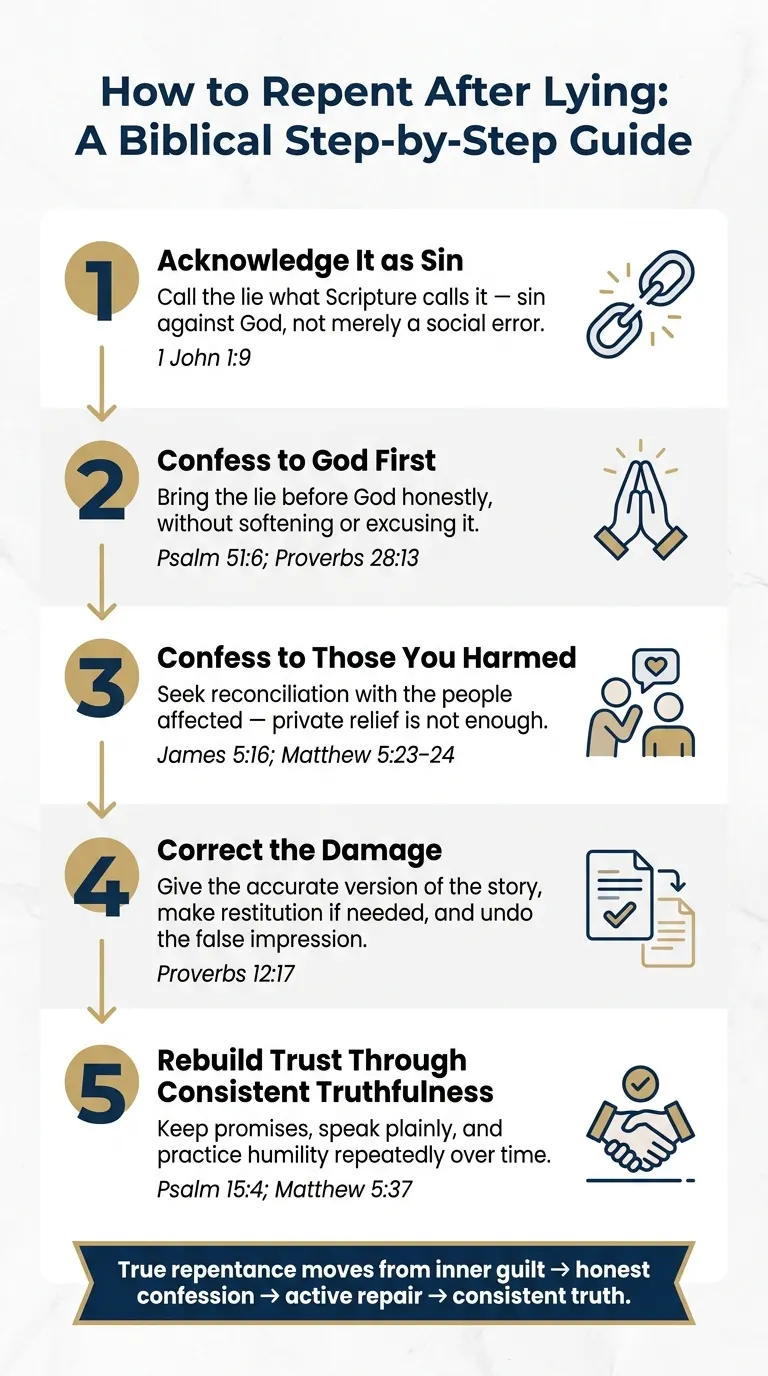
How to Repent After Lying: A Biblical Step-by-Step Guide
How to confess and repent after lying
When a lie has already done damage, repentance has to move past inner guilt and into confession and repair.
Biblical repentance starts by calling lying what it is: sin against God, not just a mistake that hurt another person. First John 1:9 says that when we confess our sins, God is faithful to forgive us and cleanse us. But confession doesn’t stop there. It also needs to reach the people who were harmed. James 5:16 and Matthew 5:23-24 call believers to seek reconciliation, not just private relief. Psalm 51:6 makes the starting point plain: repentance begins with inner honesty, not polished words.
"Whoever conceals his transgressions will not prosper, but he who confesses and forsakes them will obtain mercy." – Proverbs 28:13
True repentance means saying the lie plainly. No softening it. No excuses. No shifting blame. It also means taking steps to correct the damage. If you stretched a story or passed along a false report, go back and give the accurate version. If the lie caused financial harm, make restitution.
How to rebuild trust through consistent truthfulness
After confession, trust usually comes back slowly. It grows through repeated truthfulness in everyday speech.
That means accepting the fallout of the lie without trying to shrink it. Rebuilding trust looks simple, but it’s not easy:
- Own the lie
- Keep your promises
- Speak plainly
- Practice humility over time
If dishonesty has turned into a pattern, pastoral care or Christian counseling may help get at what is driving it, whether that’s fear, pride, or fear of disapproval.
Using Psalmlog for honest self-examination and spiritual growth

Honest self-examination helps bring hidden motives into the light and shows what keeps dishonesty going.
Psalmlog can help by giving you a place to speak plainly, tag Scriptures like Proverbs 12:22 and Ephesians 4:25, and review recurring triggers over time.
FAQs
Is lying ever justified in a hard situation?
The Bible treats lying as sin and as something that runs against God’s truthful nature. That part is plain enough.
At the same time, Scripture also gives us hard cases, and Rahab is one of the clearest examples. That’s where the debate comes in. The text isn’t hard because truth matters less. It’s hard because life in a fallen world can force painful moral conflict.
Some readers hold that lying is never right under any condition. Others argue that people are not always owed the truth, especially when telling it would hand evil exactly what it wants, such as in cases where a life is at stake or a higher moral duty is in view.
Even with that debate, truthfulness remains the standard.
Does the Bible treat gossip like lying?
Yes. The Bible treats gossip as a kind of dishonest speech and a breach of the command not to bear false witness.
Scripture groups gossip, rumors, and whispering with other sinful forms of speech because they twist the truth, damage a neighbor’s name, and erode trust inside a community. God is a God of truth, so He stands against speech that misstates what is real or aims to hurt other people.
How can I rebuild trust after repeated dishonesty?
Rebuilding trust after repeated dishonesty takes steady, transparent behavior over time. Start by fully owning the harm and offering a sincere confession without excuses.
Trust comes back through patterns, not promises. Show reliability through honest actions, answer questions openly, and welcome accountability. Repair takes time.