
Bible Warnings About Fake Friends
Scripture maps 12 warning signs of harmful friendships and offers biblical tests, boundaries, and prayerful discernment.
Not every friend is safe. In this article, I show how Scripture flags 12 patterns that can damage trust, peace, and faith: abandonment, flattery, gossip, drama, temptation, betrayal, using people, fake godliness, refusal to repent, cutting off wise counsel, mocking spiritual growth, and denying harm.
Here’s the short version: if a friendship keeps producing conflict, secrecy, compromise, or one-sided gain, I should stop brushing it off as “just their personality.” The article’s main test is simple: look for patterns, not one bad day. A godly friend tends to show loyalty, honesty, peace, correction, and care over time.
I also get a practical path for action:
- Match the pattern to a Bible verse
- Ask one clear question about the friendship
- Set healthy boundaries
- Track what changes over time
- Bring the pattern to prayer and wise counsel
A few facts stand out right away:
- The article centers on 12 warning signs
- It uses a side-by-side snapshot of fake friend vs. godly friend traits
- It gives 7 direct boundary responses tied to Scripture
- It points me back to verses from Proverbs, Psalms, the Gospels, and the Epistles
Bible verses about fake friends
Quick Comparison
| Area | Harmful Pattern | Godly Pattern | Simple Test |
|---|---|---|---|
| Loyalty | Leaves when life gets hard | Stays in adversity | Do they show up when I have little to offer? |
| Honesty | Uses flattery | Tells the truth in love | Do they help me grow or just keep me pleased? |
| Trust | Spreads secrets | Guards private matters | Can I speak freely without fear? |
| Influence | Pulls me toward sin | Pushes me toward wisdom | Do I feel closer to God or farther away after time with them? |
| Conflict | Fuels drama | Seeks peace | Does this friendship keep me calm or worn out? |
| Motive | Uses me for gain | Gives with care | Is the relationship mutual or mostly one-way? |
| Correction | Refuses to own wrong | Repents and changes | Do apologies lead to changed behavior? |
If I want one takeaway before reading the rest, it’s this: a healthy friendship does not just feel good in the moment; it bears good fruit over time.
How to Use These Bible Verses for Discernment Through Voice Journaling
Speaking Bible verses aloud helps turn discernment into a steady practice. Proverbs 22:24–25 says:
"Don’t befriend a hot-tempered man. Don’t associate with one who harbors anger, lest you learn his ways and ensnare your soul."
Here’s a simple way to use it: pick one verse that fits one friendship, say it out loud, and record what pattern it brings to the surface. That matters because the goal isn’t to overreact to one bad moment. It’s to sort out the difference between a single conflict and a repeated cycle of harmful behavior.
That line can get blurry. When you’re around the same unhealthy pattern again and again, it can start to feel normal. Voice journaling helps break that spell. It pushes you to name what is actually happening and how that friendship leaves you feeling.
Psalmlog is made for this kind of reflection. It’s a voice-first Christian journaling app that lets you tag entries to Scripture, review patterns over time, and revisit hard relationships in one private place. So instead of just logging emotions, you’re letting Scripture test the friendship. Use these reflections as you compare the warning signs below with the friendships in your life.
Fake Friends vs. Godly Friends at a Glance
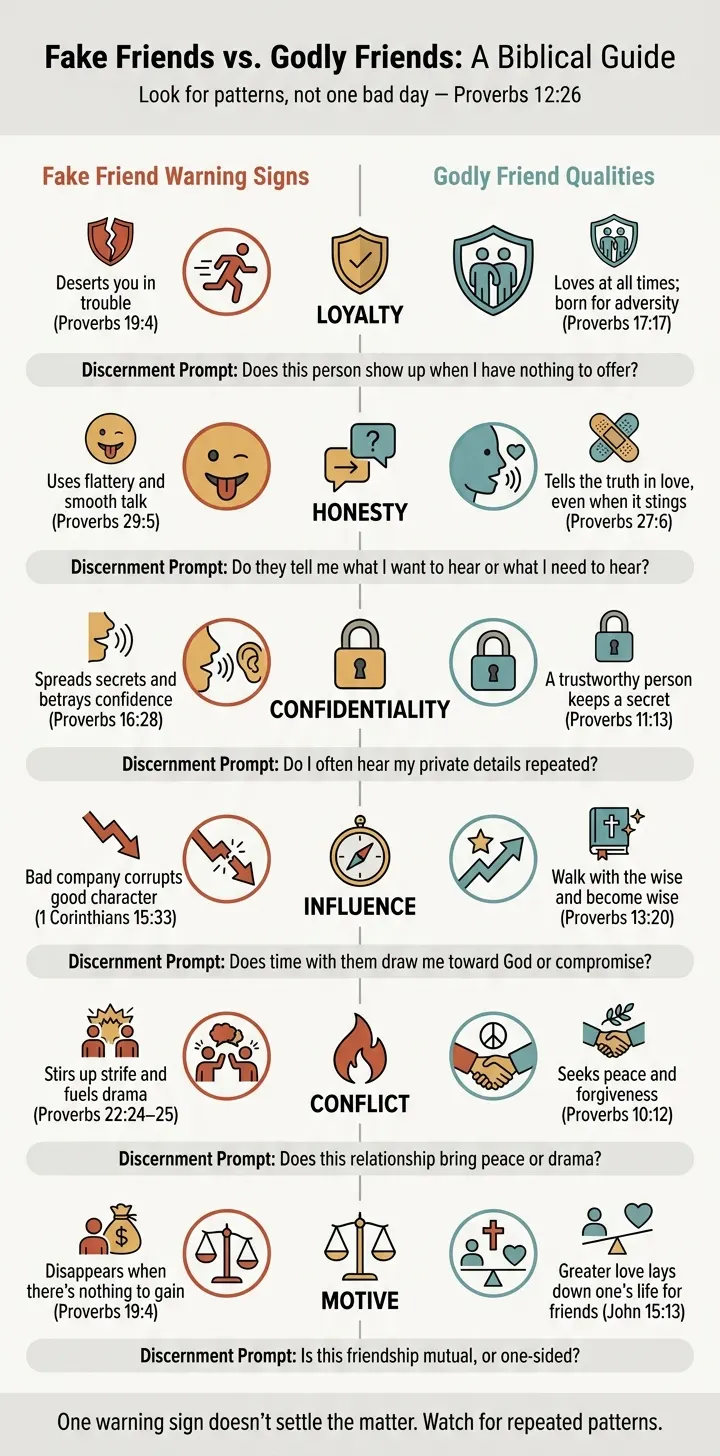
Fake Friends vs. Godly Friends: A Biblical Comparison
Not every close friendship is safe. Scripture draws a clear line between people who pull your faith off course and people who help it grow. And that line usually shows up in patterns, not isolated moments.
"The righteous choose their friends carefully, but the way of the wicked leads them astray." – Proverbs 12:26
Use this snapshot as a gut-check for the patterns ahead. It gives you a side-by-side look at warning signs and godly traits before each one gets unpacked in more detail. Each row includes a warning verse, a godly-friend verse, and one question to ask yourself right now.
| Trait | Fake Friend Warning Sign | Godly Friend Quality | Discernment Prompt |
|---|---|---|---|
| Loyalty | Deserts you in trouble (Proverbs 19:4) | A friend loves at all times, and a brother is born for a time of adversity (Proverbs 17:17) | Does this person show up when I have nothing to offer them? |
| Honesty | Flattery and smooth talk (Proverbs 27:6; Romans 16:18) | Faithful are the wounds of a friend; but the kisses of an enemy are deceitful (Proverbs 27:6) | Do they tell me what I want to hear or what I need to hear? |
| Confidentiality | A whisperer separates close friends (Proverbs 16:28) | A trustworthy person keeps a secret (Proverbs 11:13) | Do I often hear my private details repeated? |
| Influence | Bad company corrupts good character (1 Corinthians 15:33) | Walk with the wise and become wise (Proverbs 13:20) | Does time with them draw me toward God or compromise? |
| Conflict | A perverse person stirs up conflict (Proverbs 22:24–25) | Seeks peace and forgiveness (Proverbs 10:12) | Does this relationship bring peace or drama? |
| Self-Interest | Wealth attracts many friends, but the poor person is deserted (Proverbs 19:4) | Greater love has no one than this: to lay down one’s life for one’s friends (John 15:13) | Is this friendship mutual, or one-sided? |
Be honest with the prompts. One warning sign doesn’t settle the whole matter. But when the same problem keeps showing up and there’s no repentance, that tells you a lot. The next sections walk through each warning sign in Scripture.
1. Friends Who Abandon You in Trouble
The first red flag is simple: some people seem like friends until life gets messy. Scripture speaks to that kind of person in plain terms.
"Like a broken tooth or a lame foot is reliance on the unfaithful in a time of trouble." – Proverbs 25:19
That picture lands hard. A broken tooth gives out when you need it, and it hurts on top of that. A lame foot can’t hold your weight. That’s what shaky support feels like when you’re under pressure.
Proverbs 19:4 makes a similar point. Money can pull people in, but when someone becomes poor, those same “friends” may drift away.
Scripture gives a very different picture of real friendship:
"A friend loves at all times, and a brother is born for adversity." – Proverbs 17:17
So pay attention to patterns, not just promises. A good friend might have an off week or miss a moment. That happens. But a fake friend keeps vanishing when things get hard, then shows up again when they need help. If that pattern keeps repeating, and there’s no repentance or repair, don’t lean on that person for support.
2. Friends Who Use Flattery Instead of Honesty
Another red flag is flattery. It feels good in the moment because it hides what it’s doing. But that’s the problem. It can pull you in before you even notice.
"Those who flatter their neighbors are spreading nets for their feet." – Proverbs 29:5 (NLT)
That image matters. A net stays out of sight until it traps someone. Flattery often works the same way. It can sound like support, but it may be aimed at getting something in return. So it helps to ask a simple question: Who gains from the praise? If the compliments keep showing up when someone wants approval, wants to dodge tension, or wants a favor, don’t brush that off.
Scripture puts this kind of speech next to something very different: a friend who tells the truth, even when it stings.
"Faithful are the wounds of a friend; but the kisses of an enemy are deceitful." – Proverbs 27:6
A friend who never says the hard thing may feel easy to be around, but that kind of silence won’t help you grow. Real friendship cares more about your spiritual health than your short-term comfort. And when praise is used to steer or control, trust often starts to slip next.
3. Friends Who Spread Gossip and Reveal Secrets
Gossip takes something private and passes it around. A fake friend does that with the trust you gave them. In Scripture, that isn’t just rude. It’s a betrayal.
"A gossip betrays a confidence, but a trustworthy person keeps a secret." – Proverbs 11:13
Proverbs 11:13 says it plainly: a gossip betrays confidence, while a trustworthy person keeps a secret.
Proverbs 16:28 and 17:9 repeat the same idea. Gossip stirs up conflict and drives close friends apart. That makes keeping a secret a simple way to judge trust.
A good test is this: if you wouldn’t say it directly to the person involved, don’t say it behind their back. Proverbs 20:19 gives the same warning:
"A gossip goes around telling secrets, so don’t keep company with gossipers."
If they tell you other people’s secrets, odds are they’ll tell yours too. Does this friendship guard trust, or use it against you?
4. Friends Who Stir Up Strife and Drama
When gossip stops being private, it rarely stays small. It spills out into tension, hurt, and open conflict. Some friendships seem to run on that cycle. A tiny issue turns into an argument. A misunderstanding becomes a feud. In a harmful friendship, conflict starts to feel normal instead of rare. Scripture gives a direct warning about that pattern.
"A perverse man stirs up strife. A whisperer separates close friends." – Proverbs 16:28
That verse links two things that often travel together: stirring up trouble and spreading private talk. The result is painful but plain. Close relationships get torn apart.
"Without wood a fire goes out; without gossip a quarrel dies down." – Proverbs 26:20
That picture is hard to miss. Gossip is like fuel on a fire. It keeps the argument burning by feeding anger, suspicion, and sides.
A more subtle sign shows up when a friend pushes you to choose sides. Maybe they want you to prove your loyalty by joining their conflict with someone else. That kind of pressure can pull you into fights that were never yours to carry. Proverbs 22:24–25 warns against staying close to hot-tempered people because their habits rub off on you and can trap your soul.
"Don’t befriend a hot-tempered man. Don’t associate with one who harbors anger, lest you learn his ways and ensnare your soul." – Proverbs 22:24–25
This matters because conflict doesn’t just stay around you. Over time, it gets into you. Proverbs 27:15 shows how constant conflict wears a person down over time. Bit by bit, that strain can shape how you speak, how you react, and whether you have any peace left. Next comes a deeper warning: friends who pull you toward sin.
5. Friends Who Tempt You Into Sin
Not all harm shows up with a bang. Sometimes it slips in through a friendship that chips away at your convictions little by little. A person can train you to excuse sin without ever saying, "Ignore God." And after a while, obedience can start to feel optional instead of clear. That’s the heart of the issue: Does this friendship make obedience easier or harder?
"Do not be misled: ‘Bad company ruins good morals.’" – 1 Corinthians 15:33
This kind of pull is often slow. Proverbs says that "a companion of fools suffers harm". Psalm 1:1 shows how that drift happens: first "walking in the counsel of the wicked", then "standing in the way of sinners", and finally "sitting in the seat of mockers". You don’t wake up one day in open compromise. More often, you slide there step by step.
Maybe your obedience becomes the punchline. Sin gets brushed off. Prayer starts to feel heavier. You begin hiding compromise just to stay in the group. That’s why Proverbs 4:14–15 speaks so plainly: "Do not set foot on the path of the wicked… Avoid it, do not travel on it; turn from it and go on your way".
A good friend doesn’t cheer on your compromise. They correct you for your good, even when that stings. And when pressure to compromise turns into broken trust, the next warning sign is betrayal.
6. Friends Who Betray Your Trust
Betrayal lands hard when it comes from someone close. It cuts deeper because this is the person who knows your story, your weak spots, and the things you only say in private. The hurt often gets worse when that person turns around and uses that knowledge against you.
"Even my close friend, someone I trusted, one who shared my bread, has turned against me." – Psalm 41:9
David wrote those words about Ahithophel, his trusted counselor, who defected and backed Absalom’s rebellion against him (2 Samuel 15:12). That matters. This wasn’t an enemy at the gate. It was someone from the inside. The phrase "lifted up his heel" in Psalm 41:9 gives a harsh image: like a horse kicking the very owner who fed it. That’s what betrayal does. It turns care into a weapon.
This is why trust sits at the center of friendship. A safe friend makes room for truth, weakness, and correction. An unsafe friend makes you pay for honesty. And one of the clearest places this shows up is in how they respond when you confront harm.
A real friend can admit wrong and work to repair it. A fake friend often answers correction with anger, distance, or smear tactics. Proverbs 27:6 says it plainly: "Faithful are the wounds of a friend, but deceitful are the kisses of an enemy". Judas did exactly that. He used a kiss to identify Jesus for arrest (Matthew 26:47–50). Warmth on the surface, betrayal underneath.
Most of the time, betrayal doesn’t begin with one dramatic moment. It starts small. A private detail gets repeated. A story gets tweaked. A confidence gets broken.
When that keeps happening, it’s wise to limit access to private parts of your life. Trust doesn’t come back because someone feels bad in the moment. It comes back when they take ownership and their behavior changes. If trust becomes a tool they use on you, the friendship has already shifted into something else. And when trust turns into leverage, self-interest usually isn’t far behind.
7. Friends Who Use You for Personal Gain
When trust gets turned into leverage, friendship stops being friendship. It turns into a transaction. And when betrayal is tied to gain, self-interest is usually sitting right at the center of it. At first, this kind of person can seem warm, loyal, even generous. But the moment you stop being useful, the tone changes.
"Everyone is a friend to a man who gives gifts." – Proverbs 19:6
Proverbs 19:7 pushes the point even harder: when resources run out, even close friends are "nowhere to be found". In those cases, the bond was never built on care. It was built on what you could give.
Scripture gives blunt examples. Judas sold his access to Jesus for 30 pieces of silver. Delilah used the closeness of her relationship with Samson to learn his weakness and hand it over for money. In both cases, profit twisted something that looked like a bond.
You can see the same pattern in daily life. A transactional friend tends to appear when there’s something in it for them – your influence, your network, your help, or your generosity. Then they fade when those things are gone. One simple way to read the situation is to spend time together when there’s no upside for them, just fellowship. Another is to say no to a request. A real friend can handle a boundary. A user often answers with distance, anger, or guilt.
2 Timothy 3:2–5 warns about people who love money and themselves, so surface charm isn’t enough. Patterns tell the story. Motive matters just as much as words.
8. Friends Who Pretend Godliness Without Fruit
Not every fake friend looks selfish on the surface. Some wrap themselves in spiritual talk. They quote Scripture, show up at church, and speak about faith all the time. But their day-to-day actions tell another story. In Scripture, friendship is tested by fruit, humility, and how someone responds when corrected. Jesus said it plainly:
"Watch out for false prophets. They come to you in sheep’s clothing, but inwardly they are ferocious wolves. By their fruit you will recognize them." – Jesus Christ
That word fruit matters. Jesus is pointing to visible character, not polished talk. How do they treat people when no one’s watching? Do they admit when they’re wrong? Does time with them pull you closer to God, or does it slowly pull you off course?
Paul makes the same point in 2 Timothy 3:5: some people have a form of godliness but deny its power. The outside performance looks right, but the inside life hasn’t changed. Titus 1:16 describes that same pattern: "They claim to know God, but by their actions they deny him."
A simple way to test this is to bring up a small concern and pay attention to the response. This is where fruit becomes visible. A growing believer may feel the sting, but still receives correction with humility. A pretender often shuts down, gets angry, or flips the issue back on you.
This kind of discernment doesn’t come from fear. It comes from the Spirit. Watch the pattern over time, not just one moment. You’re not judging a single bad day. You’re looking at whether their life steadily shows the character of someone being shaped by the Holy Spirit, or whether the spiritual language is just sheep’s clothing covering self-interest.
When a person keeps rejecting correction and the same pattern keeps surfacing, the issue is no longer just poor fruit. It becomes a refusal to repent.
9. Friends Who Refuse to Reconcile or Repent
Scripture makes a clear distinction between a one-time failure and a repeated refusal to turn around. Matthew 18:15 gives the first move: go to the person in private and seek restoration. If they listen, there’s room to rebuild. But if they keep refusing to listen, the relationship can’t stay the same. When private correction goes nowhere, Scripture treats that response as a serious warning sign.
Proverbs 28:13 draws that line with plain language: confession and turning away from sin bring mercy, and repentance shows up in changed behavior.
Pay close attention to patterns. Some people keep rewriting the story so they always come out looking innocent. Others deny what happened, shift blame, or say “sorry” just to make the tension stop. Proverbs 15:32 says that refusing correction harms the person who rejects it, while receiving reproof leads to understanding. A friend who can hear correction without attacking the messenger shows the kind of humility that leaves room for reconciliation.
Limiting access isn’t revenge. It’s stewardship. Proverbs 4:23 calls you to guard your heart, and sometimes that means pulling back from a friendship that keeps producing the same kind of harm. A rough season isn’t the main issue. An unchanged cycle is. And when repentance is refused, wise counsel is often pushed away too.
10. Friends Who Cut You Off from Wise Counsel
When a friend won’t take correction, isolation often comes next. Sometimes it happens quietly. A friend who mocks your pastor, brushes off your parents, or shuts down wise mentors is doing more than being rude. They’re cutting you off from correction.
Proverbs 18:1 says it plainly: "Whoever isolates himself seeks his own desire; he breaks out against all sound judgment." So if a friend keeps pushing you away from wise counsel, they aren’t guarding you. They’re separating you from the people who could help keep you grounded.
Proverbs 13:20 shows the other path: a companion of fools suffers harm, while walking with the wise brings wisdom. That’s pretty direct. If a friendship keeps pulling you away from people who speak truth, it isn’t helping you grow.
At times, the isolation gets more obvious. Controlling friends may label biblical correction as "judgment" or say, "You’re the only one I trust", so their voice stays the loudest in a closed loop. That isn’t loyalty. It’s a trap.
Take an honest look at the fruit of the friendship. Have you grown more cynical about your church? More resistant to correction since the friendship got deeper? If so, that relationship may be shaping your attitude more than Scripture. And that matters, because godly friendship welcomes truth instead of trying to block it.
11. Friends Who Mock Your Spiritual Growth
Repeated ridicule of your faith is a warning sign.
Some friends don’t just ignore wise counsel. They make fun of the growth that counsel is meant to build. Psalm 1:1 shows how this drift happens: first you hear bad counsel, then you hang around it, and over time you end up in the seat of scoffers. A friend who rolls their eyes at your prayer life, jokes about your church attendance, or treats your obedience like a weakness is pulling you in that direction, one comment at a time.
A simple test comes from Proverbs 27:17: does this friendship sharpen your spiritual edge, or is it slowly making it dull? If time with them leaves you cynical, ashamed, or less willing to pray, pay attention. That’s not a small thing.
Mockery can cut even deeper when the friend won’t admit what they’ve done.
Don’t argue with mockery. Proverbs 14:7 advises leaving the company of scoffers. Set a clear boundary: "I’m not comfortable with this conversation." You don’t owe a debate to someone mocking your faith. Set the boundary early so the pattern doesn’t go further.
12. Friends Who Deny Responsibility for Harm
Another sign of an unsafe friendship shows up after the hurt is named. If a friend wounds you and then refuses to own it, trust gets damaged twice. The first hurt is painful enough. Then comes the second hit: they rewrite the story, downplay what happened, or turn the blame back on you. That kind of denial is both a relational and spiritual warning sign.
Proverbs 28:13 says it plainly: "Whoever conceals their sins does not prosper, but the one who confesses and renounces them finds mercy." A friend who keeps hiding behind vague apologies or deflection is still sidestepping repentance. And 1 John 1:8–10 warns that claiming to be without sin is self-deception. Scripture points to fruit. Matthew 3:8 calls for visible, steady change in behavior, not just talk. So look for ownership, not excuses. A real apology names the harm, confesses it, and shows changed behavior over time.
Pay close attention to the wording of an apology. Small words can tell you a lot. Phrases like “if” or “but” often water down blame instead of admitting it. Scripture gives a very different model in Psalm 51:3–4, where David says, "For I know my transgressions… Against you, you only, have I sinned." No qualifiers. No blame-shifting. If the apology spends more time defending the self than naming sin, that tells you what you need to know. Wait for clear fruit before restoring trust.
A friend who admits harm and changes over time points you toward the kind of friendship Scripture honors.
What Godly, Trustworthy Friends Look Like in Scripture
After the warning signs, Scripture also gives a plain picture of the kind of friendship worth holding onto.
Proverbs 17:17 says a true friend loves at all times. Proverbs 18:24 adds that one friend who stays closer than a brother is worth more than a crowd of shaky acquaintances. In hard seasons, a true friend doesn’t disappear. Faithful friendship matters more than numbers.
Honesty is another clear mark. Proverbs 27:6 says that wounds from a friend can be trusted. That means a godly friend cares more about your character than your comfort. They don’t flatter you. They tell the truth in love, even when it stings. That kind of honesty guards the friendship instead of twisting it for control.
Proverbs 27:17 shows that godly friendship goes both ways. Each person helps the other grow in holiness, accountability, and wisdom. Good friendship isn’t passive. It shapes you, corrects you, and points you back to what is right.
The New Testament adds more depth to that picture: sacrifice, burden-bearing, and peacemaking. John 15:13 gives the model of Christlike sacrifice: being willing to lay down one’s life for one’s friends. Galatians 6:2 calls believers to bear one another’s burdens. Matthew 5:9 reminds us that peacemaking reflects godly character. Put together, these traits form a solid test for the people closest to you.
| Quality | Biblical Anchor | What It Looks Like |
|---|---|---|
| Loyalty | Proverbs 17:17 | Loving at all times and sticking close during adversity |
| Honesty | Proverbs 27:6 | Offering loving correction even when it stings |
| Sharpening | Proverbs 27:17 | Challenging each other toward holiness and growth |
| Sacrifice | John 15:13 | Putting a friend first with Christlike self-giving |
| Burden-Bearing | Galatians 6:2 | Showing up with real support during trials |
| Peacemaking | Matthew 5:9 | Resolving conflict rather than fueling it |
Test friendships by loyalty, honesty, growth, sacrifice, and peace. Use these traits to examine your friendships, then set boundaries where needed. Let this standard help you see what needs repair, what needs distance, and what needs protection.
Setting Biblical Boundaries With Harmful Friends
Pulling back from a harmful friendship can be wise, not unloving. Proverbs 4:23 tells believers to guard their hearts, and that also means being careful about who gets close to them. Discernment is stewardship, not cruelty. You can be kind without giving someone close access. From there, the goal is to set limits without becoming harsh.
When Scripture brings a pattern into view, boundaries help protect what discernment has already shown. If a harmful pattern is clear, respond to the pattern itself, not to the latest excuse tied to it. A one-time failure is not the same as repeated gossip, manipulation, or a stubborn refusal to repent.
Start small. Change the subject. Stop sharing private details. Spend less time in settings where the harm keeps growing. Use simple responses at first, then add more distance if the pattern keeps repeating.
Before you involve other people, Matthew 18:15 gives a plain path: address the issue privately and directly first. If the person refuses to listen, bring in a trusted pastor or a mature believer for help.
"Boundaries are not a dramatic cutoff. They are a wise way to guard your heart and refuse participation in repeated sin patterns while keeping your speech respectful." – Mentoring Young Christians
Love freely, but grant access carefully. The table below turns these ideas into simple boundary responses.
Boundary Responses Table
This table links each pattern to a Scripture and a boundary you can use right away. The idea is simple: when you spot the pattern, match it to the verse and respond fast. That helps you move from noticing the issue to doing something about it.
| Behavior | Key Verse | Healthy Boundary Response |
|---|---|---|
| Gossip & Revealing Secrets | Proverbs 20:19 | Decline the conversation. Stop sharing sensitive details. |
| Flattery & Manipulation | Proverbs 29:5 | Don’t let praise push you past your values. |
| Betrayal of Trust | Psalm 41:9 | Limit access to personal details and step back if the harm continues. |
| Temptation & Sinful Pressure | 1 Corinthians 15:33 | Leave the setting and refuse to compromise your conscience. |
| Stirring Up Conflict | Proverbs 22:24–25 | Refuse to take sides. Limit time around the drama. |
| Using You for Personal Gain | Proverbs 19:4 | Say no to transactional requests; watch whether they stay when you give nothing. |
| Refusing Correction | Proverbs 15:32 | Speak once in private, then let your boundaries speak for you. |
Using Psalmlog to Track Discernment and Healing

After you set boundaries, the next step is simple: watch what the relationship produces.
Use Psalmlog as a private voice journal to record prayers, Scripture reflections, and notes about the relationship. The focus here is what happens after the boundary is in place. What changes? What stays the same? And over time, what does that pattern show you?
It helps to practice boundary language out loud. Say things like: "I’m not comfortable with that" or "I can’t go against my conscience." Then, tag your entries so you can spot patterns as they repeat. You can group notes around themes like:
- anger
- gossip
- character
- spiritual influence
That way, you don’t have to piece the timeline back together from memory.
Once you tag those patterns, review them each week for fruit, not just feelings. Psalmlog’s weekly trend review can show whether time with a certain person leaves you more peaceful or more reactive, more grounded or more drained. Proverbs 4:23 calls us to guard our hearts, and steady tracking gives you a concrete way to do that.
The point isn’t just spotting a pattern on paper. It’s using that pattern to pray with more clarity, respond with more calm, and make wiser choices. Bring what you notice into prayer and into wise conversation.
Psalmlog is not a substitute for pastoral care, mentoring, or counseling. Use it to get ready for a conversation with your pastor, mentor, or counselor, and bring specific patterns with you.
Conclusion
Scripture clearly names harmful friendship patterns and points us toward loyal, honest, peaceful, Christ-centered relationships. So the issue isn’t closeness by itself. The issue is the kind of fruit a friendship produces over time.
Friendships shape you. As Proverbs 13:20 puts it, a companion of fools suffers harm, while walking with the wise brings wisdom. That means you need to watch for repeated patterns, not just one bad moment.
When the pattern becomes clear, boundaries come next. Guard your heart, and let wisdom decide how much access someone should have to it. Use what you’ve recorded in prayer and voice journaling to sort out what to keep, what to limit, and what to release. Track these patterns through journaling, pray through them, and act on what Scripture shows.
Scripture calls us to faithful friends who tell the truth, keep trust, and draw us closer to Christ.
FAQs
How can I tell a fake friend from a flawed one?
The main difference comes down to pattern and how each person responds when things go wrong.
A flawed friend is still imperfect. We all are. But that kind of friend can admit wrong, try to make things right after conflict, and speak the truth for your good.
A fake friend is different. They show a repeated pattern of manipulation, selfishness, and deceit. A godly friend gives honest correction to help you grow. A fake friend leans on flattery or gossip for personal gain, then disappears when hard times hit.
When should I set boundaries instead of ending a friendship?
Set boundaries when harmful behavior turns into a pattern, like manipulation, gossip, anger, or pressure toward sin, and starts draining your peace or pulling you away from your values.
Boundaries are an act of wisdom, not a sign that you care less. They help guard your spiritual direction, reduce negative influence, and create needed space while still leaving room for grace and forgiveness.
What does the Bible say a true friend should look like?
According to the Bible, a true friend shows love, loyalty, and care for your spiritual growth. Their love doesn’t come and go with your circumstances. It stays steady, especially when life gets hard, not just when things are going well.
A true friend gives wise counsel and tells you the hard truth when you need it, instead of feeding you empty praise. They help shape your character, celebrate your wins without envy, and speak up for you when you’re not in the room. In that sense, real friendship reflects Christlike love through selfless support, honesty, and consistency.