
1 Corinthians 15:33 Explained: Bad Company
Explains how false teaching and repeated influences erode faith and character, and how to test and limit corrupting influences.
1 Corinthians 15:33 is not vague advice about “the wrong crowd.” I read it as Paul’s warning that false teaching changes behavior – and that steady exposure to the wrong voices can wear down faith, conviction, and conduct.
Here’s the short version:
- Paul’s main issue is resurrection denial in 1 Corinthians 15, not just rough friendships.
- Bad company means shaping influence – people, teachers, feeds, podcasts, dating partners, and peer groups.
- The danger is usually slow, not sudden. Beliefs shift first, then habits follow.
- The test is simple: does this influence move you toward Christ, repentance, and holiness – or toward compromise, cynicism, and drift?
- The answer is not isolation. It’s wise limits, better company, and regular self-checking.
A 2023 Pew Research Center report found that about 7 in 10 U.S. adults use social media. That matters here because repeated voices shape what we think is normal. And Barna research has long shown that many churchgoers hold mixed or unclear views on core Christian beliefs. What I hear often will affect how I live.
Evil Company Corrupts: The Dangerous Power of Influence | 1 Corinthians 15:33
Quick take
| Point | What it means |
|---|---|
| Context | Paul is dealing with people denying the resurrection (1 Cor. 15:12) |
| Warning | Wrong influence can spoil character over time |
| Today | Friends, dating, work, media, and online voices can all shape me |
| Main sign | I feel more numb to sin, less clear on truth, or more eager for approval |
| Right response | Test the influence, set limits, and stay close to godly people |
So if I want to use this verse the right way, I should start with Paul’s point: what I let shape my mind will, over time, shape my life.
What 1 Corinthians 15:33 Actually Means
Paul’s warning about resurrection denial in Corinth
In 1 Corinthians 15, Paul is answering people in the church who were saying there is no resurrection of the dead (1 Cor. 15:12). That idea doesn’t stay in the realm of abstract belief. It leads to the slogan, "Let us eat and drink, for tomorrow we die" (1 Cor. 15:32), and from there, any drive for holy living starts to fall apart.
That’s the issue Paul is dealing with. He isn’t just fixing a point of doctrine on paper. He is showing how doctrine shapes behavior. What people believe about the future changes how they live in the present.
How verse 33 connects false teaching to corrupted living
That’s why verse 33 appears right here. Paul says, "Do not be deceived", which points to influence that slips in quietly, not open rebellion. In this setting, he has close ties with resurrection-denying voices in view.
The word translated "corrupts" carries the idea of gradual spoilage. That’s an important detail. False ideas don’t just sit harmlessly in the mind. With repeated exposure, they start to work their way into a person’s conduct. Corrupt speech, heard again and again, can slowly reshape how someone lives.
Paul’s point is simple: false teaching can numb moral alertness. Influence usually works by inches, not all at once. But it still works.
Why Paul cites a familiar saying
The line itself – "Bad company corrupts good character" – comes from the Greek poet Menander’s play Thais. By Paul’s day, it was likely a familiar proverb in the Greco-Roman world.
Paul uses that well-known saying to press a bigger point: distorted belief leads to distorted conduct. What you keep close shapes who you become.
That warning still fits any setting where repeated voices shape what Christians believe and how they live. So yes, the verse still speaks to friendships, dating, work, and even the online voices people listen to every day.
How Bad Company Corrupts Christian Character Today
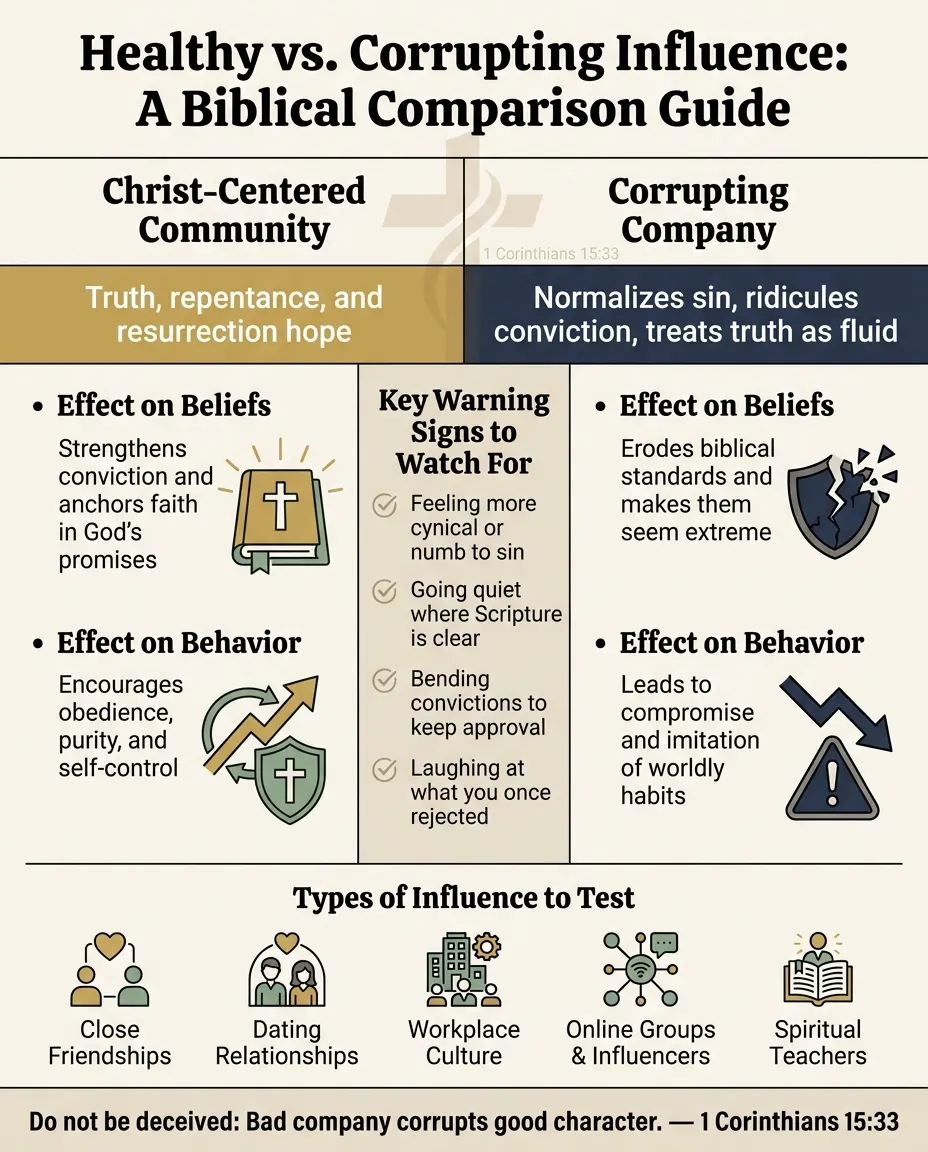
Healthy vs. Corrupting Influence: A Biblical Comparison Guide
What counts as bad company today
Paul is talking about regular relationships and repeated voices that shape how you think. This warning doesn’t stay in ancient Corinth. It reaches into the things that shape our habits now. Today, bad company can include friends, dating partners, coworkers, social feeds, shows, and online voices that make sin look normal or make conviction feel outdated. Some influences are even more dangerous because they sound religious while quietly attacking core truths like the resurrection.
How repeated exposure changes beliefs and behavior
This kind of corruption usually begins in small ways. Boundaries slip. Conviction gets dull. Things that once bothered your conscience start to feel normal. A mocking friend, a compromising relationship, or a cynical feed usually doesn’t change you all at once. But steady exposure wears down resistance.
The same thing happens online. A social media feed can turn into a daily voice in your life. When you’re exposed again and again to cynicism about Scripture, or to content that treats holiness like a joke, it starts to chip away at spiritual resolve before you even notice it happening.
Healthy spiritual company vs. corrupting company: a comparison
The contrast can be easy to miss, especially when corrupting voices use religious language. The clearest difference is in the fruit each influence produces.
| Source of Influence | Core Message | Effect on Beliefs | Effect on Behavior |
|---|---|---|---|
| Christ-Centered Community | Truth, repentance, and resurrection hope | Strengthens conviction and anchors faith in God’s promises | Encourages obedience, purity, and self-control |
| Corrupting Company | Normalizes sin, ridicules conviction, or treats truth as fluid | Erodes biblical standards and makes them seem extreme | Leads to compromise and imitation of worldly habits |
The clearest warning sign usually isn’t dramatic. It’s quiet. You feel more cynical, more numb, or less troubled by sin than you used to be. That’s the point when you need to examine the people, voices, and spaces shaping you.
A Biblical Framework for Testing Relationships and Influences
Not every imperfect person is bad company. Paul is warning about influences that, over time, pull you away from truth, holiness, and the hope of the resurrection. That difference matters. One relationship shows ordinary human weakness. The other keeps tugging you away from Christ.
Paul’s point is plain: false voices don’t stay in the realm of ideas. They shape how you live. So when you test the people and voices around you, ask not only whether they sound right, but where they are leading you.
Questions to ask about any person or voice shaping you
Paul’s warning isn’t only about who gets your time. It’s also about which repeated voices train you to think, excuse, and act in certain ways. What you hear often, watch often, and let slide often will shape your heart. That makes the next questions simple and direct.
Does this person or voice make your sin seem smaller than it is? Are you bending your convictions to keep their approval? Does what you take in from them lead to humility, obedience, and hope in Christ – or to cynicism, compromise, and spiritual drift?
Warning signs in friendships, dating, work, and online spaces
The most common warning signs are concrete. You can usually spot them in everyday choices, not just big moments.
- Going quiet where Scripture is clear, not from conviction, but to avoid awkwardness
- Laughing at what you once rejected
- Excusing someone’s compromise because they are likable or useful
- Bending your convictions again and again to keep a relationship intact
Online spaces bring the same danger. A podcast host, influencer, or social media feed that keeps mocking biblical conviction or treating core doctrine like it’s up for negotiation is acting like a discipling voice – whether you notice it or not.
Discernment table: types of influence, warning signs, and likely outcomes
| Type of Influence | Key Question | Warning Sign | Likely Outcome if Ignored |
|---|---|---|---|
| Close Friendship | Does this person strengthen my allegiance to Christ? | Mocking biblical conviction or pressuring you to relax your standards | You grow numb to sin until it no longer feels wrong |
| Dating Relationship | Does this person share my devotion to God and hope in the resurrection? | Minimizing serious differences in values to protect the relationship | Worship and priorities stay under pressure |
| Workplace Culture | Am I bearing witness, or being quietly shaped by the environment? | Calling compromise “wisdom” to preserve professional standing | Spiritual fervor fades |
| Online Group / Influencer | Does this content celebrate what Scripture condemns? | Normalizing sin or constant cynicism about God’s Word | Discernment grows dull |
| Spiritual Teacher | Does their teaching align with the plain truth of the resurrection and Christ’s authority? | Christian vocabulary used while stripping away repentance, judgment, and resurrection hope | Theological compromise leads to moral decline |
Once you can name the influence, you can start replacing it with care. Discernment should lead to change, not isolation.
How to Guard Your Character Without Withdrawing from the World
Paul’s warning isn’t a call to hide from the world. It’s a call to stay different in the world. Christians are meant to engage, speak, and live as witnesses. The danger starts when approval matters more than faithfulness, or when corrupting voices begin to set your moral direction. Be present with unbelievers, but don’t let them shape your convictions. Jesus spent time with sinners without giving up the truth.
That difference matters. The answer isn’t retreat. It’s replacement.
Practical steps for replacing corrupting influence
Swap harmful influence for mature Christian counsel, healthy friendships, and disciplined media habits. Find at least one mature Christian – a mentor, pastor, or older believer – whose life shows obedience and hope. Build friendships that make holiness feel normal, not awkward. If a podcast, social feed, or group chat keeps mocking biblical conviction or treats biblical truth like it’s up for negotiation, see it for what it is: a voice that’s shaping you. Limit it. Boundaries are ordinary wisdom, not an overreaction.
Using voice journaling and Psalmlog for ongoing discernment

Influence tends to work slowly. That’s why regular reflection helps you spot drift before it sets in.
"Good morals are not corrupted in a day. It takes weeks, or months, or even years."
Connecting voice journaling with Scripture can help you notice patterns you’d miss in the moment. Psalmlog can help bring those patterns into view through Scripture tagging, sentiment review, and a personal insights dashboard – a tool for reflection alongside Scripture, prayer, and Christian community.
What Paul’s warning should lead us to do
Paul’s warning calls you to test influence, reject what dulls conviction, and pursue company that strengthens faith. The next step is to test influence honestly and act on what you find.
FAQs
Does this verse mean I should avoid unbelievers?
No. 1 Corinthians 15:33 does not call for total withdrawal from unbelievers.
It warns against close influence from people who spread false teaching or push immoral, pleasure-first living, because those ties can wear down a Christian’s character and faith.
How can I tell if an influence is slowly shaping me?
Pay close attention to small changes in your thinking, habits, and values. They often happen little by little. And over time, repeated exposure can dull your sense of what’s wrong.
That’s why it helps to notice early signs. Maybe you feel less eager to pray. Maybe your spiritual zeal has cooled. Maybe certain habits that once bothered your conscience don’t seem like a big deal anymore, even though they clash with your Christian beliefs.
Take an honest look at the influences around you too. Are your relationships helping you grow in faith? Are the online spaces you spend time in drawing you closer to God, or slowly pulling you in the other direction? The same goes for the media you take in. Bit by bit, it can shape what you accept, excuse, or desire.
Is Paul talking about false teaching more than friendships?
Paul is addressing both. In 1 Corinthians 15, he gives this warning while defending the resurrection against people who denied it.
His point is simple: close ties with people who spread error can damage both faith and behavior. So the verse warns against relationships or social circles that normalize sin or chip away at core biblical truth.