
15 Bible Verses to Read When You're Facing a Difficult Decision
15 Bible verses and practical tips to help you find wisdom, peace, and courage when facing difficult decisions.
When life presents tough choices, turning to Scripture can provide clarity, peace, and direction. The Bible offers timeless wisdom to help navigate uncertainty, reminding us to trust in God’s plan, seek His guidance, and find courage in His presence. Here are 15 verses that can guide you:
- Proverbs 3:5-6: Trust God fully and lean on His understanding, not your own.
- James 1:5: Ask God for wisdom, and He will generously provide it.
- Jeremiah 29:11: God’s plans are for your good, offering hope and a future.
- Matthew 7:7-8: Persist in prayer – ask, seek, and knock for clarity.
- Psalm 32:8: God promises to guide and counsel with care.
- Philippians 4:8: Focus on what is true, noble, and right when making choices.
- 2 Corinthians 6:14: Avoid deep partnerships that conflict with your values.
- Colossians 3:15: Let Christ’s peace guide your decisions.
- Proverbs 16:9: Plan wisely, but trust God to direct your steps.
- Joshua 1:9: Be strong and courageous, knowing God is with you.
- 1 Peter 5:7: Cast your worries on God, for He cares for you.
- Romans 8:28: Trust that God works all things for your good.
- Isaiah 43:18-19: Let go of the past and embrace the new path God is creating.
- 2 Corinthians 5:17: Make decisions aligned with your renewed identity in Christ.
- Ephesians 4:22-24: Put off old habits and embrace righteousness in your choices.
These verses encourage trust in God, seeking wisdom, and finding peace in His guidance. Pray, reflect, and consult trusted advisors as you navigate decisions. God’s Word reassures us that no choice is beyond His redemptive power.
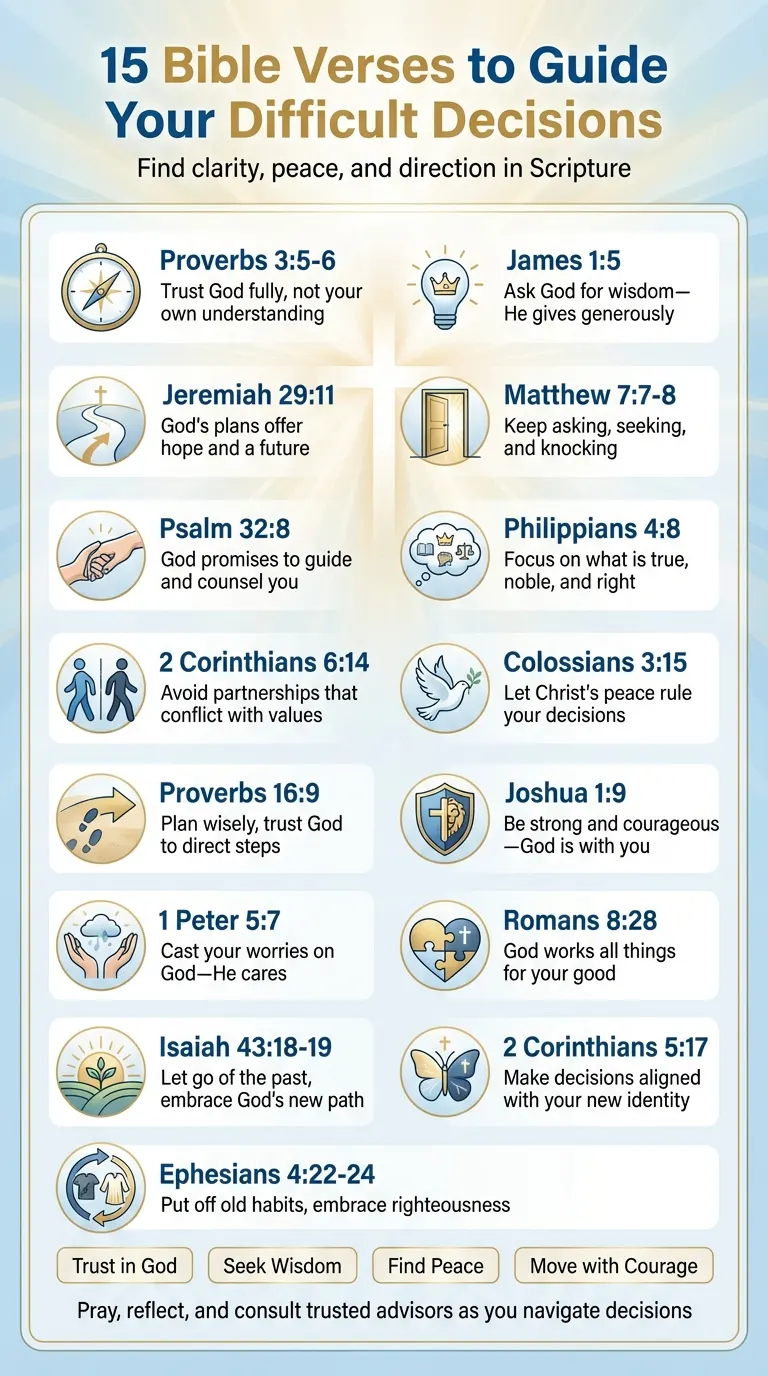
15 Bible Verses for Difficult Decisions: Quick Reference Guide
How to Make Difficult Decisions (Powerful Biblical Principles)
1. Proverbs 3:5-6
"Trust in the Lord with all your heart and lean not on your own understanding; in all your ways submit to him, and he will make your paths straight." – Proverbs 3:5-6
This verse is a go-to for many when they’re grappling with difficult decisions. It speaks to a universal challenge: the gap between our limited perspective and God’s complete understanding. While we can only see a small piece of the puzzle, God views the entire picture. The message here is clear – don’t rely solely on your own reasoning to navigate life’s crossroads.
Instead, it encourages full trust in God. When you submit your plans and decisions to Him, He clears the way, ensuring that unresolved sin or resistance doesn’t cloud your judgment. Mary Lowman, Founder of The Christian Working Woman, captures this beautifully:
"He has promised to make your path straight – to show you the right way and guide you where you should go. But the condition to that promise is that you submit all your ways to him".
Start by taking stock: outline what you know, pinpoint uncertainties, and bring your fears and preferences to God in prayer. This shifts decision-making from a solo endeavor to a conversation with Him.
While this verse doesn’t hand you a detailed roadmap, it reshapes how you move forward. Trust shows up in small, deliberate actions – making a call, sending an email, or taking a single step forward without locking yourself into a rigid plan. Keep your plans flexible, ready to shift if God redirects you.
2. James 1:5
"If any of you lacks wisdom, you should ask God, who gives generously to all without finding fault, and it will be given to you." – James 1:5
This verse is a reminder that it’s okay not to have all the answers. When you’re unsure or facing a tough decision, James 1:5 encourages you to turn to God with honesty and vulnerability. There’s no need to hide your uncertainty. The wisdom offered here goes beyond mere knowledge – it’s about moral clarity and the ability to discern what’s truly right for your situation.
The beauty of this verse lies in how it connects our need for guidance with God’s generous and compassionate nature. God doesn’t belittle your questions or judge your lack of direction. Instead, He invites you to seek wisdom freely. As Mary Lowman, Founder and Speaker at The Christian Working Woman, puts it:
"This is where you begin every time you face a tough decision. You ask God to give you wisdom. … Wisdom has been promised to you."
Make asking for wisdom a regular practice, not just for major life decisions but for everyday choices too. Be specific in your prayers. You might say, "God, I’m unsure what to do; please guide me", or "Help me untangle my motives and see clearly." Stay open to the ways wisdom might come – through Scripture, advice from trusted people, or a sense of peace and clarity. A practical approach is to take five minutes to write down what you know, what’s unclear, and what’s worrying you. Then, pray through James 1:5, asking for the insight you need.
3. Jeremiah 29:11
"For I know the plans I have for you", declares the LORD, "plans to prosper you and not to harm you, plans to give you hope and a future." – Jeremiah 29:11 (NIV)
This verse offers comfort when you’re grappling with tough decisions. Originally, Jeremiah shared these words with exiles in Babylon, urging them to resist impulsive actions and instead trust in God’s long-term plan. It’s a reminder that even in the midst of uncertainty, God’s intentions are always for our ultimate good.
The promise in this verse goes beyond material success. The word "prosper" is translated from the Hebrew shalom, which encompasses peace, wholeness, and spiritual well-being – not just financial gain or physical comfort. God’s plans are never meant to harm us, even when we face difficult choices. As Debbie McDaniel, a writer for iBelieve, puts it:
"God will never allow us to walk through deep struggle without allowing it to bring greater hope and purpose, both in our own lives and the lives of those around us".
Jeremiah’s advice to the exiles was clear: avoid acting on desperation. Instead of rushing into decisions that promise quick relief, they were encouraged to settle in Babylon – build homes, plant gardens, and make the best of their current circumstances. The same principle applies today: sometimes, growth happens when we embrace where we are instead of forcing a change that isn’t in God’s timing.
When fear of making the wrong choice sets in, remember that God sees the entire picture – He’s already in your tomorrows. Even the hardest paths can lead to a hopeful future. Trust His guidance rather than trying to create your own escape plan.
4. Matthew 7:7-8
"Ask and it will be given to you; seek and you will find; knock and the door will be opened to you. For everyone who asks receives; the one who seeks finds; and to the one who knocks, the door will be opened." – Matthew 7:7-8 (NIV)
This passage lays out a simple yet powerful approach for seeking direction in life. Jesus highlights three active steps – asking, seeking, and knocking – to underscore the importance of persistence in prayer. Many modern translations emphasize this persistence by phrasing these actions as "keep asking", "keep seeking", and "keep knocking."
The process begins with prayerful asking, where you seek wisdom and clarity from God. Then, it progresses to actively seeking guidance in ways that align with Scripture. Finally, it requires perseverance – continuing to knock until the path forward becomes clear.
"Before you decide, make a list of at least three people with whom you can consult, and be sure to meet with them before you make your final decision." – Christian counselor Kristen Zuray
The commentary from John Gill reminds us that "faith in prayer is a key that opens this door", emphasizing the importance of trust in the process. Meanwhile, The Message translation encourages us to be straightforward in expressing our needs to God.
Using this framework, think of prayer as an ongoing conversation with God. Combine this with thoughtful consultation from trusted advisors and Scripture-based guidance. If clarity still feels distant, continue to ask, seek, and knock – remaining steadfast in prayer and open to wise counsel until peace and direction come into focus.
5. Psalm 32:8
"I will instruct you and teach you in the way you should go; I will counsel you with my loving eye on you." – Psalm 32:8 (NIV)
Psalm 32:8 portrays God as a compassionate teacher who walks beside you, guiding you through life’s twists and turns. This verse highlights that divine guidance isn’t just a fleeting moment of clarity but an ongoing process. The phrase "my loving eye on you" paints a picture of tender, parental care – guidance that is both thoughtful and deeply relational, not rooted in judgment.
"The voice here is tender, almost like a parent walking with a child on a path. Guidance is framed not only as cognitive but as relational: God watches you with love while you learn."
This nurturing guidance encourages you to take practical steps toward discerning your path.
Psalm 32:8 calls you to embrace a teachable spirit. When faced with tough decisions, pay attention to recurring themes in your prayers, Scripture readings, or conversations. Try keeping a journal to jot down verses, meaningful discussions, or subtle signs that seem to point you in a certain direction. Setting aside quiet moments – whether through reflection, prayer, or even a walk – can help you notice the gentle confirmations that illuminate your next steps.
"God sees the whole picture – the past, present, and future of our lives. He teaches and counsels us as He reveals Himself to us through His Word and Spirit."
Because His perspective spans beyond what you can see, His guidance often takes into account unseen factors. As Debbie McDaniel explains:
"God reminds us that He will counsel us and watch over us constantly. We can leave at His feet the burdens we’re carrying."
This verse invites you to place your trust in the One who lovingly oversees every step of your journey.
6. Philippians 4:8
"Finally, brothers and sisters, whatever is true, whatever is noble, whatever is right, whatever is pure, whatever is lovely, whatever is admirable – if anything is excellent or praiseworthy – think about such things." – Philippians 4:8 (NIV)
Philippians 4:8 offers a powerful framework for shaping our thoughts and decisions. This verse encourages us to focus on virtues that reflect Christ’s character, providing a mental guide for evaluating our choices. Instead of letting fear or worry dictate our actions, it redirects our attention to eight specific qualities: truth, honor, justice, purity, loveliness, commendability, excellence, and praiseworthiness. By meditating on these virtues, we can gain clarity and align our decisions with God’s wisdom rather than the pressures of the world.
When you’re navigating tough choices, consider applying a "Virtue Test." Ask yourself if the option before you aligns with what is true, honorable, just, and pure. This approach mirrors the trust in God’s guidance described in Proverbs 3:5-6. Aretha Grant underscores this principle:
"If the particular decision requires lying or deception, you can rest assured the Lord isn’t leading you to make the decision. God isn’t going to encourage us to sin".
Evaluating decisions through this lens can also help reveal hidden motives, such as selfishness or a willingness to compromise. Reflect on which path embodies excellence and brings the most glory to God. As Grant further advises:
"When you’re trying to make a significant decision, ask yourself if it glorifies God or self. If the thing you’re seeking to do doesn’t glorify God, your answer should be a resounding no".
To make this process even more practical, consider keeping a prayer journal. Writing down how your choices measure up to virtues like justice or loveliness can bring clarity, especially when emotions cloud your judgment. Additionally, a quick conversation with a trusted mentor can offer valuable insight into whether your potential decision reflects honor and excellence. By using this virtue-centered approach, you can ensure your choices align with the broader biblical principles explored earlier.
7. 2 Corinthians 6:14
"Do not be unequally yoked with unbelievers. For what partnership has righteousness with lawlessness? Or what fellowship has light with darkness?" – 2 Corinthians 6:14 (ESV)
This verse provides straightforward wisdom when you’re making decisions about close partnerships – whether in marriage, business, or other significant relationships. Paul advises against forming deep connections with those who don’t share your core biblical values. Such differences can create tension and misalignment in your goals and purpose. God’s design for relationships encourages harmony with His teachings and values.
This guidance becomes even more critical when emotions are involved. Before stepping into any major commitment, take a moment to consider: Does this person or partnership align with your foundational beliefs? Will it support your spiritual growth and journey?
Choosing to avoid being unequally yoked helps establish a foundation for lasting peace and stability. Take the time to reflect on this principle, and seek advice from trusted, spiritually grounded mentors before making any significant decisions. Their perspective can offer clarity and reassurance as you navigate these important choices.
8. Colossians 3:15
"Let the peace of Christ rule in your hearts, since as members of one body you were called to peace. And be thankful." – Colossians 3:15 (NIV)
When you’re grappling with tough decisions, peace can act as your internal guide. The word "rule" in this verse suggests a decisive authority – like a referee making the final call. In the decision-making process, the peace of Christ should serve as that ultimate guide, stepping in after you’ve done the necessary work to weigh your options. This peace helps you navigate the right path with clarity and confidence.
"When you’ve prayed, sought counsel, and examined your motives, pay attention to the peace of Christ ruling in your heart. That doesn’t mean the decision feels easy or comfortable, but there’s a settled confidence that comes from knowing you’ve done due diligence and can trust God with the outcome." – Evang. Anabelle Thompson, Founder, Believers Refuge.
After taking steps like praying, seeking advice, and reflecting on your intentions, look for the steady peace of Christ as confirmation of His guidance – even if some uncertainty or nervousness lingers. It’s important to distinguish between comfort and peace. For example, you might feel uneasy about a big life change, such as moving to a new city for a job or ending a long-term relationship. Yet, deep down, you may sense a quiet assurance that you’re on the right track.
This verse encourages you to approach decisions with a well-rounded process: pray, consult trusted and spiritually grounded friends, and examine your motives. It’s not about skipping the hard work and relying solely on a feeling of peace. Instead, peace becomes a reliable guide after you’ve put in the effort to seek God’s wisdom. It also reminds you to "be thankful." Practicing gratitude journaling during decision-making can shift your focus away from fear and uncertainty, allowing you to rest in God’s sovereignty and align your heart with His will.
9. Proverbs 16:9
"In their hearts humans plan their course, but the LORD establishes their steps." – Proverbs 16:9 (NIV)
Proverbs 16:9 reminds us of a profound truth: while we may carefully plan our lives, it is ultimately God who guides our every step. This verse echoes earlier teachings about trusting in God’s wisdom and sovereignty over our personal ambitions.
The Hebrew word for "plans" (chashav) reflects deliberate and thoughtful intentions, while "steps" (tsa’ad) refers to the tangible actions we take. Ellicott’s Commentary captures this dynamic perfectly:
"Man proposes, God disposes." – Ellicott’s Commentary
Planning is important, but it’s just as crucial to approach life with humility and a willingness to adjust when God redirects our path.
When faced with challenging decisions, start with small, intentional actions – make that call, send that email, or schedule that meeting. Pay attention to how circumstances unfold, as they often reveal God’s guidance. If you encounter obstacles or closed doors, consider them not as setbacks but as divine redirection toward something better. Trust that God, who establishes your steps, will also provide the strength to take them.
This delicate balance of thoughtful planning and unwavering trust allows us to move forward with confidence, knowing that God’s hand is in every detail.
10. Joshua 1:9
"Have I not commanded you? Be strong and courageous. Do not be afraid; do not be discouraged, for the LORD your God will be with you wherever you go." – Joshua 1:9 (NIV)
Joshua 1:9 serves as a powerful reminder that courage isn’t just a suggestion – it’s a directive from God. These words were initially spoken to Joshua as he prepared to lead the Israelites, but they resonate far beyond that moment in history. They remind us that true strength and bravery are rooted in God’s presence, not in our own abilities.
The opening question, "Have I not commanded you?" challenges us to rise above our fears and self-doubt. When facing obstacles or moments of uncertainty, this verse reassures us that we are never alone. God’s promise to walk with us provides the foundation for stepping forward, even when the path ahead feels unclear.
This assurance extends to every decision and every journey in life. When fear creeps in, take a moment to reflect on God’s unchanging promise: He is with you, no matter where you go or what you face.
"The consideration of which would serve to animate him to the work he was called unto, to encourage his faith in God, to engage in his service cheerfully and readily." – John Gill
As you navigate life’s choices, trust in God’s steady presence. Let His words guide you, giving you the courage to move forward with confidence and faith.
11. 1 Peter 5:7
"Cast all your anxiety on him because he cares for you." – 1 Peter 5:7 (NIV)
When life feels overwhelming and decisions weigh heavily on your mind, 1 Peter 5:7 offers a clear reminder: hand over your worries to God. This verse encourages a deliberate act of trust, calling you to release your burdens into His care. The original Greek word "epiriptō", translated as "cast", paints a vivid picture of throwing something away with intention – like a fisherman casting a net into the sea.
Whether you’re grappling with major decisions, such as a career change, a move, or a relationship, or simply dealing with the daily stresses that disrupt your peace, this verse invites you to lean fully on God’s care. His attention to your struggles is not distant or passive. Scholars often describe His care as tender and deeply involved, showing that He is invested in even the smallest details of your life.
This passage doesn’t just comfort; it also calls for action. Peter’s words urge you to approach life’s challenges with humility and faith. When faced with tough choices, bring your concerns to God through prayer. Instead of letting fear and doubt take hold, ask Him for the wisdom and patience to navigate your path. Then, allow His peace – the kind that defies human understanding – to settle your heart and mind, guiding you as you move forward.
12. Romans 8:28
"And we know that God works all things together for the good of those who love Him, who are called according to His purpose." – Romans 8:28 (NIV)
Romans 8:28 serves as a comforting reminder during tough decisions: God is intricately involved in every part of your life. The phrase "God works" shifts the responsibility for outcomes to His hands, emphasizing that He is actively shaping even the most difficult moments into something meaningful. This verse reassures us that every choice, no matter how overwhelming, plays a role in God’s greater plan.
The idea of "good" in this context often points to spiritual growth. It’s not about avoiding challenges but embracing the way they mold your character. Decisions that lead to hardship can still align with God’s purpose if they strengthen your faith and refine who you are.
God’s care extends to every detail – blessings, setbacks, delays, and even missteps are all within His control. When you encounter a closed door or an unexpected hurdle, consider it part of the intricate plan He’s crafting for your ultimate well-being. Think of Joseph’s life: betrayal and hardship eventually led him to a position of leadership, showing how struggles can prepare us for something greater.
This verse encourages us to see setbacks as stepping stones. When faced with a decision, ask yourself how it can deepen your relationship with God and reflect Christ in your actions. Focus on making choices rooted in obedience rather than personal gain or temporary ease. As you move forward, hold your plans with open hands, trusting that God’s unseen work surpasses anything you could design. Writing down how challenges shape you can be a helpful way to see His hand at work over time.
13. Isaiah 43:18-19
"Forget the former things; do not dwell on the past. See, I am doing something new; it is emerging – can you see it? I am making a way in the wilderness and streams in the wasteland." – Isaiah 43:18-19 (NIV)
This verse offers encouragement to anyone feeling stuck between what was and what could be. When life feels weighed down by past mistakes, disappointments, or routines, it’s easy to let those experiences cloud your decisions and outlook. Isaiah 43:18-19 reminds us to release the grip of the past so we can step into the future with renewed hope.
The phrase, "I am doing something new," carries a sense of immediacy, urging us to recognize that God is already at work, even if we can’t fully see it yet. Often, His plans begin quietly, beneath the surface, requiring us to tune in spiritually to perceive His guidance. It’s a promise that even in the most challenging circumstances – like a wilderness or wasteland – God is clearing paths and bringing refreshment.
"God alone has the power to make a way where there seems to be no way. We don’t have to stay stuck in the past or fear the future." – Debbie McDaniel, iBelieve Contributing Writer
Let go of past burdens and open your heart to the new things God is preparing. Pray for clarity and the ability to see opportunities that might not align with your original plans but are part of His greater purpose. Instead of remaining trapped in old patterns or pain, ask for guidance to embrace His transformation. Trust that God is actively working for your good, and let this perspective shape the choices you make moving forward.
14. 2 Corinthians 5:17
"Therefore, if anyone is in Christ, the new creation has come: The old has gone, the new is here!" – 2 Corinthians 5:17 (NIV)
When you’re torn between two paths, unsure which one aligns with who you’ve become, this verse serves as a grounding reminder. To be "in Christ" means your identity has been transformed – you’re no longer tied to past mistakes, old habits, or worldly ways of thinking. That old version of you is gone.
"The old self is gone and replaced by Christ’s new purpose." – BibleRef.com
Before making a decision, consider this: "Am I choosing based on my renewed identity in Christ, or am I letting old fears or patterns guide me?" This question can bring clarity in moments of uncertainty. If a choice involves dishonesty, fuels pride, or pulls you back into destructive behaviors, it’s likely not in line with your new identity. As with other scriptures, let your transformed self lead you to decisions that honor God and reflect His purpose for your life.
"A key question before making a decision is ‘do I choose to please myself, or do I choose to please the Lord?’" – GotQuestions.org
Let go of the labels and limitations tied to your past. When you’re faced with uncertainty, don’t allow previous struggles to dictate your choices. Instead, renew your mind through Scripture, letting God’s truth shape how you evaluate your options. Seek the peace that comes from knowing your decision honors the new life He’s given you – a life centered on His glory rather than your own desires. Let every choice you make reflect the incredible transformation Christ has brought into your life.
15. Ephesians 4:22-24
"You were taught, with regard to your former way of life, to put off your old self, which is being corrupted by its deceitful desires; to be made new in the attitude of your minds; and to put on the new self, created to be like God in true righteousness and holiness." – Ephesians 4:22-24 (NIV)
This passage offers a powerful reminder when you’re at a turning point in life: let go of the "old self" and its deceitful desires. These desires might seem appealing, offering quick gratification, but they ultimately lead to emptiness and regret. Before making a decision, pause and ask yourself – are you being influenced by old habits and worldly thinking, or are you allowing your renewed identity in Christ to guide you? The call here is to embrace the "new self", shaped by God’s grace and committed to pursuing righteousness and holiness.
"Sinful desires promise happiness but ultimately lead to destruction." – Matthew Henry, Author of Matthew Henry’s Commentary
The transformation begins with renewing your mind. To be "made new in the attitude of your minds" means replacing worldly perspectives with the truth found in Scripture. This isn’t just about what choices you make – it’s about how you evaluate those choices. By grounding yourself in God’s Word, you gain clarity and wisdom to choose paths that reflect your identity in Christ.
Let righteousness and holiness steer your decisions. If a choice involves dishonesty or selfish ambition, it likely clashes with the new life you’ve been called to live. Think of old patterns and sinful tendencies as garments that no longer fit – cast them aside and allow God’s grace to shape your actions and decisions.
How to Use These Verses When Making Decisions
Reading these verses is just the beginning; the real growth comes when you intentionally apply them. Start with prayer before opening your Bible. A simple question like, "Lord, what do you want me to learn today?" invites divine guidance and prepares your heart to receive wisdom. Prayer becomes the connection between your heart and God’s insight, reminding you to rely on His understanding instead of your own. This step lays the groundwork for making thoughtful decisions.
Consider keeping a prayer journal to deepen your connection with God. Write down verses that resonate with you, along with your prayers and reflections. Over time, this practice can help you see how God is working in your life. Journaling can also reveal hidden motives or blind spots that might be influencing your choices. Use prompts like, "Do I feel peace about this decision, or am I feeling anxious and rushed?" or "Will this choice conflict with the responsibilities God has already given me?" Once you’ve reflected on your thoughts, seek guidance from others to gain a broader perspective.
The Bible emphasizes the importance of seeking wise counsel. Find at least three trusted individuals to consult – these could be friends, family members, a pastor, or a Christian counselor. Choose people who will challenge your perspective and provide honest feedback. If you’re married, your spouse should be your primary partner in this process. These conversations can help you see angles you might have missed when you’re too close to the situation.
Move forward only when you feel a sense of divine peace. Christian counselor Kristen Zuray offers this advice:
"Don’t move forward until you experience the peace that passes all understanding, which only God can give".
If you’re still uncertain, stay in prayer until clarity comes. For significant decisions, consider pairing prayer with fasting to seek God’s will. Major choices deserve this level of spiritual focus and care.
Conclusion
These 15 Bible verses highlight four key themes: trusting in God’s sovereignty, seeking wisdom, letting peace guide you, and finding courage to move forward. When fear grips you, Scripture helps shift your focus back to God’s infinite wisdom. As Debbie McDaniel, a writer and pastor’s wife, beautifully puts it:
"God is already in all our tomorrows. He knows our way; He has a plan. And we can know beyond a doubt that it’s always the best one for us."
No mistake can derail God’s plan for your life. He has the power to redeem any path you take, which eases the burden of striving for a "perfect" decision.
Rather than offering rigid instructions, Scripture provides guiding principles. It encourages you to seek wisdom, lean on godly counsel, look for peace, and step forward with confidence – trusting that God is directing your steps, even when the full journey isn’t clear.
When uncertainty clouds your way, turn to these verses. Let them ground you in trust, sharpen your wisdom, guide you with peace, and fill you with courage. The Bible doesn’t just provide direction – it reassures you that God is at work in every decision you make.
FAQs
How can I use these Bible verses to make better decisions?
Start by opening your heart through prayer, asking God for wisdom and direction, as James 1:5 encourages. Take time to thoughtfully read the verses, writing them down and placing them somewhere you’ll see them often. Reflect on their meaning and how they connect to your situation, trusting in God’s promise to lead you (Proverbs 3:5-6).
Then, evaluate your options against biblical principles. Ask yourself: Does this choice bring peace (Philippians 4:6-7)? Does it align with God’s guidance (Psalm 25:4-5)? Seek advice from trusted Christians (Proverbs 15:22) and weigh their insights alongside Scripture. If one option feels aligned with biblical truths and provides clarity, it could indicate God’s direction.
Finally, move forward with confidence, trusting that God will guide your steps (Proverbs 16:9). Pray over your decision, thank God for His guidance, and take a tangible next step. By leaning on Scripture, prayer, and wise counsel, you can navigate tough decisions with faith and assurance.
What should I do if I still feel unsure after praying and reflecting on these Bible verses?
If you’re feeling unsure, keep turning to God for guidance through prayer. Ask Him directly for wisdom, as encouraged in James 1:5, and take time to reflect on the thoughts or feelings He places on your heart. Using a prayer journal can be especially helpful – it allows you to track patterns or moments of clarity over time.
It’s also a good idea to share your decision with trusted friends or mentors who are spiritually grounded. Proverbs 15:22 reminds us that seeking wise counsel can lead to clarity and success. Talking through your options with others can bring fresh perspectives and might even confirm what you already feel in your heart.
Remember, God’s guidance often unfolds gradually. Even if the way forward isn’t immediately obvious, Proverbs 3:5-6 reassures us that He is directing your steps. Take a step forward in faith, keep praying for peace, and trust that God will affirm your decision with a growing sense of confidence.
How can I seek God’s guidance when making a tough decision?
Discerning God’s guidance begins with a foundation of prayer and trust. James 1:5 offers reassurance: “If any of you lacks wisdom, you should ask God, who gives generously to all without finding fault, and it will be given to you.” Take intentional time to pray, listen, and trust that God will provide the clarity you need.
Another essential step is turning to Scripture for direction. Passages like Proverbs 3:5-6 encourage us to “Trust in the Lord with all your heart… and He will make your paths straight,” while Psalm 25:4-5 says, “Show me your ways, Lord… guide me in your truth.” These verses can serve as a compass, helping you reflect on God’s promises and how they apply to your current situation.
Finally, seek wise counsel and pay attention to the peace that God provides. Proverbs 15:22 emphasizes the value of community: “Plans fail for lack of counsel, but with many advisers they succeed.” Reach out to trusted believers who can pray with you and offer thoughtful insights. When your decision aligns with Scripture, brings peace, and is affirmed by others, you can move forward with confidence, trusting it’s in line with God’s will.