
Bible on Manipulation: What It Means
Manipulation is sin, not skill — the Bible exposes deceit, flattery, and coercion and calls believers to truth, boundaries, and discernment.
The Bible treats manipulation as sin, not just bad people skills. It links it to lying, flattery, selfish ambition, and control. And the line is simple: if someone uses guilt, fear, charm, pressure, or spiritual language to force a yes, that is not godly influence.
Here’s the short answer in plain terms:
- Manipulation twists truth to get a result
- It ignores another person’s freedom to say no
- It often shows up as guilt, flattery, urgency, or fear
- Scripture contrasts it with love, honesty, humility, and self-control
- The right response is discernment, clear boundaries, and wise help
The article also points to clear Bible examples. Rebekah and Jacob used deception in Genesis 27. Delilah wore Samson down with repeated pressure in Judges 16. Jezebel used power and false charges in 1 Kings 21. In each case, manipulation harmed people and damaged trust.
A simple test I’d use is this: what happens when the answer is no?
If the response is calm, honest, and respectful, that looks like godly persuasion. If the response turns into pressure, blame, silence, anger, or more spin, that points to manipulation.
| Issue | Godly influence | Manipulation |
|---|---|---|
| Truth | Open and plain | Hidden, twisted, or partial |
| Motive | Love and God’s honor | Self-will and personal gain |
| Response to “no” | Respects it | Pushes past it |
| Method | Reason, truth, patience | Guilt, fear, flattery, pressure |
Bottom line: the Bible calls believers to walk in truth, not control. So if you see a repeated pattern of deception and pressure in dating, family, friendship, church, or work, it should not be brushed off as “just how they are.”
Recognizing Manipulation Through Biblical Discernment
What Is Manipulation in Biblical Terms?
Scripture doesn’t often use the word manipulation. But it clearly condemns the behavior behind it: deceit, flattery, selfish ambition, and coercion. Those are the patterns the Bible points to again and again.
At its core, manipulation tries to control another person by working on their emotions, judgment, or sense of pressure.
Biblical Words That Describe Manipulative Behavior
Deceit and lying are at the center of it. Proverbs 12:22 says, "Lying lips are detestable to the LORD, but those who deal faithfully are His delight." Colossians 3:9 adds, "Do not lie to each other." Manipulation distorts the truth so it can steer someone else’s judgment.
Flattery is more subtle, but it’s still dangerous. Proverbs 26:28 warns that a flattering mouth works ruin. Proverbs 26:24-25 makes the danger plain:
"A malicious man disguises himself with his lips, but he harbors evil in his heart. When his speech is charming, don’t believe him, for there are seven abominations in his heart."
Flattery feeds pride so a person lets down their guard.
Selfish ambition often fuels the whole thing. James 3:14-16 ties selfish ambition to "disorder and every evil practice." Philippians 2:3 gives the opposite way to live: "Do nothing out of selfish ambition or empty pride, but in humility consider others more important than yourselves." A manipulative person pushes, spins, or hides part of the truth to get what they want at someone else’s cost.
Coercion is part of this pattern too. 1 Peter 5:2-3 warns leaders not to be "lording it over" those in their care. Scripture does not permit using power to force compliance.
How Manipulation Differs from Godly Persuasion
The difference comes down to motive, method, and whether the other person’s freedom is respected.
| Feature | Godly Persuasion | Sinful Manipulation |
|---|---|---|
| Honesty | Transparent about motives | Uses half-truths or hidden agendas |
| Autonomy | Respects the other person’s freedom to say no | Seeks to dominate or control |
| Response to "No" | Accepts "no" as a valid answer | Uses guilt, pressure, or punishment |
| Method | Appeals to truth and conscience | Uses emotional pressure or confusion |
| Motive | Seeks the other person’s good and God’s glory | Driven by self-will and personal gain |
This is why Scripture treats manipulation so seriously. When words, emotion, or power are used to control a relationship, the issue isn’t just poor communication. It’s sin showing itself in a very personal way.
Why the Bible Treats Manipulation as Sin
Scripture treats manipulation as sin because it blends deceit, self-will, and control. It follows the pattern of the father of lies in John 8:44, not the character of God. And the harm goes deeper than dishonesty alone. Manipulation turns people made in God’s image into tools for personal gain instead of treating them with dignity and care, as Philippians 2:3-4 calls believers to do.
Bible Examples of Manipulation and Their Consequences
The Bible doesn’t leave this vague. It shows, in plain terms, what manipulation does.
Rebekah and Jacob (Genesis 27) carried out a careful plan to deceive Isaac, who was old and blind, so Jacob would receive the blessing meant for Esau. What followed was fear, tension, and family conflict.
Delilah (Judges 16) used steady emotional pressure and pretended love to wear Samson down. She kept pushing him day after day until he gave in. That led to his capture and death.
Jezebel (1 Kings 21) used royal power to set up false charges against Naboth. Her plot ended in Naboth’s murder and brought judgment on her house.
Each account points to the same grim pattern: manipulation doesn’t stay small. Deceit and control spill outward, hurting more people than the one first targeted.
How Manipulation Damages Trust, Peace, and Spiritual Health
Proverbs 6:16-19 includes "a lying tongue" and "a heart that devises wicked schemes" among the things God hates. Psalm 12:2-4 speaks against those who use "flattering lips and a double heart."
Manipulation also tears at trust and peace. People on the receiving end often grow anxious, guarded, and unsure of their own judgment. That’s one reason this sin cuts so deep – it doesn’t just twist a moment; it can unsettle a person from the inside out.
Ezekiel 34 condemns leaders who rule with harsh control instead of caring for the flock. Jesus sets a very different pattern in Mark 10:42-45, contrasting domineering leadership with the servant-hearted way He lived out Himself.
That’s why Christians need a clear way to separate godly influence from sinful control.
Godly Influence versus Manipulation: How to Tell the Difference
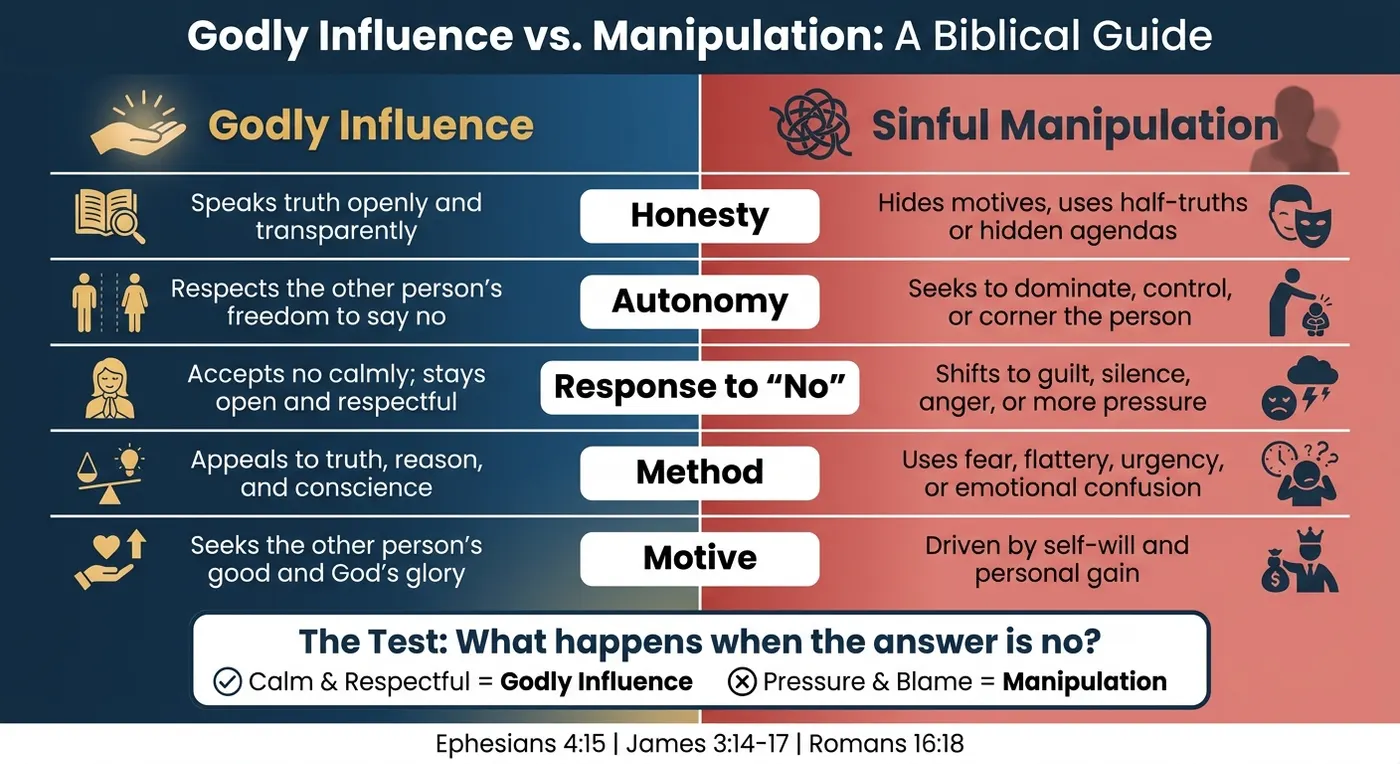
Godly Influence vs. Manipulation: A Biblical Guide
Manipulation can wear a spiritual face. It can sound kind, caring, and even wise at first. That’s why the test isn’t how it looks. The test is whether the influence stays honest, gentle, and free of pressure. That line matters in dating, setting healthy boundaries with family, friendship, church, and work.
Motives and Methods: Love and Truth versus Fear and Control
Godly influence has a clear shape. It tells the truth openly. It stays steady when questioned. And it respects the other person’s freedom to say no. Ephesians 4:15 calls it "speaking the truth in love", and James 3:17 describes it as "pure, then peaceable, gentle, open to reason, full of mercy and good fruits."
Manipulation runs on something else. James 3:14-16 ties it to "bitter jealousy and selfish ambition", and Romans 16:18 warns about people who use "smooth talk and flattery" to deceive. Biblical counselor Andrea Lee says it in plain terms:
"Anytime one person tries to control another person using unbiblical means, primarily by targeting the emotions, manipulation is present."
A simple test helps here. When someone hears no, what happens next?
Godly influence accepts the answer and stays calm, clear, and open. Manipulation changes tactics. It may lean on guilt, silence, anger, or fake urgency. In other words, one way honors freedom; the other tries to corner it.
Comparison Table: Godly Influence versus Sinful Manipulation
The main difference is straightforward: godly influence is open and willing to be examined, while manipulation depends on hidden motives. Paul welcomed the Bereans to check his teaching for themselves (Acts 17:11). That kind of openness marks godly influence.
Manipulation doesn’t hold up well under close review. Proverbs 26:24-25 puts it like this:
"A malicious man disguises himself with his lips, but he harbors evil in his heart. When his speech is charming, don’t believe him."
Here’s the contrast in plain language:
| Godly influence | Sinful manipulation |
|---|---|
| Speaks truth openly | Hides motives |
| Respects a person’s freedom to say no | Pushes for control |
| Stays gentle when challenged | Changes tactics when resisted |
| Invites questions and testing | Avoids scrutiny |
| Works through love and truth | Works through fear, guilt, or flattery |
These differences tend to show up most clearly in dating, family, friendship, church, and work.
How Christians Can Recognize and Respond to Manipulation
Spotting Manipulation in Dating, Family, Friendship, Church, and Work
Once the difference is clear, the next step is learning to spot manipulation in daily life. It usually doesn’t announce itself. More often, it shows up slowly. You start feeling like you’re walking on eggshells, doubting your own judgment, or making yourself smaller just to keep the peace. That kind of strain often follows the same deceit, flattery, and control that Scripture condemns. What matters most is not one awkward talk, but the pattern.
The tactics may look different from one relationship to another, but the setting changes while the sin stays the same. In family conflict, guilt can sound like, "If you don’t visit, you don’t love me", or money and inheritance can be used to steer an adult child’s choices. In friendships, flattery may be used to win loyalty, while approval is given and then pulled back to keep someone chasing it. In church settings, "The Lord told me" may be used to shut down questions, and disagreement can bring shunning or loss of privileges. In the workplace, fear over a job or career standing may be used to force compliance with selfish demands.
Across all these settings, the pattern tends to repeat:
- pressure
- urgency
- resistance to "no"
A manipulator often pushes for an immediate answer and cuts off time to think or pray. And when you do say no, the tactic may change fast: guilt, silence, anger, or another round of pressure. Again, the pattern tells you more than any one conversation.
Setting Biblical Boundaries and Getting Wise Help in Hard Situations
Boundaries are not unloving. A boundary means refusing to take part in pressure, deception, or false guilt. It means saying no when someone is pushing you toward sin.
When you face manipulation, start with prayer and ask God for discernment. Proverbs 2:6 says wisdom comes from God. Then speak plainly. Ask clear questions like, "What do you really want here?" or "Why does this need to happen right now?" Those kinds of questions can expose urgency and hidden motives.
If the pattern keeps going, bring it into the light. Talk with a trusted mentor, pastor, or counselor. Manipulation loses force when it is no longer hidden and is seen by others who can help you think clearly and act wisely.
Biblical counselor Andrea Lee warns about what can happen when approval matters more than obedience:
"If you want peace or approval from the manipulator so much that you avoid confronting sin or you avoid doing what is right, then this person’s affirmation is more important to you than honoring and glorifying God."
Conclusion: Pursue Truth, Discernment, and God-Honoring Relationships
When you start to see the pattern, the response becomes plain. Manipulation may hide behind charming words, spiritual talk, and emotional pressure, but it does not hold up under honest scrutiny. Godly influence stays open, honest, and respectful. Christians answer it with truth, boundaries, and trusted support.
FAQs
Is manipulation always a sin?
Yes. The Bible treats manipulation as deceit, control, and coercion. That runs against the honesty, integrity, and respect God calls for.
Scripture tells believers to turn away from falsehood and speak the truth in love, not use people or push them for selfish gain.
How can I tell if someone is manipulating me?
Watch for repeated feelings of confusion, guilt, or fear in the relationship. Those patterns usually aren’t random. Manipulation often works through deceit, half-truths, or hidden information so one person can stay in control.
Some common signs are:
- Emotional pressure
- Threats or ultimatums
- False accusations
- Playing the victim
- Questioning your reality
- Using spiritual authority to demand submission
If you keep doubting your own perception or end up feeling responsible for their mistakes, manipulation is likely happening.
What should I do if a Christian leader is manipulative?
Recognize that manipulation is not biblical leadership. Respond with discernment and courage, not blind trust.
Test what they say against Scripture. Don’t let confidence, charm, or spiritual language do the thinking for you.
Set clear, calm boundaries. You don’t need to be harsh, but you do need to be firm.
Bring the situation into the light with trusted believers. Manipulation tends to grow in secrecy, so talk with people who are wise, steady, and grounded.
If needed, confront them directly. Speak plainly and stay focused on the issue.
If you see serious red flags, involve other mature leaders or trusted adults right away.