
Bible on Toxic Family & No-Contact
How Scripture supports honoring family while setting boundaries, and when limited contact or no-contact can be a faithful choice.
Yes – according to the article, a Christian can forgive a toxic family member and still choose distance or even no-contact. The main point is simple: honor does not mean unlimited access, forgiveness does not equal reconciliation, and peace has limits when harm keeps happening.
If I had to sum up the whole piece in a few lines, it would be this:
- Honor means treating family with respect, not obeying every demand.
- Forgiveness is between me and God; it does not require restored access.
- Reconciliation needs two people, repentance, and changed behavior.
- Boundaries can be biblical when contact keeps causing harm.
- No-contact may be the right step when abuse or repeated harm does not stop.
The article also points to a few key Bible passages to support that view:
- Romans 12:18: live at peace with everyone if possible
- Matthew 18:15–17: confront sin, and if there is no listening, limit the relationship
- 2 Timothy 3:1–5: step away from people who stay harmful
- Proverbs: staying close to angry or destructive people can lead to harm
- Genesis 2:24: protecting my spouse and children comes first
A big takeaway is that not every hard family situation calls for cutting contact. Sometimes the right move is shorter visits, fewer calls, public-only meetings, or supervised contact around children. But if the pattern is severe, repeated, and there is no repentance, the article says full separation can still be faithful.
Here’s the clearest side-by-side view:
| Response | What it means | When it fits |
|---|---|---|
| Limited contact | Less access, fewer chances for harm | Repeated disrespect, manipulation, conflict |
| Strong boundaries | Clear rules with follow-through | Interference, verbal attacks, pressure, control |
| No-contact | No direct access at all | Abuse, threats, or repeated harm with no change |
The article closes with 3 plain questions I should ask before deciding:
- Is there actual harm or danger?
- Has the person shown real repentance over time?
- Can contact continue without harming my conscience, peace, or family?
In short: the article argues that love, honor, and forgiveness do not require me to stay close to someone who keeps hurting me. If I choose distance, the goal should be protection, peace, and faithfulness – not revenge.
That’s the frame for everything that follows.
What Scripture says about honoring family, confronting sin, and protecting peace
Honor does not cancel truth or accountability
The command to honor means giving weight to a person, not saying yes to every demand. Honor shapes how you treat a parent or family member. It does not mean unlimited compliance.
For adults, honor can look like respectful firmness. It can mean naming sin plainly and refusing to support destructive patterns. In that sense, honor and confrontation are not opposites. Honor can include clear confrontation.
Matthew 18:15–17 lays out a plain process: address the sin in private first, then bring witnesses, then involve the church. If the person still refuses to listen, Jesus says to treat them as "a Gentile and a tax collector" – in other words, a relationship with limits. That brings up the next issue: what kind of biblical boundaries with family make sense when repentance never comes?
Peace is biblical, but safety and wisdom matter too
Proverbs warns that staying close to fools and angry people leads to harm and entanglement. That matters. When harm keeps repeating, staying close can come at a moral cost.
Genesis 2:24 also shows that marriage forms a new primary household, which means protecting your immediate family can come before the demands of extended family. If a family member’s behavior puts your spouse or children at risk, guarding them is not harsh. It is a biblical duty.
Forgiveness, reconciliation, and restoration are not the same thing
Mixing up these terms often creates guilt. The big point is simple: forgiveness is not the same as access.
| Term | What it requires | Who is involved |
|---|---|---|
| Forgiveness | Releasing vengeance before God | You alone – it’s a heart decision |
| Reconciliation | Mutual repentance and accountability | Both people must participate |
| Restoration | Rebuilt trust over time | Both people, over an extended period |
You can forgive someone fully and still keep your distance. Forgiveness does not require resumed contact, and it does not depend on the other person’s participation.
Reconciliation and restoration are different. They require the other person to show up with honesty and change. Without that, they cannot happen. Acting as if they already have is not faithfulness. When repentance does not come, these distinctions help clarify whether limited contact, strong boundaries, or no-contact is the wisest next step.
Going ‘No Contact’ with Parents: Is It Biblical? | Ep 1345
When boundaries or limited contact may be the wiser response
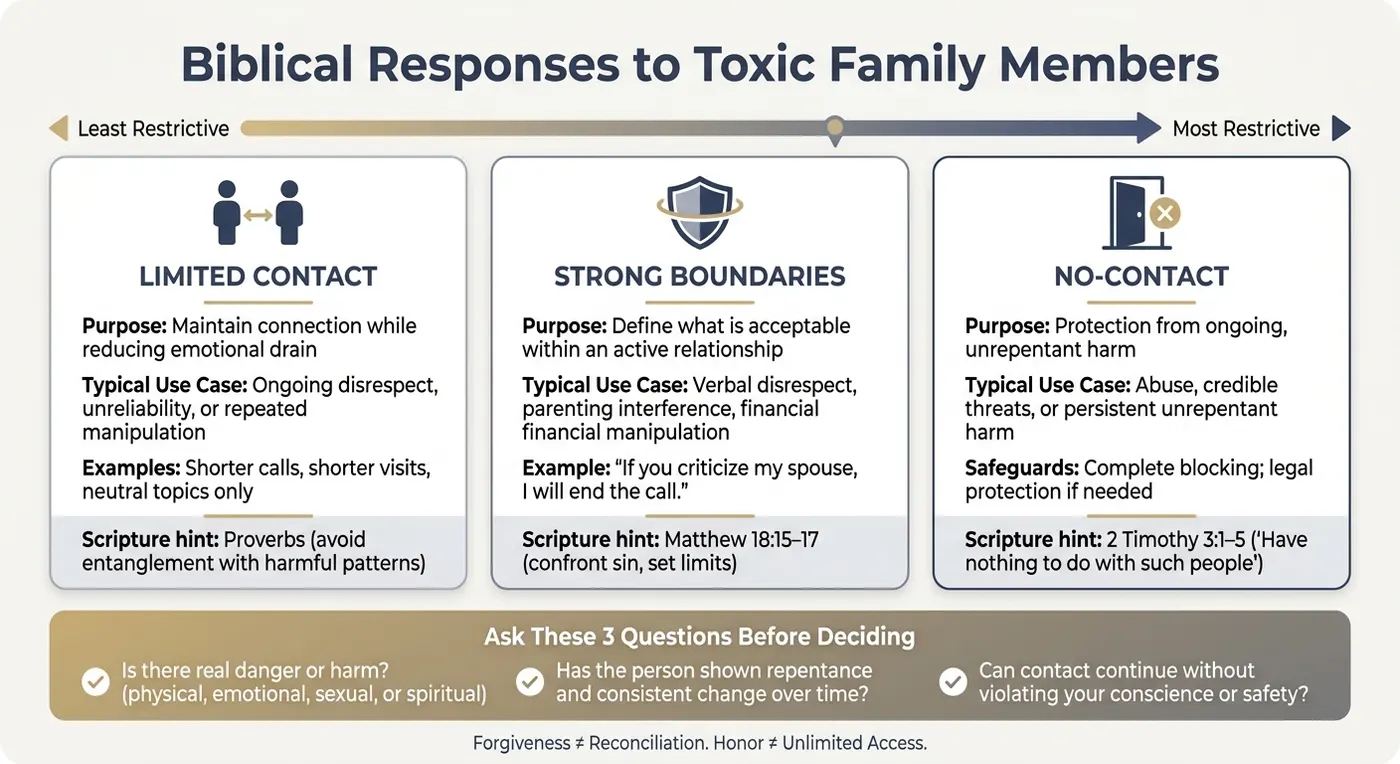
Biblical Responses to Toxic Family Members: Limited Contact vs. Boundaries vs. No-Contact
Not every painful family relationship calls for no-contact. Sometimes the wiser move is limited contact that protects your household, conscience, and safety. When reconciliation isn’t possible, Scripture still leaves room for wise limits. The key issue is simple: what level of distance fits the harm? Here’s what that can look like in daily life.
Situations that often call for reduced contact
Proverbs makes a difference between foolish behavior and settled evil. Repeated disrespect, manipulation, and conflict can justify reduced contact. You don’t have to keep absorbing the same damage over and over.
If a parent keeps undermining your parenting decisions, if a sibling turns every family gathering into an argument, or if a relative keeps disrespecting your spouse after being told to stop, that pattern calls for a response.
What practical boundaries can look like
With toxic people, it helps to limit access and keep your tone calm. Shorter calls, shorter visits, and neutral topics can lower exposure without forcing a formal break. If children are involved and a relative shows favoritism or disrespect, supervised contact may be a reasonable way to protect them.
The clearest boundaries often sound like simple if/then statements:
"If you begin criticizing my spouse, I’ll end the call and we can try again another time."
Brief. Calm. Specific. And most of all, make sure you choose boundaries you can keep.
Limited contact, strong boundaries, and no-contact compared
These three responses are not the same.
| Approach | Purpose | Typical Use Case |
|---|---|---|
| Limited Contact | Maintain connection while reducing emotional drain | Ongoing disrespect, unreliability, or repeated manipulation |
| Strong Boundaries | Define what is acceptable within an active relationship | Verbal disrespect, parenting interference, or financial manipulation |
| No-Contact | Protection from ongoing, unrepentant harm | Abuse or ongoing unrepentant harm |
Setting a boundary is not punishment. It is stewardship of what God has entrusted to you: your household, your conscience, and your safety.
When no-contact can be a biblically faithful decision
When limited contact stops keeping you safe, no-contact may be the next step that fits Scripture. The Bible leaves room for separation when harm keeps happening and the person refuses to turn from it.
Biblical reasons no-contact may be necessary
2 Timothy 3:1–5 describes people who stay harmful and unrepentant, then gives a direct command: "Have nothing to do with such people." That warning does not disappear because the person is family. So no-contact is a serious biblical category, not a case of being too sensitive.
Scripture treats unrepentant abuse as dangerous and tells believers to step away from it.
Proverbs also makes helpful distinctions. The wise person accepts correction. The foolish person may keep repeating harmful patterns and need limited access. The scoffer goes further. This person seeks to wound, control, or tear down. In cases like that, full separation may be the safest path.
Protecting your children and guarding the peace of your home is also a matter of stewardship, not just preference. If a family member puts your spouse or kids at risk, removing access can be a faithful act, not a selfish one.
What no-contact is and is not
No-contact means ending direct access: calls, visits, and messages. That may be for a set season or for the long term. It is not the same thing as bitterness or payback. You can forgive someone and still block access. Forgiveness gives up personal vengeance. Reconciliation requires repentance.
Biblical Counselor Tania Hilton puts it plainly:
"Forgiveness is a heart posture, a decision to release someone from the debt they owe us… Reconciliation requires mutual ownership of wrongs, humility, accountability, and effort."
That means future reconciliation depends on steady repentance and changed behavior, not just words or promises.
Temporary distance, structured separation, and no-contact compared
These options differ in length, access, and purpose. The level of harm – and the person’s response to correction – helps show which kind of separation fits.
| Option | Duration | Level of Access | Recommended Safeguards | Harm It Addresses |
|---|---|---|---|---|
| Temporary Distance | Short-term (days to weeks) | Minimal/none temporarily | Prayer, self-reflection, therapy | High tension, confusion, need for clarity |
| Structured Separation | Ongoing but conditional | Limited (public only, no 1-on-1) | Clear if/then boundaries; surface topics only | Chronic manipulation, boundary-crossing, mild patterns of harm |
| No-Contact | Indefinite or long-term | Zero access | Complete blocking; legal protection if needed | Abuse, credible threats, or persistent unrepentant harm |
Use no-contact only when the harm is severe, ongoing, and unrepentant. The next step is figuring out which response matches the harm in front of you.
How to discern your next step and move forward with support
3 biblical questions to guide your decision
These questions can help you sort out whether limited contact, structured separation, or no-contact makes the most sense. The goal isn’t guilt. It’s clarity.
First: Is there real danger or harm? That can mean physical, emotional, sexual, or spiritual abuse, not just tension or disagreement. If you or your children are facing real, repeated risk, protection is not selfish.
Second: Has the person shown repentance and consistent change? Pay attention to a pattern of repentance, not a single apology, emotional moment, or promise to do better.
Third: Can contact continue without violating your conscience or safety? Romans 12:18 tells believers to live peaceably with everyone, as far as it depends on you. That’s an important line. If staying in contact puts your conscience or safety in conflict, distance may be the wise move.
If your answers point toward distance, the next step is to act with calm and clarity, not on raw emotion.
Practical steps before and after setting boundaries
Start with prayer. James 1:5 says God gives wisdom generously to those who ask. Bring the whole situation to God. Ask plainly for wisdom.
Then document the patterns. Write down specific incidents: what was said, what happened, and how it affected you and your household. One promise can sound good in the moment. A pattern tells the truth.
If it’s safe, begin with a limited boundary. Be clear about what you will and will not accept. Then give the other person room to show whether they can respect that limit.
Before you lock in a final decision, seek godly counsel. A trusted pastor, biblical counselor, or Christian psychologist can help you see the situation from the outside. That’s often the difference between clarity and getting pulled back into confusion or manipulation.
"Where there is no guidance, a people falls, but in an abundance of counselors there is safety." – Proverbs 11:14
Once wise counsel and clear limits are in place, the next part is simple to say and hard to do: follow through.
Grieve the relationship you wanted. A boundary can be right and still hurt. Those two things can sit side by side.
After you set a boundary, keep it steady. Expect denial, blame-shifting, and even Scripture used as pressure. That pushback can feel unsettling, but it does not mean you made the wrong call.
Conclusion: Faithfulness may mean peace-making, distance, or protection
Once you understand the level of harm, faithfulness means choosing the response that fits it. Honoring family does not mean giving unlimited access. Forgiveness does not, by itself, restore access. And when harm is severe and unrepentant, no-contact can be a biblically faithful act, not a failure of love.
Whatever your next step is, take it with prayer, wise counsel, and a clear conscience. Protect what God has entrusted to you: your faith, your family, and your peace.
FAQs
How do I know if no-contact is biblical?
No-contact can be biblical when you separate forgiveness from reconciliation. Scripture calls Christians to forgive. But it does not require you to give unlimited access to someone who is abusive, manipulative, or destructive.
If the harm keeps going even after clear boundaries and honest truth-telling, distance may be an act of self-protection, not sin. Sometimes it’s the right response when a person refuses accountability.
Can I honor my parents without obeying them?
Yes. Honoring your parents doesn’t mean giving them unlimited control, pretending nothing is wrong, or staying in harmful situations.
You can honor them by praying for them, speaking with respect, and treating them with dignity while still setting firm boundaries. Those boundaries may be there to protect your well-being, your marriage, and your children from manipulation or harm. Choosing health over dysfunction is not unbiblical.
What does real repentance look like over time?
Real repentance shows up in steady, visible change – not just promises, apologies, or the right words. It means naming the harm plainly and then doing the slow work of rebuilding trust over time.
This goes beyond simply avoiding conflict. It shows up in a changed pattern of behavior, especially in how a person treats other people day to day. If someone keeps causing harm or using manipulation, they aren’t ready for the trust and closeness that a restored relationship asks for.