
A Christian's Guide to Co-Parenting and Blended Families
Biblical guidance for peaceful co-parenting in blended families: forgiveness, communication, boundaries, and faith-centered routines.
Navigating co-parenting and blended families can be challenging, but the Bible offers clear guidance to help you create a peaceful and loving environment for your children. Here’s what you need to know:
- Focus on Peace: Romans 12:18 reminds us to live in peace with everyone, prioritizing your child’s well-being over personal conflicts.
- Forgiveness and Grace: Ephesians 4:31-32 emphasizes letting go of bitterness and showing kindness, even in difficult relationships.
- Effective Communication: Practice being "quick to listen, slow to speak, and slow to anger" (James 1:19) to build trust and resolve conflicts.
- Consistency Across Households: Align on rules and values to provide stability for children, while respecting each parent’s boundaries.
- Faith-Centered Practices: Incorporate prayer, Bible study, and Christ-like behavior into daily life to strengthen your family’s spiritual foundation.
The journey isn’t easy, but with God’s guidance, you can build a family rooted in love, forgiveness, and unity. Let’s explore these principles in detail.
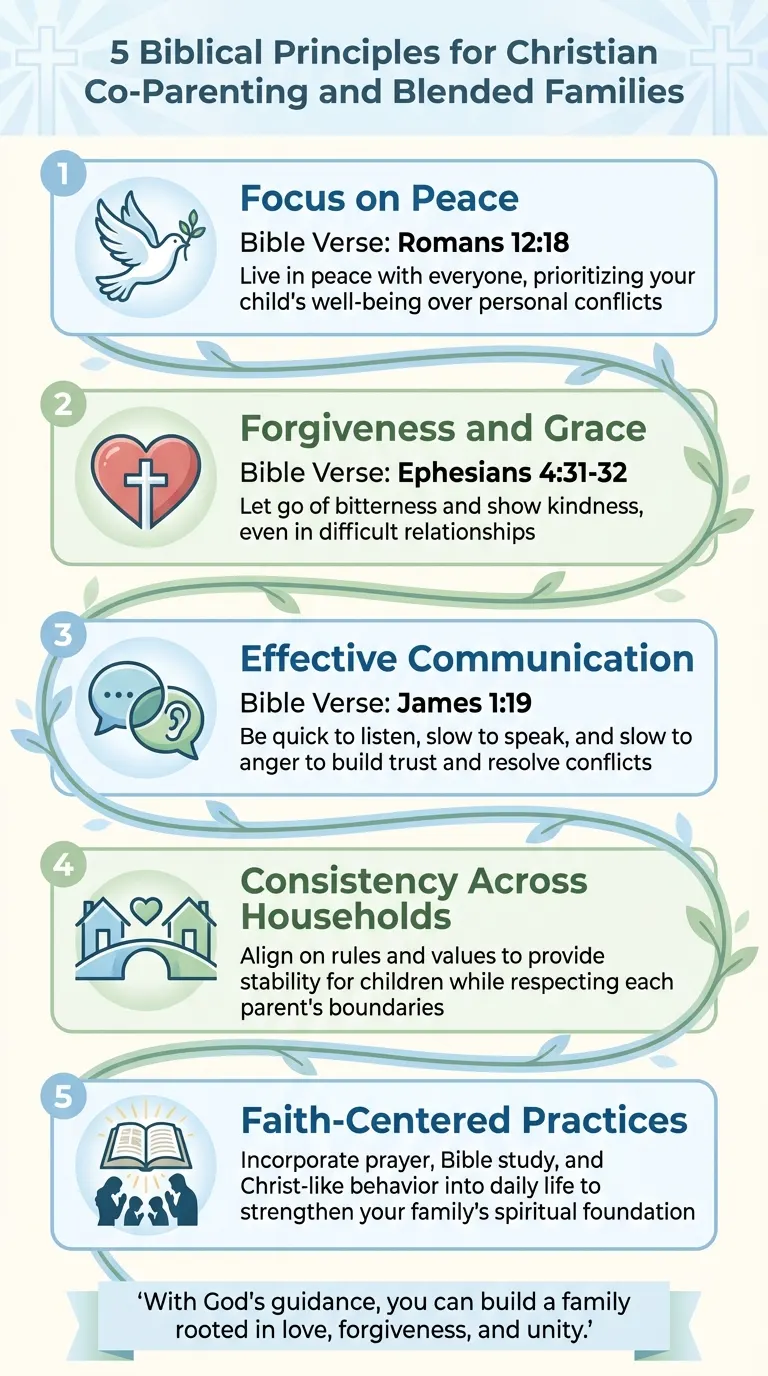
5 Biblical Principles for Christian Co-Parenting and Blended Families
A Biblical Perspective on Blended Families
What Scripture Says About Family and Unity
The Bible speaks to the heart of family life, offering guidance that transcends time. While it doesn’t specifically address modern dynamics like blended families or co-parenting, its principles on unity, forgiveness, and love are deeply relevant. Take Ephesians 4:31-32, for example: "Let all bitterness and wrath and anger and clamor and slander be put away from you, along with all malice. Be kind to one another, tenderhearted, forgiving one another, as God in Christ forgave you." This verse encourages co-parents to replace harmful emotions with compassion and grace.
Forgiveness is central to this. As Ron Deal, Author and Director of FamilyLife Blended, explains:
"Gratitude for what God has done for you is what fuels your ability to be kind and forgiving to others – even challenging, difficult co-parents."
Reflecting on God’s mercy can shift your perspective, making forgiveness about your faithfulness to Christ rather than the other person’s actions. It’s a powerful reminder that grace isn’t earned – it’s given.
Unity in a blended family doesn’t mean ignoring past hurts or agreeing on every issue. Instead, it’s about putting the child’s well-being first – emotionally, behaviorally, and spiritually. This may involve speaking positively about the other parent, acknowledging their strengths, and trusting their ability to manage their home without unnecessary interference. These biblical principles provide a foundation for navigating the unique dynamics of blended families.
Common Challenges in Blended Families
Blended families often face hurdles that traditional families might not encounter. One of the biggest challenges is building trust between stepparents and stepchildren. This trust doesn’t happen overnight, especially when children feel torn between loyalty to their biological parent and accepting a new parental figure. Some children may even feel guilt for forming a bond with a stepparent. Meanwhile, unresolved conflicts between co-parents can spill over into the family, creating tension that undermines a child’s sense of security.
Another challenge is dealing with different parenting styles across households. For instance, one home might enforce strict rules around bedtime and screen time, while the other is more relaxed. These differences can confuse children and frustrate parents. The temptation to micromanage the other household or compete for the child’s affection can strain relationships. Instead, respecting boundaries and trusting the other parent’s competence – unless there are clear safety or moral concerns – helps create a more harmonious environment.
Biblical Principles for Strong Family Relationships
Forgiveness and Grace in Family Life
Forgiveness in a family – especially a blended one – is not about erasing the past or pretending everything is okay. Instead, it’s about renewing your mindset through faith. Romans 12:2 urges believers to be "transformed by the renewal of your mind", which means actively choosing to let go of bitterness and blame, replacing them with compassion and understanding. This kind of transformation doesn’t happen automatically – it takes effort and a deep reliance on God.
The ability to extend grace begins with remembering how much grace you’ve received. Reflecting on God’s mercy through Christ can shift your perspective, making it easier to show kindness to others – even when it’s hard. Forgiveness becomes less about whether the other person deserves it and more about your own commitment to following Christ.
In practical terms, this involves separating past hurts from present responsibilities. As Ron Deal explains, "Becoming a healthy co-parent… begins with recognizing that old marital hurts are not sufficient cause for ongoing co-parental battles. The former was about you; the latter is about an innocent child who does not deserve to be caught in the middle." Your children’s well-being must come first. This might mean speaking positively about your co-parent, acknowledging their good qualities, or trying to see things from their perspective. These steps require humility and empathy but can help build a healthier environment for your kids.
God-Honoring Communication
Effective communication in a blended family calls for intentionality and biblical principles. James 1:19 provides timeless advice: "Be quick to listen, slow to speak, and slow to anger." This means giving your full attention to family members, pausing before responding, and keeping your emotions in check during disagreements. When people feel truly heard, conflicts tend to resolve more peacefully, and relationships grow stronger.
One way to promote open dialogue is by holding regular family meetings. Whether weekly or biweekly, these gatherings provide a space for everyone to share concerns, ideas, or even celebrate victories. Starting these meetings with prayer reinforces that God is the foundation of your household, as Psalm 127:1 reminds us: "Unless the LORD builds the house, the builders labor in vain." Additionally, one-on-one check-ins with each child can help stepparents build trust and deepen connections. These private conversations give children the chance to share feelings they might hesitate to express in a group setting.
Ephesians 4:2 teaches, "Be completely humble and gentle; be patient, bearing with one another in love." This patience is especially crucial when blending two households with different communication styles. If conflicts persist despite your best efforts, Proverbs 15:22 offers wisdom: "Plans fail for lack of counsel, but with many advisers they succeed." Seeking guidance from Christian counselors or church-based support can provide the tools needed to navigate challenges. Thoughtful communication builds a foundation for a unified family, one where every member feels valued and supported.
Building Family Unity
In a blended family, unity doesn’t mean everyone has to think the same way or share the same background. Instead, it means centering your household around Christ as your common ground. Activities like shared devotions, family Bible studies, or group reading plans can help create spiritual connection and remind everyone that faith – not fleeting emotions – is the bedrock of your family. Ephesians 5:21 encourages mutual submission, urging family members to respect one another out of reverence for Christ.
Creating new family traditions can also strengthen bonds. Whether it’s a weekly game night, monthly service projects at church, or even a special holiday ritual, these shared experiences foster togetherness in a natural, low-pressure way. The goal isn’t to achieve perfection but to show up for each other consistently. Over time, these efforts build trust and a sense of belonging among step-siblings and stepparents alike. Together, these practices help form a family united in faith and love.
Mastering Co-Parenting: The Power of Discernment | Blended Family Podcast
Practical Co-Parenting Strategies
Applying biblical principles of communication and unity becomes more effective when paired with practical co-parenting strategies.
Defining Boundaries and Roles
In co-parenting, boundaries should act as tools for healthy stewardship – not as barriers driven by selfishness. Proverbs 4:23 advises believers to guard their hearts, which in this context means protecting your values and decisions while respecting the autonomy of the other parent’s household. Dr. John Townsend explains this concept clearly:
"Boundaries are your personal property line, where you set out where you end, and where the other person begins".
This approach emphasizes taking responsibility for your own emotions and actions, instead of focusing on controlling what happens in the other home.
Defining roles clearly can also reduce unnecessary conflict. Decide who will handle specific tasks like medical appointments, school communication, or managing extracurricular activities. Using neutral terms like "limit" when discussing boundaries can foster cooperation. The Bible highlights self-control as a fruit of the Spirit but does not advocate for controlling others. As Henry Cloud and John Townsend put it:
"We are not, for example, responsible for other people. Nowhere are we commanded to have ‘other-control,’ although we spend a lot of time and energy trying to get it".
For stepparents, boundaries require a nuanced approach. First Timothy 5:1-2 advises treating those you’re not married to as brothers or sisters in Christ, with "absolute purity". Stepparents should understand that while they have a practical role in parenting, they don’t replace the emotional connection between a biological parent and child. Acknowledging this distinction helps maintain respect and clarity in family dynamics.
Once boundaries and roles are established, the next step is to focus on working together effectively.
Working Together with Your Co-Parent
Successful co-parenting places the child’s emotional, behavioral, and spiritual well-being above personal preferences. This mindset promotes a "same side" mentality, emphasizing that both parents share the common goal of raising a healthy, well-rounded child.
Empathy and trust are essential. Assume your co-parent is capable unless there are valid concerns about safety or moral issues. When communication becomes difficult, Christian counseling or neutral mediation can help navigate complex situations.
Collaborate on major decisions, especially those involving your child’s religious upbringing, education, and healthcare [2, 10]. If possible, pray together or read scripture as a co-parenting team to stay aligned with God’s guidance. Ephesians 4:31-32 offers a helpful reminder to "be kind to one another, tenderhearted, forgiving one another, as God in Christ forgave you". Practicing forgiveness and grace can strengthen cooperation and mutual respect in your shared parenting efforts.
Consistency across households is another important factor in creating a stable environment for your child.
Maintaining Consistency Between Households
Children thrive when both households uphold similar expectations and values. Coordinating long-term goals between homes helps provide a stable, faith-centered foundation [2, 10]. For example, if your son is entering adolescence, you might decide which parent is better suited to lead conversations about biblical manhood while the other offers support.
Spiritual consistency is equally important. Work with your church’s youth minister to ensure your children stay involved in church activities, even during weeks spent with the other parent. This reinforces the idea that faith is a shared priority, fostering unity across both households. Unless there are safety or moral concerns, respect the other home’s rules and routines without unnecessary interference.
When disagreements arise over discipline or household rules, turn to scripture for guidance. Romans 12:2 encourages a renewal of the mind, reminding you to see your co-parent as a teammate rather than an adversary. Ultimately, children benefit most when they observe their parents working together peacefully, even if each household has its own distinct way of operating.
Making Faith Part of Daily Family Life
Blended families come with their own set of challenges, especially when it comes to uniting people with different histories and habits under one spiritual framework. Incorporating faith into daily life – not just reserving it for Sunday mornings – can help create the sense of unity and stability that every family needs.
Prayer as a Family Practice
Prayer doesn’t have to be long or formal to have meaning. As Tom, a father in a blended family, puts it, "I don’t know how this works if you don’t have Christ as the center of your life. You base everything in the Word." For blended families, simple prayer routines can help maintain a spiritual connection, even across multiple households.
Consider using Psalm 46:10 – "Be still and know that I am God" – as a reminder of God’s presence and control in your family’s life. Romans 8:26 is another comforting verse, assuring us that the Holy Spirit steps in when we struggle to find the right words. These scriptures can guide your family in finding peace and strength through prayer.
Pray intentionally for smooth transitions between households and for a sense of peace during those changes. Stepparents might also pray for a heart that reflects Christ’s selfless love. To make prayer accessible for everyone, try incorporating quick, bite-sized devotionals, like the "FamilyLife Blended Minute", a resource designed to fit into busy schedules.
By establishing consistent prayer practices, you’re setting the stage for deeper engagement with scripture.
Family Bible Study and Reflection
Daily prayers can lead naturally into regular Bible study, which helps build a stronger spiritual foundation for your family. Short, manageable devotionals can bring everyone together without feeling overwhelming. Digital tools and structured programs, like Life.Church’s four-week "Blend" study, offer practical steps for fostering spiritual unity.
You might also schedule weekly or biweekly family meetings that include prayer, open discussions, and moments of gratitude. These gatherings can be a time to work through disagreements or tensions using guidance from scripture – James 1:19, which encourages us to be "quick to listen, slow to speak", is a great starting point.
In addition, spending one-on-one time with each child can strengthen their sense of security and help reinforce your family’s spiritual values.
Modeling Christ-Like Behavior
Kids often learn more from what they see than what they’re told. Joy Allmond, a writer and stepmom, shares, "Choosing to love and serve my stepsons – even though I don’t know whether I will ‘earn’ their loyalty – has helped me identify with Christ in a unique way." This kind of sacrificial love is a powerful way to live out Jesus’s teachings in your everyday actions.
Forgiveness is another key element. Ephesians 4:32 reminds us to "Be kind and tenderhearted, forgiving one another just as in Christ God forgave you." Speaking kindly about your co-parent and acknowledging their strengths can help avoid unnecessary tension and foster harmony between households. When children witness you choosing patience over frustration or kindness over criticism, they’re seeing Christ-like behavior in action, which can have a lasting impact on their understanding of faith and love.
Conclusion: Trusting God with Your Blended Family
Blending a family comes with its share of challenges, but you don’t have to face them on your own. The biblical principles we’ve discussed – like forgiveness, grace, Christ-like communication, and consistent faith – become powerful when rooted in prayer and scripture. As Tom, a parent navigating a blended family, beautifully puts it:
"Anytime you’re forced to seek God and His Word, you become stronger".
By leaning into these faith-based strategies, you can reframe challenges as opportunities for spiritual growth. Whether you’re juggling schedules, balancing parenting styles, or helping children adapt, these struggles can deepen your faith. When you view them as part of a process that strengthens your relationship with Christ, you’re embracing the call to love and serve, even without immediate earthly rewards. Every obstacle becomes a step closer to a more meaningful walk with Him.
Trust that God is guiding every step of your journey. Psalm 46:10 reminds us to rest in His sovereignty, and Romans 8:26-27 assures us of the Holy Spirit’s intercession during uncertain times. Gratitude for God’s faithfulness fuels the patience and kindness needed for difficult moments – whether it’s dealing with co-parents or navigating transitions.
When you base your decisions on God’s Word, you keep Christ at the center. Let Ephesians 4:32 inspire you to practice tenderhearted forgiveness:
"Be kind to one another, tenderhearted, forgiving one another, as God in Christ forgave you".
FAQs
How do I forgive my co-parent when they won’t apologize?
Forgiving a co-parent who hasn’t apologized is a powerful expression of grace and obedience, deeply rooted in Christian teachings. It’s not about excusing harmful behavior but about letting go of resentment. Start by praying for strength to release bitterness, meditating on scripture that emphasizes forgiveness, and trusting God to bring justice and healing in His time. This act of forgiveness not only reflects God’s grace but also creates a more peaceful atmosphere for your children, promoting unity even amidst human flaws.
What boundaries should I set with my ex to protect my kids?
Establishing boundaries with your ex is essential to protect your children and create a positive co-parenting environment. The key lies in focusing on respectful collaboration, maintaining clear communication, and working together on decisions about your kids’ upbringing.
Here are a few practical steps to help:
- Limit emotionally charged interactions: Keep conversations focused on parenting topics and avoid letting personal feelings influence discussions.
- Maintain consistency: Work together to establish routines and rules that are consistent across both households.
- Create stability: Prioritize decisions that provide your children with a sense of security and minimize disruptions in their lives.
These practices echo biblical values of respect, unity, and protection, ensuring your children are shielded from conflict and feel safe in their environment.
How can we keep faith consistent in both homes?
Maintaining a steady faith across two homes takes purposeful effort and a commitment to biblical values. Start by emphasizing respect, cooperation, and demonstrating Christ-like love and forgiveness in everyday interactions. Incorporating regular prayer and reflecting on scripture – both as individuals and as a family – can strengthen a shared spiritual bond. By focusing on grace, fostering unity, and turning to God for guidance, parents can cultivate a faith-filled atmosphere that supports their children’s relationship with Christ, no matter which household they’re in.