
What Does the Bible Say About Dating and Finding a Godly Partner?
Biblical dating centers on prioritizing God: seek shared faith, assess character, set purity boundaries, pray, and rely on community.
Dating as we know it today isn’t mentioned in the Bible, but Scripture provides timeless principles about love, purity, and relationships. Here’s a quick guide:
- Focus on Faith: Seek a partner who shares your faith and prioritizes God (2 Corinthians 6:14). Building godly relationships on a Christ-centered foundation creates a lasting bond.
- Biblical Love: Love is patient, kind, and selfless (1 Corinthians 13:4-7). Look for these traits in a potential partner.
- Purity Matters: The Bible calls for sexual purity in both actions and thoughts (1 Thessalonians 4:3-5, Matthew 5:27-28). Set clear boundaries to honor God.
- Character Counts: Assess a partner’s character through their actions, how they treat others, and their relationship with God (Galatians 5:22-23).
- Prayer and Discernment: Pray for wisdom and seek guidance from trusted mentors and community.
Dating with biblical principles means putting God first, setting boundaries, and seeking a partner who helps you grow spiritually. Trust God’s timing and let Him guide your relationships.
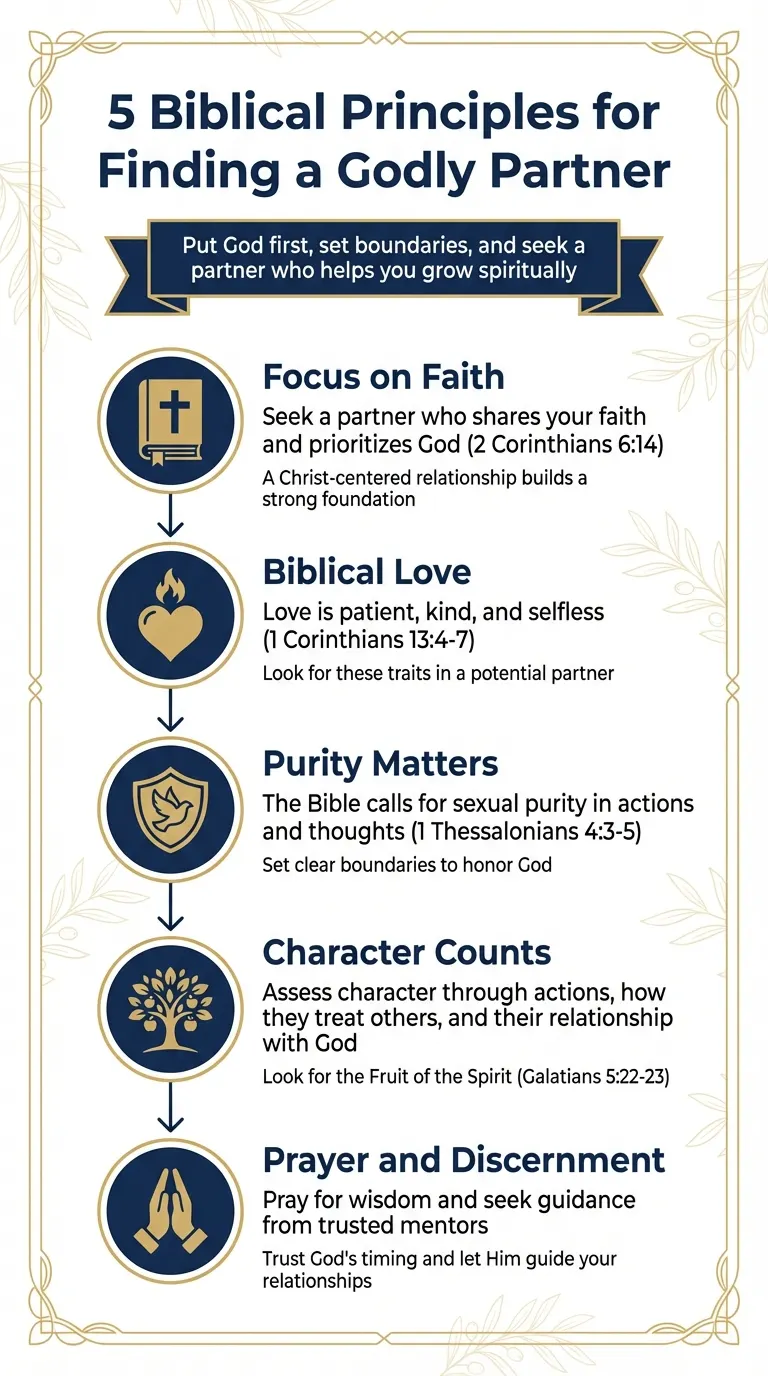
5 Biblical Principles for Finding a Godly Partner
Christian Dating Advice: What to Look for in a Spouse | Biblical Relationship Guide
Biblical Principles for Relationships
The Bible provides enduring guidance on love, respect, and honor, offering a foundation for meaningful, lifelong relationships. Let’s dive into how Scripture defines love and encourages us to cultivate virtues essential for healthy connections.
What Scripture Says About Love
1 Corinthians 13:4-7 paints a vivid picture of love with 15 defining attributes. With the word "love" appearing over 300 times throughout the Bible, its importance in God’s design is undeniable.
At the heart of biblical love is patience. John MacArthur describes this as "the ability to be inconvenienced or taken advantage of by a person over and over again and yet not be upset or angry". In the context of dating, this means showing grace when your partner makes mistakes or falls short, choosing understanding over frustration.
Next comes kindness. Pastor Matt Black explains, "To be kind is to make life easier for the other person and to serve them from your heart". A godly relationship focuses on giving rather than taking. True love also avoids jealousy, arrogance, or selfishness. It doesn’t dishonor others, nor does it keep a tally of wrongs. These principles foster trust and respect, creating a relationship free from rivalry or bitterness.
Purity and Holiness in Dating
The Bible emphasizes the importance of sanctification, especially in the realm of sexual purity. 1 Thessalonians 4:3-5 commands believers to abstain from sexual immorality, reminding us that our bodies are temples of the Holy Spirit (1 Corinthians 6:18-20). This isn’t just advice – it’s a direct call to honor God through our actions and thoughts.
Purity extends beyond physical actions to include intentions. Jesus made this clear when He equated lustful thoughts with adultery of the heart (Matthew 5:27-28). This means guarding not only what we do but also what we think and consume. Randy Alcorn, founder of Eternal Perspective Ministries, puts it plainly:
Sexual purity is ALWAYS in your best interest. Be smart, not stupid, and you’ll enjoy the best God has for you!
Practically speaking, treating your partner "with absolute purity" (1 Timothy 5:2) means seeing them as a brother or sister in Christ. Edward D. Andrews, CEO of Christian Publishing House, cautions:
If a relationship cannot thrive without sexual stimulation, then it is not being sustained by biblical love, but by appetite.
To honor this principle, set clear boundaries early, avoid tempting situations (like being alone together late at night), and establish accountability with a trusted mentor or friend.
Partnership and Mutual Support
God designed relationships to strengthen and uplift both individuals. Ecclesiastes 4:9-12 reminds us that "two are better than one" because they can support each other in times of need, providing both encouragement and protection. A Christ-centered partnership unites two individuals to serve God more effectively together.
Proverbs 31:10-31 offers a detailed portrait of a partner whose worth transcends physical beauty. Verse 30 underscores that "charm is deceptive, and beauty is fleeting; but a person who fears the Lord is to be praised". This passage highlights qualities like trustworthiness, diligence, and wisdom, showing that these traits are the foundation of a strong relationship. Proverbs 31:11 further notes, "the heart of her husband safely trusts her", emphasizing that a solid partnership is built on reliability and mutual benefit.
Garrett Higbee, Director of Lead Healthy Retreats, captures this idea well:
If you are complete in Christ, you don’t need someone else to complete you. Now you can engage in a relationship to give more than take, to love more than need, and to bless more than be blessed.
This perspective shifts the focus of dating from self-fulfillment to a shared mission rooted in Christ. Together, partners can encourage one another toward love and good deeds, as Hebrews 10:24-25 advises.
How to Find a Godly Partner
Finding a partner who honors God requires intentionality, prayer, and a commitment to biblical values.
Assessing Character and Faith
Godly relationships are built on a foundation of reverence for the Lord. A potential partner should prioritize their relationship with God and live according to Scripture. As Immanuel Baptist Church wisely notes, "When you find someone who loves Jesus more than they love you, you’ve found a treasure."
Character is often revealed in the small moments of life. Look for the Fruit of the Spirit (Galatians 5:22-23) in their reactions to stress, disappointment, and conflict. A godly partner is someone who is already fulfilled in Christ – someone who gives selflessly rather than seeking to fill a personal void.
Pay close attention to how they treat people who can offer them nothing in return, such as service workers or strangers. This often reflects their true character. Family relationships are also telling; a man who does not honor his mother or a woman who disrespects her parents may struggle to uphold the biblical values of honoring family within a marriage. As Ruth Bell Graham aptly put it, "A good marriage is the union of two forgivers."
Introducing a potential partner to trusted friends and your church community early on can provide valuable insights. Look for someone with a teachable spirit – someone open to guidance from mentors and elders. Also, consider their involvement in a local church. A casual approach to church attendance might signal a casual approach to their faith.
Once you’ve assessed their character, seek God’s direction through prayer to confirm what you’ve observed.
Prayer and Discernment in Dating
Prayer is essential for aligning your desires with God’s wisdom. As Bible Stories Hub explains, "If purpose is your destination, prayer is the compass. Intentional dating without prayer easily becomes wishful thinking." Use prayer, such as Psalm 139:23-24, to examine your motives and seek God’s guidance in your decisions.
When discerning God’s will, consider three aspects: your genuine desire (do you truly want this?), confirmation from trusted community members, and the opportunities God places before you. Even when your desires and community align, a relationship might not work out. This could be God preparing you for something better. As Desiring God puts it, "God withholds good from his people when He’s not yet good enough – when He wants and has planned something better for us."
Accountability is crucial. Rely on mature church leaders, parents, and trusted friends who will ask honest questions about your spiritual and emotional health. Avoid entering a relationship with the hope of converting someone to faith; instead, seek a partner who is already rooted in Christ. Garrett Higbee cautions, "You either find satisfaction in Christ as your first love, or you will look for love in all the wrong places."
Setting Boundaries for Purity
As you evaluate character and seek God’s guidance, setting boundaries is key to maintaining purity and avoiding unnecessary pitfalls. Boundaries are not about restriction but about creating a safe space for emotional and spiritual intimacy to grow without the confusion that premature physical involvement can bring. Physical intimacy can release hormones like oxytocin, which may cloud judgment about long-term compatibility. That’s why it’s important to set clear limits before emotions take over.
A helpful guideline is the "swimwear rule" – keep physical boundaries to areas typically covered by modest swimwear. Establishing a set "home by" time can help avoid late-night situations where good judgment may falter. Avoid being alone in potentially compromising locations, such as a bedroom, an empty house, or a parked car at night. Randy Alcorn, founder of Eternal Perspective Ministries, advises, "When it comes to sexual temptation, it always pays to be a coward."
Discuss your boundaries with your partner early on and agree on them together. Having a plan for risky situations – like using a simple phrase such as, "I care about you, and we’re stopping here. Let’s change settings" – can help diffuse the moment. As the Christian Pure Team states, "A boundary says, ‘This relationship will not lead; Jesus will.’" When emotions run high, using a "PPP" reset – Pause, Pray, and regain Perspective – can help ensure your actions honor God.
Finally, share your boundaries with a trusted Christian mentor or friend for added accountability and prayer support. Praying together at the start and end of each date, while maintaining personal worship and church attendance, helps keep Christ at the center of your relationship.
Using Psalmlog for Spiritual Guidance in Dating

Biblical dating thrives on consistent reflection, prayer, and discernment. Psalmlog equips you with practical tools to process your experiences through Scripture, helping you ensure that your relationships align with God’s will. These tools integrate seamlessly with the biblical principles discussed earlier, offering a deeper way to apply Scripture to your dating life.
Voice Journaling to Reflect on Relationships
Reflection is key in navigating relationships, and speaking your thoughts aloud can help clarify emotions and concerns. Psalmlog’s voice journaling feature allows you to express your dating experiences naturally. Instead of flipping through a concordance, you can record your thoughts, and within 60 seconds, the app analyzes your entry. It then provides relevant Scripture passages and pastoral insights tailored to your situation. This immediate feedback helps you recognize patterns of biblical virtues in your relationships. To keep things organized, Psalmlog categorizes your reflections under themes like Major Decisions, Family Relationships, and Anxiety & Stress.
Personalized Scripture for Dating Challenges
When facing challenges in your relationship – whether it’s deciding on the future of the relationship or managing conflicts – Psalmlog offers more than just Bible verses. Its Guidance Now feature delivers biblical perspectives along with actionable steps for decision-making. This aligns with the emphasis on prayerful choices discussed earlier. Additionally, the app’s Biblical Wisdom Archive allows you to save and revisit Scripture and insights, making it easier to apply them as you navigate complex situations. Whether you’re working on maintaining boundaries, discerning if someone shares your faith (2 Corinthians 6:14), or handling family conflicts, Psalmlog ensures Scripture is part of your decision-making process. As of March 2026, the app has been praised as a "24/7 biblical companion", simplifying the search for applicable Scripture.
Tracking Spiritual Growth with Psalmlog
Self-reflection is crucial in understanding your spiritual and relational growth. Psalmlog’s scripture journal helps you track patterns in your dating life, offering insights into your journey toward Christ-likeness. This feature is invaluable for discerning whether a relationship aligns with God’s covenantal design for marriage or stems from fleeting desires. The app’s insights dashboard highlights recurring issues, such as dishonesty or disregard for spiritual boundaries, which may indicate incompatibility. It also helps you stay mindful of not "awakening love before its time" (Song of Solomon 8:4) by tracking emotional vulnerability. Furthermore, recording moments of gratitude for your partner fosters spiritual intimacy and emotional resilience, keeping Christ at the center of your relationship.
Psalmlog offers a 7-day free trial for new users. The Faith Builder plan is priced at $19.99 per month, with discounts available for annual subscriptions. Plus, the app’s offline functionality lets you capture reflections right after a date and sync them later, ensuring no important insight is lost.
Conclusion
Key Takeaways on Biblical Dating
Biblical dating is about putting God first in every aspect of your life. Mark 12:30 reminds us to love God with all our heart, soul, mind, and strength – this should be the foundation before pursuing any romantic relationship. When you prioritize your relationship with God, it helps you seek a partner who not only professes faith but also lives it out through genuine spiritual growth. The Bible’s warning against being "unequally yoked" (2 Corinthians 6:14) highlights how crucial it is to align spiritually with a potential partner.
Physical attraction fades, but character endures. Qualities like integrity, kindness, self-control, and a heart for serving others are what sustain a marriage. These traits reflect the fruits of the Spirit mentioned in Galatians 5:22-23. Maintaining purity in your relationship is also essential, as emphasized in 1 Timothy 5:2. Pastor Thembelani Maqajana sums it up well: "Dating can be a venture that is concerned with godliness, an expression of wisdom, full of prayer and carried out in community."
Trusting God’s Timing and Will
Another cornerstone of biblical dating is trusting in God’s perfect timing. Patience doesn’t mean sitting idly – it’s about actively trusting in God’s sovereign plan for your life. When you center your relationship on God, everything else will align as it should.
The process of biblical dating is a reflection of a larger truth: trusting God’s faithfulness in every part of your life. Jeremiah 29:11 reminds us that God knows the plans He has for us, and Proverbs 3:5-6 encourages us to trust Him fully: "Trust in the Lord with all your heart, and do not lean on your own understanding. In all your ways acknowledge him, and he will make straight your paths." Your journey in relationships is part of His greater purpose – trust that His timing is perfect and His plans are always for your ultimate good.
FAQs
How do I know if we’re spiritually compatible?
To evaluate spiritual compatibility, focus on finding a partner who aligns with your faith, values, and dedication to God. Seek qualities outlined in scripture, such as love, patience, humility, and integrity, as described in passages like 1 Corinthians 13:4-7 and Proverbs 31:10-31. Prayerfully ask for guidance and thoughtfully assess their character to ensure it reflects biblical principles and supports a shared spiritual journey.
What boundaries should we set to stay pure?
Setting boundaries is crucial for steering clear of temptation and maintaining purity. These boundaries can include physical limits, such as avoiding scenarios that might lead to sexual intimacy before marriage. Additionally, establishing emotional boundaries can help keep your focus on spiritual growth and personal development.
Another helpful step is staying accountable to trusted individuals, such as mentors or close friends, who can provide guidance and encouragement. Prioritizing a Christ-centered relationship is also key, as it creates a foundation rooted in faith and shared values, supporting both partners in their journey.
How can I discern God’s will about this relationship?
To understand God’s will, start by praying for clarity and asking for the guidance of the Holy Spirit. Reflect on whether the person’s character and intentions align with biblical teachings. Trust that when you surrender your plans to God, He will direct your path. Spend time in prayer, study scripture, and examine your heart to ensure your relationship reflects God’s purpose and brings honor to Him.