
10 Bible Verses for When You're Struggling with Your Kids
Ten Bible verses offering comfort, guidance, and practical parenting wisdom for discipline, worry, and exhaustion.
Parenting is rewarding but often challenging. When you’re feeling overwhelmed, these 10 Bible verses provide comfort, wisdom, and practical guidance. From handling discipline to managing anxieties about your child’s future, these scriptures offer timeless advice to help you navigate tough moments and nurture your child’s heart.
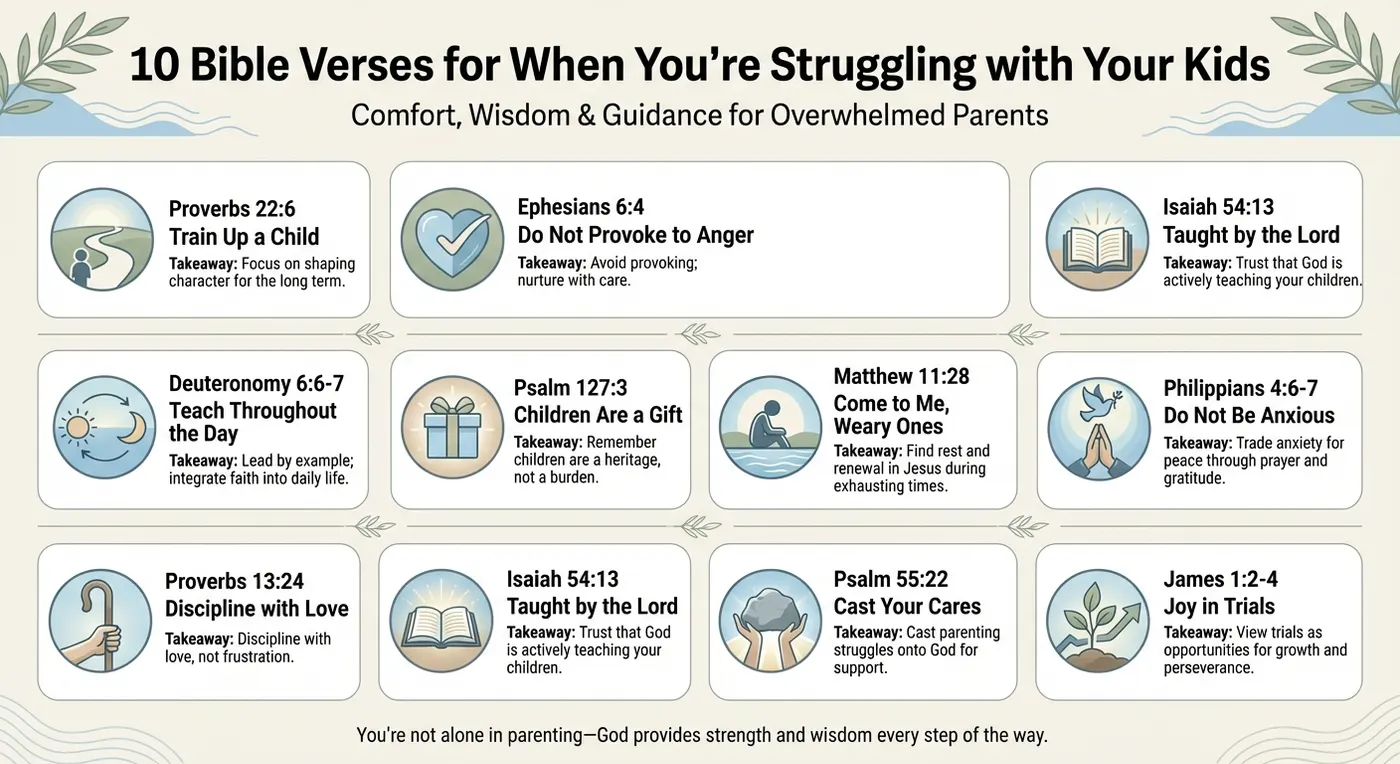
Key Takeaways:
- Proverbs 22:6: Focus on shaping your child’s character for the long term.
- Ephesians 6:4: Avoid provoking your child and nurture them with care.
- Deuteronomy 6:6-7: Lead by example and integrate faith into daily life.
- Psalm 127:3: Remember that children are a gift from God, not a burden.
- Proverbs 13:24: Discipline with love, not frustration.
- Isaiah 54:13: Trust that God is actively teaching your children.
- Matthew 11:28: Find rest and renewal in Jesus during exhausting times.
- Philippians 4:6-7: Trade anxiety for peace through prayer and gratitude.
- Psalm 55:22: Cast your parenting struggles onto God for support.
- James 1:2-4: View trials as opportunities for growth and perseverance.
These verses remind you that you’re not alone in parenting – God is with you, providing strength and wisdom every step of the way.
10 Bible Verses for Struggling Parents: Quick Reference Guide
Are you a Worried Mom? Listen to these Verses!
1. Proverbs 22:6 – Train Up a Child in the Way He Should Go
"Train up a child in the way he should go; even when he is old he will not depart from it." – Proverbs 22:6
This verse speaks directly to the responsibility of parents to guide their children with intention and care. The Hebrew word for "train" (hanak) implies dedicating or setting a foundational path for a child’s life. It’s a reminder that parenting isn’t just about managing behavior in the moment – it’s about shaping a child’s character for the long haul.
The phrase "even when he is old" encourages parents to think beyond immediate results. Are your methods building a relationship that will endure as your child grows? Are you instilling values that will stay with them through life’s challenges? These are the questions this verse invites you to consider.
"Our first parenting shift was to embrace our role as trainers, not merely tellers." – Desiring God
This shift – from simply instructing to actively training – can transform your home. Training means creating an environment where your family’s values shine through daily life. One way to do this might be by crafting a Family Creed, a set of guiding principles unique to your family. It’s also essential to recognize that every child is different. Tailor your guidance to their individual strengths and interests, paying attention to what makes them tick.
At its core, true training is about discipline grounded in love. It’s about leading your child to understand their need for a Savior while modeling forgiveness and grace. This kind of guidance isn’t just about rules – it’s about a lifelong journey of faith and relationship.
2. Ephesians 6:4 – Fathers, Do Not Provoke Your Children to Anger
"Fathers, do not provoke your children to anger, but bring them up in the discipline and instruction of the Lord." – Ephesians 6:4
This verse speaks directly to the profound impact parents have on their children’s emotional health. The Greek term parorgizo translates to "exasperate", highlighting actions that can lead to deep frustration or resentment. Paul encourages parents to avoid behaviors that make children feel perpetually inadequate or defeated.
"Parents can cause their children to become angry and bitter… there are times when our children are justified in their anger toward us."
- Tim Challies, Author and Pastor
This idea challenges us to reflect on how our daily interactions shape the atmosphere at home. For example, constantly demanding perfection, frequently shifting rules, or criticizing without acknowledging achievements can harm a child’s self-esteem. Other harmful behaviors might include favoritism, using shame as a tool, or dismissing a child’s attempts to communicate. These patterns can create a sense of unfairness and unattainable expectations.
The verse doesn’t stop at cautioning against negative behavior. It also provides a proactive solution: "bring them up" in the Lord’s discipline and instruction. The word ektrephete conveys the idea of nurturing with care and encouragement. This means correcting children in a way that includes teaching biblical principles behind the rules and celebrating their progress when they follow them. And if you lose your temper? Apologizing shows humility and teaches them how to handle mistakes.
"Fathers, don’t frustrate your children with no-win scenarios. Take them by the hand and lead them in the way of the Master."
3. Deuteronomy 6:6-7 – These Commandments Are to Be on Your Hearts
"These commandments that I give you today are to be on your hearts. Impress them on your children. Talk about them when you sit at home and when you walk along the road, when you lie down and when you get up." – Deuteronomy 6:6-7
This verse emphasizes a key aspect of parenting: you can’t pass on what you don’t already hold in your own heart. To teach your children biblical values, you must first internalize them. God’s Word needs to shape and transform your heart before it can flow naturally into your parenting.
"The single most powerful influence in a child’s life is his or her parents’ visible, passionate love for the Lord Jesus Christ." – Nathaniel Wall, Alpine Bible
The Hebrew word "shanan", often translated as "impress" or "teach diligently", points to the idea of repetition through everyday moments. Think of it as weaving Scripture into the fabric of daily life. For instance, you could talk about God’s blessings while preparing meals or discuss forgiveness after a sibling argument. The verse highlights four natural opportunities for these conversations: at home, on the go, at bedtime, and in the morning.
This approach isn’t about perfection – it’s about consistency. Maybe you leave Bible verses on sticky notes around the house, share how you’ve seen God at work during dinner, or play worship music during car rides. The goal is to create an environment where faith is an ongoing part of life. As Nathaniel Wall puts it, "Teaching is experiencing the truth personally, living out the truth before the children".
In today’s world, this kind of visible, lived-out faith is more important than ever. Your example – your genuine love for Christ – will leave the deepest impression on your children and help shape their spiritual journey.
4. Psalm 127:3 – Children Are a Heritage from the Lord
"Children are a heritage from the Lord, offspring a reward from him." – Psalm 127:3
Parenting isn’t always easy. Between tantrums, sleepless nights, and moments of defiance, it’s natural to feel overwhelmed. But this verse offers a powerful reminder: your children are not just responsibilities – they are cherished gifts from God. They are entrusted to you as blessings, not burdens.
The Hebrew word for "heritage" (nachalah) speaks to this truth. It conveys the idea of an unearned inheritance, a gracious gift from God’s love.
"You can’t be the parent God wants you to be if you don’t see the children He’s given you the way He sees them." – Dr. John MacArthur, Author and Pastor
When frustration creeps in, try reframing your thoughts. Instead of thinking, "This child is wearing me out", remind yourself, "This child is a heritage from the Lord." That shift in perspective can transform how you handle tough situations. Parenting becomes less about managing challenges and more about nurturing a life that has been entrusted to you for a divine purpose – like an arrow carefully aimed toward a meaningful goal.
Psalm 127 also reminds us, "Unless the Lord builds the house, those who build it labor in vain." This verse underscores an important truth: your parenting is not something you do alone. God’s involvement is the foundation of your efforts. On days when it feels like you’re doing everything but seeing little progress, take comfort in knowing you’re not the sole architect. You are a steward, partnering with God to create a home that reflects His love and purpose.
When you view your children through this lens – as gifts from God – you can approach the daily challenges of parenting with renewed strength and purpose.
5. Proverbs 13:24 – Whoever Spares the Rod Hates Their Children
"Whoever spares the rod hates his son, but he who loves him is diligent to discipline him." – Proverbs 13:24 (ESV)
At first glance, this verse might seem harsh, especially when viewed through today’s lens. But learning how to understand the Bible and its original context sheds light on its true meaning. In ancient Hebrew culture, the "rod" (shebet) symbolized guidance and protection, much like a shepherd’s staff. Consider Psalm 23, where the rod is described as a source of comfort, not fear. This perspective reframes the verse and helps to clarify the intent behind the word "hate."
Here, "hate" doesn’t mean active hostility or resentment. Instead, it reflects the idea of neglecting a child’s well-being. When parents avoid setting boundaries or fail to correct harmful behavior, they risk allowing negative patterns to develop unchecked. The Message Bible paraphrases it well: "A refusal to correct is a refusal to love; love your children by disciplining them."
Biblical discipline emphasizes thoughtful and consistent correction rooted in love, not frustration or anger. It’s about addressing problems as they arise and guiding children toward values that reflect God’s teachings. For instance, if a child refuses to share with a sibling, discipline should not only address the specific behavior but also teach the importance of generosity and kindness.
In practice, this means ensuring consequences are fair and proportional while maintaining emotional control. Following correction with reassurance – through hugs, affirming words, or prayer – demonstrates that discipline stems from love. And when parents make mistakes, admitting them and apologizing models humility and accountability. This balance of firmness and compassion helps set boundaries that prepare children for real-life challenges.
Ultimately, clear boundaries and loving discipline help children grow. When kids understand that their parents care enough to guide them and sometimes say "no", they experience love in action – not neglect or anger, but genuine care for their future.
6. Isaiah 54:13 – All Your Children Will Be Taught by the Lord
"All your children will be taught by the Lord, and great will be their peace." – Isaiah 54:13 (NIV)
This verse offers reassurance to parents, reminding you that God plays the central role in shaping your child’s spiritual growth. While you are an important guide, God is the ultimate teacher, walking alongside you in this shared journey of faith. Rather than replacing your efforts, God’s involvement strengthens and deepens your role as a parent.
"All your children will have God for their teacher – what a mentor for your children!" – The Message
What makes this promise even more profound is the peace it brings. The "great peace" mentioned here (shalom) goes beyond mere calmness. It points to a sense of wholeness, safety, and inner stability. When God takes the lead in teaching your children, the outcome isn’t just improved behavior – it’s a deep, unshakable spiritual well-being that no parenting strategy alone can achieve.
The historical backdrop of Isaiah 54 adds another layer of meaning. This chapter was written to a people who were broken and in turmoil, offering them a message of hope and restoration. If you’re in a tough season with your children – whether you’re facing defiance, rebellion, or feeling unheard – this verse is a reminder that God is actively working to rebuild and strengthen your family, even when the situation feels overwhelming.
To embrace this promise, think about ways to create space for God’s teaching in your home. Read Scripture together, pray over your children, and establish simple, consistent practices like giving thanks at meals or saying blessings at bedtime. The goal isn’t to be flawless – it’s to foster a steady rhythm that points your kids toward their ultimate Teacher.
7. Matthew 11:28 – Come to Me, All You Who Are Weary and Burdened
"Come to me, all you who are weary and burdened, and I will give you rest." – Matthew 11:28 (NIV)
Parenting can feel overwhelming, especially when sleepless nights and constant demands leave you running on empty. This verse offers a comforting reminder: Jesus invites those who are tired and weighed down to find rest in Him. It’s a promise of spiritual peace, even when life feels chaotic.
"The peace of God that Jesus offers isn’t dependent on having a perfect schedule or getting eight hours of restful sleep. It’s available right in the middle of the mess." – Families With Grace
What’s so comforting here is that you don’t need to have everything figured out before coming to Him. Jesus meets you where you are, offering rest and a lighter burden. His "yoke" represents a partnership – He walks alongside you, helping to carry the load. Through prayer, you can hand over your worries and trade them for His gentle support. This isn’t just about spiritual renewal; it’s also about finding practical ways to rest and recharge.
Incorporating this verse into daily life means seeking small moments to reconnect with God. A quick prayer during a chaotic morning, humming a favorite hymn on the way to school, or pausing for a few deep breaths during a toddler’s tantrum can remind you of His presence. Setting boundaries and asking for help when needed are also ways to embrace the rest Jesus promises. A soul at rest is more patient and resilient, which benefits not only you but your children as well.
8. Philippians 4:6-7 – Do Not Be Anxious About Anything
"Do not be anxious about anything, but in every situation, by prayer and petition, with thanksgiving, present your requests to God. And the peace of God, which transcends all understanding, will guard your hearts and your minds in Christ Jesus." – Philippians 4:6-7 (NIV)
Philippians 4:6-7 offers a practical approach to tackling anxiety, particularly for parents. When challenges arise, this verse provides a roadmap for shifting from worry to peace: identify the concern, pray with gratitude, and receive God’s peace. This guidance is especially timely, given that the National Institute of Mental Health reports one in eight children experience anxiety disorders. Parents often juggle their own worries alongside their children’s, making this passage a valuable source of reassurance.
"Philippians 4:6–7 is a Spirit-filled pattern: worry → prayer with thanksgiving → peace of God → guarded heart and mind." – Divine Disclosures
The Greek word for "guard" in verse 7 paints a vivid picture of a military garrison standing watch. It suggests that God’s peace actively protects your emotions and thoughts, even in the middle of ongoing struggles. Greg Palys, Director of Children’s Ministries at College Park Church, explains it this way: "Freedom from anxiety means trusting God with our circumstances, yielding control knowing that He has our best in mind, regardless of the outcome".
To apply this in your life, start by identifying specific parenting worries instead of letting them linger vaguely in your mind. For example, are you anxious about your teenager’s decisions? Or maybe you’re overwhelmed by constant sibling conflicts? Bring these concerns to God in prayer, and include thanksgiving by reflecting on His past faithfulness. This practice shifts your perspective from focusing on challenges to recognizing His provision.
Lisa Coleman, a Licensed Independent Clinical Social Worker, emphasizes the importance of modeling this for children: "Parents have a wonderful opportunity to help our children hardwire their brains to hand over all their worries to God the minute anxious thoughts come into their minds".
Consider keeping a prayer journal to record your specific anxieties and how God’s peace has carried you through each situation. This habit not only strengthens your trust in Him but also serves as a reminder of His ongoing care. And don’t hesitate to pray repeatedly for the same issue throughout the day – peace often comes through persistence.
9. Psalm 55:22 – Cast Your Cares on the Lord
"Pile your troubles on God’s shoulders – he’ll carry your load, he’ll help you out. He’ll never let good people topple into ruin." – Psalm 55:22, The Message Bible
The Hebrew word for "cast" (shalak) carries the idea of throwing or discarding something with intention and force, not just gently setting it aside. In this context, it means actively letting go of your worries. The word for "burden" (yehab) refers to your specific "lot" in life – the circumstances and challenges uniquely placed before you, including difficulties in parenting. This verse encourages you to release the weight of these specific struggles and trust God to handle them.
David wrote Psalm 55 during a time of intense personal pain, likely during his son Absalom’s rebellion. His words reflect the anguish of family turmoil. When God promises to "sustain" (kul) you, it means He will uphold, guide, and provide for you through every trial. Melissa Tumino, Founder of Think About Such Things, explains it beautifully:
"Throw away those things you carry due to your circumstances; throw them on God, then He will maintain you, guide you, feed you, and provide for you because He will never in all eternity let righteous people waver, slip, shake, or fall."
To put this verse into practice, try naming the specific burdens you’re carrying – like your child’s struggles with anger or difficulty forming friendships – and consciously give them to God. Resist the urge to take those worries back. Reflect on moments when God has carried you through tough times before, and lean on a community of believers who can pray with you and support you when parenting feels overwhelming.
10. James 1:2-4 – Consider It Pure Joy When You Face Trials
"Under pressure, your faith-life is forced into the open and shows its true colors." – James 1:2-4, The Message Translation
James encourages us to find joy in the face of trials, which can feel counterintuitive – especially during the tough moments of parenting. Whether you’re navigating sleepless nights with a newborn or dealing with a teenager’s defiance, joy probably isn’t your first reaction. But the Greek word for joy, chara, referenced here, isn’t about pretending everything’s fine. It points to a steady, enduring joy that persists despite difficult circumstances.
The word "consider" in this passage challenges us to shift our mindset intentionally when faced with hardships. It’s about viewing struggles through God’s perspective. These trials, much like refining fire, test and strengthen your faith, building perseverance. Without challenges, faith can weaken and stagnate over time.
In fact, embracing trials can turn bitterness into resilience. As Desiring God explains:
"God draws his straightest lines from life’s greatest difficulties to our deepest joys."
Dr. Tom Constable echoes this sentiment:
"The attitude James advocated can take all the bitterness out of even very uncomfortable trials."
While the challenges themselves may remain, bitterness can be replaced with growth and strength. When perseverance is allowed to do its work, it brings maturity, leaving you equipped and whole.
So how can you live out this verse in those overwhelming parenting moments? Start by pausing and praying for focus on Jesus rather than the stress at hand. James 1:5 reminds us to ask God for wisdom when we’re uncertain – He’s ready to provide it. Another practical step is keeping a gratitude journal. Use it to document lessons learned and moments of growth during tough times, turning those trials into opportunities for faith to deepen.
Dr. Karyn Purvis offers a powerful reminder:
"A gift you can give to your child is taking good care of yourself."
Take care of your spiritual and emotional health. Prioritize your role as a parent over personal comfort, and avoid isolating yourself. Surround yourself with a community of believers who can offer prayer, encouragement, and perspective. Remember, God uses these challenges to shape you into the person He intends you to be. Each trial, no matter how hard, becomes a step toward a stronger, more mature faith.
Conclusion
Parenting is a profound responsibility, but it’s not a journey you’re expected to navigate by yourself. The same God who entrusted you with your children also equips you to guide them. When the challenges of discipline, exhaustion, or uncertainty feel overwhelming, lean on the Holy Spirit for strength and turn to God’s Word for wisdom and direction.
The Bible offers more than just comforting words; it provides practical guidance for parenting. These ten verses can become part of your daily life – whether during car rides, at the dinner table, or even through simple reminders like Post-it notes placed around your home. When worries arise about your child’s health, safety, or future, take those concerns to God in prayer, trusting Him to carry the burdens you cannot.
God’s character is a constant source of reassurance. He is a shepherd, tenderly caring for His flock, especially those raising children. Isaiah 40:11 beautifully illustrates this: "He tends his flock like a shepherd: He gathers the lambs in his arms and carries them close to his heart; he gently leads those that are young." Each day brings new mercies, giving you fresh opportunities to love, guide, and forgive.
As you nurture and teach your children, remember that the ultimate growth in their hearts comes from God. Your role is to point them to Jesus and trust Him to handle the rest.
Don’t forget to care for your own spiritual and emotional well-being. Share stories of God’s faithfulness with your children – these lessons can leave a lasting legacy for generations. You are not alone in this mission. With God’s guidance, you can face the challenges of parenting with confidence and hope.
FAQs
How do I discipline my child without losing my temper?
To manage discipline calmly, center your approach on love, patience, and self-control. Seek wisdom through prayer and remain grounded in grace. When correcting, opt for gentle guidance and encouragement rather than reacting with anger. Steer clear of harsh words or shouting, ensuring that discipline comes from a place of love to nurture mutual respect. Biblical principles, such as Proverbs 22:6 and Ephesians 6:4, highlight the importance of teaching children with kindness, preserving peace, and fostering a strong, loving bond.
What does “spare the rod” mean for parents today?
"Spare the rod" today highlights the importance of loving and thoughtful discipline. The focus is on guiding and correcting children with kindness and understanding, rather than resorting to harsh or physical punishment. This approach reflects biblical teachings that encourage parents to raise their children with care, patience, and firm but compassionate boundaries.
How can I stop worrying about my child’s future?
You can find peace about your child’s future by leaning on God’s promises and seeking Him through prayer. Verses like Psalm 91:11 ("For he will command his angels concerning you to guard you in all your ways") and Jeremiah 29:11 ("For I know the plans I have for you", declares the Lord, "plans to prosper you and not to harm you, plans to give you hope and a future") remind us of His protection and guidance. Taking time to reflect on these scriptures can bring reassurance and help you trust in His plans for their journey.