
Trust God in Difficult Times - 15 Verses
One verse, one prayer, one small step: 15 scriptures to steady your heart through fear, grief, and exhaustion.
If life feels heavy today, I don’t need 15 long Bible studies. I need one verse, one prayer, and one next step.
This article gives me exactly that. It takes 15 Bible verses for fear, anxiety, grief, waiting, money stress, loneliness, and exhaustion, then shows me how to use each one in real life. The core idea is simple: read the verse, pray it back to God, and act on it.
A big point in the article stood out to me: Bible reading is linked with lower stress and higher hope, but engagement matters more than speed, which is key to consistently reading the Bible. In other words, one verse I sit with can help more than a rushed reading plan.
Here’s the full list covered in the article:
- Proverbs 3:5-6 - when I want control and don’t have answers
- Isaiah 41:10 - when fear feels close
- Psalm 46:1 - when I need help right now
- Psalm 55:22 - when a burden feels too heavy
- Psalm 23:4 - when I walk through grief or loss
- John 14:1 - when my heart feels troubled
- John 16:33 - when trouble is part of the day
- Psalm 34:17-18 - when I feel brokenhearted
- Isaiah 40:31 - when I am worn out and waiting
- Romans 8:28 - when pain feels random
- Philippians 4:6-7 - when anxiety hits hard
- 1 Peter 5:7 - when I need to hand worry over to God
- Hebrews 13:5-6 - when fear shows up around money or lack
- Lamentations 3:22-23 - when grief lasts longer than I want
- Matthew 11:28-30 - when I am tired in my soul
God Will Bring You through Every Trouble - Psalm 91 by Tim Keller [Trusting God in Difficult Times]
Quick comparison
| Situation | Best verse to start with | Main focus | Simple next move |
|---|---|---|---|
| Fear | Isaiah 41:10 | God is with me | Name the fear and pray line by line |
| Anxiety | Philippians 4:6-7 | Pray instead of spiral | Tell God the exact worry |
| Grief | Psalm 34:17-18 | God is near the brokenhearted | Read it out loud slowly |
| Uncertainty | Proverbs 3:5-6 | Trust over control | Ask, “What does obedience look like right now?” |
| Waiting | Isaiah 40:31 | Strength while I wait | Read it each morning |
| Exhaustion | Matthew 11:28-30 | Jesus gives rest | Name what I need to stop carrying alone |
| Money stress | Hebrews 13:5-6 | God will not leave me | Pray before opening bills |
| Heavy burden | Psalm 55:22 | Cast it on the Lord | Say the burden out loud and hand it over |
What I like here is that the article does not tell me to ignore pain or force calm feelings. It keeps things plain: trust often grows through small acts of surrender. So if I don’t know where to start, I can pick the verse that matches today’s struggle and use the same short pattern:
- Read it aloud twice
- Notice one phrase
- Turn that phrase into prayer
- Take one small step of trust
That’s the whole path in a few lines, and it makes the rest of the article easy to use.
How to Use These Verses When Life Feels Heavy
You don’t need to read all 15 verses today. Each one uses the same simple pattern: the verse, what it means when life hurts, and one next step.
Before you scroll, name the burden you’re carrying - fear, grief, pressure, or exhaustion. Put words to it. That keeps the verse connected to your actual life, not just the page in front of you. Then choose the verse that speaks most directly to that weight.
After that, move through the pattern slowly.
- Read it aloud twice.
- Notice the word or phrase that stands out.
- Turn that phrase into a short, honest prayer.
- Write the verse, say it into your voice journal, or whisper it when anxiety starts to rise.
Each entry stays centered on what the verse says and on God’s presence, faithfulness, and care. It doesn’t promise more than the verse promises, and it doesn’t try to hurry you past pain. That’s the pattern you’ll use for every verse below.
At the end of the article, you’ll find a quick reference to help you match a verse to your situation, along with a simple daily practice you can use to make this a daily habit. Start with the first verse below.
1. Proverbs 3:5-6
Proverbs 3:5-6 speaks right into fear, uncertainty, and that strong pull to control what you can’t fix. It calls us to trust the Lord with all our heart, not lean on our own understanding, and acknowledge him in all our ways.
This is the verse to use when you need answers you don’t have - about your health, your money, or a hard decision - and your mind won’t slow down. It meets you in the kind of pressure that feels close, personal, and urgent.
The key word here is “all.” Not partial trust. Full trust. That matters because a lot of us hand some things to God while still gripping other parts with white knuckles.
“Lean not on your own understanding” doesn’t mean you stop thinking or throw out reason. It means you don’t let your limited view make the final call. You may not see the whole picture, and that’s exactly why the next move is surrender, not more analysis.
“Make your paths straight” points to God’s guidance, not a painless road or instant relief. Sometimes that means he corrects your direction. Sometimes he clears what was in the way. Sometimes he leads one step at a time through a season that still feels confusing.
Put the verse to work in a plain, direct way: name the exact burden you’re carrying, then pray it back slowly: Lord, I trust You with what I cannot understand. I do not want to rely only on my own understanding. I acknowledge You in this situation; please direct my path. If you’re facing a decision, ask, “What does obedience look like right now?” Use this before hard calls, impulsive texts, or any moment when fear is pushing you to grab control.
2. Isaiah 41:10
Isaiah 41:10 (NIV) reads: "So do not fear, for I am with you; do not be dismayed, for I am your God. I will strengthen you and help you; I will uphold you with my righteous right hand."
God gave this promise to Israel in a time of exile and threat. That matters. The comfort here isn't that pain vanishes or life suddenly gets easy. It's that God remains with His people and carries them through it.
That makes this verse deeply personal when fear feels close and hard to shake.
It speaks right into anxiety in the modern world, discouragement, grief, and that sinking feeling that you may not have enough strength to keep moving forward.
The promise comes in layers: presence, belonging, strength, help, and support. When God says He will "uphold" you, the point is simple and powerful: you were never meant to carry the whole load by yourself. Even when life feels crushing, God is the One holding you up.
"Righteous right hand" points to God's power and His faithful character. He isn't weak, absent, or careless. He helps with strength you can lean on.
A simple way to use this verse is to name the fear, then pray the promise back to God one line at a time.
"God, I am afraid of this diagnosis. You say You are with me. You say You will strengthen me and help me. Uphold me today when I feel like I might collapse."
Use the table below to connect the promise to what you're facing.
| Struggle | Isaiah 41:10 Promise | How to Pray It |
|---|---|---|
| Anxiety | "Do not be dismayed, for I am your God." | "You are my God - anchor me when I feel unsteady." |
| Grief | "I will uphold you with my righteous right hand." | "Hold me up when I have nothing left to give." |
| Uncertainty | "I will strengthen you and help you." | "Give me what I need for today's decision, not next month's." |
| Waiting | "I am with you." | "Remind me You are here, even in the silence." |
3. Psalm 46:1
Psalm 46:1 reads: "God is our refuge and strength, a very present help in trouble."
This verse gives three promises in one line: refuge - a safe place to run, strength - the power to keep going, and very present help - God is not distant. He is here, right now. That matters. The comfort in this verse isn't fuzzy or generic. God Himself is the refuge, the strength, and the help. Use this when you need God's help to feel immediate, not far away or theoretical.
Psalm 46:1 fits the moments when you need shelter, strength, and help now. It was written into a world of shaking, flooding, and chaos, so it meets us in seasons when life feels like it's coming apart. Diagnosis. Money stress. Conflict at home. Panic that hits out of nowhere. This verse speaks into those moments.
It doesn't say trouble will vanish. It says God is present in the middle of it. Coming back to this verse often can steady your heart when the pressure feels close and constant.
Say it out loud when anxiety spikes. Make it personal. Make it plain:
"God, be my refuge, strength, and present help in this diagnosis, this wait, and this hard conversation."
Use the phrases below to connect the verse to what you're facing.
| Struggle | Psalm 46:1 Promise | How to Pray It |
|---|---|---|
| Financial fear | "God is our refuge." | "You are my true security, not my bank account. Be my refuge today." |
| Illness or diagnosis | "God is our strength." | "My body is weak. Be my strength through every appointment and unknown." |
| Family conflict | "A very present help in trouble." | "My home feels unstable. Show me You are present here, even in this tension." |
| Anxiety or overwhelm | "God is our refuge and strength." | "I can't carry this. Be both my shelter and my strength right now." |
4. Psalm 55:22
Psalm 55:22 reads: "Cast your burden on the Lord, and he will sustain you; he will never permit the righteous to be moved."
When a burden feels like too much, this verse gives you a direct response. "Cast" means throw it onto God, not place it down with care. This is active surrender.
Psalm 55 is David's lament after betrayal by a close companion. That matters. He doesn't hide the pain or clean it up first. He names it, then hands it to God. That's the move here too: say the hurt plainly, then give it over.
God may not take the burden away at once. But he will sustain you and keep you steady.
Be specific when you pray. Not just "I'm stressed", but "Lord, I'm terrified about this job situation" or "I'm carrying the hurt from what my friend did." Then pray the verse back to him: "You said to cast my burden on you. I'm casting this fear, this betrayal, this exhaustion onto you right now. Sustain me." Name the burden, pray the verse back, and repeat it each time the worry returns.
Use these examples to turn the verse into a prayer for your situation.
| Burden | How to Pray It |
|---|---|
| Betrayal or relational hurt | "You see this wound. I cast this hurt onto you. Sustain me and keep me from becoming bitter." |
| Job stress or financial fear | "I cast today's fears onto you. Show me faithful next steps and sustain me through the unknown." |
| Family conflict | "This feels beyond me. I cast this conflict on you. Help me respond with wisdom, not fear." |
| Chronic anxiety | "My anxiety feels heavier than I can bear. I cast it on you. Sustain me day by day." |
5. Psalm 23:4
When grief, loss, or fear makes life feel like a dark valley, Psalm 23:4 meets that pain head-on: "Even though I walk through the valley of the shadow of death, I will fear no evil, for you are with me; your rod and your staff, they comfort me."
There’s something striking here. The psalmist doesn’t pretend the valley is bright or easy. He admits the darkness is there. But he also says fear won’t rule him. That’s the difference. The pain is real, yet it doesn’t get the last word. The turning point is in the phrase "with me." Even when nothing around you has changed, God is still present in the middle of it, not far away and not silent.
You can pray this verse out loud. Sometimes hearing the words matters. Say the verse, name your valley, and end with "you are with me" as a declaration, even if your feelings haven’t caught up yet. That simple act can help steady your heart.
"Hope, in Scripture, is often something you say out loud before you feel it." - Psalmlog [1]
6. John 14:1
"Do not let your hearts be troubled. You believe in God; believe also in me."
Jesus speaks these words to His disciples in the upper room on the night before His crucifixion. Just before this, He tells them He is leaving, that one of them will betray Him, and that Peter will deny Him. No wonder they feel anxious, confused, and afraid. That context matters, because this verse meets the kind of heart that feels shaken today.
The word "troubled" points to a heart that is agitated, restless, or deeply disturbed. Jesus isn't brushing that aside. He isn't saying their pain isn't real. He is telling them not to let fear take control. Then He gives them the answer: trust God, and trust Him too. This isn't pretending everything is fine. It's a clear, deliberate turn away from fear and toward trust.
When life feels heavy, coming back to Scripture can steady your heart.
You can pray the verse like this:
"Jesus, You said, 'Do not let your hearts be troubled. You believe in God; believe also in me.' I confess my heart is troubled. I'm scared about [name it - my health, my finances, my family conflict]. Help me trust You here, not just in general, but in this."
Name the fear, then pray the promise back to Him.
Daily cue: "Troubled heart, trusting Savior." When a stressful email hits your inbox, when the news feels dark, or when a hard meeting is on the calendar, say that line and follow it with the verse. It may not remove the problem, but it can redirect your heart.
7. John 16:33
"I have told you these things, so that in me you may have peace. In this world you will have trouble. But take heart! I have overcome the world."
After Jesus tells troubled hearts not to fear, He pulls the lens back. Trouble is coming, but His win still stands.
Jesus says this near the end of the Last Supper discourse, just before His arrest and crucifixion. He is getting His disciples ready for what comes next: fear, loss, and pressure. That matters, because this verse doesn't soften pain or pretend hard times aren't hard. It says it plainly: in this world, trouble is part of life. Jesus doesn't say you may face distress. He says you will.
Take heart means choose courage. Not fake calm. Not denial. Courage.
And when Jesus says He has overcome the world, He is talking about sin, death, and spiritual darkness. He says it before the cross, yet He speaks as though the ending is already set. That's the force of this verse. Jesus has already defeated sin, death, and spiritual darkness.
The peace Jesus gives is not the kind that depends on quiet circumstances. It's a steady trust right in the middle of trouble. So this verse does two things at once: it tells the truth about suffering, and it points straight to Christ's victory.
Use this verse when fear feels bigger than what you're facing.
You can pray it like this:
"Jesus, You said that in this world I will have trouble, and I feel that right now in my [health, finances, relationships, grief, anxiety]. But You also said to take heart because You have overcome the world. Help me choose courage today. Steady me with Your peace, not because my situation is easy, but because Your victory is sure."
Daily cue: "Trouble is real. So is His victory." When fear spikes, or when the news feels heavy, repeat that line and let it turn your attention back to Christ's peace.
8. Psalm 34:17-18
"When the righteous cry for help, the Lord hears and delivers them out of all their troubles. The Lord is near to the brokenhearted and saves the crushed in spirit." - Psalm 34:17-18 (ESV)
Psalm 34 is often linked to David during a hard stretch of his life, when he was running from Saul and acted insane before Achish. That setting matters. These words come from someone who knew what it felt like to be trapped, shaken, and scared.
When life feels heavy, this verse adds another layer of comfort: God hears you, and He comes close. It speaks right into grief after loss, burnout, or seasons of spiritual dryness.
Near means God is close, not far off. He moves toward you with care and attention. He is not standing back and merely observing. And crushed in spirit points to deep sorrow, failure, or discouragement. God's nearness is true even before you feel it.
You can pray it like this:
"Lord, my heart feels shattered right now. You say You are near to the brokenhearted, so help me trust that You are near to me. Hear my cry, save my crushed spirit, and keep me from being overwhelmed today."
Then say the verse out loud again and notice the one word that hits home most.
Daily cue: "When I cry, God is near - so I will say this verse aloud or into my voice journal." Put it on a sticky note, save it in your phone's notes app, or speak it out loud when a hard moment hits. Let it turn your attention back to who God is: attentive, compassionate, and close.
9. Isaiah 40:31
"But they who wait for the Lord shall renew their strength; they shall mount up with wings like eagles; they shall run and not be weary; they shall walk and not faint." - Isaiah 40:31 (ESV)
Isaiah 40 speaks to weary Judean exiles in Babylon. Their nation had been crushed, and many of them felt worn down, discouraged, and forgotten by God.
This verse meets people in long stretches of exhaustion and waiting. It speaks to faith that feels drained. Here, "wait" does not mean doing nothing. It means active hope. And "renew" points to God giving fresh strength in place of your own.
The movement in the verse matters too. It goes from soaring to running to walking. That's a picture of God's strength for every pace of life. Not just the big, dramatic moments, but also the slow, ordinary days when you simply need enough strength to take the next step.
Use this verse when you don't have the strength to push your way ahead. Pray it like this:
Father, I am tired. I choose to wait for You and receive Your strength for today. Help me keep going.
Write Isaiah 40:31 on a notecard. Name one thing you're waiting on. Then read the verse each morning as you wait on God's character, not just the outcome.
10. Romans 8:28
"And we know that for those who love God all things work together for good, for those who are called according to his purpose." - Romans 8:28 (ESV)
Turn to this verse when pain feels random and you can't see any good in it yet. Romans 8:28 sits inside Romans 8:26–39, where Paul points to God at work through weakness, suffering, and prayer.
This promise is for "those who love God" and are "called according to his purpose." That matters. It's not a blanket promise that life will go smoothly for everyone. The comfort here is personal and rooted in your relationship with God. And the "good" in this verse is shaped by God's purpose - not by our plans, wishes, or timing.
In this part of Romans, that good means believers are being shaped into the image of Christ. That process can move slowly. In fact, it often unfolds in seasons that don't feel good at all while you're living through them. That's why this verse asks for trust before clarity.
Romans 8:28 gives a long-view promise: God is still at work, even when the outcome is hidden.
Use this verse when you're dealing with regret, confusion, or a situation that just won't resolve. Pray it plainly:
Lord, this hurts deeply, and I don't understand it. But you promise that you are working all things together for good because I belong to you. Help me trust your purpose, even when I can't see the outcome yet.
You can also put this verse into a simple daily practice. Each morning:
- Write down one hard thing you're carrying.
- Read Romans 8:28.
- Ask, "What is God forming in me through this?"
- Say the hard thing out loud, then speak Romans 8:28 as your response.
Write one hard thing, then ask: What might God be forming in me here?
11. Philippians 4:6-7
"Do not be anxious about anything, but in every situation, by prayer and petition, with thanksgiving, present your requests to God. And the peace of God, which transcends all understanding, will guard your hearts and your minds in Christ Jesus." - Philippians 4:6-7 (NIV)
Use this verse when anxiety feels immediate and tied to one thing in front of you, like waiting on test results, money problems, or some other situation you can't control. Paul doesn't leave you guessing. He gives a clear next step.
Thanksgiving matters here because it turns your attention toward what is still true: God's faithfulness, his presence, and his care. That shift can calm the spiral. The peace Paul describes doesn't make the problem disappear. It helps steady you while you're still in it.
And this wasn't abstract advice. Paul wrote these words from prison, which gives the command extra weight.
When anxiety hits, try this short prayer pattern pulled straight from the verse:
God, I'm anxious about [name it specifically]. Please help me trust you with this. Thank you for [one true thing]. Guard my heart and mind with your peace.
Say it before bed. Then pray it again when the same fear comes back.
12. 1 Peter 5:7
If anxiety keeps coming back, this verse shows you what to do next: cast it on God.
"casting all your anxieties on him, because he cares for you." - 1 Peter 5:7 (ESV)
It’s a short verse, but it carries a lot of weight. Cast means throw. Not gently set down. Not keep half of it in your hands. Peter is saying: hand your worries over to God on purpose.
And here’s why you can do that: He cares for you. That line isn’t filler. It’s the whole reason this works. When money is tight, when a doctor gives scary news, or when you’re worn out from caring for someone and feel like you have nothing left, it’s easy to think God is far away or unmoved. This verse says the exact opposite.
And notice the word all. Every worry counts. Your own fears. Your family’s stress. The load you carry for other people. Nothing is too small to mention, and nothing is too heavy to bring.
Here’s a simple way to put this into practice:
- Open your hands, palms up.
- Name each worry out loud to God, one at a time.
- Pray, “God, I’m throwing my fear about ____ onto You, because You care for me.”
Then do it again when the anxiety comes back. Sometimes that’s what faith looks like in the moment: open hands, honest words, and giving the same burden back to God more than once.
13. Hebrews 13:5-6
When fear shows up as lack, Hebrews 13:5-6 speaks right to it. Financial stress can do that. A job loss, medical bills, or a paycheck that just doesn't stretch far enough can stir up a deeper fear: Will I be left on my own? This passage points your sense of safety back to God's presence, not to money.
"Keep your life free from love of money, and be content with what you have, for he has said, 'I will never leave you nor forsake you.' So we can confidently say, 'The Lord is my helper; I will not fear; what can anyone do to me?'" - Hebrews 13:5-6 (ESV)
The promise is strong and plain: God will not leave you. That's why you can say, "The Lord is my helper; I will not fear." This isn't about pretending bills aren't real or acting like needs don't matter. It's about resting in the fact that God's presence is more secure than any paycheck.
Don't use this promise only as a comforting thought. Use it as a prayer. You can pray it like this: Lord, I'm afraid I won't have enough. You have said You will never leave me or forsake me. You are my helper. I will not fear. That simple shift can move your mind from panic to prayer.
Say the verse out loud when you open bills, then record your prayer in your voice journal. In a tense moment, that gives you a way to stop, breathe, and remember that God is with you and helping you.
14. Lamentations 3:22-23
When grief drags on so long that hope starts to feel useless, this verse speaks right into that place. It was written after Jerusalem was destroyed around 586 BC, so this is hope spoken from grief, loss, and exile.
"Because of the Lord's great love we are not consumed, for his compassions never fail. They are new every morning; great is your faithfulness." - Lamentations 3:22-23 (NIV)
What gives this verse its force is simple: it came from the middle of ruin, not from the other side of it. In verse 21, the writer says, "this I call to mind", which shows that trust can be a chosen act of memory when life feels shaky and nothing around you gives comfort.
The words "new every morning" matter a lot when hardship doesn't let up, whether that's chronic illness, money stress, or grief that hangs on. God's mercy is not used up by yesterday's pain. Each new day starts with fresh compassion and renewed faithfulness.
Try putting this verse in front of your eyes before anything else gets your attention. Name one thing that may weigh on you today, like:
- a medical appointment
- a bill
- a hard conversation
Then pray it plainly: "Lord, because of your great love, I am not consumed by [name it]. Your compassions are new this morning. Help me notice them today." At the end of the day, write down one mercy you did notice. Over time, that becomes a record of God's faithfulness.
If grief has left you tired to the bone, the next verse turns to rest.
15. Matthew 11:28-30
When hardship has worn you down, this is Jesus’ invitation to stop carrying it by yourself.
"Come to me, all who labor and are heavy laden, and I will give you rest. Take my yoke upon you, and learn from me, for I am gentle and lowly in heart, and you will find rest for your souls. For my yoke is easy, and my burden is light." - Matthew 11:28-30 (ESV)
Jesus calls the weary, not the people who think they have everything under control. He tells you to come with your burden, not fix it first. If you’re dealing with chronic stress from a hard job, caregiving, medical bills, or fear about the future, this verse speaks right into that kind of strain. He offers deep rest: peace, safety, and the relief of not having to carry life alone. This is the verse for those moments when burden turns into plain exhaustion.
A yoke points to a shared load and shared direction. Jesus leads, and you stop trying to drag everything forward on your own. Taking His yoke means letting His words, His pace, and His direction shape how you respond.
“Rest for your souls” goes deeper than physical sleep. It reaches your inner life. In practice, it can look like less panic and more trust - trust that you are not managing life by yourself.
To put this verse to work, pray it back in plain, honest words:
"Jesus, I am worn out by [name the burden]. I come to You. I take Your yoke. Show me what to carry today and what to release."
Come back to that prayer whenever you feel yourself tightening your grip. Let it be your cue to hand back what only God can carry.
Use the quick reference next to match this verse to your situation.
Which Verse Fits Your Situation? A Quick Reference
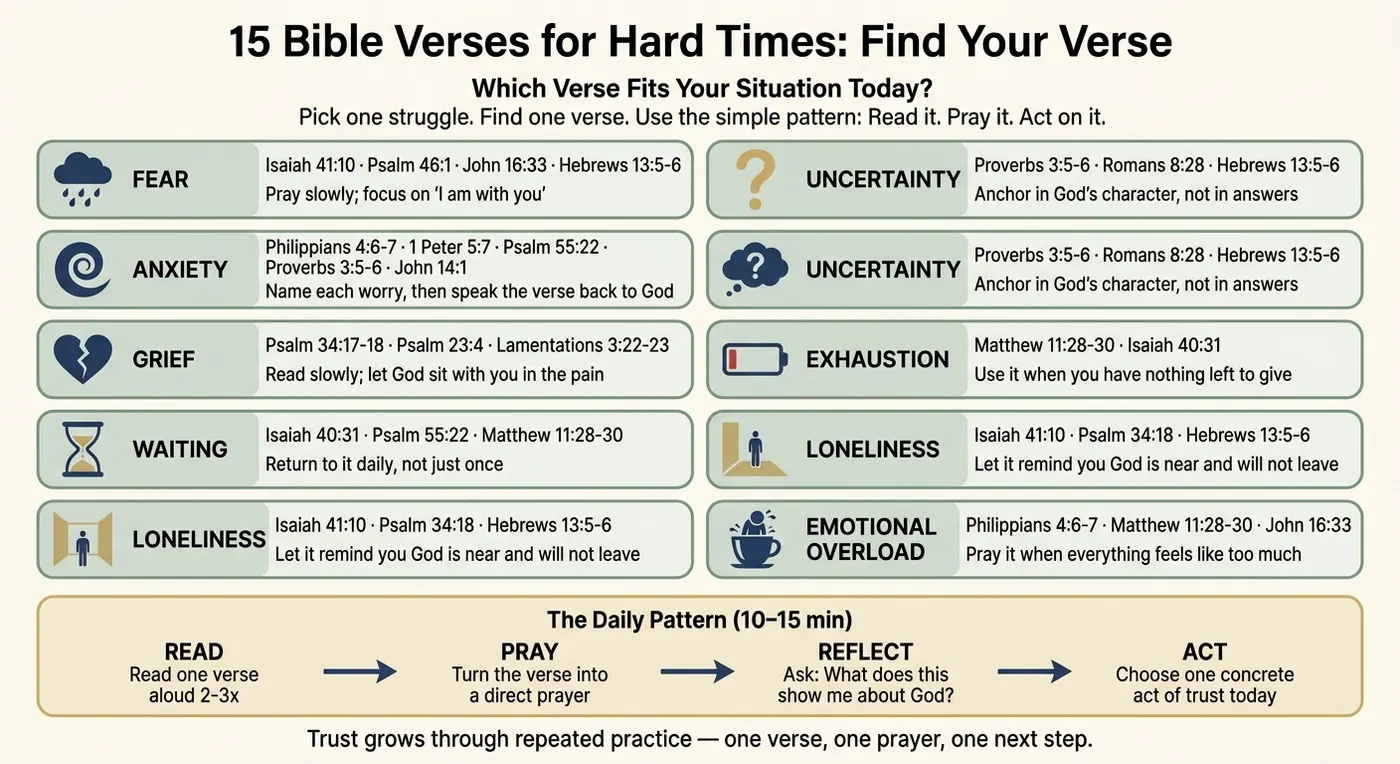
If you're not sure where to begin, use this quick guide to match one verse with the struggle right in front of you.
Some verses show up in more than one row. That's normal. Life is messy, and one passage can meet you in more than one place.
| Situation | Verse(s) | How to use it |
|---|---|---|
| Fear | Isaiah 41:10; Psalm 46:1; John 16:33; Hebrews 13:5-6 | Pray slowly; focus on "I am with you" and "do not fear." |
| Anxiety | Philippians 4:6-7; 1 Peter 5:7; Psalm 55:22; Proverbs 3:5-6; John 14:1 | Name each worry, then speak the verse back to God. |
| Grief | Psalm 34:17-18; Psalm 23:4; Lamentations 3:22-23 | Read slowly; let God sit with you in the pain. |
| Uncertainty | Proverbs 3:5-6; Romans 8:28; Hebrews 13:5-6 | Anchor yourself in God's character, not in answers. |
| Waiting | Isaiah 40:31; Psalm 55:22; Matthew 11:28-30 | Return to it daily, not just once. |
| Exhaustion | Matthew 11:28-30; Isaiah 40:31 | Use it when you have nothing left to give. |
| Loneliness | Isaiah 41:10; Psalm 34:18; Hebrews 13:5-6 | Let it remind you that God is near and will not leave you. |
| Emotional overload | Philippians 4:6-7; Matthew 11:28-30; John 16:33 | Pray it when everything feels like too much. |
Start with the row that fits today, pick one verse, then use the daily practice below. You can also organize these verses into a spiritual habit planner to stay consistent.
A Simple Daily Practice for Building Trust in God
If one verse keeps pulling your attention, stay with it. Let it walk with you through fear, grief, uncertainty, or waiting. Over time, those hard places can turn into prayer, reflection, and action. This rhythm takes about 10–15 minutes, and using the same pattern each day helps move the verse from something you read to something you live.
The pattern is simple: read, pray, reflect, and act.
-
Read one verse slowly. Read it out loud two or three times. Pay attention to one word or phrase that stands out. Write it down, stick it on a note, or make it your phone lock screen.
-
Pray it aloud. Turn the verse into a direct prayer. Say the words out loud, then bring your own situation into it.
-
Reflect on what it reveals about God. Ask: "What does this verse show me about God?" Then write or say one sentence: "This verse shows me that God is ______."
-
Choose one concrete act of trust. This is where the verse moves from your head into your day. If you're sitting with 1 Peter 5:7, write down your specific fear, say, "God, I give this to You", and resist the urge to take it right back through overplanning.
If reflection feels hard, Psalmlog gives you a private place to speak the verse, name what you feel, and respond with biblically grounded prompts.
Track the verse, your prayer, and one sign of God's help. Trust grows through repeated practice.
Conclusion
Trusting God in hard times usually doesn’t happen in one big moment. More often, it grows through repeated surrender - coming back to God again and again in prayer, Scripture, and obedience, even when your feelings haven’t caught up yet. Staying close to Scripture matters because seeing God’s Word over and over builds trust over time.
Taken together, these verses give you a simple path back to God when life feels heavy. These 15 verses aren’t just a list to get through. They are a way back to God in fear, grief, uncertainty, and waiting. If you still feel anxious or overwhelmed, that doesn’t mean you’ve failed. Faith is not the same as calm feelings; it is choosing to turn toward God again.
Start with one verse today. Write it down, pray it back to God, and come back to it during the day. Share it with a trusted friend, small-group leader, or pastor, and ask them to pray with you. Read it, pray it, and act on it - the same three moves used throughout this article. Bring your real situation to him in that verse, and let him meet you there. His mercies are new every morning, and he will not leave you or forsake you.
FAQs
How do I choose the right verse for my situation?
Name the need behind the struggle first. Don’t just search the Bible in a broad, vague way. If you need comfort, start with Psalms. If you need practical wisdom, go to Proverbs. If you want to hear Jesus’ words and way of life, read the Gospels. If you’re walking through pain and don’t know what to do with it, spend time in Job.
Just as important, read each verse in context. A single line can sound very different when you read the verses around it and see what it meant in the first place. After that, check other passages that support the same point. And if you’re still unsure, talk it through with trusted people in your faith community.
What if I pray a verse and still feel anxious or afraid?
Feeling anxious or afraid after praying a verse is common. It does not mean your faith has failed. Sometimes prayer feels powerful. Other times, it feels routine. Keep going anyway.
It helps to name what’s happening without handing it the steering wheel. Acknowledge your feelings, but don’t let them lead you. Fear can be loud, but it doesn’t get the final word.
Be specific with God about what scares you. Don’t stay vague. Say the thing plainly, and pray with thanksgiving at the same time. That mix of honesty and gratitude can steady your heart, even when your emotions haven’t caught up yet.
The Psalms are a good place to go when you don’t have polished words. They show you how to pray honestly, without pretending everything is fine. They also help shift your focus from your fear to God’s character - who He is, how He cares, and why you can keep bringing your worries to Him.
How can I make this a daily habit when life feels overwhelming?
Keep it simple and steady. Link the habit to a regular moment, like before you check your phone or right at the end of the day. Miss a day? Just begin again. No guilt, no drama. Keep your journal or the Psalmlog app within reach so the next step feels easy.
When life feels like too much, lean on a simple rhythm: SOAP, voice journaling, praying God’s names that match the struggle in front of you, and writing down His faithfulness so you can look back on it later.