
Bible Study Methods Compared Guide
Compare seven Bible study methods—steps, time, tools, strengths, and risks—to pick the approach that fits your goal.
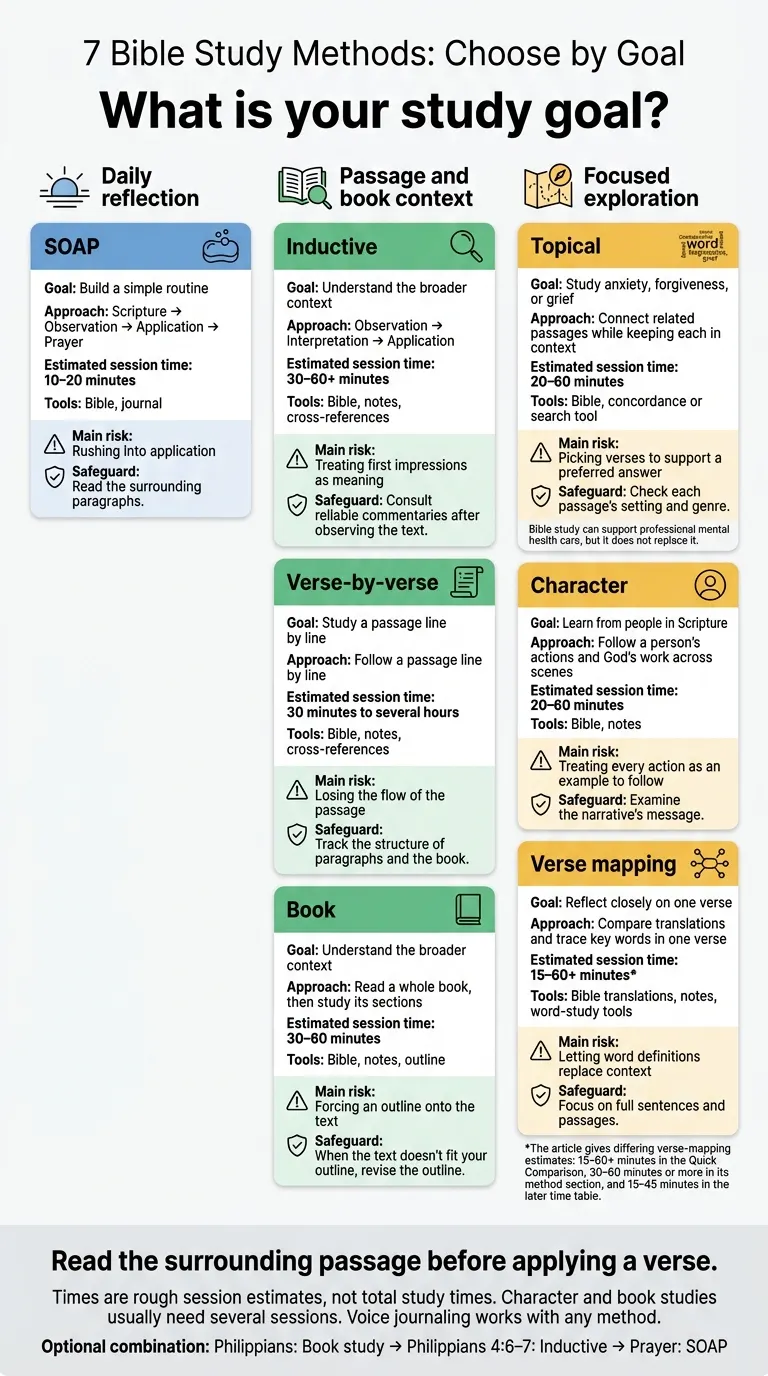
I’d start with SOAP for a 10–20-minute daily routine, or inductive study for a closer look at what a passage means. Your goal matters more than picking one method for every study.
I compare seven methods by their steps, time, tools, strengths, and reading risks. Here’s my quick guide to choosing one.
Quick Comparison
| Method | Main approach and best use | Time per session | Tools | Main risk |
|---|---|---|---|---|
| SOAP | Read, observe, apply, and pray for daily reflection | 10–20 minutes | Bible, journal | Rushing into application |
| Inductive | Separate observation, meaning, and application to check your reading | 30–60+ minutes | Bible, notes, cross-references | Treating first impressions as meaning |
| Verse-by-verse | Follow a passage line by line | 30 minutes to several hours | Bible, notes, cross-references | Losing the flow of the passage |
| Topical | Connect passages about anxiety, forgiveness, or another concern | 20–60 minutes | Bible, concordance or search tool | Picking verses to support a preferred answer |
| Character | Follow a person’s actions and God’s work across scenes | 20–60 minutes | Bible, notes | Treating every action as an example to follow |
| Book | Read a whole book, then study its sections | 30–60 minutes | Bible, notes, outline | Forcing an outline onto the text |
| Verse mapping | Compare translations and trace key words in one verse | 15–60+ minutes | Bible translations, notes, word-study tools | Letting word definitions replace context |
These are rough session estimates, not total study times. Character and book studies usually need several sessions. I can record notes by voice with any method.
My rule for all seven: <u>read the surrounding passage before applying a verse</u>. I can also combine methods - read Philippians as a book, study 4:6–7 inductively, then use SOAP to turn that reading into prayer. For anxiety, Bible study can support professional care, but it does not replace it.
1. SOAP Bible Study
Process and Context
Scripture: Read Philippians 4:4–9 and focus on 4:6–7. Observation: Note Paul’s commands: do not be anxious, pray with thanksgiving, and bring requests to God. Separate those commands from the promise of God’s peace.
Application: Turn one concern into a specific prayer of thanks and request. Prayer: Pray for help practicing the passage. Keep your notes anchored to the passage.
Time and Resources
You’ll need a Bible and somewhere to write four short notes. If you prefer voice journaling, choose a tool that links each suggestion back to the passage [2].
Strengths and Limitations
SOAP gives you a clear path from reading to action. Its short format works better for daily reflection than for studying a passage’s context in depth.
Best-Fit Study Goals
Choose SOAP for a simple daily practice or to connect a passage with a concern from your day. When you want to study the context more closely, move next to other Bible study methods like inductive study.
2. Inductive Bible Study
Process and Context
Inductive study slows down the SOAP method by breaking it into three steps. Observation asks what the passage says. Interpretation asks what it means. Application asks how to respond.
Start with James 1:2–8 and mark repeated words about trials and wisdom. Read James 1:1 first so you know who James is addressing before applying the passage to yourself.
Trace the connection between trials and asking God for wisdom. Ask how verses 5–8 develop the thought in verses 2–4, rather than reading them separately. Only then apply it: What wisdom do you need for your current trial?
Time and Resources
Use a Bible and keep separate notes for each step. Give yourself time to reread and check the surrounding passage. You can spread the work across several sessions.
For voice journaling, use “I Notice / I Wonder / I Feel” to keep observations, questions, and responses separate.
Strengths and Limitations
Inductive study makes your reasoning easier to check and helps you see patterns throughout a passage. The main risk? Mistaking your first impression for the author’s meaning, especially when you’re looking for quick reassurance.
Best-Fit Study Goals
Choose this method to understand the context more deeply or check whether an application fits the passage. Beginners can start with James 1:2–8, keeping the three stages separate. If you’d like to focus on a single verse next, the next method does that.
3. Verse-by-Verse Study
Process and Context
Read the passage one verse at a time, in order. Keep the full paragraph or chapter in view so you don’t lose the context [1].
For example, Romans 8:18–25 should be read with the rest of Romans 8 so Paul’s argument stays intact.
Time and Resources
You’ll need a Bible, notes, and time to reread both the passage and the surrounding chapter.
Strengths and Limitations
This method helps you pay close attention to the text. The main risk? Reading each verse on its own, without considering how it fits into the passage.
Best-Fit Study Goals
Choose verse-by-verse study for deeper reading of a single passage, rather than quick devotional application. To follow a theme across Scripture, use the next method: topical study methods.
4. Topical Bible Study
Process and Context
Start with one specific question, then gather passages that address it.
For example, to study how to forgive someone who hurt you, gather Matthew 6:14–15, Ephesians 4:31–32, and Colossians 3:12–13.
Read each passage in context before bringing their teachings together. Don't force every verse to answer the same question. The aim is a full biblical picture of the topic, making this method a good fit when one issue calls for an answer drawn from across Scripture.
Time and Resources
The more passages you gather - and the more context you read - the more time you'll need. Start with a Bible, a concordance or topical index, and notes. Prefer speaking to typing? Voice journaling can help you record each passage's main point and one practical response.
Strengths and Limitations
Topical study connects a personal concern with teaching across Scripture. Its main risk is proof-texting: picking verses that support your preferred answer while ignoring what they mean in context. Note any unresolved differences rather than forcing the passages to agree.
Best-Fit Study Goals
Use this method when you want biblical guidance on forgiveness or anxiety. It gives beginners a focused place to start. If you'd rather study a person than a theme, move next to character study.
5. Character Study
Process and Context
Follow one person through several passages, noting actions, relationships, failures, and God’s work. Unlike SOAP or topical study, character study tracks a person across multiple scenes.
For Peter, trace his calling, denial, restoration, and leadership.
At each stage, note who’s present, what Peter does, and what God does. Read each passage in context before connecting the stages.
Time and Resources
Set aside separate sessions for each stage of Peter’s journey. Keep the same note headings throughout: actions, relationships, failures, God’s work. If you use voice journaling, record observations and applications as you go. For digital notes, Psalm journaling tools can help you track patterns.
Psalmlog’s insights dashboard can show which passages you return to most and surface recurring themes. [2]
Strengths and Limitations
Following a person’s story makes growth and failure easier to trace. But focusing on the person can mean missing the passage’s larger message. Don’t turn Peter into merely a role model. Keep narrative details separate from application, and give God’s actions as much attention as Peter’s choices.
Best-Fit Study Goals
Choose this method to study a person’s spiritual growth, failure, and restoration. It’s a good fit for beginners who enjoy stories and a natural next step after simpler daily or theme-based studies. Next, compare how much time each method usually takes.
6. Book Study
Process and Context
Read the whole book before studying individual sections [1].
Note its setting and structure. Then revisit each passage and ask how it fits the book’s larger message.
For Philippians, partnership, humility, and contentment work well as theme headings. Let the letter’s structure set the outline.
Time and Resources
Book study usually takes multiple sessions. After your first full reading, work through smaller sections and keep notes on recurring themes.
Strengths and Limitations
Book study ties each passage to the book’s overall message. The main drawbacks are the time it takes and the risk of forcing your outline onto the text. When the text doesn’t fit your outline, revise the outline.
Best-Fit Study Goals
Choose book study when you want deeper context. Beginners can start with a shorter book and a simple outline.
For an immediate concern, such as anxiety or biblical forgiveness, topical study gives you a more direct starting point. Book study helps you understand those passages in context.
For a more visual way to trace a single verse, the next method is verse mapping.
7. Verse Mapping
Process and Context
Verse mapping takes a slower, more visual approach to studying one verse while keeping its context in view.
Start with Psalm 46:1, compare one more literal translation with one more readable translation, trace the key words with Strong’s, then read Psalm 46 as a whole before applying it.
Finish with one specific application you can act on and check.
Time and Resources
Set aside 30–60 minutes or more. Gather a Bible, multiple translations, a concordance, a lexicon, and a notebook.
Strengths and Limitations
Mapping puts close reading on the page, where you can see it. But word study must stay tied to the full passage. Dictionary definitions do not settle meaning; context does. Strong’s identifies words - it doesn’t give you the final interpretation.
Best-Fit Study Goals
Choose verse mapping when you want to slow down with one passage and connect its wording to a specific concern, such as anxiety or forgiveness. SOAP works well for quick daily reflection; inductive study allows for more detailed analysis of context.
Beginners can start with Psalm 46:1 and trace just three key words: refuge, strength, and trouble.
Comparing 6 of the Best Bible Study Methods - Deepen Your Understanding of God's Word
Time and Resources for Each Method
Use this chart to find a method that fits your schedule and study goal. Session length isn’t the same as total study time: some methods take one sitting, while others span several sessions or weeks. [2]
| Method | Estimated session time | Total study duration | Core tools | Helpful extras |
|---|---|---|---|---|
| SOAP | 10–20 minutes | Single session | Bible, journal | Voice journaling |
| Inductive | 30–60+ minutes | One or multiple sessions | Bible, notebook, cross-references | Bible dictionary, commentary |
| Verse-by-verse | 30 minutes to several hours | One passage at a time, often over multiple readings | Bible, notes, cross-references | Commentary |
| Topical | 20–60 minutes | One or multiple sessions | Bible, concordance, topical index, or search tool | Digital search tools |
| Character | 20–60 minutes | Multiple sessions | Bible, notes | Timelines, background resources |
| Book | 30–60 minutes | Several days or weeks | Bible, notebook, outline | Book introduction, commentary |
| Verse mapping | 15–45 minutes | Single session | Journal, multiple translations, cross-references | Word-study tools |
Voice journaling works with any method, letting you record notes, reflections, and Scripture links. [2]
Beyond time, you’ll also want to weigh each method’s strengths and limits.
Strengths, Limits, and Reading Risks
| Method | Strengths | Limits | Safeguard |
|---|---|---|---|
| SOAP | Daily devotion and personal engagement | Shallow reading or rushed application | Read the surrounding paragraphs. |
| Inductive | Deep understanding of context | Requires concentration and research | Consult reliable commentaries after observing the text. |
| Verse-by-verse | Close attention to the text | Can fragment arguments or lose context | Track the structure of paragraphs and the book. |
| Topical | Guidance for specific concerns | Risk of proof-texting | Check each passage’s setting and genre. |
| Character | Memorable, relatable narratives | Can mistake description for instruction | Examine the narrative’s message. |
| Book | A more complete understanding of an author’s message | Requires a large time commitment | Choose a short book and keep a consistent schedule. |
| Verse mapping | Deep reflection and memorization | Can misread isolated word meanings | Focus on full sentences and passages. |
No method produces a final interpretation. Even careful reading leaves questions.
For voice journaling, keep observation separate from application. Record what the passage says before noting your response. Use ‘I notice’ and ‘I wonder’ for observation; use ‘I feel’ and ‘I pray’ for response.
Choose a Method That Fits Your Goal
Match your study method to what you want to learn or practice.
| Study goal | Recommended method | Reason |
|---|---|---|
| Build a simple routine | SOAP | Takes each session from reading to prayer. |
| Understand the broader context | Inductive or book study | Studies a passage closely or follows a whole book. |
| Study a passage line by line | Verse-by-verse | Works through the text in order. |
| Study anxiety, forgiveness, or grief | Topical | Connects related passages while keeping each in context. |
| Learn from people in Scripture | Character | Follows people’s choices within their stories. |
| Reflect closely on one verse | Verse mapping | Keeps your attention on a single verse. |
Biblical guidance for anxiety can support professional mental health care, but it doesn’t replace it.[2]
Combine methods when helpful: read Philippians as a book, study Philippians 4:6–7 inductively, then apply it SOAP-style in prayer.
Keep your starting routine simple, adding depth only when you need it.
FAQs
How do I know if my interpretation fits the passage?
Start by noting who is speaking, who they’re addressing, and what’s happening around them. Look for repeated or emphasized words and contrasts. Read at least the full chapter, then compare your interpretation with several related passages and the Bible’s overall message of God’s love, justice, grace, and redemption. Don’t rely on an isolated verse.
If your “guidance” contradicts both wise counsel and Scripture, pause and reconsider. [1]
When should I switch Bible study methods?
Change your Bible study method when it no longer fits your needs or situation. For a specific subject, use a concordance or topical index to find relevant passages. Try AI-powered tools when emotions make it hard to put your needs into words or when you want a different perspective.
Start with what feels natural. Learning several approaches lets you combine them or switch between them as your needs change, helping you build a Bible study practice you can keep up over time.
What should I do when passages seem to conflict?
Start with each passage’s context: who wrote it, who they were writing to, and why. Read the full chapter to better understand its meaning [1]. Keep broader biblical themes - grace, justice, and redemption - in mind. Interpretations that conflict with these themes are likely misreadings [1].
Use cross-references to see how passages help explain one another. Commentaries and original-language resources can clarify subtle points that may resolve apparent differences [2][1][3].