
Lectio Divina: 4-Step Journal Guide
Four-step Lectio Divina with journal prompts—read, reflect, pray, then sit in 5–10 minutes of silence.
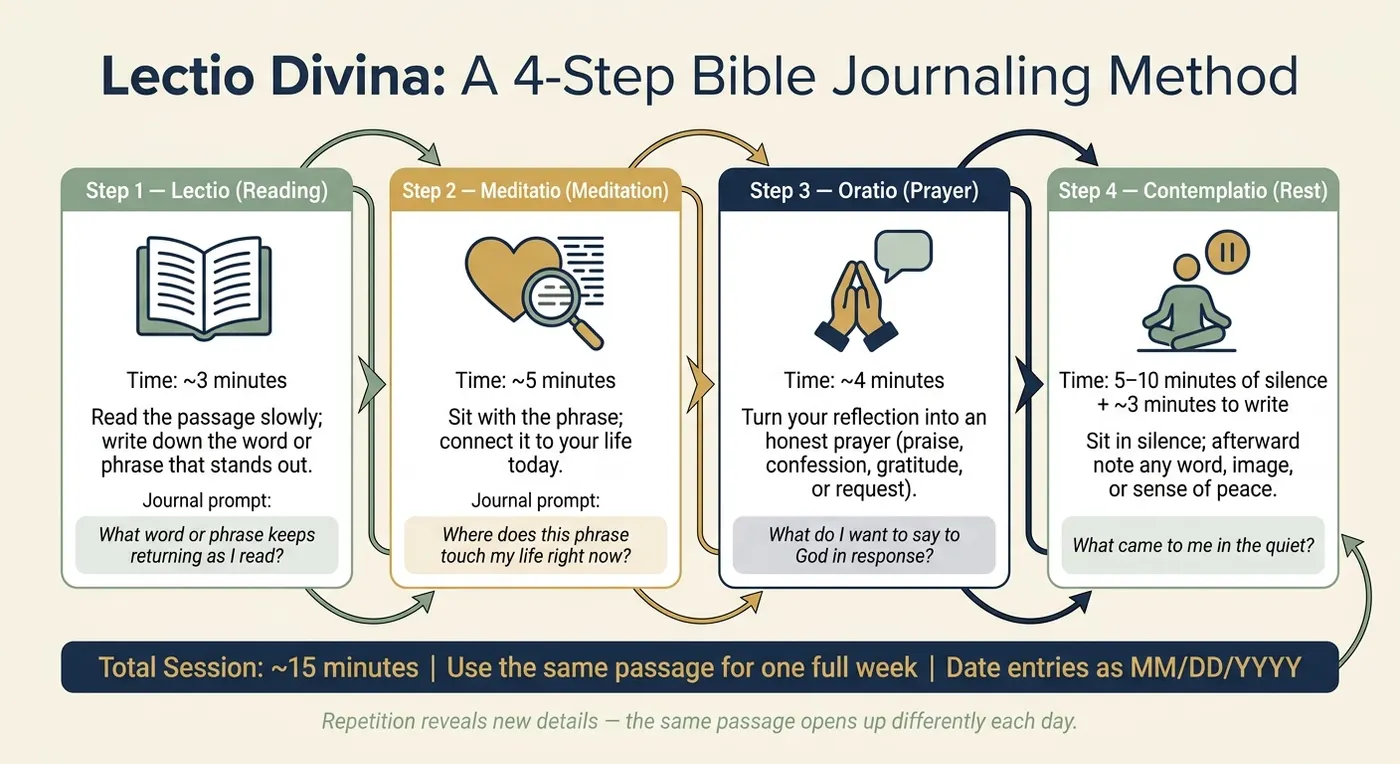
If Bible reading feels hard to apply, this method gives me a simple 4-step path: read, reflect, pray, and sit in silence.
I use Lectio Divina to slow down and stay with one passage long enough to respond to God in writing or out loud. The article breaks it into four steps - Lectio, Meditatio, Oratio, and Contemplatio - and gives me a short journal prompt for each one.
Here’s the whole idea in plain terms:
- Lectio: I read slowly and write down the word or phrase that stands out.
- Meditatio: I ask what that phrase touches in my life right now.
- Oratio: I turn that response into a short prayer.
- Contemplatio: I sit in silence for 5–10 minutes and note any peace, word, or image afterward.
The article also gives me a simple routine I can keep:
- A full session can take about 15 minutes
- I can use the same passage for one week
- I should date each entry in MM/DD/YYYY format, like 09/09/2026
- I can write by hand, type in a notes app, or record a voice-based scripture journal
The main point: I’m not trying to read more. I’m trying to pay closer attention and respond with honesty.
This guide is a short, step-by-step way to do that.
Lectio Divina - Step by Step Guide
Step 1: Lectio (Reading) and the Journal Template for This Stage
Start with Lectio. Read the passage once. Then read it again and pay close attention to the word or phrase that sticks with you.
How to Read the Passage Slowly
Lectio is slow, attentive reading. Move through the passage at an unhurried pace and notice what stands out. It might feel personal, timely, or heavy in a way you can’t ignore.
If nothing stands out at first, that’s fine. Read the passage again slowly and write down the first word or phrase that keeps coming back.
Journal Template for Lectio
Use the notes below to keep your first response brief and exact.
Use this template right after reading.
| Field | What to Write |
|---|---|
| Date | e.g., September 9, 2026 |
| Time | e.g., 7:15 AM |
| Scripture Reference | e.g., Psalm 23:1–3 |
| Word or Phrase That Stood Out | Write it exactly as it appears in the text |
| Plain Summary | One or two sentences summarizing the passage in your own words |
| First Notes | What did you notice about the structure, tone, or repeated images? |
Example prompt: What word or phrase keeps returning as I read?
At this stage, stay with observation only. Don’t try to explain everything yet. Just notice what’s there.
How to Voice Journal This Step With Psalmlog
If speaking feels easier than writing, record the same three items in a voice note connecting scripture and reflection. Psalmlog voice journaling and scripture tagging help keep the entry organized. That short record becomes your starting point for Meditatio.
After you record the word or phrase, move to Meditatio and ask what it means for your life.
Step 2: Meditatio (Meditation) and the Journal Template for Personal Reflection
Meditatio moves you from noticing the text to sitting with it. Keep the same passage open. Then let one word or phrase lead the reflection. That phrase becomes the bridge between Scripture and your life today.
How to Move From the Text to Your Life
Read the passage again with your chosen phrase in view. Slow down and let it stay with you for a minute. Then ask two plain questions: "What does this phrase stir in me today?" and "Where does this touch my life right now?"
At this stage, the text becomes a mirror. Bring it into your actual life: your stress, your relationships, your choices, or the feelings you haven’t named yet. Meditatio asks where God’s character meets your day-to-day life. Write your answers down before you move on.
Journal Template for Meditatio
Use these prompts to move from reading to personal application.
| Field | What to Write |
|---|---|
| Word or Phrase | The word or phrase that stood out in Lectio |
| Immediate Response | Your immediate emotional response (e.g., "I feel resistant to the idea of resting.") |
| Current Life Connection | The specific relationship, decision, or pressure this touches (e.g., "My resentment toward my boss.") |
| Questions for God | What feels hard to believe, or what you want to ask God about this truth |
Example prompt: Where does this phrase push back against something I've been telling myself this week?
How to Voice Journal This Step With Psalmlog
If writing feels slow, say it out loud instead. Speak the main emotion, memory, or question. Psalmlog can pick up emotional themes in your entry. Start by speaking the reflection, then come back and review it later.
From here, turn what surfaced into prayer.
Steps 3 and 4: Oratio (Prayer) and Contemplatio (Rest) With Journal Templates
In Oratio, take the phrase, insight, or conviction from Meditatio and turn it into prayer.
Oratio: Writing and Speaking Your Response to God
Oratio is your prayerful response to the passage. That might sound like praise, confession, gratitude, or a request. Start with the phrase that stayed with you, then respond to God as plainly as you can.
This simple template can guide your written or spoken prayer:
| Field | What to Write |
|---|---|
| What I'm Responding To | The word, phrase, or insight from Meditatio that stands out |
| My Honest Reaction | Praise, confession, gratitude, or a request |
| One Thing to Surrender | A fear, resentment, or habit you want to hand over |
| What I'm Asking For | A specific request connected to the passage |
Example prompt: God, help me respond honestly to what I just noticed in this passage. I feel anxious, and I want to surrender that fear to you.
You don't need polished words here. Just speak or write with honesty. If a line from the passage hits a nerve, stay with it.
Contemplatio: A Short Template to Use After Silence
When your prayer is done, let silence have the last word. Stop writing. Sit quietly for 5–10 minutes [1]. No prompts. No agenda. Contemplatio is rest, not output.
After the silence, write only two things:
| Field | What to Write |
|---|---|
| God's Presence | How you experienced the stillness |
| A Word, Image, or Prompting | Any word, image, or nudge to carry into your day |
Keep it short. Write only enough to remember what came to you in the quiet.
How to Voice Journal These Steps With Psalmlog
If speaking feels easier than writing, record the same prayer as a voice note with AI. Psalmlog lets you say your prayer out loud and come back to it later.
After Contemplatio, add only a brief follow-up note in Psalmlog. Just capture the word, image, or gentle impression you want to remember.
How to Build a Repeatable Lectio Divina Routine
Use the four steps in order. A 15-minute session is enough: 3 minutes for Lectio, 5 for Meditatio, 4 for Oratio, and 3 for Contemplatio. Keep the sequence the same, then shift the timing as needed. Once the rhythm starts to feel normal, stay with the same passage for the rest of the week.
A Weekly Structure You Can Actually Keep
One simple way to make this habit last is to use one passage for the whole week. That could be a single psalm, a few verses from a letter, or one scene from a Bible story. Read and pray through that same text in each session during the week.
Why does that help? Because repetition changes what you notice. A phrase that felt small on Monday can hit hard by Thursday. The same passage starts to open up in new ways, and daily repetition reveals new details in the same passage.
When you look back over your journal entries, pay attention to patterns. Notice which phrases kept showing up and what you kept praying about. Date each entry in MM/DD/YYYY format, like 09/09/2026, and add the Scripture reference next to it so you can find it fast later.
How Psalmlog Supports an Ongoing Practice
As this rhythm repeats, your journal turns into a record of the words, prayers, and themes that keep surfacing. Psalmlog works well with that kind of practice. You can speak your Oratio prayer, tag the passage, and look back at recurring patterns across your entries in the calendar and insights views.
The aim is simple: deeper attention to one passage and a more honest response to God.
FAQs
How do I choose a passage for Lectio Divina?
Choose a passage that feels approachable and speaks to where you are right now instead of trying to read the whole Bible straight through.
A good place to begin is with a shorter passage that has a lot to sit with, like Psalms 1, 23, 27, or 121; Philippians 4:4–7; John 1:1–14; Romans 8; or the Sermon on the Mount.
You can also pick a passage that fits your current season of life or one your church has talked about in a recent sermon.
What if no word or phrase stands out to me?
If no word or phrase jumps out at you, pick the part of the passage that holds your attention, pushes back on you a little, or brings a sense of peace.
It can also help to read the passage slowly at least three times. If you still feel stuck, keep it simple. Notice who is speaking, what’s happening in the passage, or which themes show up more than once.
Pray for humility and ask God to guide your attention, even if no clear connection shows up right away.
Can I do Lectio Divina without a journal?
Yes. A short note after each step - Lectio, Meditatio, Oratio, and Contemplatio - can make your reflections easier to hold onto and easier to revisit later.
That said, writing isn’t required. You can still move through each step slowly and prayerfully without putting anything on paper. If writing feels like a chore, try voice journaling instead. It gives you a simple way to keep a record of your reflections and prayers while staying close to the practice.