
Bible Verses to Stop Overthinking
Scripture-based steps to move past repetitive worry: five Bible passages, brief spoken reflections, and one faithful next step.
When my thoughts keep circling, I can start with one Bible passage and one next step - not try to solve everything at once. I read the passage in context, name my concern, and pray about what I can do and what I need to leave with God.
These 5 passages offer different places to start:
- Philippians 4:6–8: Bring repeating thoughts to God in prayer and turn toward what is true.
- Matthew 6:25–34: Focus on today’s responsibilities instead of tomorrow’s “what ifs.”
- Proverbs 3:5–6: Seek wisdom and trust God when a decision feels uncertain.
- Psalm 42:5: Name discouragement while making room for hope.
- Psalm 55:22: Hand over burdens while taking steps such as apologizing or setting a boundary.
I can also use a 2–5-minute spoken reflection, with or without Psalmlog, to read, reflect, and pray. The goal is a faithful response - not instant calm. <u>Worry does not mean weak faith</u>, and prayer can work alongside support from trusted people and licensed mental health professionals.
STOP OVERTHINKING: Scriptures to Recite when your Overthinking
How to Read Scripture When Your Mind Feels Unsettled
Overthinking means getting stuck in repetitive, distressing thoughts. You might replay a conversation, second-guess a decision, dwell on a mistake, or imagine the worst. Scripture speaks to fear and anxiety without treating every difficult emotion as a spiritual failure. A racing mind does not put you outside God’s care.
Planning moves you toward action. Repetitive worry keeps asking for certainty. Ask yourself whether your thinking points to a useful next step or circles questions you can’t settle. Matthew 6:25–34 addresses anxiety about tomorrow - not responsible preparation. Reading that distinction in context matters, and the same care applies to other passages.
Unless otherwise noted, Bible quotations in this article use the New International Version (NIV). Before applying a verse, read the surrounding paragraph. Notice who is speaking, who they’re addressing, and what is promised. Philippians 4:6–8 comes from a context of persecution and opposition. It isn’t a formula for making distress disappear[1].
Read the passage twice, then name your concern in one sentence. Write down one fact, one fear, and one faithful next step. In the passage, note one instruction, one truth about God, and one hope. Turn your next step into a brief prayer.
If distress persists or limits your ability to function, contact a licensed mental health professional or medical provider. Seek immediate help if you may harm yourself or someone else.
With that context in mind, start with Philippians 4:6–8.
1. Philippians 4:6–8 - Pray About Repeating Thoughts
Paul’s answer to spiraling thoughts is to turn toward God in prayer - not to control every thought. He connects prayer and thanksgiving with a shift in attention. Verses 6–7 invite you to make specific requests and describe God’s peace guarding your heart and mind in Christ. The promise is peace and protection, not control over every outcome.[1][2][3]
If a conversation keeps replaying, ask one question: Does anything need clarification? If yes, clarify it. If not, release the uncertainty to God instead of chasing certainty about what others think. If the loop remains unresolved, move from analysis to gratitude.
Thanksgiving helps keep fear from taking up all your attention. Name one way God has sustained you or one person who has supported you. That doesn’t make your concern unimportant. It gives you something else to focus on alongside it.
Verse 8 turns your attention toward what is true, honorable, just, pure, lovely, worthy of praise and approval, and good. This is not denial; it is disciplined attention. Ask yourself: Is my conclusion based on evidence or an assumption? Does replaying it help me respond wisely?[3] Then pray for one clear next step.
Prayer:
God, You know the thought I keep returning to. I bring You my fear and my request for help. Thank You for sustaining me. Guard my heart and mind with Your peace, and show me the next faithful step. Amen.
2. Matthew 6:25–34 - Face Today Without Carrying Tomorrow
When your thoughts run ahead to tomorrow, Jesus speaks directly to that habit. In the Sermon on the Mount, He addresses anxiety about food, drink, and clothing. He isn’t dismissing responsibility. He’s separating faithful planning from carrying tomorrow’s worries today. The opening “therefore” connects this warning to His teaching about treasure and divided loyalty.
Jesus sets a boundary for future-focused thoughts:
“each day has enough trouble of its own” (Matthew 6:34).[4]
Healthy planning leads to action. Overthinking keeps reopening uncertainty without bringing peace. When worst-case thoughts take over, separate what you know today from what you’re predicting. Set aside unanswered “what if” questions. If there’s a responsible step you can take now, take it.
Practical steps - budgeting, care, counseling, and asking for help - fit with trust and can interrupt replaying, predicting, and second-guessing.
Verse 33 points us toward seeking God’s kingdom and righteousness. The aim isn’t to feel certain about tomorrow. It’s to act faithfully today.
Reflection: What belongs to today, and what am I carrying ahead of time?
Prayer:
Father, give me grace for today’s responsibilities. Help me receive your care, act wisely with what is in front of me, and leave tomorrow in your hands.
3. Proverbs 3:5–6 - Trust God When Decisions Feel Uncertain
If you keep second-guessing today’s decision, Proverbs 3 invites you to trust God without needing total certainty. It teaches trust through wisdom, instruction, and correction.[7] That doesn’t mean setting aside reason or wise counsel. It means admitting that your view is limited - and that your own analysis isn’t the final authority.[5]
“lean not on your own understanding”[5]
When your mind keeps reopening the same choice, these words challenge the need to understand every possible outcome before you act. God’s promise to guide your path doesn’t guarantee an easy choice or a detailed picture of the future. The focus is on living wisely and faithfully.
When your analysis starts looping, pause before revisiting the decision. Write four brief statements: what you know, what you assume, which biblical principles apply, and your next responsible step. Set a deadline, then stop rechecking the same information.[6] Discomfort alone doesn’t mean the decision is wrong.
Prayer:
Lord, I trust that you see more clearly than I do. Help me use wisdom, seek good counsel, and make the next faithful decision. Keep me from confusing endless analysis with guidance, and help me leave the outcome with you.
4. Psalm 42:5 - Name Your Feelings and Turn Toward Hope
When your mind gets stuck in a loop, Psalm 42 offers a gentler response. It describes tears, longing for God, and a mind quiet enough to speak to itself.
“Why, my soul, are you downcast? Why so disturbed within me? Put your hope in God.”[8][9]
Hope and sadness can coexist. Verse 11 reminds us that turning toward God may take more than one try.[8][10]
When thoughts keep circling, take one minute to name the feeling rather than treat every fear as fact. Write three brief lines: what I feel, what I’m assuming, and what I can entrust to God. Let the feeling be a feeling - not a prediction. Naming it can help you hand it over instead of replaying it.
Prayer:
God, You see that my mind feels unsettled and my heart feels discouraged. Help me name what I am carrying without exaggerating it or hiding it. Teach me to hope in You while I wait for clarity, and show me the next faithful step. Amen.
5. Psalm 55:22 - Give Your Burdens to God
When overthinking grows out of hurt from another person, Psalm 55 turns your attention from analyzing what happened to handing the burden to God.
“Cast your cares on the Lord”[14]
This psalm speaks to the hurt of betrayal or a painful conversation you keep replaying.[11][13] You might wonder what you should have done differently or brace yourself for more pain.
Surrender does not mean doing nothing. Apologize, clarify, or set a boundary if needed. Then leave the other person’s response with God.
Name the hurt, then focus on what is yours to do. Read Psalm 55:22 slowly, name your burden, choose one action you control, and say:
I have brought this to God; I do not need to solve the whole future right now.
If the thought comes back, repeat the practice. Its return is not a spiritual failure.
God’s sustaining help does not promise immediate relief.[12] Prayer can work alongside wise counsel, boundaries, and practical help.
Use Psalmlog for Spoken Scripture Reflection
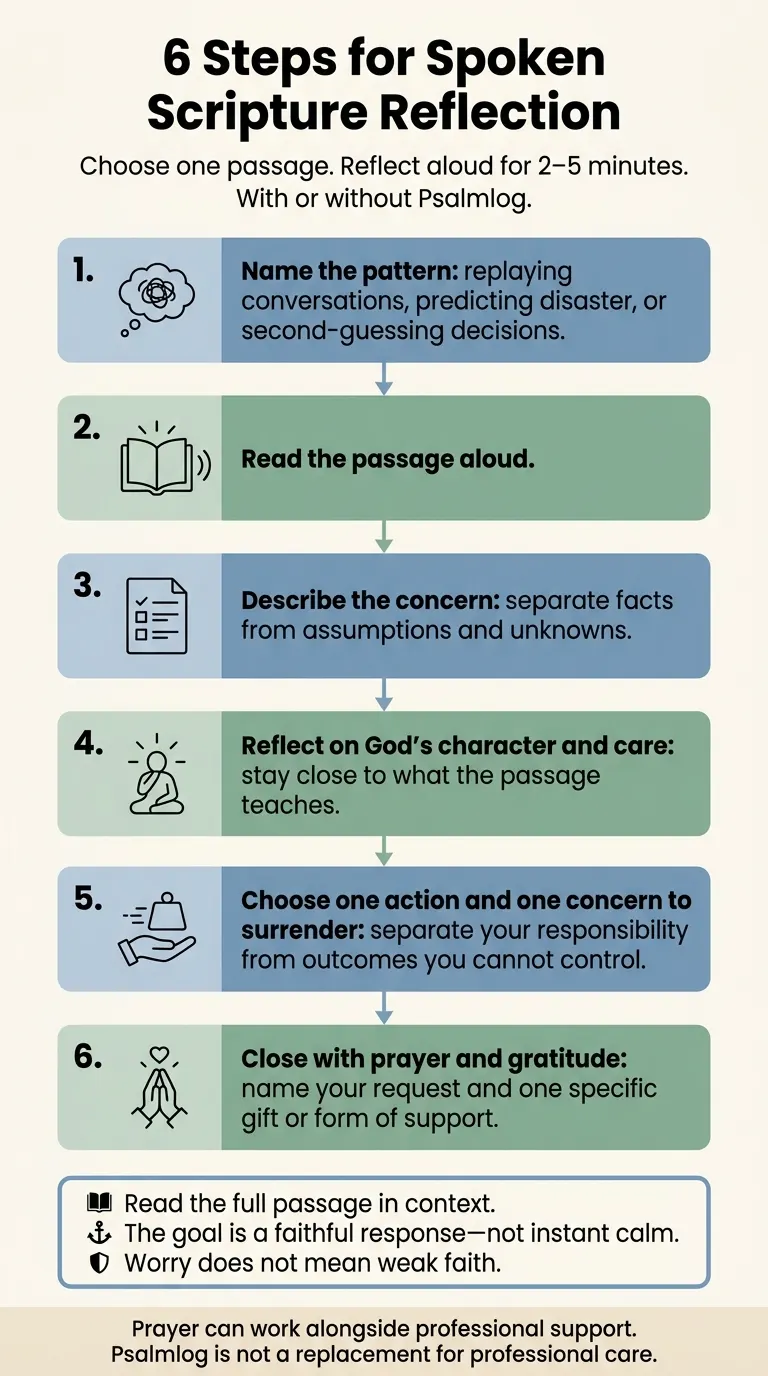
Choose a verse above and speak it aloud for two to five minutes. Use Psalmlog to record a short voice reflection on those verses. It is not a replacement for professional care.[15][16]
Stay with one passage and work through these six short prompts:
- Name the pattern: replaying conversations, predicting disaster, or second-guessing decisions.
- Read the passage aloud.
- Describe the concern: separate facts from assumptions and unknowns.
- Reflect on God’s character and care: stay close to what the passage teaches.
- Choose one action and one concern to surrender: separate your responsibility from outcomes you cannot control.
- Close with prayer and gratitude: name your request and one specific gift or form of support.
Pause when you hear yourself say always, never, must, or what if. Ask whether you’re stating a fact or predicting an outcome. Check the transcript for errors, and don’t treat patterns as diagnoses. Read the full passage in context and check that your application fits its meaning. Don’t let AI summaries take the place of careful interpretation.
Before recording private details, review the current privacy and deletion policies. Leave out identifying information you don’t need to share. If overthinking disrupts your sleep, work, or relationships, seek professional support.
Conclusion: Choose One Faithful Step Today
Choose one passage. Match it to what’s on your mind: Philippians 4:6–8 for replaying conversations, Matthew 6:25–34 for tomorrow’s worries, Proverbs 3:5–6 for uncertain decisions, or Psalm 55:22 for heavy burdens. Then take one small step today: finish a task that needs doing, ask for help, or rest.
If worry comes back, that doesn’t mean you’ve failed. Return to the verse and take the next wise step. You don’t have to feel completely calm to act wisely.
Persistent or debilitating anxiety deserves clinical support. A mental health professional or physician can assess your symptoms and discuss treatment. A pastor can also pray with you alongside that care.
FAQs
What if reading Bible verses becomes another overthinking loop?
When reading Bible verses turns into another overthinking loop, shift from analysis to action. Rather than skim several passages, choose one that speaks to your situation. Write down your thoughts or say them aloud, pray the verse back to God, and choose one small step to take today.
Scripture is meant to lead you to God - not keep you in endless mental review. If it still feels overwhelming, consider getting support from a counselor or your community.
How can I distinguish God’s guidance from anxious thoughts?
Test the message against Scripture and wise counsel - not just your feelings. God’s guidance aligns with biblical principles, can be confirmed by multiple passages, and usually brings peace as you pray (Philippians 4:6–7).
Anxious thoughts often sound alarmed and controlling. They replay what-ifs and tell you that you have to solve everything alone. Bring those worries to God, then weigh them against Matthew 6:25–34 and Proverbs 3:5–6.
How can I memorize Scripture without pressuring myself?
Focus on immersion, not formal study. Choose one or two verses that speak to your specific triggers. Write them on index cards and place them where you’ll see them often, or set them as your phone’s lock screen.
Read the verses aloud each time you see them. This repetition can help you memorize them naturally within a week, building a reserve of truth you can draw on as God’s Word gives you strength when you need it most.