
Beyond "I Can Do All Things": 9 Bible Verses for When You Feel Weak
Weakness becomes the doorway to God's strength: nine scriptures with context and simple practices to find rest, courage, and renewed hope.
When life feels overwhelming, the Bible offers strength and comfort through verses tailored to different struggles. While Philippians 4:13 is often quoted, its deeper context emphasizes contentment and reliance on Christ in all circumstances. This article dives into nine other scriptures that address specific challenges like exhaustion, doubt, fear, and grief, offering practical bible study techniques for applying them in daily life.
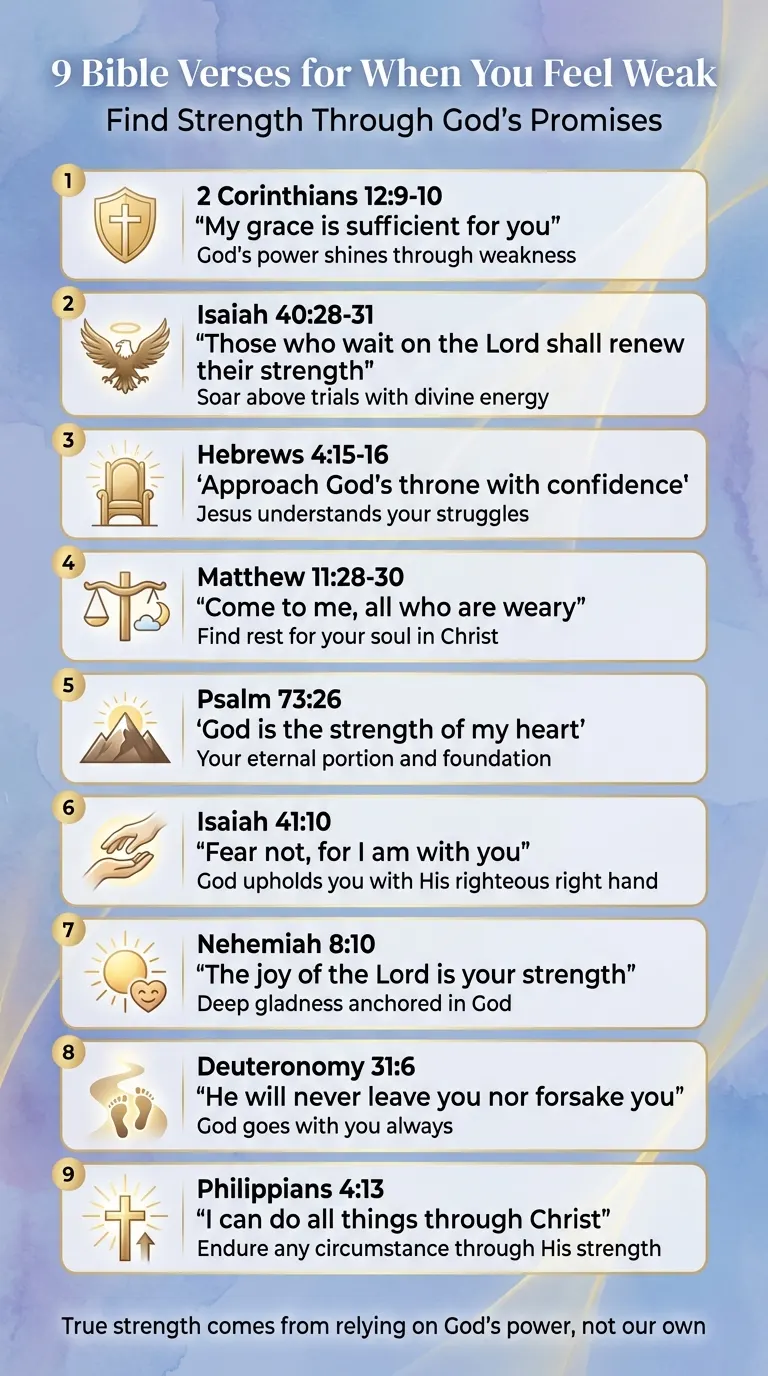
Key verses include:
- 2 Corinthians 12:9–10: God’s grace is sufficient, and His power shines through our weaknesses.
- Isaiah 40:28–31: Renewed strength comes from actively waiting on the Lord.
- Hebrews 4:15–16: Jesus understands our struggles, inviting us to approach God with confidence.
- Matthew 11:28–30: Rest for those burdened by life’s demands is found in Jesus.
- Psalm 73:26: God is our unchanging strength and eternal portion.
- Isaiah 41:10: Assurance in God’s presence and support, even in fear.
- Nehemiah 8:10: The joy of the Lord provides resilience during trials.
- Deuteronomy 31:6: God’s constant presence encourages strength and courage.
- Philippians 4:13: True strength comes from Christ, enabling us to endure all circumstances.
Each verse highlights the importance of relying on God’s power rather than our own, offering practical ways to integrate these truths into daily life. From prayer and meditation to reframing struggles as opportunities for grace, these scriptures guide us toward resilience and peace.
9 Bible Verses for Strength When You Feel Weak
Bible Verses on Strength – Scriptures for Courage and Faith
1. 2 Corinthians 12:9–10
This passage reveals how our weaknesses can become the backdrop for God’s power. Paul shares his experience with a persistent "thorn in the flesh", a struggle he pleaded with God to remove. Instead of granting relief, God responded with these powerful words: "My grace is sufficient for you, for my power is made perfect in weakness".
The word "sufficient" reminds us that God’s grace is enough to meet every need, no matter how great. His power doesn’t just compensate for our limitations – it shines through them. When we admit our dependence on Christ, His strength takes over in ways we could never achieve on our own.
This truth challenges us to rethink how we approach our struggles. As The Message translation puts it: "I quit focusing on the handicap and began appreciating the gift." Weakness, then, isn’t something to resent – it’s an opportunity for Christ’s strength to work through us. Whether you’re dealing with chronic illness, financial hardship, emotional exhaustion, or spiritual doubt, these limitations can become spaces for God’s transformative power.
Practically speaking, this means letting go of the idea that you have to handle everything alone. When life feels overwhelming, lean into prayer and acknowledge your need for God’s help. It’s in these moments of surrender that Christ’s strength becomes most evident.
The Greek term for "rest upon" (episkēnōsē) paints a vivid picture, meaning "to pitch a tent." This imagery suggests that Christ’s power doesn’t just visit us in our weakness – it sets up camp right in the middle of it, providing a constant source of strength and support. Through this, we find a daily model of reliance on God, allowing His power to shine through our human frailty.
2. Isaiah 40:28–31
Isaiah 40:28–31 highlights a profound truth: our human strength has limits, but God’s power knows no bounds. Isaiah paints a picture of God as eternal, tireless, and infinitely wise. His strength never diminishes, and His understanding is beyond our grasp.
The passage offers a beautiful promise: "He gives power to the faint, and to him who has no might he increases strength". This isn’t about summoning strength from within; instead, it’s about receiving divine power when we feel completely drained. God steps in when we can’t go any further on our own.
But there’s a condition – waiting on the Lord. This kind of waiting isn’t passive; it requires active trust and expectation. The ESV Study Bible describes it as "savoring God’s promise by faith until the time of fulfillment". When you’re worn out, instead of pushing through on sheer willpower, turn to prayer and reflect on His promises to find rest. This act of waiting connects you to the strength only He can provide.
Isaiah 40:31 uses vivid imagery to describe this renewal. It promises that you’ll soar like eagles, gaining a broader perspective even in the midst of trials. You’ll run without growing weary, finding energy to keep moving forward. And you’ll walk without fainting, handling daily challenges with steady resilience. When you hit a wall, ask yourself: are you leaning on your own strength, or are you inviting God’s power to sustain you? As Matthew Henry wisely notes, "if we go forth in our own strength, we shall faint, and utterly fall; but having our hearts and our hopes in heaven, we shall be carried above all difficulties". By relying on God, you’ll find the strength to rise above whatever you’re facing. This sets the stage for deeper lessons in the scriptures ahead.
3. Hebrews 4:15–16
Hebrews 4:15–16 reminds us that Jesus, as our High Priest, fully understands the struggles we face. He experienced hunger, exhaustion, and heartache, and the passage emphasizes that He was "tempted in every way, just as we are – yet he did not sin". This means Jesus encountered every type of human temptation, whether related to physical needs, pride, or power, making Him uniquely able to relate to whatever challenges you face.
The Greek word sympatheuo goes beyond mere empathy, signifying that Jesus truly shares in the suffering of His people. Matthew Henry captures this beautifully:
In the sight of Infinite Wisdom, it was needful that the Saviour of men should be one who has the fellow‐feeling which no being but a fellow‐creature could possibly have.
This isn’t distant pity from above – it’s a deep, personal understanding from someone who has walked through the same trials. This profound connection opens the door to bold, honest prayer.
Because Jesus genuinely understands your pain and struggles, you are encouraged to approach God’s "throne of grace" with confidence (parrēsia). You can speak openly, sharing your exhaustion or failures without fear of judgment or shame. There’s no need to hide or "fix yourself" before coming to Him.
The promise of this passage is twofold: mercy for your shortcomings and grace for your needs. Instead of pulling away in moments of weakness, you are invited to draw near with the assurance that you will be met with compassion. This access to God merges unmatched authority with limitless kindness, offering a source of strength and comfort for those who feel weary or burdened.
4. Matthew 11:28–30
In Matthew 11:28–30, Jesus extends a heartfelt invitation: "Come to me, all who labor and are heavy laden, and I will give you rest." This is a call to turn to Him in faith and prayer, especially for those carrying heavy burdens – whether they come from within or from the world around us.
The phrase "weary and heavy laden" resonates with anyone overwhelmed by the weight of legalism, guilt, societal pressures, or the endless pursuit of more. If you’re drained from striving to earn God’s favor through good deeds or crushed under the weight of unrealistic expectations, this verse is for you. Jesus promises "rest for your souls" – a deep, spiritual peace that comes not from effort, but from His forgiveness and grace.
The mention of a "yoke" might initially sound confining, but Jesus describes His yoke as "easy" and "light." As Matthew Henry explains, "It is a yoke that is lined with love". Unlike the exhausting burden of trying to achieve salvation or meet strict religious demands, Jesus’ yoke symbolizes a partnership in discipleship. The Message translation brings this to life: "Keep company with me and you’ll learn to live freely and lightly". It’s an invitation to walk alongside Him, sharing the load and discovering a more peaceful way of living.
When life feels overwhelming, approach Jesus in prayer. Take a moment to identify the weight you’re carrying – whether it’s self-imposed perfectionism, worldly ambitions, or the pressure to prove yourself – and intentionally lay those burdens at His feet. Embracing His yoke means surrendering to His guidance, which paradoxically leads to freedom, not restriction.
John Gill captures the urgency of this call beautifully: "A truly sensible sinner enjoys no rest, but in Christ; it is like Noah’s dove, which could find no rest for the soles of its feet, until it returned to the ark". When you’re worn out and depleted, remember that true rest is found in Jesus, who welcomes you just as you are.
5. Psalm 73:26
Psalm 73:26 offers a profound reminder of divine strength in the face of human frailty. It says: "My flesh and my heart faileth: but God is the strength of my heart, and my portion for ever." This verse acknowledges the inevitable moments when our bodies and spirits feel depleted. Whether you’re battling a chronic illness, mental fatigue, or spiritual burnout, this scripture validates those struggles while pointing to a source of strength that never falters.
The Hebrew word for "strength" in this verse, tsur, translates to "rock". It paints a vivid picture of God as an unmovable, steadfast foundation when everything around – or within – you feels unstable. Biblical commentary highlights that God’s strength sustains us in moments when grace feels weak, temptations seem overwhelming, or hardships pile up.
The verse also describes God as our "portion" – a term rooted in the Old Testament, where it referred to the division of the promised land among the Israelites. Here, it symbolizes something far more enduring: God as our eternal inheritance. Adam Clarke captures this beautifully, saying: "I ask no inheritance below; I look for one above… it is GOD alone that can content the desires and wishes of an immortal spirit". When health fades or clarity wavers, only God can provide the lasting fulfillment our souls crave.
Understanding the context of this psalm adds even greater depth. Written by Asaph during a period of bitterness and confusion, he wrestled with the prosperity of the wicked while he suffered. His perspective shifted only after entering God’s sanctuary, where he realized the fleeting nature of earthly wealth. This turning point transformed his despair into a reliance on God, the eternal portion and unshakable rock.
When you feel drained or defeated, let this verse serve as a "from-the-depths declaration of dependence". Acknowledge where your body or spirit is faltering – whether it’s exhaustion, fear, or spiritual dryness – and then turn to God as your rock and portion. Albert Barnes offers a poignant reminder: "When people come to die, they have ‘no other refuge’ but God. Nothing that they can accumulate of this world’s goods will meet their needs then". In moments of overwhelming weakness, declare your reliance on God’s enduring strength and unchanging presence.
6. Isaiah 41:10
Isaiah 41:10 offers a powerful assurance for anyone facing moments of weakness or uncertainty: "Fear not, for I am with you; be not dismayed, for I am your God; I will strengthen you, I will help you, I will uphold you with my righteous right hand." This verse speaks to the heart of emotional, spiritual, and physical struggles, providing comfort and strength when life feels overwhelming.
The phrase "be not dismayed" addresses the deep anxiety that comes with feeling overwhelmed. The original Hebrew word shâ‛âh conveys the idea of looking around in alarm or distress. Albert Barnes explains this beautifully:
The word rendered here ‘dismayed’… is derived from… ‘to see, to look’; and then to look about as one does in a state of alarm, or danger. The sense here is, that they should be calm, and under no apprehension from their foes.
This verse doesn’t stop at commanding calm – it promises divine care. The declaration "I am your God" highlights a personal relationship, a covenant that guarantees access to His power and protection. As John Gill puts it:
If God is the strength of his people, they need not be afraid of any persons or things.
The "right hand of righteousness" symbolizes God’s unmatched power and unwavering faithfulness. It’s not passive reassurance – it’s active intervention. This strength from God equips believers to face duties, resist temptations, and endure hardships that might otherwise feel unbearable, as if your heart could "melt like wax" under the weight of it all. Even when human energy fails, God’s strength remains constant – He never grows weary, unlike us.
These words were originally spoken to the Israelites during their Babylonian exile, a time of immense loss and despair as they witnessed their cities destroyed and felt abandoned. Yet the promise of "I am with you" offered them hope and restoration. For anyone feeling forgotten or powerless, this verse is a reminder to anchor your heart in God’s presence and trust in His ability to transform weakness into strength. It’s a call to wait on Him, knowing His sustaining power is always near, leading seamlessly into other scriptures that echo His faithfulness.
7. Nehemiah 8:10
Nehemiah 8:10 gives us one of the Bible’s most uplifting reminders: "The joy of the Lord is your strength." This verse came at a crucial time for the Israelites. After returning from exile and rebuilding Jerusalem’s walls, they gathered to hear Ezra read the Law. Overwhelmed with sorrow as they reflected on their failures, the people began to weep. But Nehemiah intervened, urging them to see the day as holy and to celebrate God’s restoration instead of mourning.
The joy mentioned here isn’t a fleeting emotion. The Hebrew word chedvah refers to a deep, steadfast gladness rooted in who God is. This kind of joy offers strength that doesn’t waver, even in the face of hardship, because it’s anchored in the unchanging nature of God. As GotQuestions.org explains:
"Joy is a tremendous source of strength. If a person is down and discouraged, almost any obstacle or hardship is enough to incapacitate him or her."
Danielle Bernock adds another layer to this understanding:
"The joy of the Lord gives us strength to reach for God’s provision of love and salvation. It shifts our focus from ourselves and our failures to God’s faithfulness and sufficiency."
When you feel overwhelmed or weak, this verse encourages you to shift your attention from your own struggles to God’s enduring promises. Nehemiah’s advice to the Israelites – celebrate with good food, extend kindness to those in need, and embrace the forgiveness God offers – shows how communal joy and gratitude can transform sorrow into renewed strength. By celebrating together and leaning on God’s faithfulness, we can find the resilience to face life’s challenges with confidence.
8. Deuteronomy 31:6
Deuteronomy 31:6 delivers a powerful reassurance against fear: "Be strong and courageous. Do not be afraid or terrified because of them, for the LORD your God goes with you; he will never leave you nor forsake you." These words, spoken by Moses to the Israelites as they prepared to enter the Promised Land, were meant to embolden them in the face of fortified cities and formidable enemies. The verse underscores a central truth: trust God’s presence instead of relying solely on yourself. This promise of God’s unwavering companionship echoes throughout Scripture.
This verse speaks directly to moments of fear, panic, or uncertainty – whether you’re facing health struggles, financial burdens, or major life transitions. It reminds us that strength comes from knowing God is with us, leading the way. As John Gill explains in his Exposition of the Bible:
Be strong in the Lord, and in the power of his might, trusting and relying on him that goes before you; and so take heart, and be of good courage, and act the manly part.
Becky, a certified health and Christian life coach, connects this verse to the everyday overwhelm many of us experience:
When life feels daunting and you are overcome by your responsibilities or the unknown, He promises to be with you. Because He is with you, you don’t have to be afraid or discouraged.
Instead of carrying the weight of your struggles alone, let those moments of weakness prompt you to pause and allow God to renew your strength.
Start embracing this verse with a simple morning practice. Begin your day by asking, "Lord, how can I use my time, energy, and even my weaknesses to honor You?" When anxiety creeps in, take a moment to be still and meditate on God’s character through His names – like Jehovah-Shalom (The Lord Is Peace) or Jehovah-Jireh (The Lord Will Provide). These small acts can help shift your perspective from the enormity of your challenges to the steadfast power of the God who never leaves your side.
9. Philippians 4:13
Philippians 4:13 is one of those verses that gets quoted a lot, but it’s also frequently misunderstood. At its heart, this verse highlights the importance of leaning on divine strength, especially when we’re feeling weak or overwhelmed. The phrase, "I can do all this through him who gives me strength," is not a promise that God will grant every wish or fulfill every personal goal. As Jason C. Meyer, Lead Pastor at Urban Refuge Church, clarifies:
This verse is not a promise that God will enable believers to do whatever they want whenever they want it. God is not a genie in a bottle.
When Paul says "all things", he’s referring to the specific challenges he was facing at the time – like hunger, imprisonment, and moments of both abundance and need. These words were written from a place of hardship, not triumph. Paul wasn’t proclaiming victory over his struggles or guaranteeing a brighter future for himself. Instead, he was sharing the secret to finding contentment: relying on Christ’s strength to remain steadfast, no matter the circumstances.
This perspective reshapes how we understand Philippians 4:13. It’s not about tapping into personal power to achieve a desired outcome. Rather, it’s about enduring life’s ups and downs through a strength that comes from beyond ourselves. The Greek word used for "strengthens" points to a power that exceeds human capability – one that helps us persevere when we feel like we’ve hit our limits. When you’re emotionally drained or self-doubt creeps in, remember that human strength isn’t infinite, but divine strength is.
Consider reframing this verse as a prayer for resilience. Instead of focusing on the challenges in front of you, focus on the One who equips you to face them. As Meyer wisely notes:
Circumstances do not determine our contentment. Our contentment comes because Christ is with us in any set of circumstances.
So, rather than striving to escape your current struggles, embrace them. Find peace in the moment, trusting that Christ’s strength is enough to carry you through. Next, we’ll explore practical ways to weave these insights into your daily scripture reflections.
How to Use Scripture in Your Daily Routine
Reading these nine verses is one thing – living them out is something entirely different. The challenge lies in finding ways to let scripture move beyond a quick reading and truly take root in your life. One effective approach is voice journaling. Instead of staring at a blank page, try speaking your thoughts aloud, weaving in scripture that resonates with your current struggles. For example, if you’re feeling drained or uncertain, start with a guided question like, "Lord, how can I use my weaknesses to honor You today?" Then record your thoughts and reflections as they come.
Breath prayers are another simple yet powerful practice, especially in stressful or chaotic moments. Take a short phrase from one of the verses – like "Your grace is sufficient" from 2 Corinthians 12:9 – and repeat it quietly or aloud as you breathe. This rhythmic practice helps anchor you in God’s truth when life feels overwhelming. Additionally, you can adopt the early church practice of parrēsia, which means speaking openly and honestly before God without fear or shame.
If voice journaling resonates with you, digital tools can take it a step further. Apps like Psalmlog are designed to make scripture integration effortless. With its voice-first interface, you can record quick reflections on a verse during your morning commute or before bed. The app automatically tags scripture and provides personalized insights. Its sentiment analysis even tracks patterns over time, showing how verses like Isaiah 40:29 can renew your strength or Nehemiah 8:10 can bring joy during challenging seasons.
Another practical strategy is inspired by Paul’s "boasting" technique in 2 Corinthians. Instead of venting about difficulties, reframe your struggles by declaring how they create space for Christ’s strength. For instance, if anxiety is weighing you down, say something like, "I’m anxious about this deadline, but I choose to boast in my weakness because it forces me to rely on God’s strength, not my own." This shift in perspective – speaking dependence instead of defeat – can transform how you face challenges.
To take it even further, incorporate the names of God into your reflections. If fear is gripping you, speak the name Jehovah Shalom (The Lord Is Peace). If you’re worried about provision, call on Jehovah Jireh (The Lord Will Provide). Pairing these names with scripture you’re meditating on transforms God’s promises into an active, personal dialogue. By using these techniques, scripture becomes more than words on a page – it becomes a living, dynamic part of your daily life.
Conclusion
Weakness isn’t something to hide or face alone – it’s an invitation to experience God’s strength in ways self-reliance could never provide. These verses remind us that God’s power is most evident in our moments of vulnerability.
The challenge is to weave these scriptures into everyday life. Turning to God’s Word shifts our perspective from fear and personal limits to a steadfast faith in His boundless strength. It’s a daily source of renewed energy for those who trust in Him.
Make it a habit to seek divine help each day. As David Sanford beautifully puts it, “The Lord God wants you and me to frequently ask for His strength to do this life.” Take this to heart – whether it’s by memorizing key promises, placing visible reminders around your home, or offering simple prayers like Nehemiah’s “Now strengthen my hands” when facing tough moments. These small practices can transform vulnerability into a constant reminder of His power.
At the core, the Bible reveals that true strength comes from God, not from ourselves. As the Apostle Paul discovered, “For when I am weak, then I am strong.” Leaning into this truth allows God’s grace to shine through every situation, turning our weakness into a reflection of Christ’s perfect power.
FAQs
How can I use these Bible verses to find strength in tough times?
To find comfort and strength in these Bible verses, take a moment to reflect on their meaning and how they connect to what you’re going through right now. For instance, Philippians 4:13 reminds you that with Christ, you have the strength to face any obstacle. Likewise, Isaiah 41:10 offers reassurance that God is always by your side, ready to support you in moments of fear or uncertainty.
Incorporate these verses into your daily life by memorizing them, jotting them down in a journal, or placing them where you’ll see them often – like on your refrigerator or desk. Take time to meditate on their words, letting their promises sink in, and pray for God’s guidance and strength as you navigate emotional, spiritual, or physical challenges. These simple practices can help you stay anchored in your faith and build resilience during tough times.
What does it mean to rely on the Lord for strength?
To depend on the Lord for strength means putting your faith in His power and perfect timing, rather than trying to manage everything through your own efforts. It’s about actively trusting Him, especially in moments when you feel weak or overwhelmed, and waiting for His guidance and renewal.
Isaiah 40:31 beautifully illustrates this: those who trust in the Lord will have their strength restored. They’ll soar on wings like eagles, run without growing tired, and walk without becoming weary. This trust isn’t passive – it’s a firm belief that God will equip you with the endurance and courage needed to navigate life’s toughest moments, even when you feel like giving up.
How can I find peace and strength in Jesus when life feels overwhelming?
Finding solace and strength in Jesus during tough times begins with placing your faith and trust in Him. In Matthew 11:28, Jesus extends an open invitation: “Come to me, all you who are weary and burdened, and I will give you rest.” This powerful verse encourages us to bring our struggles to Him, trusting in His comfort and care.
The Bible offers further reassurance in Isaiah 40:29-31, where it promises that those who place their hope in the Lord will have their strength renewed. They will endure without becoming weary or faint. Additionally, Isaiah 41:10 reminds us not to be afraid, for God is with us, offering His strength and unwavering support during life’s most challenging moments.
By reflecting on these verses, spending time in prayer, and holding fast to His promises, we can experience a deep sense of peace and find the strength to persevere. Let these scriptures serve as a steady foundation, reminding you of God’s constant love and presence, even when life feels overwhelming.