
How to Pray When You Don't Know What to Say: A Scripture-Based Guide
Scripture gives words when you can't—use Bible verses, breath prayers, and journaling to pray honestly and let the Spirit intercede.
When prayer feels overwhelming or you’re unsure what to say, Scripture offers a reliable guide. It provides words when you’re stuck, helps focus your thoughts, and strengthens your connection with God. Here’s how to approach prayer when you’re at a loss:
- Start with Scripture: Choose Bible verses that match your emotions or needs (e.g., Psalm 23:4 for comfort, Philippians 4:6-7 for anxiety).
- Reflect on God’s Promises: Meditate on the chosen verses to find hope, guidance, or encouragement.
- Pray Through Scripture: Turn verses into personal prayers by addressing God directly (e.g., "Lord, You are my shepherd").
- Use Tools to Stay Focused: Try voice journaling with Scripture, writing prayers, or practicing short "breath prayers" to maintain clarity and intention.
- Trust the Holy Spirit: Even when words fail, Romans 8:26 reminds us that the Spirit intercedes on your behalf.
The key is not perfection but genuine connection. Use Scripture as a foundation to guide your prayers and deepen your faith.
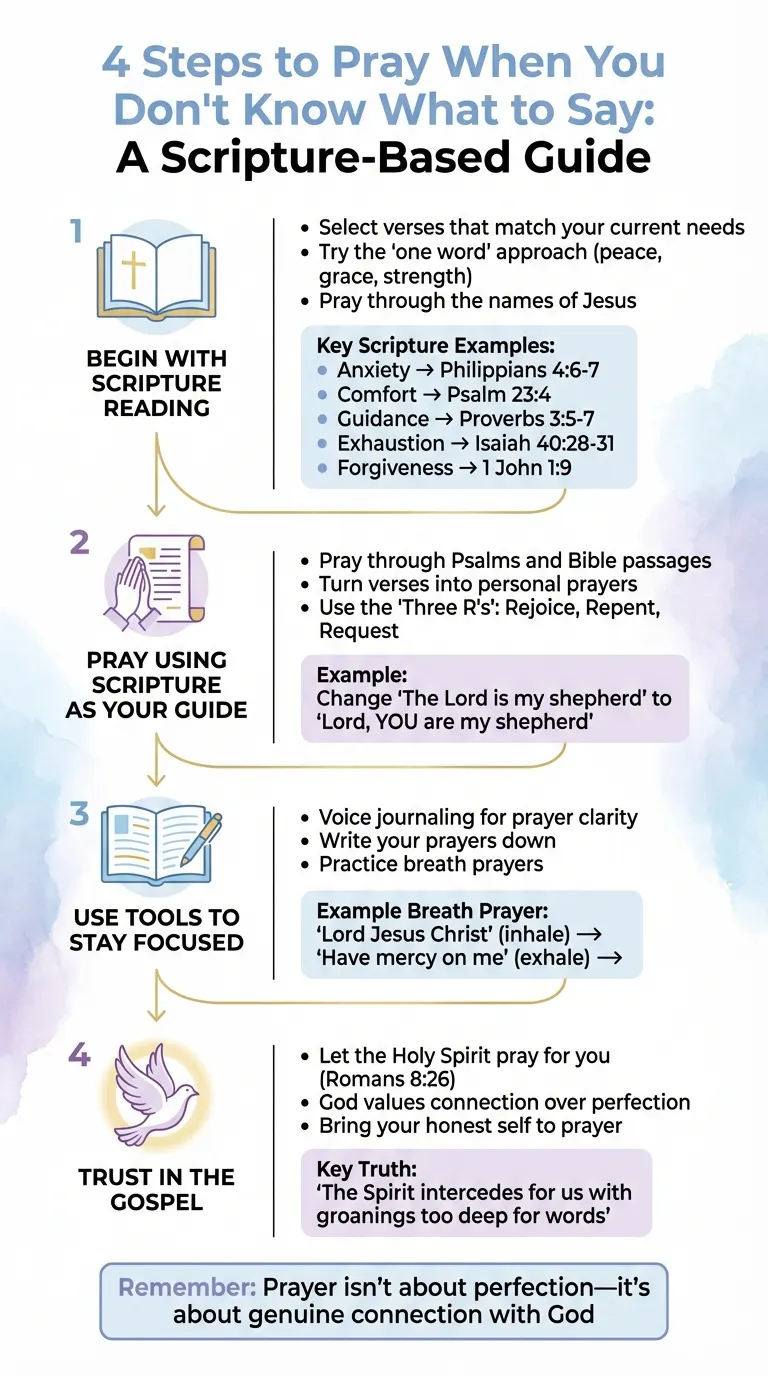
4-Step Guide to Scripture-Based Prayer When You Don’t Know What to Say
Step 1: Begin with Scripture Reading and Meditation
Select Verses That Match Your Current Needs
Start by choosing Bible passages that resonate with what you’re feeling right now. The Book of Psalms is a great place to begin – it covers every emotion imaginable, from despair to joy. Feeling anxious? Philippians 4:6-7 can bring peace. Looking for comfort? Psalm 23:4 provides reassurance. If you’re worn out, Isaiah 40:28-31 offers renewal.
If selecting a passage feels like too much, try the "one word" approach. Focus on a single word that represents your need – like "peace", "grace", or "strength" – and reflect on verses tied to that theme. Another option is to pray through the names of Jesus that relate to your struggles. For example, if anxiety is weighing you down, meditate on "Prince of Peace." Facing fear? Reflect on "Stronghold".
| Emotional/Spiritual Need | Recommended Scripture Passage |
|---|---|
| Anxiety or Worry | Philippians 4:6-7 |
| Need for Comfort | Psalm 23:4 |
| Seeking Guidance | Psalm 25:5 or Proverbs 3:5-7 |
| Physical or Mental Exhaustion | Isaiah 40:28-31 or Matthew 11:28-30 |
| Need for Forgiveness | 1 John 1:9 or Mark 11:25 |
Once you’ve chosen your passage, prepare your heart to hear God’s voice through meditation.
Reflect on What God Has Promised
After selecting a scripture, take a moment to let God speak first. As John Piper, Founder and Teacher at Desiring God, advises:
"When you sit down to pray, let God speak first. Let him have the first word. Put his living and active words into your ears, and let them shape and inspire what you say back to him".
Read the passage slowly and intentionally, soaking in God’s promises. Reflecting on His words builds trust and strengthens your connection to Him. Quoting Scripture in prayer isn’t presumptuous – it brings joy to God. While meditating, ask yourself: What in this passage gives me hope? What encourages repentance? What inspires a specific prayer request?
This thoughtful reflection lays the groundwork for a deeper, scripture-centered prayer experience in the next step.
Step 2: Pray Using Scripture as Your Guide
Pray Through Psalms and Other Bible Passages
After selecting and reflecting on a passage, turn God’s Word into your prayer. The Psalms are particularly helpful for this because they express a wide range of human emotions, making them ideal for mindful prayer practices for emotional healing. Feeling troubled? Pray through Psalm 6. Experiencing joy? Use Psalm 30. Facing a need? Turn to Psalm 109. These passages can guide your prayers, no matter your situation.
Outside of the Psalms, the New Testament also offers deeply meaningful prayers. Look at passages like Ephesians 1:15–19, Philippians 1:9–11, or Colossians 1:9–14. Even the Lord’s Prayer in Matthew 6:9–13 provides a clear structure that can be expanded upon with other Scriptures.
Once you’ve chosen a passage, make it personal – adapt the words to reflect your own heart and circumstances.
Turn Bible Verses into Personal Prayers
Take the verses you’ve meditated on and transform them into a personal dialogue with God. A simple way to do this is by shifting pronouns. For instance, change “The Lord is my shepherd” into “Lord, You are my shepherd.” This subtle adjustment makes the verse feel like a direct conversation between you and God.
You can also use the "Three R’s" approach to shape your prayer: Rejoice, Repent, and Request. This method helps you engage with Scripture in a way that deepens your relationship with God. As Puritan Thomas Goodwin once said:
"Sue Him for it, sue Him for it. Do not leave God alone. Pester Him, as it were, with His own promise. Tell Him what He has said He is going to do. Quote Scripture to Him…It pleases Him."
When you pray God’s promises back to Him – whether asking for wisdom from James 1:5 or seeking peace from John 14:27 – you’re showing trust in His faithfulness and His Word.
Step 3: Use Tools to Stay Focused During Prayer
Voice Journaling for Prayer Clarity
Speaking your prayers out loud can help you organize your thoughts and turn overwhelming emotions into clear, meaningful words. This approach transforms prayer from a mental exercise into a heartfelt conversation with God. As the editors at BibleStudyTools.com observe:
"Journaling my prayers helps me focus on what I’m saying and process through my emotions."
Tools like Psalmlog make this process even easier. With the Faith Builder plan ($19.99/month), you can record up to 300 minutes of spoken prayers each month. The app’s AI-powered analysis organizes your thoughts, provides biblical insights, and highlights patterns in your spiritual life that you might not notice otherwise. Its voice-first design removes the stress of finding the "right" words – just speak naturally, and the app helps you reflect on how God may be working in your life.
Another simple yet effective technique to stay focused is practicing breath prayers. These are short, Scripture-based phrases spoken in sync with your breathing. The team at In Touch Ministries highlights their value:
"Breath prayers are useful in helping to keep wandering thoughts and other distractions at bay."
For example, try saying, "Lord Jesus Christ (inhale), have mercy on me (exhale)" or "The Lord is my shepherd (inhale), I shall not want (exhale)." These brief prayers help you stay grounded, especially during moments when longer prayers feel daunting.
In addition to speaking your prayers, writing them down takes your reflection even deeper.
Write Your Prayers Down
While voice journaling captures your spoken prayers, writing them out sharpens your focus and creates a tangible record of your spiritual journey. Writing forces you to slow down, think intentionally, and reflect on your prayers. Kelly Minter, a Bible teacher and author, explains:
"Journaling provides a wonderful record of what God has done in my life and what has been important to me over the years."
You don’t need to be a skilled writer to benefit from this practice. Use voice journaling prompts or bullet points for quick prayer requests, jot down names of people you’re praying for, or write full paragraphs if that helps you process. You can even set aside a small space to note distracting thoughts – like tasks or errands – so they don’t interrupt your prayer time but aren’t forgotten either.
Over time, your written prayers offer a powerful reminder of God’s faithfulness. They reveal answered prayers, personal growth, and moments of grace. During spiritually dry seasons, these records can be a source of encouragement, reminding you that God’s presence is always at work, even when it feels distant.
Step 4: Trust in What the Gospel Promises
Let the Holy Spirit Pray for You
When you feel lost for words, the Gospel offers a comforting truth: you’re not meant to bear the weight of prayer on your own. Romans 8:26 reminds us that the Holy Spirit steps in during our weakest moments. The verse says, "Likewise the Spirit helps us in our weakness. For we do not know what to pray for as we ought, but the Spirit himself intercedes for us with groanings too deep for words".
This means that even your deepest sighs, unspoken aches, or complete silence can be transformed into prayer by the Spirit. Pastor Jeremy Writebol from Woodside Bible Church beautifully explains:
"The gospel news is that nothing stands in our way before God. Access is granted with the Father, the door is open with the Son, and the Spirit dwells within us".
God doesn’t need eloquence to understand you. He looks into your heart, knowing your needs even when you can’t put them into words. This assurance reminds us that what God desires most is connection, not perfection.
Remember That God Values Connection Over Perfection
Building on that truth, prayer isn’t about performing or getting it “just right.” The Gospel assures us that Jesus’ sacrifice has removed every obstacle between us and God. You can approach the Father freely, without needing polished or poetic words. As the team at In Touch Ministries puts it:
"Prayer should never be a performance but the opposite – a time we let down our guard and accept our true selves in God’s presence".
God already knows your needs before you even voice them (Matthew 6:8). What matters to Him is your honesty, not some picture-perfect presentation. Author Shauna Niequist echoes this sentiment:
"It’s about rejecting the myth that every day is a new opportunity to prove our worth".
Just come as you are. Bring your worries, no matter how small, to Him. The Gospel promises that Christ’s power is "made perfect in weakness" (2 Corinthians 12:9). So, even when you feel inadequate in prayer, it’s an opening for God’s strength to work through you. This truth reinforces that God treasures genuine connection over polished words.
A STEP-BY-STEP GUIDE TO PRAYING SCRIPTURE – how to pray scripture for beginners (with examples!)
Bible Verses to Use When You Don’t Know What to Pray
Sometimes, finding the right words to pray can feel overwhelming. Thankfully, scripture offers us a wealth of guidance, especially in the Book of Psalms, which is filled with prayers for every emotion and situation. Here’s a collection of Bible verses to lean on when you’re unsure of what to say.
Feeling anxious or worried? Turn to Philippians 4:6-7. This passage encourages you to bring your concerns to God with gratitude, promising that His peace will guard your heart and mind. When fear creeps in, Psalm 27:1 is a powerful reminder: "The Lord is my light and my salvation – whom shall I fear?" For moments when you feel weak, Isaiah 41:10 assures you of God’s strength and help.
Need direction? Proverbs 3:5-7 reminds you to trust in the Lord wholeheartedly rather than relying on your own understanding. When loneliness sets in, Matthew 28:20 offers comfort with Jesus’ promise: "I am with you always, to the end of the age." If you’re navigating grief or sorrow, Matthew 5:4 provides hope by declaring, "Blessed are those who mourn, for they will be comforted."
In moments of gratitude, 1 Thessalonians 5:16-18 encourages you to rejoice, pray continually, and give thanks in all circumstances. Wrestling with doubt? Mark 9:24 captures the honest cry of many hearts: "I do believe; help me overcome my unbelief." And when you’re so overwhelmed that words escape you, Romans 8:26 offers reassurance that the Holy Spirit intercedes for you with "groanings too deep for words."
Another way to refocus your prayers is by meditating on the names of Jesus. Titles like "Prince of Peace", "Immanuel" (God with us), and "Abba Father" emphasize His closeness and care. As Micah Maddox beautifully writes:
"Remembering the name of the Lord our God is a step in the right direction toward realizing life is bigger than what we are going through."
These verses and reflections serve as a comforting resource, offering immediate guidance when you don’t know where to begin. Let them remind you of God’s presence and His willingness to meet you in every moment.
Sample Prayers Based on Scripture
Here are examples of scripture-inspired prayers tailored to different situations.
A Prayer for Anxiety
Scripture offers comfort even in moments of anxiety: "Father, I bring my worries about [situation] to You. Please quiet the fears in my heart and fill my thoughts with Your peace. Replace my fear with trust in You. Help me rest in the assurance that You are in control, and guard my heart and mind with the peace that surpasses all understanding". This prayer turns scripture into a heartfelt dialogue with God.
A Prayer for Guidance
In times of uncertainty, Psalm 25:4 provides direction: "Lord, when I feel overwhelmed by fear and doubt, guide me with unwavering faith. Help me shift my focus from my challenges and fix my eyes on You". By praying this, you’re leaning on His promise to provide wisdom generously to those who ask, as stated in James 1:5. This transforms scripture into a deeply personal plea for guidance.
A Prayer of Thanksgiving
1 Thessalonians 5:18 reminds us to "give thanks in all circumstances". A prayer of gratitude might go like this: "God, I thank You for my family, my health, and Your constant love that sustains me. Even in difficult times, I recognize You as the source of all good things. Open my eyes to Your blessings, even when life feels challenging". This prayer transforms scripture into a genuine expression of thankfulness.
These examples help you bring God’s promises into your daily life, turning scripture into personal and meaningful prayers.
Conclusion: Growing Your Prayer Life Through Scripture
When you struggle to find the right words, scripture can speak for you. The Bible offers not just words but also structure and promises, turning hesitant prayers into confident conversations with God. By consistently leaning on scripture, your prayers shift from focusing solely on personal needs to acknowledging God as the ultimate source of answers.
Developing this habit requires regular effort. Start by setting aside time for prayer each morning and evening with a daily prayer planner, even on days when you don’t feel particularly motivated. Writing down your scripture-based prayers can help you reflect on how God is working in your life. As Martin Luther wisely said, "The fewer the words, the better the prayer". What truly matters to God is your genuine desire to connect with Him, not the length or elegance of your prayers.
As you immerse yourself in scripture, you’ll grow more attuned to God’s voice, gain a deeper understanding of His character, and find greater confidence during life’s challenges. This understanding helps align your will with His. Lori Hatcher captures this well: "Faith isn’t being sure of the outcome. Faith is being sure of the One who ordains the outcome".
FAQs
How do I find the right Bible verse to guide my prayer when I’m overwhelmed or unsure what to say?
When you’re not sure what to pray, start by tuning in to your emotions – whether you’re feeling anxious, grieving, joyful, or uncertain. The Bible has verses for almost every emotion. For instance, Psalm 6 offers comfort for a troubled heart, Psalm 30 is ideal for times of celebration, and Psalm 3:3 reminds us of God’s protection when we feel unworthy or defeated.
After selecting a verse, take your time reading it. Focus on words or phrases that stand out, like “shield,” “peace,” or “guide.” Let these words shape your prayer. You can simply repeat the verse as it is, personalize it by adding your own thoughts, or expand on its message to fit your current situation. If one verse feels too brief, explore the chapter around it or look for related passages to keep your prayer flowing. This method lets Scripture guide your conversation with God, even when you’re unsure how to start.
How can I stay focused while praying, especially when I feel distracted?
Staying focused during prayer isn’t always easy, but a few simple techniques can make a big difference. One effective way is to pray through Scripture, especially passages like the Psalms that express a wide range of emotions. For instance, you could meditate on Psalm 3:3: “You, O Lord, are a shield for me…” Let the words shape your prayer, repeating them slowly to help center your mind on God.
Another useful method is following a structured prayer outline, such as the ACTS model: Adoration, Confession, Thanksgiving, and Supplication. This framework provides a clear direction for your prayer time. If distractions are a struggle, keeping a prayer journal might help. Writing down a verse or a key prayer point can give you a visual anchor, helping you stay engaged.
Lastly, incorporating the lyrics of a favorite hymn or worship song can be incredibly grounding. Whether you sing or speak the words, these familiar, biblically rooted phrases can redirect your attention to God and deepen the meaning of your prayer.
How does the Holy Spirit help when I don’t know what to pray?
When you’re at a loss for words in prayer, the Holy Spirit steps in as your guide and helper. Romans 8:26-27 beautifully describes how the Spirit intercedes for us with "groanings too deep for words", taking the unspoken emotions and desires of our hearts and shaping them into prayers that align with God’s will.
Even in those moments when words fail, the Spirit understands your needs and brings them before the Father. This means you can find comfort and assurance, knowing that God hears and understands you, even in silence or uncertainty. Trust that the Spirit is always working, lifting up your fears, hopes, and gratitude to God.