
7 Psalms to Pray When You're Feeling Depressed or Hopeless
Seven Psalms to pray when you're depressed or hopeless—scripture, prayer prompts, and voice-journaling steps to name grief, recall God's faithfulness, and restore hope.
When life feels overwhelming, the Psalms offer comfort and guidance. These ancient prayers reflect deep emotions, from despair to hope, and provide a way to connect with God during tough times. Below are seven Psalms to help you navigate feelings of depression or hopelessness:
- Psalm 42: Expresses spiritual thirst and encourages self-talk to combat despair. Reflect on God’s past faithfulness.
- Psalm 43: Focuses on shifting from discouragement to hope. Pray for God’s light and truth to guide you.
- Psalm 27: Declares God as a refuge against fear and loneliness. Embrace His presence for strength.
- Psalm 34: Reminds that God is close to the brokenhearted and rescues the crushed in spirit. Praise Him even in struggles.
- Psalm 40: Describes depression as a "pit" and highlights the importance of waiting on God for stability and renewal.
- Psalm 62: Urges trust in God as a steady refuge amidst life’s chaos. Pour out your heart to Him.
- Psalm 77: Validates raw emotions and doubts while encouraging reflection on God’s past works to anchor hope.
Psalm 43 – From Depression to a Procession of Praise
1. Psalm 42
Psalm 42 paints a vivid picture of spiritual struggle, using the image of a deer desperately panting for water to reflect a deep longing for connection with God. Written by the Sons of Korah – a group of Levite priests tasked with leading temple worship – this Maskil (a song meant to teach) captures the anguish of feeling distant from the divine. The psalmist doesn’t shy away from expressing raw emotions, admitting to feeling “downcast,” “disturbed,” and “overwhelmed.” He compares his inner turmoil to the relentless crashing of waves.
A key feature of this psalm is the use of spiritual self-talk. Instead of passively accepting feelings of despair, the psalmist actively confronts them by asking, “Why, my soul, are you downcast?” This refrain, which appears repeatedly in both Psalm 42 and 43, encourages readers to place their hope in God. Martyn Lloyd-Jones, a physician and minister, once famously noted:
"Have you realized that most of your unhappiness in life is due to the fact that you are listening to yourself instead of talking to yourself?"
This practice of speaking truth to oneself serves as a powerful tool against despair. The psalmist recalls moments of communal worship and God’s past faithfulness, using these memories as a source of reassurance. While he doesn’t dismiss the weight of his suffering – describing his tears as his daily sustenance and his body as overwhelmed by pain – he refuses to let despair define him. Even the imagery of crashing waves becomes a reminder of God’s sovereign presence.
When praying through struggles, focus on seeking God Himself rather than simply asking for relief. Reflect on the root of your despair, whether it’s physical, emotional, or situational, and boldly affirm God’s truth. That deep thirst you feel for Him is a sign of your connection to Him and a reminder of your place in His care.
2. Psalm 43
Psalm 43 picks up where Psalm 42 left off, continuing the heartfelt dialogue with a familiar and powerful refrain:
"Why, my soul, are you downcast? Why so disturbed within me? Put your hope in God, for I will yet praise him, my Savior and my God".
This repeated line serves as a lifeline in moments of despair. The psalm offers a guide for moving from darkness to hope: acknowledge your discouragement, shift your focus to God’s unchanging nature, commit to praising Him, and ground your hope in His salvation. Even as the psalmist wrestles with feelings of being "overlooked" and questions God’s seeming absence (v. 2), he takes charge of his inner dialogue. This intentional approach lays the groundwork for a focused and heartfelt prayer.
Mary K. Mohler, Director of the Seminary Wives Institute, highlights this strategy beautifully:
"Instead of listening to the voices in our heads, we need to preach truth from the Word to ourselves".
Verse 3 offers a powerful prayer request:
"Send out your light and your truth; let them guide me. Let them lead me to your holy mountain, to the place where you live."
This is a plea for God’s light and truth to cut through the fog of deceptive emotions, providing clarity and direction. In verse 4, the psalmist describes God as his "exceeding joy", reminding us that true comfort doesn’t come solely from escaping pain but from drawing closer to God Himself.
Finally, the psalm encourages praising God in advance and seeking the strength found in community worship. The longing for the "altar of God" reflects the power of shared worship to uplift a weary spirit. This psalm invites us to integrate its promise of hope into our personal prayers, offering a path to renewed joy and peace.
3. Psalm 27
Psalm 27 shines a light on God’s power as a source of guidance, protection, and hope during life’s darkest moments. It opens with a bold declaration:
"The Lord is my light and my salvation – whom shall I fear? The Lord is the stronghold of my life – of whom shall I be afraid?"
These words directly confront the weight of despair. When life’s challenges feel overwhelming and the path ahead seems hidden, this psalm reminds us that God provides clarity, deliverance, and an unshakable refuge. As Micah Maddox beautifully puts it:
"When fear grips us, we know where to go to find light in the dark and strength when we feel depleted".
Much like the earlier psalms, Psalm 27 encourages an intimate conversation with God, one that has the power to transform feelings of hopelessness into renewed confidence and peace.
One of its most tender assurances comes in verse 10, offering solace for anyone who has felt the sting of rejection or loneliness: "Though my father and mother forsake me, the Lord will receive me." This verse underscores God’s unwavering presence, even when human relationships falter.
The psalm also points to a vital practice for navigating life’s struggles: dwelling in God’s presence and focusing on His beauty. This practice offers a way to cut through the noise of anxiety. The psalm concludes with an empowering call to action: "Wait for the Lord; be strong and take heart." These words encourage patience and trust, even when life feels overwhelming.
4. Psalm 34
Psalm 34 speaks to anyone grappling with feelings of depression or hopelessness. Written by David during a time of personal struggle, this psalm serves as a reminder that even in moments of deep despair, hope is never far away.
Verse 18 offers reassurance: "The Lord is close to the brokenhearted; he rescues those whose spirits are crushed." This verse reminds us that God doesn’t stay distant when we’re hurting. Instead, He draws near, offering comfort when we feel most broken. Theologian Matthew Henry reflects on this truth, saying:
"Nothing is more needful to true godliness than a contrite heart, broken off from every self-confidence."
This insight highlights that our brokenness isn’t a barrier to God’s presence – it’s an opportunity to draw closer to Him.
The psalm also acknowledges the reality of life’s struggles, stating: "The righteous person faces many troubles, but the Lord comes to the rescue each time." It’s a powerful reminder that facing hardships doesn’t mean spiritual failure. Instead, it affirms that challenges are part of life, but God provides deliverance – not necessarily by removing the difficulties, but by ensuring they don’t destroy us.
Verse 8 invites us to actively experience God’s goodness: "Taste and see that the Lord is good." This isn’t about passive belief; it’s a call to engage with God personally. David’s own cry in verse 6 – "This poor man cried, and the Lord heard him and saved him out of all his troubles" – encourages us to bring our struggles to God through heartfelt prayer and find refuge in His presence.
Finally, Psalm 34 urges us to praise God "at all times", even in the midst of life’s storms. This isn’t about denying your pain or pretending everything is fine. Instead, it’s about shifting your focus from the weight of your burdens to the greatness of God. This practice of praising through adversity lays the foundation for how reflective tools like connecting voice journaling with Scripture can deepen your connection with God, as we’ll explore in the next section.
5. Psalm 40
Psalm 40 paints a vivid picture of depression, describing it as a deep, disorienting pit where solid ground feels out of reach. Its imagery captures the anguish of those moments when words fail, offering a way to express pain through prayer.
The opening verse sets the tone: "I waited patiently for the Lord." This isn’t about quick fixes or instant relief. As Rick Hamlin explains, waiting itself can be a powerful act, gradually bringing light back into the darkness. Depression often unfolds slowly, and this Psalm acknowledges that healing is a journey, not an overnight transformation. It invites readers to embark on a prayerful path from despair to hope.
Psalm 40 also emphasizes honest communication with God. In verses 1–2, the writer describes being lifted out of the pit and placed on solid ground, a symbol of newfound stability. By verse 3, a "new song" of praise emerges, suggesting that through waiting and trust, hope can be renewed. However, the Psalm doesn’t shy away from ongoing struggles. In verses 12 and 17, the author confesses feelings of being "poor and needy" and having a heart that "fails". This balance of trust and raw lament makes the Psalm relatable for anyone carrying heavy emotional burdens.
To pray through Psalm 40, start by identifying and naming your "pit" aloud to God. Let the Psalm’s imagery guide your words. Verse 5 serves as a powerful reminder of God’s countless plans for you – plans beyond what you can fully grasp. Steven G. Rise, PhD, LCSW-R, offers practical advice for battling the negative thought patterns depression often brings:
A major part of depression includes the negative, self-defeating thinking patterns that continually brings down, and prevents us from coming back up… train your mind to focus on the lovely things that are worthy of praise.
Take time to reflect on even small signs of God’s past faithfulness. Memorize key verses, like verse 17, to anchor yourself in moments of darkness and remind yourself of God’s enduring truth.
6. Psalm 62
Psalm 62 offers a calming antidote to the mental chaos that often accompanies depression. Written by David during a period of deep distress – possibly while fleeing Absalom’s conspiracy or enduring Saul’s relentless pursuit – this Psalm captures the raw vulnerability of feeling like a "leaning wall" or "tottering fence." Yet, it redirects that vulnerability toward the steady, unwavering foundation of God’s support.
In verses 5–6, David speaks directly to his own soul, urging it to find rest in God. He declares, "He is my rock and my salvation; he is my fortress, I will not be shaken". These powerful metaphors – God as a "rock", "fortress", and "salvation" – paint a vivid picture of divine stability, reminding us that even in life’s most unstable moments, there is an unshakable refuge.
Verse 8 encourages complete honesty in prayer: "Trust in him at all times, you people; pour out your hearts to him, for God is our refuge". Matthew Henry beautifully expands on this, saying:
We must lay out wants and our wishes before him, and then patiently submit our wills to his: this is pouring out our hearts.
This verse invites you to bring your grief, frustrations, and fears openly to God, trusting Him to be your ultimate refuge.
The Psalm also provides a sobering reminder about the fleeting nature of human achievements. Verses 9–10 describe status and wealth as "lighter than a breath" and ultimately deceptive. When financial struggles or social rejection leave you feeling untethered, these verses call you to place your hope and trust in God’s enduring love and unchanging power.
As Gloria Dei Lutheran Church insightfully notes:
Rest quietly in God, not because he’s going to make life perfectly serene this side of eternity… but because no matter how loud the problems of this life or the guilt of our sin shout – he is greater than all of them.
In light of these truths, prayer becomes an active demonstration of trust. To pray through Psalm 62, try sitting in silent stillness before God when anxious thoughts overwhelm you. Speak to your soul as David did, commanding it to find rest in God alone. Let prayer be your immediate response, not your last resort. When challenges arise, reflect on the imagery of God as your fortress, allowing it to bring you a renewed sense of safety and peace.
7. Psalm 77
Psalm 77 is a powerful reminder that it’s okay to bring raw emotions and deep struggles, like depression, into your conversations with God. Written by Asaph, this psalm begins with unvarnished honesty: sleepless nights, a heavy spirit unable to speak, and a soul that "refuses to be comforted" [56, 60]. These are not signs of a lack of faith but a reflection of the very real challenges that depression can bring.
This psalm also encourages you to ask the difficult questions that often come during moments of despair. Questions like, "Has God forgotten to be gracious?" or "Have His promises permanently failed?" [56, 61]. Pastor Lloyd Stilley offers this perspective:
The company of the depressed is a very noble company. And whether we will admit it or not, all of us have been numbered among them.
Expressing doubts like these isn’t an affront to God – it’s the start of an honest and heartfelt prayer.
The tone shifts in verse 10, where Asaph moves from his personal grief to reflecting on "the years of the right hand of the Most High" [57, 58]. He begins to recount God’s past faithfulness – events like the Exodus and the crossing of the Red Sea. This isn’t about ignoring pain; it’s about anchoring a weary heart in the undeniable evidence of God’s work in the past.
The psalm closes with a striking image: even though God’s "footprints were unseen" during the Red Sea crossing, He was still leading His people like a shepherd (vv. 19–20) [56, 62]. This serves as a powerful reminder that even when you can’t perceive God’s presence during your struggles, it doesn’t mean He’s absent.
To pray through Psalm 77, consider these steps. Start by sending an "SOS" to God – cry out, groan, or let your prayers pour out honestly. Then, try the "napkin exercise": jot down specific blessings from your day, month, or year, such as answered prayers or moments of love from others. Lastly, when comfort feels distant, gather with others in worship to "borrow from the faith of those around you". This process of remembering, meditating, and sharing can help guide you from lament toward healing. Incorporate these practices into your prayer journal ideas or routine to make your spiritual journey more personal and meaningful.
Using Voice Journaling to Pray Through the Psalms
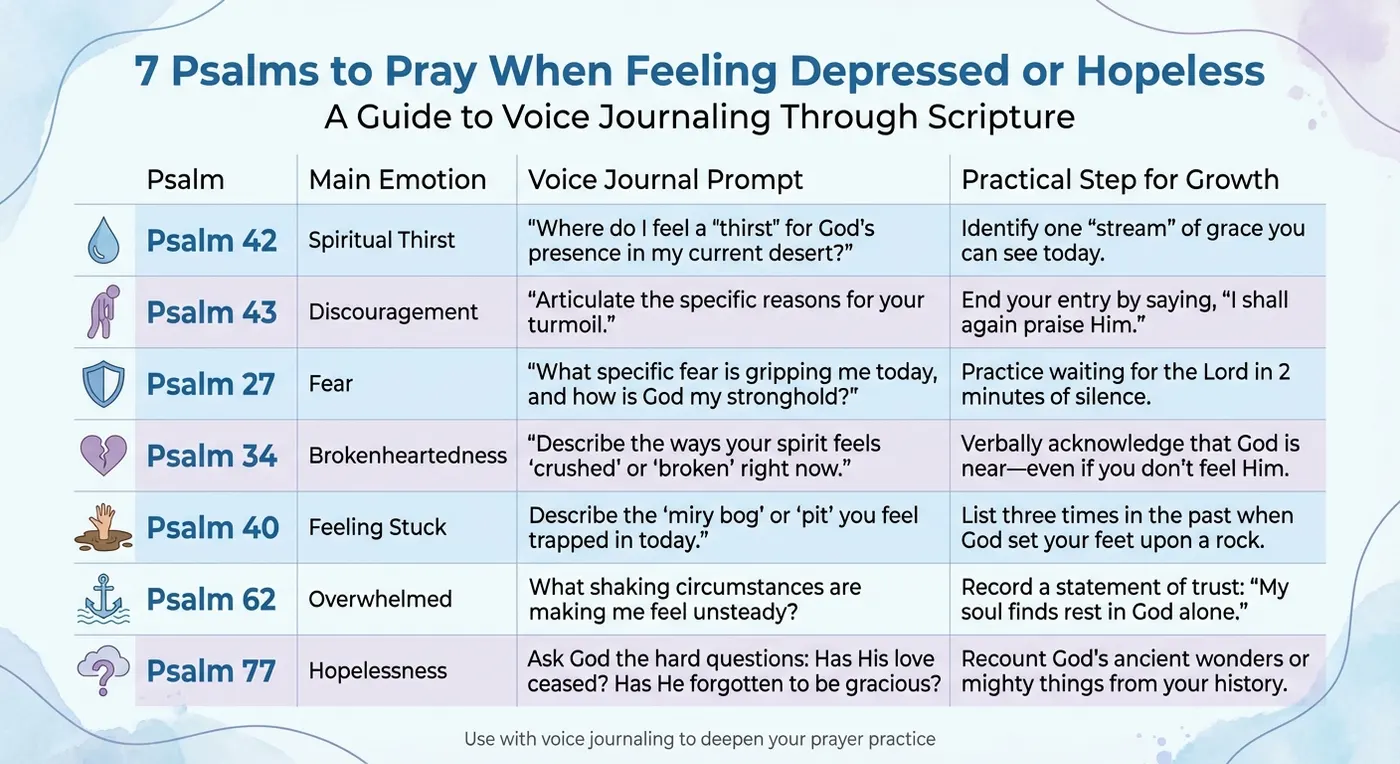
7 Psalms for Depression: Emotions, Prompts, and Practical Steps
Voice journaling offers a fresh way to connect with the emotional depth of the Psalms. It allows you to speak your sorrow directly to God, following the biblical example of expressing desperation and hopelessness through prayer [56, 64]. When grief leaves you feeling wordless, voicing your prayers aloud becomes a powerful outlet for genuine honesty. As Donald S. Whitney, Professor of Biblical Spirituality, puts it:
God gave the Psalms to us so that we would give the Psalms back to God.
The Psalmlog tool makes this practice even more accessible. Instead of flipping through Scripture, you can quickly scan five Psalms and choose one that resonates with your current emotional state. This approach deepens your prayer life while aligning with scripture-based reflection practices emphasized earlier. Using a microphone, you can speak your prayers with authenticity – no need to force joy or hide your struggles. God welcomes your raw questions and unfiltered truth. Interestingly, research indicates that speaking praise aloud can release chemicals that uplift both your spirit and body.
Below is a helpful table that pairs each Psalm with its main emotion, a voice journal prompt to get you started, and a simple step for personal growth. This builds on the emotional insights tied to each Psalm:
| Psalm | Main Emotion | Voice Journal Prompt | Practical Step for Growth |
|---|---|---|---|
| Psalm 42 | Spiritual Thirst | "Where do I feel a ‘thirst’ for God’s presence in my current desert?" | Identify one "stream" of grace you can see today. |
| Psalm 43 | Discouragement | "Articulate the specific reasons for your turmoil." | End your entry by saying, "I shall again praise Him." |
| Psalm 27 | Fear | "What specific fear is gripping me today, and how is God my stronghold?" | Practice waiting for the Lord in 2 minutes of silence. |
| Psalm 34 | Brokenheartedness | "Describe the ways your spirit feels ‘crushed’ or ‘broken’ right now." | Verbally acknowledge that God is near – even if you don’t feel Him. |
| Psalm 40 | Feeling Stuck | "Describe the ‘miry bog’ or ‘pit’ you feel trapped in today." | List three times in the past when God set your feet upon a rock. |
| Psalm 62 | Overwhelmed | "What shaking circumstances are making me feel unsteady?" | Record a statement of trust: "My soul finds rest in God alone." |
| Psalm 77 | Hopelessness | "Ask God the hard questions: Has His love ceased? Has He forgotten to be gracious?" | Recount God’s ancient wonders or mighty things from your history. |
Once you’ve spoken your prayers, take a moment to shift your focus. Redirect your thoughts toward God’s past faithfulness. A simple exercise, like the "napkin exercise", can help. Verbally list specific blessings from your day, month, or year – answered prayers, acts of kindness, or moments of love. This small pause helps you see how God has been present, even when His guidance feels invisible. Like a shepherd, He continues to lead, and this practice can help you recognize His steady hand in your life.
Conclusion
When you’re battling depression and hopelessness, even finding the words to pray can feel overwhelming. In those moments, the Psalms offer a voice for your pain and a reminder that you’re not alone – others have faced similar struggles and found their way through.
Incorporating these Psalms into your daily routine can provide the spiritual nourishment you need to face each day. One effective approach is the "Psalms of the Day" method: divide the 150 Psalms across 30 days, scan five specific Psalms each morning, and focus on the one that speaks to your current situation. This practice not only ensures regular engagement with Scripture but also helps you connect its timeless truths to your personal challenges.
Praying through these Psalms can shift your mindset, guiding you away from despair and toward God’s unwavering character and promises. Instead of letting negative thoughts dominate, you start speaking truth to yourself. As Pastor Kerry Shook puts it:
When I speak hope to my soul, I’m agreeing with the indwelling Holy Spirit who uses the authority of the eternal Word of God to declare the truth about my circumstances!
This shift in perspective ties prayer to reflection, creating a foundation of hope and resilience. Tools like Psalmlog can further support this process, allowing you to explore Psalms, voice your prayers with honesty, and track your spiritual growth during tough times. Features like voice journaling make it easier to express yourself authentically and stay connected to God’s Word.
God’s Word remains a source of true comfort and hope, and the Psalms are a gift to help you pray when words fail. With resources like the Faith Builder plan ($19.99/month), which includes 300 minutes of recording time, personalized AI journal insights, and access to common Bible translations, you can find additional support for your journey. Lean on these Psalms daily, speak them aloud, and let them guide you back to the God who never leaves His children.
FAQs
How can voice journaling deepen my prayer experience with the Psalms?
Voice journaling offers a heartfelt way to deepen your connection with the Psalms during prayer. Speaking your thoughts and emotions aloud can help you explore your feelings on a deeper level, bringing both clarity and comfort – especially during times of sadness or despair.
By recording these spoken reflections, you create a personal record of your spiritual journey. Over time, listening back to these recordings can reveal how your faith and perspective have evolved, making the Psalms feel even more personal and relevant to your life. If you’re new to voice journaling, you can begin by reading a Psalm aloud and then sharing your thoughts as though you’re having an open conversation with God. It’s a simple yet meaningful way to engage in prayer.
How can I use the messages in these Psalms to find hope and strength in daily life?
To bring the wisdom of the Psalms into your daily life, start by selecting a Psalm or verse that speaks to what you’re feeling right now – like Psalm 34 if you’re grappling with fear or Psalm 42 if you’re yearning for something deeper. Begin your day by reading it to help focus your mind and heart. You can take it a step further by memorizing a key verse or jotting it down to keep with you as a reminder throughout the day.
Let the words of the Psalm shape your prayers – ask God for guidance, courage, or strength through its message. Pay attention to moments where you sense His presence, whether it’s through an unexpected calmness or a simple act of kindness. At the end of the day, take a quiet moment to thank Him for the ways He was present and renew your trust in Him for the day ahead. These thoughtful practices can turn the Psalms into a wellspring of encouragement and wisdom that supports you every step of the way.
Why is it helpful to remember God’s faithfulness when you feel hopeless?
Reflecting on God’s faithfulness serves as a powerful reminder that the same God who guided and cared for His people in the past continues to work in our lives today. The Psalms often celebrate His goodness and protection, showing how He carried individuals through their darkest times – a testament to His unwavering care and dependability.
Looking back on answered prayers reassures us of His steadfast provision, helping us shift our focus from current challenges to His enduring presence. This perspective replaces despair with hope, encouraging us to pray with confidence, trusting fully in His ongoing help and guidance.