
Bible Verses for Healthcare Burnout
Scripture-based encouragement for healthcare workers to combat burnout and compassion fatigue with rest, strength, and renewal.
Feeling drained and overwhelmed by the demands of healthcare work? You’re not alone. Burnout and compassion fatigue are common struggles for healthcare professionals. The Bible offers comfort, guidance, and renewal through verses that remind you to rest, lean on God, and find strength beyond your own. Here’s a quick summary of 10 verses to help you regain energy and hope:
- Matthew 11:28-30: Jesus invites you to find rest and renewal in Him.
- Isaiah 40:29-31: God strengthens the weary and renews your spirit.
- 2 Corinthians 12:9-10: Your weakness is an opportunity for God’s power to work.
- Psalm 23:1-3: God provides peace and restores your soul.
- Galatians 6:9: Keep doing good; your efforts will bear fruit in time.
- Isaiah 41:10: God is with you, offering strength and support.
- Jeremiah 31:25: God refreshes and satisfies the weary soul.
- Nehemiah 8:10: The joy of the Lord is your strength.
- Hebrews 4:15-16: Jesus understands your struggles and offers grace.
- Psalm 103:2-5: Remember God’s blessings, love, and renewal.
These verses remind you that rest is essential, not selfish, and that God’s grace sustains you even in the most challenging moments. Keep these scriptures close to your heart and let them guide you toward peace and strength during your demanding workdays.
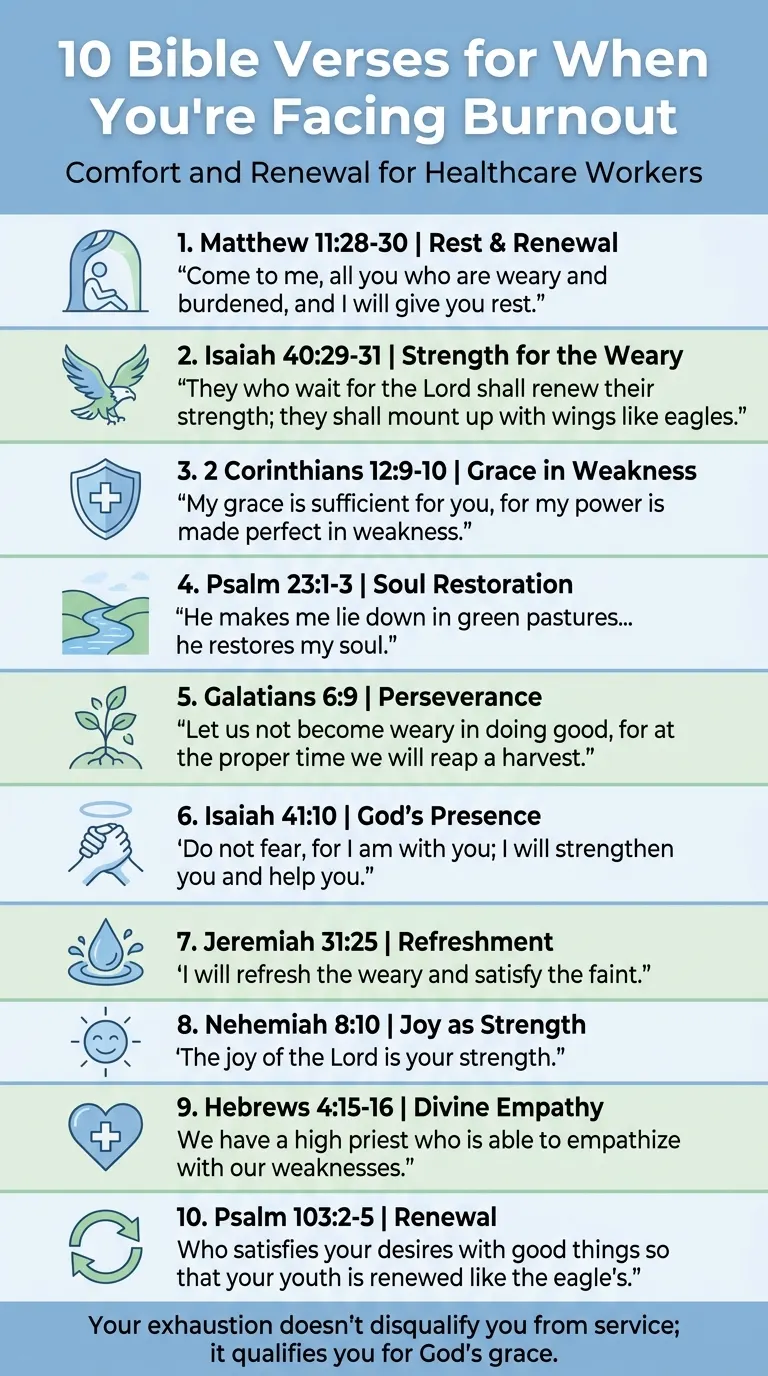
10 Bible Verses for Healthcare Workers Facing Burnout and Compassion Fatigue
5 Bible Verses to END Nurse Burnout NOW (God Renews Your Strength!)#nurses#jesus #motivationalvideo
1. Matthew 11:28-30 – Come to Me, All Who Are Weary
"Come to me, all you who are weary and burdened, and I will give you rest." – Jesus (Matthew 11:28, NIV)
This verse resonates deeply with healthcare workers who often face the dual challenges of physical exhaustion and emotional strain. Long shifts, difficult decisions, and the weight of patient care can leave you feeling drained. In these moments, Christ’s words offer more than just comfort – they provide a lifeline. His promise of rest isn’t just about physical relief; it’s about renewing your spirit and easing the burdens you carry.
The Message translation puts it this way: "Are you tired? Worn out? Burned out on religion? Come to me, and you’ll recover your life." This isn’t a demand for more effort but an invitation to find grace amid the chaos. Christ offers a lighter burden, one that brings strength rather than adding to your load.
You can live out this promise by weaving small moments of connection with God into your day. A quick prayer before starting rounds or a quiet pause during your break can serve as a reminder that self-care is a vital part of your mission. These brief but meaningful moments can help restore your energy and focus.
This scripture also affirms an important truth: taking care of yourself is not a sign of weakness or selfishness. It’s a necessary step that allows you to continue serving others with compassion and endurance. Recognizing your limits and stepping back when needed creates space for God’s strength to sustain you. Up next, see how another verse encourages you to find strength in unexpected places.
2. Isaiah 40:29-31 – He Gives Strength to the Weary
"He gives power to the faint, and to him who has no might he increases strength. Even youths shall faint and be weary, and young men shall fall exhausted; but they who wait for the Lord shall renew their strength; they shall mount up with wings like eagles; they shall run and not be weary; they shall walk and not faint." – Isaiah 40:29-31
Healthcare workers, no matter how resilient, often find themselves running on empty. This verse speaks directly to those moments when even the strongest feel drained. It’s important to understand that exhaustion isn’t a sign of failure – it’s simply part of being human.
God’s promise to "increase strength" for the weary reminds us that we don’t have to face these challenges alone. As Evang. Anabelle Thompson, Founder of Believers Refuge, puts it:
"Your exhaustion doesn’t disqualify you from service; it qualifies you for God’s grace."
The phrase "wait for the Lord" isn’t about giving up or standing still. Instead, it’s an invitation to lean on a source of strength far greater than your own. This kind of reliance can transform how you approach the demands of daily life.
The image of soaring "with wings like eagles" paints a powerful picture of rising above the chaos. It’s not about pushing through with sheer willpower but about finding renewal that goes deeper than physical rest. This kind of renewal comes when you step back, realign your focus, and allow God to replenish your spirit.
Acknowledging your limits isn’t a weakness – it’s a crucial step toward experiencing the strength God offers. Whether that means asking for support, taking a moment to pause, or simply turning to God in prayer, this openness can lead to a more sustainable rhythm of work and faith. By embracing this divine renewal, you’ll find the endurance to continue serving with both energy and purpose.
3. 2 Corinthians 12:9-10 – My Grace Is Sufficient for You
"My grace is sufficient for you, for my power is made perfect in weakness." – 2 Corinthians 12:9
This verse offers a profound reminder: vulnerability is not a flaw but a space where God’s power can shine. When you’re running on fumes after long shifts or feel overwhelmed by the demands of healthcare work, this passage reassures you that your weakness is not a sign of failure – it’s an opportunity for God’s strength to take over. Paul’s own struggles became a canvas for Christ’s strength to be displayed.
For healthcare workers, those moments of exhaustion and self-doubt are often when God’s grace becomes most tangible. You don’t have to mask your fatigue or pretend to have endless reserves of energy. As Evang. Anabelle Thompson, Founder of Believers Refuge, puts it:
"Acknowledging our limitations and dependence on God actually positions us to receive supernatural strength and renewal."
This verse redefines weakness, showing it as a doorway to strength. Paul’s declaration in verse 10, "For when I am weak, then I am strong", underscores that your value isn’t tied to how many tasks you complete or how tirelessly you work. Instead, it’s about leaning on God’s sufficiency.
Recognizing your limits isn’t giving up – it’s opening the door to divine help. Shifting from self-reliance to trusting in God transforms how you view burnout. It’s no longer a failure but an invitation to rest in His strength. Simple acts like setting boundaries, asking for assistance, or taking a break without guilt become ways to live out this truth. These choices not only honor your well-being but also prepare you to receive the renewal promised in the verses that follow.
4. Psalm 23:1-3 – He Restores My Soul
"The Lord is my shepherd; I shall not want. He makes me lie down in green pastures. He leads me beside still waters; he restores my soul." – Psalm 23:1-3 (ESV)
This passage provides a comforting reminder for healthcare workers: while you tirelessly care for others, God is caring for you. As you strive to ensure others "shall not want", this verse reassures you that your own emotional and spiritual needs are being met.
The imagery of "green pastures" and "still waters" symbolizes a sanctuary – a place of peace and renewal that goes beyond physical rest. When the weight of trauma, loss, or exhaustion starts to drain your emotional reserves, this verse offers a promise of spiritual restoration, helping you regain strength from within.
Interestingly, the Shepherd doesn’t just suggest rest – He commands it. This reframes rest as a necessity, not a luxury. Ruth Ellison, Mentor and Author, captures this beautifully:
"In fast-paced settings, rest can feel out of reach. But this psalm reminds us that God cares for caregivers, too."
Incorporating this verse into your daily routine can be simple yet meaningful. Try these ideas: use breath prayers during handwashing – inhale with "The Lord is my shepherd" and exhale with "He restores my soul." Keep Psalm 23:3 visible on your badge reel or phone lock screen as a gentle reminder. Take a brief five-minute pause as your "green pasture" to reset during a busy shift. Or, before stepping into a patient’s room, quietly ask the Shepherd to "lead you beside still waters."
Psalm 23 not only comforts but also encourages you to claim moments of rest, even in the most demanding circumstances. This promise of renewal prepares the heart for the encouragement found in the next verse.
5. Galatians 6:9 – Let Us Not Become Weary in Doing Good
"Let us not become weary in doing good, for at the proper time we will reap a harvest if we do not give up." – Galatians 6:9 (NIV)
Galatians 6:9 offers encouragement to healthcare workers who face long hours, difficult situations, and emotional exhaustion. In 2022, 46% of healthcare workers reported experiencing burnout – a sharp rise from 32% in 2018. If you’re feeling overwhelmed, know that you’re not alone. This verse acknowledges the toll that caring for others can take, while also offering hope and a promise of reward.
Every act of kindness and care is like planting a seed, and this verse reminds us that those seeds will eventually yield a harvest. Dr. Angie Mickle, Dean of the School of Nursing at Cedarville University, reflects on this reality:
"After 30 years of nursing, I can boldly state that serving on the frontlines is laborious and that the journey can become wearisome".
The "harvest" might not always be immediate or obvious – it could be in the lives you touch, the growth of your own character, or even rewards you may not fully understand until later.
Endurance doesn’t come solely from pushing yourself harder; it comes from leaning on the Holy Spirit. When your energy feels depleted, let the Spirit provide the strength, patience, and compassion that go beyond human limits. This isn’t about forcing yourself to give more but allowing divine love to work through you when you feel you have nothing left.
There are also practical ways to sustain yourself. Incorporate small moments of spiritual renewal into your day, even during a busy shift. Set boundaries to protect your well-being – you can’t carry every burden alone. When discouragement creeps in, shift your focus from the immediate struggles to the promise of a future harvest. Remember, no act of love done in Christ’s name is ever wasted.
To keep this promise close, consider placing this verse somewhere you’ll see it often – your phone’s lock screen, your locker, or even your badge reel. When exhaustion or feelings of being unappreciated set in, let it remind you that your efforts are meaningful and the harvest will come in time.
6. Isaiah 41:10 – Do Not Fear, for I Am with You
"So do not fear, for I am with you; do not be dismayed, for I am your God. I will strengthen you and help you; I will uphold you with my righteous right hand." – Isaiah 41:10 (NIV)
Isaiah 41:10 offers a powerful message for those facing intense stress, particularly healthcare workers who deal with heavy caseloads, staff shortages, or the emotional toll of patient loss. This verse follows earlier promises of rest and renewed strength, directly addressing the fear and uncertainty that can arise during demanding shifts. In moments of chaos – when every second seems to bring a new challenge – this reassurance reminds you that you are never alone.
The phrase, "I am with you," emphasizes that God is not distant or detached but is present and actively involved in your struggles. By declaring, "I am your God," the verse establishes a relationship where your burdens become His concerns. This shifts the weight of responsibility, offering you a sense of relief and support.
The word "strengthen" (from the Hebrew amats) conveys the idea of being given courage and resilience, especially when you feel drained. "Help" (from azar) and the image of God’s "righteous right hand" reinforce His dependable and active support during the most overwhelming moments.
This verse also serves as a reminder to separate your identity from the outcomes of your work. Whether it’s a tough diagnosis or a professional setback, it encourages you to focus on God’s presence rather than letting external circumstances define you. Instead of carrying every burden alone, this promise invites you to seek divine help – even for the small details of your day. It also reassures you that taking breaks or resting isn’t a weakness but a chance to allow God’s strength to work through you.
Consider keeping this verse close – write it down and place it in your workspace or memorize it. Speaking it aloud during difficult moments can help steady your heart and mind. This promise of God’s presence and sustaining support can be a source of peace and strength throughout your day.
7. Jeremiah 31:25 – I Will Refresh the Weary
"I will refresh the weary and satisfy the faint." – Jeremiah 31:25 (NIV)
Jeremiah 31:25 offers a profound message of hope and restoration, especially for healthcare workers who often face exhaustion from overwhelming caseloads, emotional strain, and the challenges of patient care. This verse promises a replenishment that goes beyond physical rest – it speaks to a deep, soul-level renewal that only divine grace can provide. The Hebrew word rawah, meaning "to be saturated", paints a vivid picture of relief, like the sensation of cool water quenching a parched throat.
This promise resonates with those who feel they are merely surviving rather than thriving. The verse acknowledges both the "weary soul" and the "languishing soul", affirming that God’s care extends to every aspect of exhaustion, whether physical, emotional, or spiritual. It reframes burnout not as a personal shortcoming but as an opportunity to experience God’s renewing grace. In this light, our human limitations become a space where divine strength can take root.
To live out this promise, consider shifting your understanding of refreshment. Instead of viewing it as an occasional break, see it as a daily practice of connecting with God. Carve out intentional moments for prayer and reflection on Scripture, allowing these spiritual pauses to restore the emotional reserves that human effort alone cannot replenish. These intentional times of connection can renew your strength, enabling you to continue caring for others with a refreshed heart.
8. Nehemiah 8:10 – The Joy of the Lord Is Your Strength
"Do not be grieved, for the joy of the Lord is your strength." – Nehemiah 8:10 (NIV)
Nehemiah 8:10 offers a profound reminder: joy is not just a fleeting emotion but a vital source of strength. For healthcare workers who often face emotional and physical exhaustion, this verse provides a much-needed lifeline. In its original setting, the Israelites were overcome with grief, but they were encouraged to set aside their sorrow and celebrate because the day was holy. This moment teaches us that joy and a sense of purpose can coexist. Joy isn’t a distraction from your work – it’s an essential part of sustaining your mission, even when the burden feels heavy.
This verse paints joy as a kind of shield, offering protection against despair. Unlike temporary happiness, the joy of the Lord is anchored in God’s unwavering character and His love for you. Your strength doesn’t depend on your own energy but on God’s boundless joy. Interestingly, modern research supports this idea: positive emotions enhance problem-solving and decision-making, which are crucial in high-pressure medical environments. This deep, enduring joy not only strengthens you personally but also fuels acts of kindness and compassion.
Kindness, in turn, strengthens communities. For healthcare teams grappling with staff shortages and demanding workloads, small gestures – like words of encouragement or sharing resources – can make a big difference. Studies in social neuroscience reveal that communal acts of gratitude and celebration boost dopamine and oxytocin levels while lowering cortisol, the hormone linked to stress.
To live out this verse, shift your focus from what drains you to the joy God takes in you. As Evang. Anabelle Thompson, Founder of Believers Refuge, puts it:
"Your exhaustion doesn’t disqualify you from service; it qualifies you for God’s grace".
You can also practice social generosity by reaching out to a colleague who might be struggling or simply sharing a meal. Remember, the call to "eat what is rich and drink what is sweet" is not just a suggestion – it’s a reminder to pause, celebrate, and renew yourself in God’s grace. Let your exhaustion signal the need to embrace His sustaining joy.
9. Hebrews 4:15-16 – We Have a High Priest Who Sympathizes
"For we do not have a high priest who is unable to empathize with our weaknesses, but we have one who has been tempted in every way, just as we are – yet he did not sin. Let us then approach God’s throne of grace with confidence, so that we may receive mercy and find grace to help us in our time of need." – Hebrews 4:15-16 (NIV)
This verse offers a comforting truth for those navigating tough moments or reflecting on difficult experiences: Jesus understands. He knows what it means to feel drained, worn out, or overwhelmed. As someone who experienced the full range of human struggles – yet remained sinless – He stands as a source of divine empathy. His understanding of human frailty, including the need for rest, reassures us that feeling weak isn’t a failure but a shared part of being human.
The invitation here is clear: approach God’s throne boldly and without hesitation. That confidence isn’t about being perfect or having it all together – it’s about trusting in His willingness to meet you where you are. The verse highlights two gifts available in these moments: mercy for the mistakes of the past and grace to carry you through the present.
Evang. Anabelle Thompson, Founder of Believers Refuge, captures this beautifully:
"The biblical model for sustainable service includes rest, community support, and regular renewal."
Recognizing your limits isn’t a weakness; it’s a step toward the renewal God offers. Bring your exhaustion to Him, knowing that His response is full of understanding and grace. Your weariness isn’t a barrier – it’s the very thing that makes you eligible for His sustaining strength.
10. Psalm 103:2-5 – Forget Not All His Benefits
"Praise the LORD, my soul, and forget not all his benefits – who forgives all your sins and heals all your diseases, who redeems your life from the pit and crowns you with love and compassion, who satisfies your desires with good things so that your youth is renewed like the eagle’s." – Psalm 103:2-5 (NIV)
When life feels overwhelming and your energy is drained, it’s easy to lose sight of what restores and sustains you. This passage highlights powerful blessings to hold onto: forgiveness, healing, redemption, love, compassion, and renewal. For healthcare workers, who spend their days pouring into others, the assurance that God "heals all your diseases" is a vital reminder to care for themselves as well.
The image of youth being "renewed like the eagle’s" goes beyond poetic beauty – it offers a promise of strength that endures, even when your own reserves feel depleted. This verse encourages you to remember God’s sustaining grace, especially during the most demanding moments of your work.
The call to "forget not" is an invitation to intentionally reflect on these blessings throughout your day. To make this practical, try keeping this verse in a place where you’ll see it often – on your badge reel, in your phone’s notes, or even taped to your workstation. Use ordinary pauses in your routine, like washing your hands, waiting for medications, or finishing up charting, as moments to meditate on these truths. Diane McCroskey, an ICU nurse and educator, captures this sentiment perfectly:
"Scripture is the essential element to keep a nurse’s life firmly on the rock of Jesus Christ in the midst of the storms life and death in healthcare."
When your compassion feels stretched thin, let this verse remind you that being crowned with love and mercy means divine renewal is always available. Your moments of weariness are an opportunity for God’s grace to replenish you.
Conclusion
These verses are meant to be lived out, offering you a steady foundation when you’re feeling drained. Incorporating Scripture into your day doesn’t require much time. Whether you’re washing your hands between patients, waiting for lab results, or wrapping up charting, these small pauses can become moments of spiritual refreshment.
Evangelist Anabelle Thompson, Founder of Believers Refuge – which reaches over 76,000 monthly readers as of April 2026 – shares this powerful reminder:
"Your exhaustion doesn’t disqualify you from service; it qualifies you for God’s grace."
This perspective shift is so important: your weariness isn’t a sign of failure but an acknowledgment of your need for divine strength. By embracing your limitations and turning to Scripture, you follow the example of Jesus, who often sought solitude and prayer to renew His spirit. Now, let’s consider how to incorporate these scriptures into your everyday routine.
To make these verses part of your day, keep one or two "anchor" passages within easy reach – on your badge reel, saved in your phone, or even taped inside your locker. These small habits can help Scripture remain a steady source of encouragement throughout your day. During shift changes, take a moment to say a quick prayer – for steady hands, for protection against discouragement, and for the ability to rest without guilt. As David, Founder of Devotion Nest, reminds healthcare workers:
"Feeling tired or overwhelmed does not mean weakness – it shows a heart that truly cares."
Let these verses ground you, turning even the busiest moments into opportunities for renewal, no matter how challenging your workday might be.
FAQs
How can I tell burnout from compassion fatigue?
Burnout and compassion fatigue may seem similar, but they are distinct challenges, especially in demanding fields like healthcare. Burnout develops from enduring workplace stress, often characterized by emotional exhaustion, detachment, and a sense of reduced achievement. On the other hand, compassion fatigue results from the emotional strain of consistently caring for others, leading to empathy depletion and even emotional numbness.
Understanding these differences is crucial. It allows healthcare professionals to tackle each issue effectively, using approaches such as prioritizing self-care and seeking opportunities for spiritual renewal to restore balance and well-being.
What are quick ways to use these verses during a busy shift?
Here are some simple ways to incorporate these Bible verses into your day, even during a hectic shift:
- Commit key verses to memory, such as Matthew 11:28-30, so you can reflect on them whenever you need a moment of peace.
- Jot down verses on small cards or sticky notes and tuck them into your pocket or badge holder for quick inspiration throughout the day.
- Take a short pause during tough moments to silently recite or meditate on verses like Isaiah 41:10, offering comfort and a sense of renewal.
When should I seek professional help, not just spiritual support?
If burnout, emotional exhaustion, or compassion fatigue continue even with spiritual support, it’s important to seek professional help. Similarly, if you’re dealing with symptoms like depression, anxiety, or thoughts of self-harm, reaching out to a mental health professional can make a significant difference. Early intervention ensures you receive the care and guidance necessary to navigate these challenges effectively.