
What the Bible Says About Self-Care and Mental Health
Biblical principles for rest, prayer, and caring for body and mind, plus practical steps and community resources for faith‑based mental health.
The Bible encourages self-care as a way of honoring God by taking care of the body, mind, and soul. It emphasizes rest, renewal, and reliance on God through practices like prayer, reflection, and community support. Key teachings include:
- Rest is a gift from God: Jesus invites us to find rest in Him (Matthew 11:28-30), showing that physical and spiritual renewal are essential.
- Caring for your body is stewardship: Treat your body as the "temple of the Holy Spirit" (1 Corinthians 6:19-20), meeting basic needs like sleep, nutrition, and exercise.
- Mental health matters: The Bible acknowledges struggles like anxiety and offers tools like prayer, Scripture meditation, gratitude journaling, and casting worries on God (1 Peter 5:7).
- Faith-based self-care equips us to serve: Jesus modeled rest and prayer to recharge and serve others effectively.
Practical steps include building a prayer routine, prioritizing rest, releasing burdens to God, and seeking support from a Christian community. This often involves balancing vulnerability and strength in your walk with Christ. Tools like Psalmlog, a faith-based journaling app, can help integrate these practices into daily life for $19.99/month.
Taking care of yourself isn’t selfish – it’s a biblical principle that prepares you to love and serve others more fully.
What Does The Bible Say About Self Care? | Christian Counseling
Bible Verses on Rest and Renewal
The Bible doesn’t just talk about rest as a nice-to-have; it portrays rest as a core part of God’s plan for living well. These verses show how rest is both an invitation from God and a practical way to recharge mentally, emotionally, and spiritually.
Matthew 11:28-30: Jesus’ Invitation to Rest
Jesus offers an invitation to those feeling weighed down by life’s demands, promising "rest for your souls." This isn’t just about physical rest – it’s a deeper kind of renewal that touches every part of your being, even when life feels overwhelming.
In biblical times, a yoke was a wooden tool that allowed two oxen to share a load. Jesus describes His yoke as "easy", meaning it’s kind and supportive. Unlike the burdens of today – like perfectionism, people-pleasing, or the constant hustle – Jesus offers a partnership where He helps carry the weight. As Joel Min puts it, "Jesus doesn’t remove responsibility. He removes the crushing weight of carrying it alone."
Rest, according to Jesus, isn’t something you earn; it’s a gift. Dr. Michelle Bengtson, a neuropsychologist, explains it this way: "Jesus showed us that rest isn’t laziness; it’s obedience." To embrace this kind of rest, start by identifying the burdens you’re carrying – whether that’s impossible deadlines, the need to meet others’ expectations, or constant performance pressure – and exchange them for Christ’s lighter yoke through prayer.
Psalm 23: Restoration for the Soul
Psalm 23 paints a picture of God as a Shepherd who takes care of every need. The opening line, "The Lord is my Shepherd, I shall not want", reminds us that when God leads, we lack nothing. It’s a call to shift our focus from self-reliance to trusting in His care.
True rest begins with letting go of control. The psalm describes God leading His people to "lie down in green pastures", showing that real renewal happens when we follow His guidance instead of trying to manage everything ourselves. Sarah Frazer, a Bible study mentor, points out, "God’s rest is not something we strive for when we ‘get away.’ His rest is for us in the mess of the middle of our lives."
Even in life’s darkest moments – the "valley of the shadow of death" – God’s presence calms our fears. Instead of tackling your daily to-do list alone, invite God into your plans. Trust that He will provide the moments of rest you need, helping you weave His guidance into your routines while also encouraging practical self-care.
Mark 1:35: Jesus’ Practice of Rest and Prayer
Mark 1:35 gives us a glimpse into Jesus’ routine: He woke up early, while it was still dark, and went to a quiet place to pray. This shows the importance of setting boundaries to protect your mental, emotional, and spiritual health. Even though Jesus was divine, He modeled the human need for solitude and connection with God before facing the demands of the day.
This verse highlights that rest and prayer aren’t things that happen by accident – they require carving out intentional time. Jesus didn’t wait for the perfect moment; He created it. Dr. Michelle Bengtson points out, "Jesus, the Son of God Himself, modeled this kind of rest. If He prioritized renewal, shouldn’t we?"
To follow this example, consider setting up a dedicated quiet space – maybe a room, a cozy chair, or even your car – where you can regularly step away from distractions. M. Wells, a mental health expert, reminds us, "Rest is an act of faith – it’s trusting that God will take care of what you leave undone." This intentional pause isn’t just about recharging; it’s a disciplined way to reconnect with God and renew your spirit daily.
Biblical Answers to Anxiety and Fear
Anxiety touches everyone at some point, regardless of their beliefs, but the Bible offers guidance for releasing fear and finding steadiness during life’s trials.
1 Peter 5:7: Giving Your Worries to God
The Greek word used here suggests an active process of handing over your burdens to God. When Peter wrote these words, he was addressing early Christians who faced Roman persecution and social alienation. His instruction wasn’t just poetic; it was a practical way to navigate uncertain and frightening times.
Holding onto anxiety can stem from pride, as it reflects a belief that we must solve everything on our own. Biblical scholar Thomas R. Schreiner explains:
Worry is a form of pride because when believers are filled with anxiety, they are convinced that they must solve all the problems in their lives in their own strength. The only god they trust in is themselves.
By casting your worries on God, you acknowledge your limitations and trust in His care. This act of surrender is a way to humble yourself before Him.
To practice this, bring each specific worry to God in prayer, affirming truths like, "He is with me," "He will sustain me," and "He cares for me." If the burden feels overwhelming, lean on your Christian community for support. This approach helps shift your focus from fear to faith, paving the way to embrace God’s strength as described in Isaiah 41:10.
Isaiah 41:10: God’s Strength in Difficult Times
Isaiah 41:10 was written for Israelites in exile, reminding them that God’s promises shine brightest in times of crisis. The command "do not fear" isn’t about denying emotions but rests on God’s character and His promise, "I am with you." His "righteous right hand" symbolizes strength, authority, and unwavering justice, assuring His support.
God provides clarity and endurance even in the toughest moments. Anne Peterson, an author and speaker, shared her experience of applying this verse during a nerve-wracking courtroom testimony in July 2019. Despite her fear, she visualized resting in God’s presence and softly sang to herself, replacing her anxiety with peace. This practice gave her the composure to face the situation.
You can apply this by imagining placing your fears into God’s hands. Pair this visualization with a prayerful walk to physically and spiritually connect with His strength. These small steps cultivate a sense of renewal and reinforce the importance of daily reliance on God.
2 Timothy 1:7: Rejecting Fear and Embracing Faith
Building on the themes in 1 Peter and Isaiah, 2 Timothy 1:7 encourages us to replace fear with God-given empowerment. This verse reminds us that fear doesn’t define us and isn’t part of God’s plan for our lives. Instead, He equips us with three tools: power, love, and a sound mind.
Brian J. Tabb, President and Professor of Biblical Studies at Bethlehem College and Seminary, explains:
The Spirit brings order to our scattered lives, awakens new desires to resist sin and to please God, and helps us to think and act with sobriety and wisdom.
The "spirit" here refers to the Holy Spirit, who empowers believers to overcome fear.
When fear arises, turn to prayer, as Peter did in Matthew 14:30. Speak specific promises from Scripture over your fears, much like Jesus did when He was tempted. Shifting your focus to serving others can also weaken fear’s grip. For example, if public speaking makes you anxious, start practicing in a small, supportive group. This gradual exposure builds courage and resilience.
Applying Biblical Self-Care in Daily Life
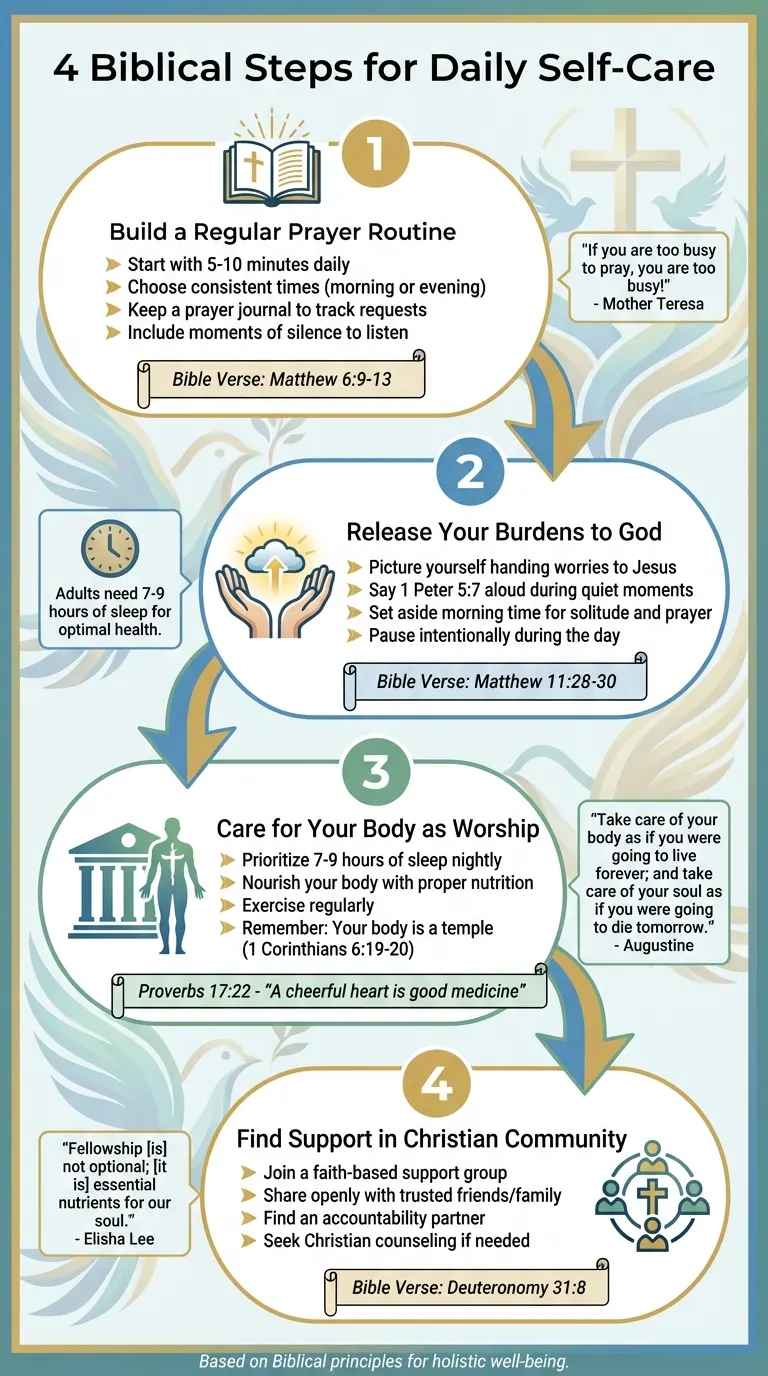
4 Biblical Steps for Daily Self-Care and Mental Health
Understanding biblical teachings is one thing, but making them a part of your daily life takes effort and intention. The practices below offer ways to turn the wisdom of Scripture into habits that nurture both your spiritual and mental health.
Building a Regular Prayer Routine
Jesus often withdrew to pray, showing us that connecting with God is essential, not optional. Start small – just 5–10 minutes a day – and gradually increase as it becomes a habit. To make it stick, choose consistent times, like early mornings before the day begins or evenings when things quiet down. Prayer doesn’t have to be confined to a specific time; you can incorporate it into everyday moments, like while commuting, cooking, or walking.
Keeping a prayer journal or list can help you track your requests and reflect on how God responds, strengthening your faith over time through Christian journaling best practices. Use Matthew 6:9–13 as a guide for heartfelt conversations with God, rather than a script to recite. You might also try a "concentric circles" approach to prayer: start with your personal needs, then expand outward to include family, community, and global concerns.
Mother Teresa famously instituted a daily "Holy Hour" of Eucharistic adoration for the Missionaries of Charity to sustain them during their demanding workdays. She said:
If you are too busy to pray, you are too busy!
Pastor Craig Groeschel also emphasizes the purpose of prayer:
The purpose of prayer isn’t to get God to do our will. The purpose of prayer is to know God so we can do His will.
Prayer is a two-way conversation, so include moments of silence to listen for God’s voice. Consider joining a prayer group or partnering with a friend for mutual encouragement and accountability. Once prayer becomes a regular part of your life, focus on giving your burdens to God.
Releasing Your Burdens to God
Jesus invites us in Matthew 11:28–30: "Come to me, all you who are weary and burdened, and I will give you rest." To live out 1 Peter 5:7, picture yourself handing your worries to Jesus, or say the verse aloud during quiet moments like walking or driving.
Guided prayers can help you verbalize surrender – ask God for wisdom to say "no" when needed and to shift your focus from achievements to your identity as His child. Set aside time each morning for solitude and prayer to center your mind and heart. Intentionally pause during the day, even if tasks are unfinished, to honor the principle of rest.
Caring for your body is also an act of worship. Adults generally need 7–9 hours of sleep each night to support brain function and immune health. Proverbs 17:22 reminds us, "A cheerful heart is good medicine" .
Augustine’s words capture the balance beautifully:
Take care of your body as if you were going to live forever; and take care of your soul as if you were going to die tomorrow.
Finding Support in Christian Community
Fellowship is as crucial for your spiritual and emotional well-being as prayer and rest. Christian community provides the encouragement needed to stay strong in faith. Elisha Lee, a counselor at Restoring You Christian Counseling, explains:
Fellowship [is] not optional; [it is] essential nutrients for our soul. They keep us connected to the source of our strength and hope, empowering us to navigate life’s challenges with grace and faith.
Jesus modeled the importance of community by surrounding Himself with others, balancing personal rest with shared support. By caring for yourself, you’re better equipped to serve and love others.
Joining a faith-based support group can offer mutual encouragement, and sharing openly with a small circle of trusted friends or family allows for prayer and emotional support. Accountability partners can help you stay consistent in practices like prayer and rest. If needed, seek professional help from Christian counselors who integrate biblical principles with mental health care.
When faced with criticism about prioritizing rest or self-care, lean on Scripture to affirm its importance. Eliza Huie, Director of Counseling at McLean Bible Church, highlights this truth:
Wisely caring for ourselves according to God’s Word enables us to effectively pour ourselves into the lives of others.
The Christian Journal echoes this idea:
Caring for yourself is not selfish: we are commanded to "love your neighbor as yourself", which presupposes that first we look after ourselves.
Deuteronomy 31:8 reassures us that God will never leave or forsake us. Likewise, biblical community means walking alongside one another, offering and receiving steadfast support as we grow in faith together.
Using Psalmlog for Faith-Based Self-Care

Let’s dive into how Psalmlog can help you weave Scripture into your self-care routine. This app brings biblical principles to life through voice journaling and tailored spiritual insights, offering a space to connect with God in your everyday moments. Inspired by Jesus’ practice of solitary prayer, Psalmlog provides a private sanctuary to “talk to God”.
Voice Journaling for Spiritual Reflection
There’s something transformative about speaking your thoughts aloud – it bridges your emotions with clarity of mind. Psalmlog’s voice journaling feature allows you to verbalize your fears, anxieties, and prayers, echoing the instruction in 1 Peter 5:7 to “cast all your anxiety on him”. By sharing your burdens out loud, you symbolically hand them over to God, fostering resilience and peace.
Whether it’s first thing in the morning or just before bed, journaling can help you quiet your mind and become more aware of God’s presence. Christine Wood, a counselor and author, emphasizes this connection:
Self-care is a biblical principle that is God honouring.
This practice also aligns with the biblical perspective of stewardship, reminding us that our minds and bodies are “temples of the Holy Spirit”. Regular reflection nurtures both spiritual and emotional well-being.
Scripture Tagging and AI-Powered Insights
Psalmlog doesn’t stop at journaling – it also offers AI-driven scriptural insights to support you around the clock, even during restless nights. The app suggests Bible verses tailored to your specific struggles, whether it’s fear, fatigue, or uncertainty. Studies reveal that engaging deeply with Scripture can reduce anxiety by 30% and cortisol levels (the body’s stress hormone) by 20%.
The app’s AI analyzes your journal entries and provides actionable advice based on Cognitive Behavioral Therapy (CBT), such as reframing negative thoughts or practicing calm responses to stress. This aligns beautifully with Hebrews 4:12:
For the word of God is alive and active. Sharper than any double-edged sword, it penetrates even to dividing soul and spirit… it judges the thoughts and attitudes of the heart.
Psalmlog offers a judgment-free space to pour out your heart while tracking your spiritual and emotional growth.
Making Biblical Wisdom Part of Your Daily Routine
Consistency is key to turning knowledge into transformation. Psalmlog helps you live out verses like Psalm 23 by encouraging moments of pause to enjoy God’s provision and renew your strength. For $19.99/month, the Faith Builder plan includes 300 minutes of recording time, personalized AI insights, and access to all Bible translations – an affordable alternative to professional therapy.
You can establish a “Sabbath” rhythm by scheduling quiet moments for reflection, much like Jesus did when withdrawing from crowds. During these sessions, focusing on blessings or the beauty of creation can fill your heart with peace and joy.
Conclusion: Following God’s Design for Well-Being
God’s blueprint for well-being is straightforward, reflected in Jesus’ prayers, the Sabbath, and His invitation to hand over our anxieties to Him. Taking care of yourself, as the Bible encourages, means being a good steward of the body and mind God has entrusted to you.
Incorporating practices like regular rest and time for reflection equips you to serve others with renewed energy. When you take time to rest, immerse yourself in Scripture, and lay your worries before God, you’re better prepared to live out your purpose. Resting is an act of faith, a way of acknowledging that God is the one who sustains you.
Modern tools can complement these age-old practices. For example, Psalmlog offers a way to weave these habits into your daily routine. Whether you’re jotting down your fears in the stillness of the morning or meditating on God’s promises over a cup of coffee, the app provides a private space to process emotions and find personalized biblical insights. At $19.99 per month, it’s a practical way to bring biblical wisdom into your self-care habits.
Start small – set aside 15 minutes tomorrow morning for quiet prayer. Write down one specific worry, and consciously release it to God. Caring for yourself in this way aligns with Scripture’s call to honor the temple of your body and mind. Just a few moments of intentional prayer and surrender each day can refresh your spirit and prepare you to share God’s love more fully with others.
FAQs
Is self-care selfish in the Bible?
The Bible presents self-care not as selfish but as an essential part of stewardship over our body, mind, and spirit. This stewardship is seen as an act of obedience to God, allowing us to better serve and love others. Scripture highlights the importance of rest, setting healthy boundaries, and seeking renewal. Verses like 1 Corinthians 10:24 and 3 John 1:2 reflect this balance, showing that caring for yourself is integral to living faithfully and supporting others effectively.
What does the Bible say to do when I feel anxious?
The Bible offers valuable advice for navigating anxiety. In Philippians 4:6, believers are urged to pray with a heart of gratitude, bringing their concerns to God and trusting Him to grant peace. Similarly, Matthew 6:25-34 reassures readers not to stress over daily necessities, emphasizing that God, who cares for all creation, will meet their needs. The Psalms provide further encouragement, as David often turned to God during times of distress, demonstrating deep trust in His protection and authority.
How can I build a simple daily prayer routine?
To create a meaningful daily prayer routine, start by acknowledging your identity as part of God’s creation, as highlighted in Psalm 139:14: "I praise you because I am fearfully and wonderfully made." Choose a consistent time each day and find a quiet space where you can focus, following Jesus’ example of seeking solitude for prayer (Mark 6:31).
Begin your prayer with gratitude, thanking God for His blessings. Incorporate Scripture, such as Psalm 23, to guide your thoughts and deepen your connection. Spend a few moments in silence, allowing yourself to listen for God’s voice and guidance. Conclude your prayer by expressing trust in Him, asking for His peace and strength to renew your spirit.