
How to Study the Bible for Deep Transformation, Not Just Information
Move beyond surface reading—use prayer, HEAR or SOAP, voice journaling, and meditation to let Scripture reshape your heart, choices, and daily life.
Studying the Bible isn’t just about learning facts or completing a routine. It’s about allowing Scripture to reshape your heart, decisions, and daily life. Many people struggle to move beyond surface-level reading, missing the life-changing potential of God’s Word. This guide offers practical steps to help you engage deeply with Scripture for true transformation:
- Start with Prayer: Ask for guidance, confess distractions, and prepare your heart.
- Use the HEAR Method: Highlight key verses, explain their meaning, apply lessons to your life, and respond with action or prayer.
- Try the SOAP Technique: Focus on Scripture, make observations, apply insights, and pray for change.
- Leverage Tools: Apps like Psalmlog enhance your study with voice journaling, sentiment tracking, and AI insights.
- Focus on Small Sections: Choose 4-7 verses that address your current challenges or emotions.
- Meditate and Reflect: Repeat verses aloud and explore their deeper meanings through verse mapping.
Transforming your life through Scripture requires intentionality, reflection, and action. By combining structured methods like HEAR or SOAP with tools like Psalmlog, you can deepen your connection to God’s Word and see lasting change in your spiritual journey.
Preparing Your Heart and Tools for Transformational Study
Start with Prayer and Clear Intentions
Begin your study with prayer, inviting the Holy Spirit to guide your understanding. This step sets the tone for transformation, as you seek divine insight into the text. Psalm 119:18 provides a beautiful example of this approach:
"Open my eyes, that I may behold wondrous things out of your law."
Take a moment to confess any sins or let go of distractions. Joyce Meyer emphasizes that consistent study is key to spiritual growth. The goal isn’t just to gather knowledge but to allow Scripture to shape you. Even finding a quiet space matters – Jesus often withdrew to solitary places to pray (Mark 1:35), away from distractions like those we face today.
Once your heart is ready, it’s time to organize your tools for deeper engagement.
Set Up Psalmlog for Voice Journaling
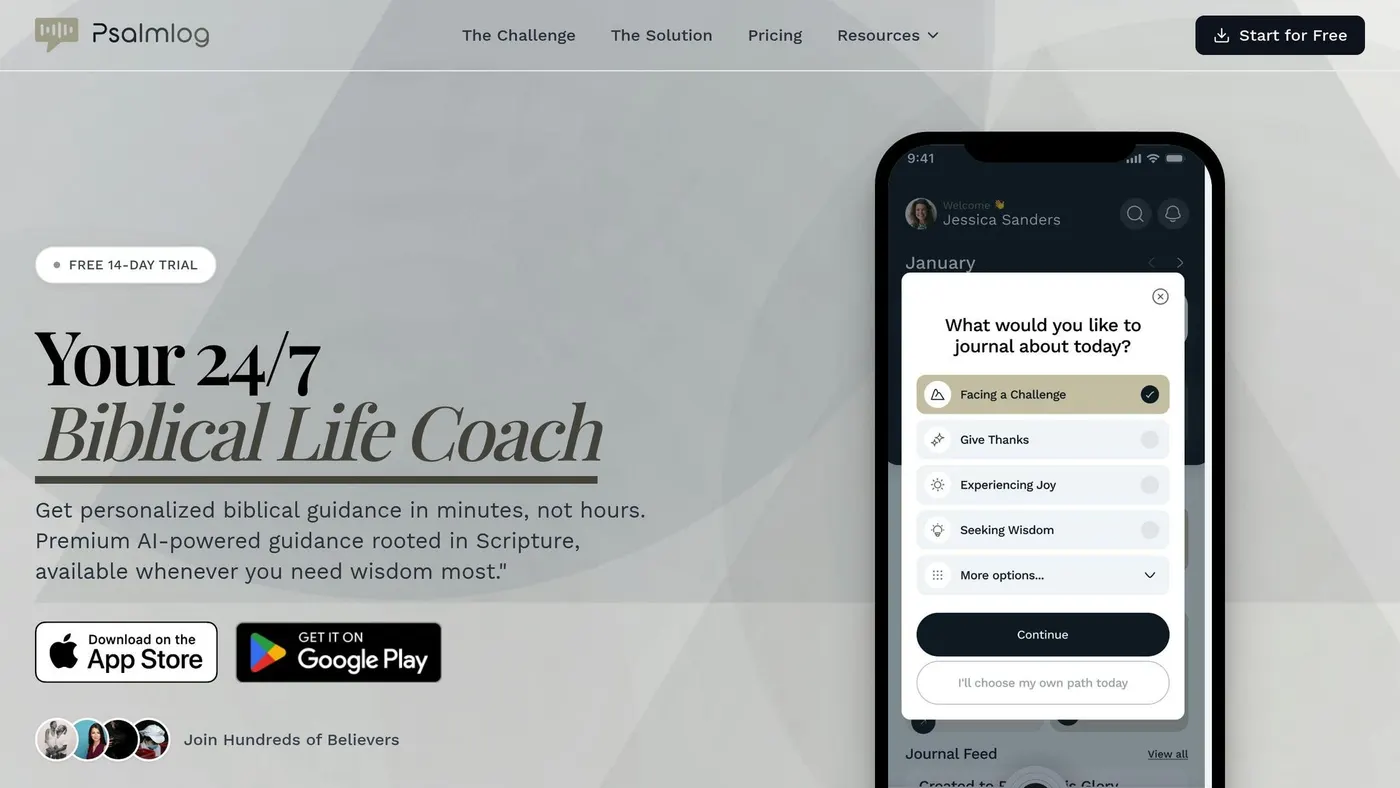
After preparing your heart, use Psalmlog’s voice journaling feature to capture your reflections immediately after reading. Speaking Scripture aloud not only helps you retain it but also engages multiple parts of your brain, making the experience more impactful.
With Psalmlog, you can tag scriptures for easy reference and use the app’s sentiment analysis to track your spiritual growth. For $19.99 per month with the Faith Builder plan, you’ll have access to 300 minutes of recording time, personalized AI insights, and all Bible translations. These tools help you move beyond simply reading the text to deeply reflecting on it.
Now, it’s time to focus on passages that resonate with your current situation.
Choose Passages That Match Your Current Needs
With your heart prepared and your journaling tool ready, select scriptures that align with what you’re facing in life. A concordance can help you find verses addressing emotions like anger, fear, or hope.
Choose shorter sections – 4 to 7 verses – to allow for deeper meditation rather than rushing through a longer passage. For emotional comfort, Psalms can provide encouragement and healing. For practical guidance, Proverbs offers clear advice for daily living. As George H. Guthrie, Professor of New Testament, advises:
"Choose a passage that you can cover well in your designated period of time… Trying to study too large a section all at once will lead to frustration."
The aim is to dig deep into the text, not to cover as much ground as possible.
What is the Transformational Bible Study Method?
Using the HEAR Method for Voice Journaling
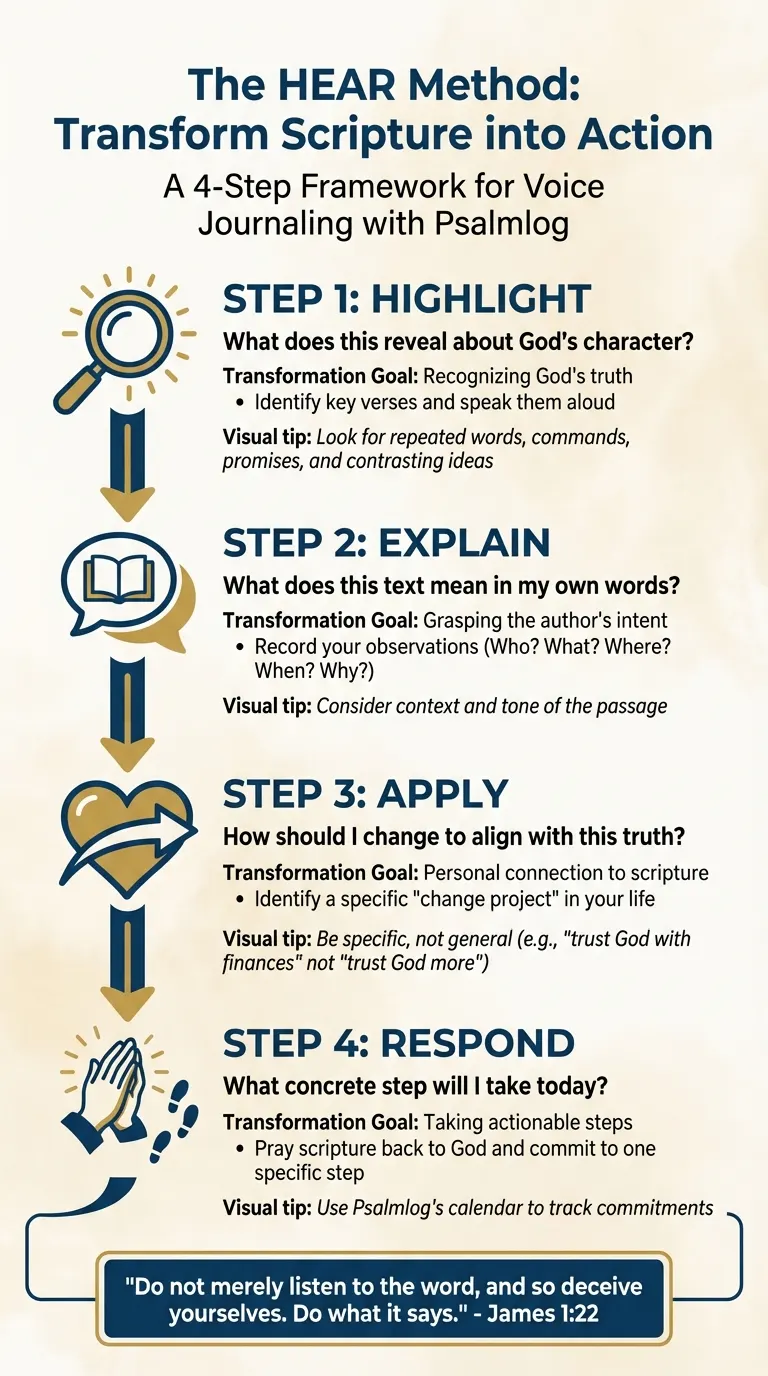
HEAR Method for Bible Study: 4-Step Transformational Framework
The HEAR method – Highlight, Explain, Apply, Respond – offers a structured way to move from simply reading scripture to applying it in meaningful ways. As S. Joseph Kidder points out, this approach transforms your Psalmlog voice journal into a tool for spiritual growth. Each step helps you go deeper: pinpointing key insights, interpreting their meaning, connecting them to your life, and committing to action. By combining your prepared tools and selected scripture, the HEAR method shifts journaling from passive reflection to active change.
Highlight: Identify Key Verses
Begin by reading your chosen passage and speak aloud the verses that stand out to you. Instead of silently reading, use Psalmlog’s voice recording feature to capture the verses that resonate most. Bible teacher Shannon Leibold describes this process as a "treasure hunt", where you uncover glimpses of God’s character within the text.
Pay attention to repeated words, commands, or promises that signal significance. For instance, in 1 Corinthians 13, the word "love" appears nine times in just 13 verses. Look for contrasting ideas, like light versus darkness or righteousness versus sin, which often highlight the central message of the passage.
As you record, ask yourself: "What does this reveal about God’s character?" Shift your focus from what the scripture says about you to what it reveals about Him. Tag the verses in Psalmlog for easy reference later.
Explain: Record Your Observations
Next, put the passage into your own words to deepen your understanding. This step moves beyond simple memorization. Use Psalmlog to answer basic questions: Who is involved? What’s happening? Where and when does it take place?
Drew Hunter, Teaching Pastor at Zionsville Fellowship, emphasizes the goal of this step:
"Our goal is to restate the author’s point in a way that he would agree with. Our goal is to say, Author, if I’m reading this correctly, here’s what you’re saying… and the author would respond, Yes, that’s exactly my point!"
Context is key here. Look at what happens before and after the passage to avoid misinterpreting its meaning. Note the tone – does Paul write with urgency or joy? Is the psalmist expressing despair or hope? Speaking these observations aloud not only reinforces your understanding but also creates a transcript in Psalmlog that you can revisit later.
Apply: Connect Scripture to Your Life
Think about how the passage challenges you to change. Be specific as you record your reflections with scripture in Psalmlog.
Identify a clear "change project" in your life. Instead of general statements like "I need to trust God more", get specific: "I struggle to trust God with my finances, especially when unexpected bills arise." Psalmlog’s AI insights and sentiment analysis can help you spot recurring themes in your journaling, revealing areas where God may be prompting you to grow. Remember, transformation takes time, and your voice journal becomes a record of this ongoing process.
Respond: Pray or Take Action
Wrap up by praying the scripture back to God and outlining one specific step of obedience. As James 1:22 reminds us, "Do not merely listen to the word, and so deceive yourselves. Do what it says."
Share how the passage has impacted you and ask for God’s help in living it out. For example, you might pray: "This week, when I feel anxious about money, I will pause and speak Philippians 4:19 aloud, reminding myself that God supplies all my needs."
Use Psalmlog’s calendar and tagging features to track your commitments. When you look back weeks later, you’ll see evidence of how God has been working in your life. Over time, this practice becomes a powerful testimony of how scripture is not just informing your mind but transforming your heart and actions.
| HEAR Step | Key Question to Record | Transformation Goal |
|---|---|---|
| Highlight | What does this reveal about God’s character? | Recognizing God’s truth |
| Explain | What does this text mean in my own words? | Grasping the author’s intent |
| Apply | How should I change to align with this truth? | Personal connection to scripture |
| Respond | What concrete step will I take today? | Taking actionable steps |
Using the SOAP Technique for Deeper Reflection
The SOAP method – Scripture, Observation, Application, Prayer – offers a thoughtful approach to engaging with the Bible on a deeper level. Originally developed by Pastor Wayne Cordeiro in 2007, this method encourages a more personal and reflective study. As S. Joseph Kidder, Professor of Christian Ministry at Andrews University, explains:
"The primary purpose of the Bible is not to communicate information but to change and transform us at the level of our hearts".
Unlike the HEAR method, which guides you through scripture step by step, SOAP allows you to pause and immerse yourself in each phase, giving space for the Holy Spirit to guide your reflection.
Scripture: Speak It Aloud with Psalmlog
Start by selecting a passage and reading it aloud into Psalmlog. Hearing your own voice repeat the scripture can serve as a form of meditation, helping the words settle deeply in your heart. Repeating the verse aloud enhances memorization and understanding, making the passage feel more personal.
Observation: Capture Key Insights
Once you’ve recorded the scripture, use Psalmlog to document your observations. Ask foundational questions like Who, What, Where, When, and Why to better understand the passage’s context. Pay attention to repeated words, contrasting ideas (like light versus darkness), and what they reveal about God’s character.
To dig even deeper, try the "Three Symbols" method: say "Lightbulb" to highlight new insights, "Question Mark" for areas that require further exploration, and "Arrow" for connections that feel personally relevant. Regularly reviewing these audio notes can help you identify recurring themes, and Psalmlog’s insights dashboard makes it easy to track these patterns over time.
Application and Prayer: Turning Insights into Action
This phase is where scripture becomes practical. Instead of making broad commitments, use the "SPACEPETS" framework: Is there a Sin to confess, Promise to claim, Attitude to change, Command to obey, Example to follow, Prayer to pray, Error to avoid, Truth to believe, or Something to praise God for?.
Psalmlog’s reflection tools can help you set specific, actionable goals, whether it’s forgiving someone, embracing a new habit, or adjusting your mindset. Wrap up by recording a heartfelt prayer, asking for the Holy Spirit’s guidance in living out these lessons. By making SOAP a daily practice, you can cultivate meaningful transformation in your spiritual journey.
Practicing Scripture Meditation and Verse Mapping with Voice
Building on the HEAR and SOAP methods, vocal meditation and verse mapping add practical ways to engage deeply with Scripture.
Vocal Repetition for Meditation
Meditating on Scripture goes beyond simply reading – it’s about intentional repetition. David Platt, Lead Pastor for McLean Bible Church, describes it this way:
"Memorization… involves repeating the Word over and over again in our minds, and sometimes with our mouths, until it becomes second nature".
With Psalmlog, you can record yourself reciting a verse multiple times, focusing on a different word or phrase each time. Reading the passage aloud two or three times helps you absorb its themes and layers of meaning. Listening to your recordings later can further deepen your understanding. This active process of vocal repetition takes Scripture from being just words on a page to something that resonates deeply within you.
Verse Mapping Through Voice Journaling
Verse mapping is a way to break down Scripture and uncover its deeper meanings. By identifying the subject, object, and connecting words (like "therefore", "but", "if", or "because") and asking aloud, “What does this word mean here?”, you can clarify the text’s purpose. Psalmlog’s transcription feature makes it easy to capture these spoken reflections, helping you create a detailed breakdown of the verse. This process enhances your understanding and strengthens your connection to the text.
Track Your Spiritual Growth with Psalmlog
Spiritual growth is a continuous process, as S. Joseph Kidder points out:
"Since character development is an ongoing experience, not a one-time event in the life of a believer, we should continually read the Bible for transformation".
Psalmlog’s insights dashboard lets you revisit past voice journals, making it easier to spot recurring themes and patterns in your reflections. These recordings not only provide encouragement during tough times but also give you a clear view of how your spiritual journey is evolving.
Conclusion: Transform Your Life Through Intentional Bible Study
Key Takeaways for Transformational Study
Studying the Bible intentionally isn’t just about gaining knowledge – it’s about reshaping your heart and mind. A deep dive into Scripture does more than fill your head with facts; it changes the way you live and think. Begin each study session with prayer, preparing your heart to receive what God wants to reveal. Using methods like HEAR and SOAP can help you consistently engage with Scripture, while Psalmlog’s voice journaling allows you to capture your reflections on the spot and track your spiritual growth over time.
While tools and techniques are helpful, the real power lies in asking meaningful questions: What does this teach me about God? What does it show me about myself? What needs to change in my life? By combining vocal repetition, verse mapping, and regular journaling with Psalmlog, you can unlock the transformative potential of Scripture (Hebrews 4:12). Psalmlog’s tools turn your reflections into a tangible record of your spiritual journey, helping you see how far you’ve come.
When you approach Bible study with these principles, the path to transformation becomes clearer.
Next Steps: Start Your Transformational Journey
Now that you know the process, it’s time to take the first step. You don’t need to make drastic changes all at once. Begin small: choose a passage, open Psalmlog, and record your first reflection. Use the HEAR or SOAP method to guide your thoughts, and speak honestly about how the Scripture is moving you. Most importantly, act on what you learn (James 1:22).
Transformation is a gradual process. Every time you journal, you’re taking another step forward in your spiritual growth. With Psalmlog’s Faith Builder plan at $19.99/month, you’ll have access to 300 minutes of recording time, personalized AI insights, and every Bible translation you need. It’s everything required to shift from simply learning Scripture to living it. Hit record and let the Holy Spirit shape your journey.
FAQs
How can I study the Bible in a way that transforms my life, not just adds knowledge?
To truly grow and change through Bible study, approach it as more than just an intellectual activity – see it as a deeply personal and spiritual journey. Begin by preparing your heart. Take a moment to pray, asking for guidance and a spirit of openness before diving into the text. As you read, pause to reflect on the passage. Ask yourself questions like: What does this teach me about God? and How can I apply this to my life today?
Take it a step further by internalizing what you’ve learned. Focus on key verses, meditate on them, and jot down your thoughts in a journal. Think about specific, practical actions you can take to live out the truths you’ve discovered. A framework like Meditate, Apply, Pray, Share (MAPS) can help keep you on track. When Bible study becomes a purposeful and relational practice, its wisdom has the power to influence your thoughts, guide your decisions, and shape your actions, fostering genuine growth and change.
How can voice journaling with Psalmlog enhance my Bible study experience?
Voice journaling with Psalmlog can take your Bible study to a whole new level by making it more heartfelt, reflective, and interactive. When you speak your thoughts out loud, you engage with scripture on a deeper level, creating an emotional and spiritual connection that goes beyond just reading. It also opens the door to honest self-expression, allowing for meaningful insights and personal growth.
Another great perk of voice journaling is its convenience. Whether you’re relaxing at home or on the move, you can easily record your reflections without needing to grab a notebook or pen. This flexibility makes it easier to stick with your study routine. Plus, listening back to these recordings over time can show you how your understanding and relationship with scripture have evolved, offering a beautiful way to track your spiritual journey.
What’s the difference between the SOAP and HEAR Bible study methods?
The SOAP method offers a straightforward and organized way to study the Bible, broken into four clear steps: Scripture (read a specific passage), Observation (identify key points and insights), Application (think about how the passage relates to your life), and Prayer (talk to God about what you’ve learned). This approach helps move from simply reading the text to reflecting on it and putting it into action.
Details about the HEAR method aren’t included in this context, so a side-by-side comparison isn’t possible here. However, if you’re familiar with the HEAR process, you might notice overlaps with SOAP’s emphasis on observation, application, and prayer.