
How to Apply Scripture to Your Life When You Feel Stuck
Move from spiritual stagnation to action: identify your struggle, focus on 2–3 scriptures, use SOAP voice journaling, and take one Bible-based step.
Ever feel like your prayers go unheard or that reading the Bible feels like a chore? You’re not alone. Many people experience spiritual ruts, where faith feels distant and emotions take over. The good news? You can break free by focusing on what you know from Scripture, not just what you feel. Here’s how to do it:
- Identify your struggle: Be specific about what’s weighing you down (e.g., fear, bitterness, exhaustion).
- Find relevant Bible verses: Choose 2-3 scriptures that directly address your challenge.
- Voice journal your reflections: Speak your thoughts aloud using the SOAP method (Scripture, Observation, Application, Prayer).
- Take one actionable step: Align your actions with biblical truths and track your progress.
Tools like Psalmlog can simplify this process by helping you find verses, organize reflections, and monitor growth. Feeling stuck isn’t the end – it’s an opportunity to reconnect with God and His Word.
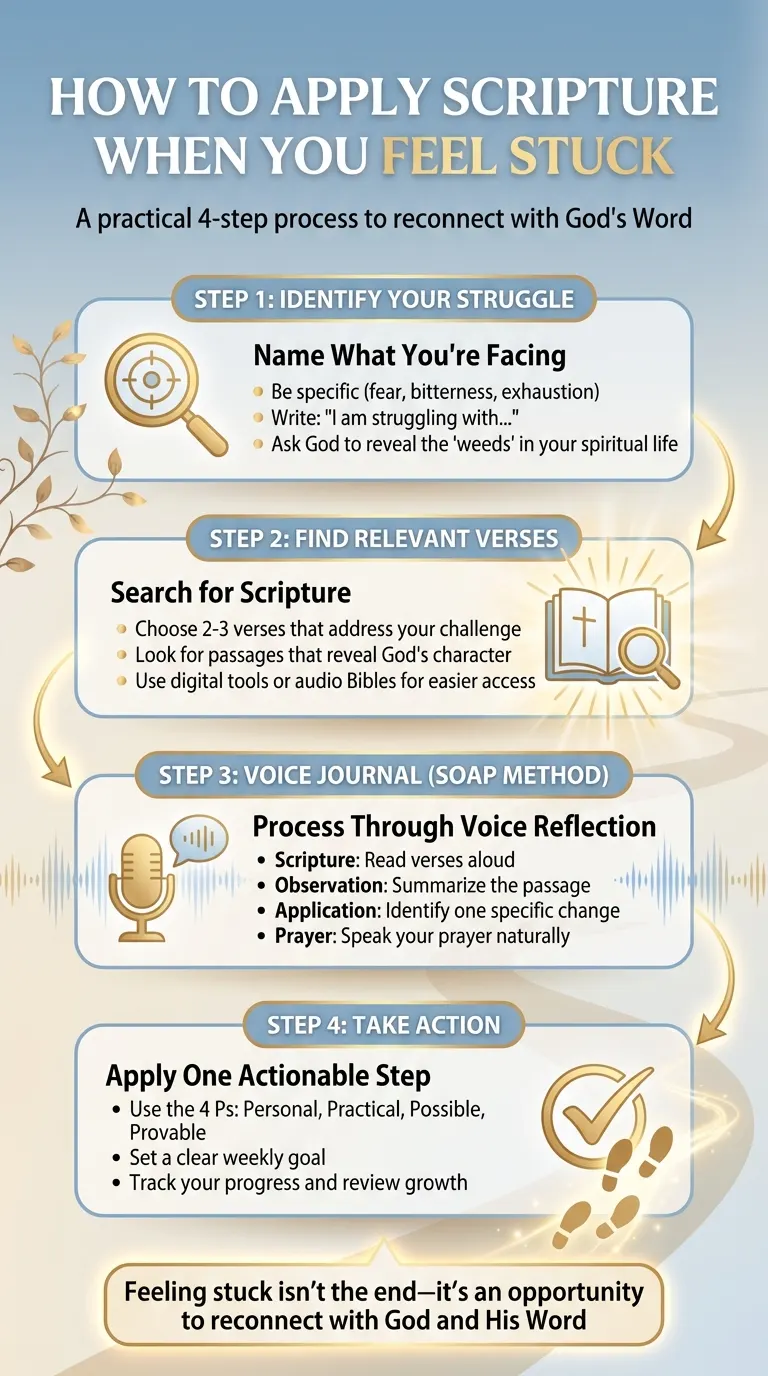
4-Step Process to Apply Scripture When Feeling Spiritually Stuck
Finding the Right Scripture for Your Situation
Name What You’re Struggling With
Before diving into the Bible, take a moment to pinpoint exactly what you’re dealing with. Vague feelings of spiritual disconnection won’t guide you to the right verses. Instead, focus on specific challenges – whether it’s fear, bitterness, exhaustion, or something else weighing on your heart.
Ask God to help you identify the specific "weeds" in your spiritual life. Is it the constant busyness that leaves no room for prayer? The false sense of security tied to money? Or perhaps a hidden anger about how things have unfolded in your life? As Pastor Rick Warren wisely says:
"Your life is the only one you can change. So your application will start with the word ‘I,’ not ‘we’ or ‘you’" [3].
Write down your struggle in one sentence, beginning with, "I am struggling with…" This keeps your focus personal and honest. Then, take some time to jot down your anxious thoughts. For each one, find a biblical truth to counter it. This practice helps shift your mindset from being consumed by emotions to standing on the solid foundation of God’s Word.
Once you’ve clarified your challenge, you can start exploring Scripture that directly addresses it.
Search for Bible Verses That Speak to Your Challenge
Now that you’ve identified your struggle, it’s time to search for Scripture that speaks to it. Ask yourself: What does this passage say about my situation? Does it offer a promise I can hold onto or a call to turn away from sin?. These questions help you dig deeper and connect the verses to your life in a meaningful way.
Using digital tools can make this process easier. For instance, Psalmlog’s voice-input feature lets you speak your struggle aloud and quickly access relevant passages without needing to type. Audio Bible apps are another great option – listening to Scripture during your commute or while doing chores can sometimes make a verse resonate even more deeply. When you come across passages addressing challenges like fear or pride, try personalizing the language to make it feel directly applicable to your life.
Once you’ve gathered a handful of relevant verses, narrow your focus to just a few that truly stand out.
Choose 2-3 Verses to Focus On
Avoid the temptation to collect a long list of verses. Instead, focus deeply on 2-3 passages that feel especially meaningful. Choose ones that are Personal, Practical, Possible, and Provable in relation to your specific struggle [3].
Look for verses that reveal God’s character or directly counter the lies you’ve been believing. For example, if you’ve been feeling forgotten by God, select verses that emphasize His faithfulness and perfect timing. Prioritize passages that point you back to Jesus, as these provide the ultimate foundation for lasting change.
These carefully chosen verses will serve as the cornerstone for your reflection, voice journaling, and next steps.
Using Voice Journaling to Process Scripture
Why Voice Journaling Works
Speaking your thoughts aloud does more than just organize ideas – it helps you process emotions on a deeper level. When you vocalize your reflections on Scripture, you’re not only working through your feelings in real time but also allowing the Spirit to guide your thoughts freely. This practice moves you from simply knowing theology to actually experiencing faith, transforming abstract biblical ideas into actionable, everyday decisions.
Voice journaling is also incredibly practical. It fits seamlessly into busy lifestyles – you can reflect while commuting, taking a walk, or even during a quick lunch break. Regular engagement with Scripture through this method can help you break out of spiritual stagnation and build confidence in your faith. By openly expressing struggles like anxiety, family tension, or work challenges, voice journaling bridges the gap between understanding Scripture and living it out. This natural practice lays the groundwork for a more organized approach to spiritual reflection.
How to Use the SOAP Method with Voice
The SOAP method adds structure to your voice journaling, breaking it into four straightforward steps: Scripture, Observation, Application, and Prayer. Start by recording yourself reading 2-3 chosen verses aloud. Hearing your own voice proclaim God’s Word helps the message resonate more deeply.
Next, summarize the passage out loud. Reflect on God’s character, highlight repeated phrases, or think about how the original audience might have understood the message. A simple trick can help: use symbols like a lightbulb for insights, a question mark for uncertainties, and an arrow for personal connections. Then, take a moment to honestly evaluate how the Scripture speaks to your current struggles. Identify one specific change or action step you can take this week to align with the truth you’ve uncovered. Wrap up your session with a heartfelt prayer, letting your words flow naturally.
How Psalmlog Supports Voice Reflection

Once you’ve chosen your Scripture passages, Psalmlog can take your voice journaling to the next level. This tool enhances your engagement by offering personalized, Scripture-based insights in a matter of seconds. Simply speak for about 45 seconds about what’s on your mind – whether it’s anxiety, a big decision, or relationship challenges – and receive tailored biblical guidance that directly applies to your situation. Psalmlog also transcribes your reflections, tracks your spiritual growth, and ensures your data remains secure for honest, private journaling.
The platform doesn’t stop there. It includes sentiment analysis and a personal insights dashboard, helping you see how your faith is evolving and where God has been actively working in your life. Sarah M., a Psalmlog user, shared her experience:
"I was torn about a job offer. Psalmlog gave me Scripture about trusting God’s plans that completely shifted my perspective. Made the decision with total peace".
Psalmlog offers trial options and flexible pricing, making it accessible for anyone looking to deepen their spiritual walk.
Turning Scripture into Action Steps
Moving from Understanding to Doing
It’s one thing to know what Scripture says, but living it out? That’s a whole different challenge. As theologian John Frame puts it:
"Every request for ‘meaning’ is a request for an application because whenever we ask for the ‘meaning’ of a passage we are expressing a lack in ourselves, an ignorance, an inability to use the passage."
True transformation happens when Scripture doesn’t just inform your thoughts but reshapes your motives and actions.
For example, when you read about trusting God in uncertain times, the key question isn’t just, "What does this mean?" Instead, ask yourself, "Where am I not trusting God right now?" Dig deeper: What command do you need to follow? What sin should you leave behind? Whose example inspires you? What promise can you lean on? These questions help bridge the gap between knowing Scripture and living it out.
This kind of reflection lays the groundwork for practical, actionable steps each week.
Identify One Action to Take This Week
Clear, specific goals are the engine of real change. Once you’ve identified where your actions don’t align with your beliefs, focus on one concrete step for the week. Use the 4 Ps framework to shape that step: make it Personal (start with "I"), Practical (something you can actually do), Possible (realistic for your current circumstances), and Provable (linked to a clear deadline). For example: "I will spend 10 minutes in prayer before breakfast every weekday this week."
If you’ve been holding onto a lie – like thinking, "God doesn’t care about my career struggles" – write it down and replace it with a specific truth from Scripture. Then, define your Intent: what’s the one change you’ll make this week to address that false belief? Maybe it’s setting a boundary with a difficult coworker or reaching out to mend a strained family relationship. The key is to focus on one clear, actionable step.
Track Your Progress with Psalmlog
Making a decision to change is just the first step – tracking your follow-through is what builds lasting habits. That’s where Psalmlog comes in. Its calendar and dashboard features are designed to help you stay on track. When you log your weekly action step, make sure it aligns with the SMART framework: Specific, Measurable, Achievable, Relevant, and Time-bound.
Set up daily "Checkups" to stay consistent with your goal. For instance, you could schedule a reminder for your morning prayer or ask a trusted friend to hold you accountable. Psalmlog’s dashboard allows you to track daily and weekly progress, which can be far more motivating than distant, long-term goals.
As you look back on your past reflections, you’ll start to notice patterns of growth and see how God has been moving in your life. It’s a tangible way to live out James 1:22:
"Be doers of the word, and not hearers only."
Making Scripture Reflection a Regular Habit
Set Up a Daily or Weekly Schedule
Consistency starts with a simple, manageable plan. Dedicate 10 minutes each morning or evening to quiet meditation and reflection. If committing to a daily routine feels too daunting, try the "Verse of the Week" approach: pick one verse on Sunday and revisit it throughout the week during everyday moments – whether you’re commuting, cooking, or even brushing your teeth.
The secret to success lies in tying this new habit to something you already do. For instance, place a favorite verse on your car dashboard, set it as your phone’s lock screen, or keep a list of reflection prompts tucked inside your Bible. As the philosopher Edmund Burke wisely observed:
"To read without reflecting is like eating without digesting".
These small, practical steps can help you build a consistent routine and lay the groundwork for integrating digital tools into your spiritual practice.
How Psalmlog Helps You Stay on Track
Once you’ve established a rhythm, Psalmlog can help you stay committed with its digital tools and features. The Faith Builder plan, priced at $19.99 per month, offers 300 minutes of reflection time to track your progress. You can also organize your reflections by themes – like "Feeling Stuck" or "Promise to Claim" – making it easier to revisit specific entries when life throws new challenges your way.
Psalmlog’s built-in reminders are another way to keep your schedule intact, especially during times when motivation might waver. These gentle nudges serve as a lifeline, helping you stick to your reflection goals. As Conrad Mbewe puts it:
"What we will be spiritually twenty or thirty years from now depends largely on whether we maintain a habit of prayerfully meditating on the Word of God as part of our daily walk with him".
Review Past Reflections to See Your Growth
Alongside regular reflection, taking time to review your past entries can provide powerful insights into your spiritual journey. Revisiting old reflections through Psalmlog’s dashboard can reveal patterns – recurring struggles, answered prayers, or shifts in your understanding of Scripture – all of which highlight your growth over time.
During moments when you feel stuck (and those moments will come), looking back at earlier entries can remind you of God’s faithfulness and the enduring truths of Scripture, even when your emotions suggest otherwise. As She Is Emboldened wisely notes:
"One of the best gifts of journaling is that it makes you slow down and process what you’ve read. Not to mention you can look back and see what you’ve learned and how God was working in your life".
How To Apply The Bible To Your Life In 4 Simple Steps
Conclusion: Turn to Scripture Whenever You Feel Stuck
Feeling spiritually stuck is something we all experience more than once in our lives. Even figures like David and Job wrestled with moments of deep spiritual struggle. The way forward begins with a shift in perspective – from asking, "What do I feel?" to grounding yourself in "What do I know?" As Neil Stewart reminds us:
"Yahweh is always nearer to us than we feel." – Neil Stewart
When those moments arise, lean on practical strategies like naming your struggle, focusing on key Bible verses, journaling with the SOAP method, and taking intentional steps forward. Small actions can make a big difference – try printing reflection questions and keeping them in your Bible as a reminder, or set calendar alerts to revisit your spiritual goals and track your growth. These habits can serve as anchors when spiritual stagnation creeps in.
Let Psalmlog be a companion on this journey, helping you recognize patterns in your spiritual life and revisit past entries as evidence of God’s enduring faithfulness.
FAQs
How can I recognize the areas where I’m spiritually stuck?
To figure out where you might feel spiritually stuck, start with some honest self-reflection alongside Scripture. Choose a Bible verse that focuses on growth – such as Psalm 1:1-3 or Hebrews 4:12 – and write it down. This simple act helps center your thoughts on God’s Word. Then, ask yourself a few reflective questions, like: What does this verse teach me about God? or How does it challenge my habits or mindset? These questions can help reveal areas where the Holy Spirit might be nudging you toward change.
Once you’ve pinpointed a specific struggle – whether it’s doubt, avoidance, or selfish ambition – transform it into a clear, actionable goal. For instance, if patience is something you wrestle with, dedicate 10 minutes each morning to pray specifically for patience. To keep yourself on track, set reminders or share your goal with someone you trust. By pairing Scripture-based reflection with tangible steps, you can tackle the barriers holding back your spiritual growth and take meaningful steps forward.
What are some simple ways to reflect on Scripture daily and apply it to my life?
Incorporating Scripture into your daily life can deepen your connection with God and provide guidance during challenging times. Here are some practical ways to make it part of your routine:
- Begin your morning with Scripture: Before diving into emails or scrolling through social media, take a moment to read a verse or a short passage. It’s a simple way to set a positive, faith-centered tone for the day ahead.
- Focus on a meaningful verse: Pick a verse that speaks to your current circumstances and reflect on it throughout the day. You can write it down, memorize it, or even set reminders to revisit it during breaks.
- Pray through Scripture: Use passages as the foundation for your prayers. For instance, after reading about love in 1 Corinthians 13, ask God to guide you in showing patience and kindness in your daily interactions.
- Write down your reflections: After reading, jot down what stood out to you, how it relates to your life, and any actions you feel inspired to take. Revisiting these notes later can be a powerful way to track your spiritual growth.
- Incorporate Scripture into daily tasks: Pair verses with everyday activities, like reciting one while brushing your teeth, during your commute, or while exercising. These moments can become opportunities for spiritual reflection.
By weaving Scripture into your daily routine, you can create a stronger spiritual foundation and feel more in tune with God’s direction for your life.
How can voice journaling help me connect with Scripture and apply it to my life?
Voice journaling turns the act of reading Scripture into a deeply personal and interactive dialogue with God. By speaking your thoughts out loud – whether it’s unpacking the meaning of a verse, connecting it to your life, or considering the actions it calls for – you engage both your heart and mind on a deeper level. This approach helps you absorb Scripture more fully, making it easier to draw upon its wisdom during life’s challenges.
Hearing your own voice as you reflect adds a powerful layer to the experience. It allows the Holy Spirit to work through the emotions and insights you vocalize, often capturing nuances that writing alone might overlook. For instance, after reading Psalm 23, you might record how the phrase “The Lord is my shepherd” brings peace in your current season and decide to dedicate a few minutes each morning to prayer. Listening to these recordings later not only reinforces your understanding but also inspires you to put Scripture into practice, making it a guiding force in your daily life.