
A Parent's Guide: 12 Bible Verses for Raising Resilient Children
12 Bible verses with practical parenting tips to help children build perseverance, courage, and hope through faith.
Raising children in today’s world is tough. From social media pressures to academic struggles, resilience is a must-have skill for kids. But how do you teach it? The Bible offers guidance, showing that challenges can shape character, perseverance, and hope. Here’s a quick summary of 12 Bible verses to help your child grow stronger through faith:
- John 16:33: Life will have troubles, but Jesus has overcome them. Teach your child to find peace in Him.
- Romans 5:3-5: Hardships build perseverance, character, and hope. Use challenges as learning moments.
- James 1:2-4: Trials refine faith and strengthen character. Encourage your child to see struggles as growth opportunities.
- Psalm 34:18: God is near to the brokenhearted. Remind your child they’re never alone in pain.
- Psalm 147:3: God heals emotional wounds. Show them how to turn to Him for comfort.
- Romans 8:28: God works all things for good. Help your child find purpose in setbacks.
- Deuteronomy 31:8: God is always with us. Teach them to face fears with courage.
- Romans 8:39: Nothing separates us from God’s love. Build their confidence in His unwavering care.
- Joshua 1:9: Be strong and courageous. Encourage them to trust God during tough times.
- Psalm 103:13: God’s compassion is like a father’s. Show empathy while guiding them through challenges.
- Proverbs 22:6: Train your child in God’s way. Tailor your guidance to their unique strengths.
- Ephesians 6:4: Discipline with love and fairness. Correct without provoking anger.
These verses emphasize trusting God, embracing challenges, and growing stronger through faith. By applying these lessons daily – through prayer, reflection, and open conversations – you can help your child build resilience that lasts a lifetime.
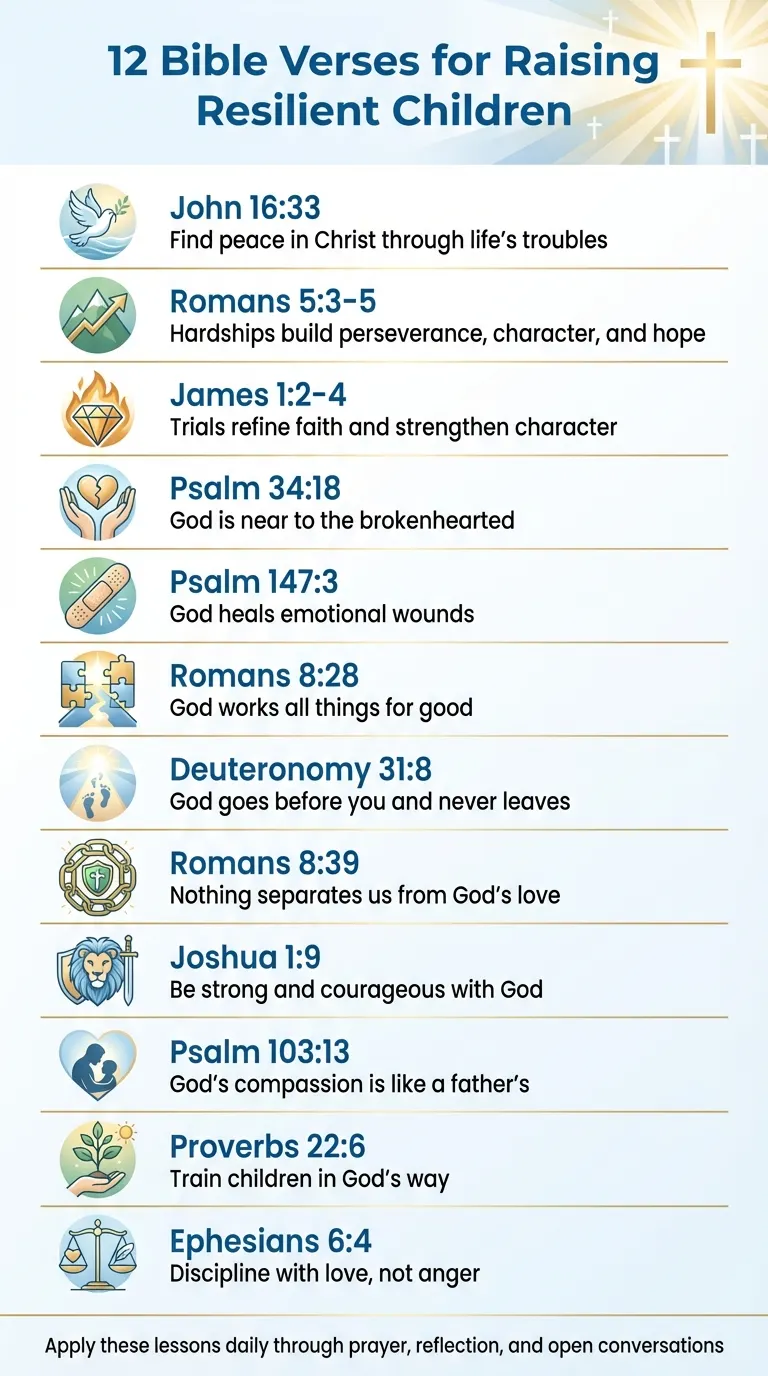
12 Bible Verses for Building Resilience in Children
Raising Resilient Children
1. John 16:33 – Overcoming Worldly Troubles
"I have told you these things, so that in me you may have peace. In this world you will have trouble. But take heart! I have overcome the world." (John 16:33, NIV)
This verse reminds us that struggles are part of life. Whether your child is dealing with bullying at school or feeling crushed after a tough loss on the sports field, challenges are inevitable. But here’s the good news: Jesus has already overcome these struggles. As Lauren Gaines, author and contributor to Family Christian, puts it:
"Here on earth you will have many trials and sorrows. But take heart because I have overcome the world."
The focus should be on helping children find peace in Christ, rather than waiting for their circumstances to magically improve. This mindset lays the foundation for teaching them how to navigate life’s challenges with resilience.
For instance, when your daughter doesn’t make the team or your son faces difficulties with a teacher, resist the urge to jump in and fix everything. Instead, ask them, "What do you think you can do?" Licensed Professional Counselor Debbie Pierce emphasizes:
"You want your kids to know that you recognize they’re in a tough situation, but it’s not impossible to deal with and you’re confident they can get through it."
Your actions speak volumes, too. When you face your own challenges – be it a setback at work or biblical financial principles – let your children see how you "take heart" by trusting in Christ. Share examples from your life, like how prayer guided you through a tough decision. This shows them that resilience isn’t about ignoring problems but about leaning on Christ when life gets hard.
Encourage your children to turn to prayer when they feel overwhelmed. Teach them to pause, reflect, and pray John 16:33 during difficult moments. Sitting quietly and seeking the peace Jesus promised can be far more grounding than turning to distractions.
2. Romans 5:3-5 – Suffering Builds Endurance and Hope
"Not only so, but we also glory in our sufferings, because we know that suffering produces perseverance; perseverance, character; and character, hope. And hope does not put us to shame, because God’s love has been poured out into our hearts through the Holy Spirit, who has been given to us." (Romans 5:3-5, NIV)
This passage reminds us that hardships are not without purpose. Suffering lays the groundwork for perseverance, which shapes character and ignites hope. For parents, this message serves as a guide to turn life’s challenges into opportunities for growth – not just for themselves but for their children.
When setbacks arise, try to reframe them as moments for learning and perseverance. For example, if your child feels defeated after not making the varsity team or struggles with a tough subject in school, use this as a chance to discuss where their hope is rooted. Is it tied to worldly achievements, or does it rest in God’s enduring faithfulness? A simple question like, "What do you think you can do next?" can encourage them to take ownership of the situation and develop problem-solving skills.
It’s important not to shield your children from every difficulty. Everyday challenges – like disagreements with friends, tough homework, or disappointing grades – are essential for building the resilience described in Romans 5. These smaller struggles prepare them for the larger trials they may face later in life.
Sharing your own experiences can be powerful. Talk about a time when God helped you persevere through a tough season. Show how that perseverance shaped your character and ultimately strengthened your hope. When your children encounter their own trials, remind them to pray not just for the situation to improve but for the strength and growth that God can bring through it. This perspective helps them see challenges not as setbacks, but as steps in their faith journey.
3. James 1:2-4 – Trials Create Steadfastness
"Consider it pure joy, my brothers and sisters, whenever you face trials of many kinds, because you know that the testing of your faith produces perseverance. Let perseverance finish its work so that you may be mature and complete, not lacking anything." (James 1:2-4, NIV)
James offers a profound perspective on life’s challenges, encouraging believers to view trials as purposeful moments for spiritual growth. The Greek term dokimion (testing) refers to a refining process, much like purifying gold, to reveal the authenticity of one’s faith. In essence, difficulties aren’t just random misfortunes – they’re deliberate steps toward building a stronger, more resilient character.
The phrase "Count it all joy" is a call to embrace adversity as a chance for growth. For instance, when your child faces a tough situation – whether it’s a social setback or a school-related challenge – it can be tempting to step in immediately. However, research shows that nearly 80% of adults credit their childhood struggles for shaping their character and deepening their faith. Dr. Kathy Koch explains it well: "Children must learn that God is not a magic genie who does away with all evil and suffering".
This perspective encourages us to guide children toward self-reflection when they encounter difficulties. Asking questions like, "What went wrong? How can you approach this differently next time?" helps them analyze their experiences and grow from them. Allowing small, manageable mistakes – like forgetting an assignment, losing a game, or navigating a disagreement with a friend – builds the perseverance muscles they’ll need for a mature and steady character.
It’s also important to help them see God’s presence in their struggles. Point out moments where they might feel His peace during anxiety, His wisdom in confusion, or His strength when they’re on the verge of giving up. By allowing perseverance to do its work, as James describes, you’re helping them develop the spiritual maturity and resilience needed to face life’s challenges. Constantly stepping in to solve every problem can unintentionally rob them of the growth these moments are meant to provide.
4. Psalm 34:18 – God Is Near to the Brokenhearted
"The LORD is near to the brokenhearted and saves those who are crushed in spirit." (Psalm 34:18, NIV)
Psalm 34:18 reminds us of a comforting truth: God draws closest when we feel most broken. For children facing emotional pain, this verse offers a profound reassurance. The Hebrew phrase nishberei lev, meaning a heart that feels shattered or crushed, captures the depth of disappointment or rejection they might experience. It’s a promise that God doesn’t stand at a distance during these moments. Instead, He steps into the pain with us, offering His presence in a deeply personal way.
What makes this verse particularly impactful is how it connects God’s nearness with His active role as a source of comfort. He’s not a passive observer of our struggles but a refuge, providing strength and solace when we feel overwhelmed. This understanding can naturally nurture resilience, helping children see that they are never alone, even in their hardest moments.
When a child is heartbroken, resist the urge to immediately fix their pain. Instead, acknowledge their feelings with empathy. Saying something like, "I see how much this hurts, and I trust that God will guide you through it", can validate their emotions while pointing them toward God’s comfort. Encourage them to take time to reflect, pray, and invite God into their sadness, helping them experience His closeness in a tangible way.
Sharing your own story of finding comfort in God can also make a lasting impact. Talk about a time when you felt brokenhearted and how God’s presence brought you peace. This shows that resilience isn’t about avoiding pain – it’s about knowing where to turn when challenges come. As Dr. Caren Baruch-Feldman, author of The Grit Guide for Teens, explains:
"Resilient people understand that ultimately they will be strengthened by the problems and challenges they face."
5. Psalm 147:3 – God Heals the Brokenhearted
"He heals the brokenhearted and binds up their wounds." (Psalm 147:3, NIV)
Psalm 147:3 takes God’s care a step further than just being present in our pain – it shows He actively heals. The verse paints a vivid picture of God as a compassionate doctor, tending to our emotional wounds with the same care you’d use to clean and bandage a child’s scraped knee. This promise of healing speaks to the deeper hurts caused by rejection, loss, or disappointment, offering not just restoration but also the strength to face future challenges.
The verse also reveals God’s attentiveness. Earlier in the Psalm, it describes how God counts and names every star in the universe (verse 4), yet He still focuses on the brokenhearted with intimate care. This contrast helps children understand that their feelings matter deeply to an all-powerful God who governs galaxies but also sees their personal struggles.
As a parent, you can bring this healing promise to life in practical ways. When your child faces heartbreak – whether from being left out at school, losing a pet, or struggling with failure – use the idea of a "bandage" to make God’s care relatable. You might say, "Just like I clean and cover your scrapes, God is wrapping up the hurt in your heart right now." Encourage them to take a quiet moment to feel God’s peace instead of rushing to distractions. These pauses can become a meaningful way to navigate life’s challenges.
Sharing your own experiences of heartache and how God brought healing can also be powerful. When children see you lean on God in tough times, they learn that pain isn’t meaningless – it’s an opportunity to experience His healing and grow stronger. Your stories help reinforce the truth that healing leads to resilience.
Finally, guide your child to pray for those who may have caused their pain. Ask God not only to heal your child’s heart but also to bring healing to the other person involved. This shift from bitterness to compassion shows how God’s healing can turn personal pain into growth and even transform difficult situations into opportunities for grace.
6. Romans 8:28 – God Works Everything for Good
"And we know that in all things God works for the good of those who love him, who have been called according to his purpose." (Romans 8:28, NIV)
Romans 8:28 reminds us that struggles are not meaningless – they’re part of God’s greater plan. Pain and challenges, while difficult, can shape resilience, courage, and trust in Him. When your child faces setbacks – whether it’s not making the team, struggling with schoolwork, or losing a friendship – this verse encourages a shift in perspective. Instead of asking, "Why is this happening to me?", they can begin to wonder, "What might God be teaching me through this?"
Start by acknowledging your child’s feelings. Before encouraging them to see the bigger picture, it’s important to let them process their emotions. As Becky Sweat wisely notes:
"It is easier to hang in there when we focus on the big picture of what God is doing in our lives".
Once your child feels heard, you can guide them toward reflection by sharing your own experiences.
Be open about your personal journey. Share a time when you faced a challenge – whether it was a job loss, a health crisis, or financial hardship – and explain how God ultimately brought good out of that situation. Maybe it taught you patience, deepened your faith, or opened doors to new opportunities. Stories like these bring Romans 8:28 to life, showing that it’s not just a comforting idea but a truth we can rely on. The story of Joseph in Genesis 37–50 is another powerful example. Despite betrayal and imprisonment, God used Joseph’s trials to save countless lives during a famine.
Practical reflection can help your child connect these lessons to their own life. Ask them questions like, "What do you think God might be teaching you right now?" Encourage them to jot down their thoughts in a journal – whether on paper or digitally – so they can revisit these moments of growth later. These "God-moments" can serve as reminders of His faithfulness during future challenges.
As Dr. Caren Baruch-Feldman explains:
"Resilient people understand that ultimately they will be strengthened by the problems and challenges they face".
7. Deuteronomy 31:8 – God Will Never Leave You
"The Lord himself goes before you and will be with you; he will never leave you nor forsake you. Do not be afraid; do not be discouraged." (Deuteronomy 31:8, NIV)
Fear and uncertainty can be overwhelming for children – whether it’s starting at a new school, moving to a different neighborhood, or dealing with a friendship ending. Deuteronomy 31:8 offers a comforting reminder: God is not only by their side but is also ahead of them, preparing the way.
Moses originally shared these words with Joshua, who was about to lead Israel into uncharted territory. Today, this same promise can reassure your child. Whether your daughter feels nervous about trying out for a new team or your son is anxious about an upcoming test, this verse serves as a reminder that they are never alone. Abby Flynn, Executive Editor at MomLife Today, emphasizes:
"By sharing this verse with our children, we help them understand that they need not fear or be discouraged because God is with them every step of the way, providing strength and courage in all circumstances".
This verse isn’t just comforting; it’s actionable. Use it as a tool to help your child during life’s transitions. Pray these words over them, especially when they’re facing something new or intimidating. Encourage them to memorize the phrase "He will never leave you nor forsake you" so they can recall it in moments of fear – whether it’s being scared of the dark or feeling uncertain before a big event. Teach them to pause and reflect on God’s constant presence.
You can also share your own experiences to make this promise feel real. Talk about times when you felt God’s presence during challenges like a health scare, job change, or financial difficulty. These personal stories can help your child see that God’s faithfulness is not just an idea – it’s something they can rely on when life feels tough.
8. Romans 8:39 – Nothing Can Separate Us from God’s Love
"And I am convinced that nothing can ever separate us from God’s love. Neither death nor life, neither angels nor demons, neither our fears for today nor our worries about tomorrow – not even the powers of hell can separate us from God’s love." (Romans 8:38-39, NLT)
When your child comes home heartbroken after being cut from the basketball team, or when they’re lying awake at night, worried about fitting in at school, there’s one truth they need to hear loud and clear: God’s love never falters. Romans 8:39 lays it out plainly – nothing, not death, struggles, fears, or even the powers of hell, can separate us from His love. This truth is a cornerstone for building resilience rooted in faith.
This verse serves as a powerful reminder of God’s unwavering love through every challenge. It’s important to help your child understand that this love isn’t earned through perfect grades, flawless behavior, or athletic success. As Our Savior Lutheran School puts it:
"God’s love remains constant regardless of behavior or circumstances – this truth builds lasting confidence".
When your child faces setbacks – whether it’s missing out on a team or struggling in school – these moments are opportunities to reinforce that their worth isn’t tied to performance. Separate their actions from their value: "I know you’re disappointed, but that doesn’t change how much I love you – or how much God loves you." This perspective helps them navigate everyday anxieties with a sense of security.
Take time to walk through the challenges listed in Romans 8:38-39 with your child when they’re feeling scared or unsure. If they’re nervous about an upcoming doctor’s appointment or worried about making friends at a new school, show them how this passage speaks directly to their fears. It makes God’s promise feel personal and tangible.
You can also create habits that reinforce this truth and build their faith. Encourage your child to start a "Blessings Journal" where they jot down three things each day that remind them of God’s love – like a kind gesture from a friend, a beautiful sunset, or a breakthrough on a tough homework problem. When disappointments arise, pray Romans 8:39 over them before bedtime, reminding them that failure doesn’t define their identity in Christ. Share your own experiences – times when you felt weak or inadequate but were reminded of God’s constant love as your source of strength. These practices can help them see that nothing – not even life’s hardest moments – can separate them from God’s love.
9. Joshua 1:9 – Be Strong and Courageous
"Have not I commanded thee? Be strong and of a good courage; be not afraid, neither be thou dismayed: for the Lord thy God is with thee whithersoever thou goest." (Joshua 1:9, KJV)
Joshua 1:9 carries a powerful message about facing challenges head-on with faith and determination. It reminds us to draw strength and courage, not from ourselves, but from the unwavering presence of God.
Think about a child standing nervously at the edge of a diving board or a teenager hesitating before stepping on stage for an audition. Those moments of fear and self-doubt echo what Joshua must have felt as he prepared to lead the Israelites into the Promised Land after decades in the wilderness. The verse teaches us that being "strong and courageous" isn’t about never feeling fear – it’s about trusting God to guide us through it.
This promise of God’s presence is a powerful antidote to fear. Whether it’s at school, on the soccer field, or during a visit to the doctor, God is there. When your child faces a tough moment, start by validating their emotions with a simple, “I know this is hard.” Then gently remind them, “God is with you, and you’re not alone.”
Encourage your child to face challenges, even small ones, to grow their resilience. For example, if they lose a game or misplace a favorite toy, help them process the setback by asking, “What can you do next?” Reciting Joshua 1:9 together can become a daily reminder of God’s support. Sharing your own experiences of relying on God during overwhelming times can also show them that strength and courage come from leaning on Him, no matter your age.
10. Psalm 103:13 – God’s Compassion Like a Father’s
"As a father has compassion on his children, so the LORD has compassion on those who fear him; for he knows how we are formed, he remembers that we are dust." (Psalm 103:13-14)
This verse draws a beautiful comparison between a father’s tender love and God’s boundless compassion, inviting us to let our own actions reflect this divine mercy. The Hebrew word raham conveys a deep, caring love that moves one to act. Compassion, in this sense, isn’t passive; it’s about stepping into someone’s struggle with understanding and support.
When your child faces hurt or rejection, the comfort you offer mirrors God’s care for us. It’s important to remember that challenges are often tools for growth, not obstacles to be instantly removed. In fact, studies show that overcoming difficulties helps build resilience and character. Being compassionate doesn’t mean solving every problem for your child but creating a safe space where they can learn to lean on God’s strength.
For example, if your child is upset about a tough math test or a loss in a soccer game, resist the urge to jump in and fix it. Instead, acknowledge their feelings by saying something like, "I see this is hard for you", and follow up with, "What do you think you’ll do next?" This approach not only validates their emotions but also encourages them to develop problem-solving skills. Teach them to take a moment to pause, reflect, and find quiet in God’s presence rather than rushing to distractions. These small but meaningful steps can make a big difference in their ability to handle life’s challenges.
Show compassion daily by offering fresh starts, just as God’s mercies are "new every morning". Take time to express your pride in them and remind them that they are "fearfully and wonderfully made" in God’s image. These acts of kindness and encouragement help lay a strong biblical foundation for their emotional resilience. By embodying God’s compassion in our everyday parenting, we prepare our children to face life’s ups and downs with strength and grace.
11. Proverbs 22:6 – Train Children in the Right Way
"Train up a child in the way he should go, and when he is old he will not depart from it." (Proverbs 22:6)
This verse doesn’t suggest a one-size-fits-all approach to raising children. Instead, it highlights the importance of recognizing each child’s unique qualities. The Hebrew word "chanak" refers to dedicating a child to follow God’s path, focusing on shaping their moral and spiritual life with intention. The phrase "in the way he should go" suggests tailoring guidance to fit a child’s individual personality, strengths, and abilities.
Start by paying close attention to what sparks joy in your child. Notice their natural talents and inclinations – whether it’s creativity, problem-solving, or leadership. For instance, you might see your daughter light up as she organizes her room or your son show remarkable determination when fixing a broken toy. These small moments reveal opportunities to nurture their God-given potential and build a strong, faithful foundation.
Your words play a powerful role in shaping who your child becomes. As Peggy O’Mara wisely said:
"The way we talk to our children becomes their inner voice".
This underscores the importance of weaving biblical truths into everyday life. Talk about God’s faithfulness over breakfast, admire His creation during a walk, or end the day with prayer. Even small, consistent actions make a difference. Research shows that when fathers regularly attend church, it significantly increases the likelihood of their children continuing in faith.
12. Ephesians 6:4 – Discipline Without Provoking Anger
"Fathers, do not provoke your children to anger by the way you treat them. Rather, bring them up with the discipline and instruction that comes from the Lord." (Ephesians 6:4, NLT)
This verse encourages parents to approach discipline in a way that strengthens their children rather than discourages them. When discipline is rooted in Christ’s teachings, it nurtures a child’s growth in resilience without fostering rebellion.
The call to avoid provoking children to anger doesn’t mean avoiding correction altogether. Instead, it’s a reminder to steer clear of unreasonable or harsh treatment. The Amplified Bible expands on this idea, urging fathers not to:
"exasperate them to the point of resentment with demands that are trivial or unreasonable or humiliating or abusive; nor by showing favoritism or indifference to any of them."
Joel Beeke highlights that nurturing helps shape a child’s character, while appropriate admonition guides their behavior.
Practical steps can make a big difference. Avoid disciplining in anger – take a moment to cool down before addressing the issue. Keep your promises, and ensure consequences are fair and proportionate. For instance, if a child spills a glass of milk, a calm reminder is far more constructive than harsh words. On the other hand, when a clear boundary is crossed, a measured consequence delivered privately and without favoritism can teach without humiliating.
Fathers, don’t frustrate your children with no-win scenarios. Take them by the hand and lead them in the way of the Master.
How to Use Scripture in Daily Parenting
Incorporating Scripture into your daily parenting routine can help strengthen your child’s sense of resilience, grounding them in God’s promises.
One way to do this is by weaving Scripture into everyday moments. Create Scripture cards with verses like Joshua 1:9 or James 1:2-4 and place them in spots where they’ll be seen often – bathroom mirrors, car dashboards, or even on your child’s desk. These simple reminders turn ordinary spaces into opportunities for spiritual encouragement.
When your child encounters challenges – a tough grade, a disagreement with a friend, or a loss in sports – resist the urge to immediately step in and fix things. Instead, ask them, “What do you think you should do next?” Work together to brainstorm solutions. This not only builds problem-solving skills but also opens the door to discussing how Scripture can guide their choices.
Bedtime is another great moment to nurture their faith. Start a "Blessings Journal" where your child writes down three positive things – what you might call “God’s reminders” – from their day. This practice helps them focus on gratitude and recognize God’s presence in the small details of life. When they feel disappointed, encourage them to pause and reflect on verses like Romans 12:2, which speaks of finding peace through God’s transformative power. These routines, practiced consistently, can help deepen their resilience and prepare them to face future challenges with faith.
For additional support, tools like Psalmlog can be a valuable resource. This platform offers personalized Scripture guidance and features like voice journaling, allowing kids to record their thoughts and prayers. Their Faith Builder plan provides up to 300 minutes of recording time each month for $19.99, helping to foster spiritual growth in a practical way.
Finally, don’t underestimate the power of sharing your own experiences. Talk openly about how God has strengthened you during tough times. When children see resilience modeled – whether through your stories or the lives of biblical figures like Joseph, Esther, and Ruth – they begin to understand that challenges are a natural part of life and can be overcome. As Bible enthusiast Piper McMillan puts it:
"The Bible doesn’t present resilience as a mere human quality but as a divine gift that develops as we walk with God through life’s challenges".
Conclusion
These verses don’t just echo earlier teachings – they lay out a practical roadmap for instilling resilience grounded in faith. The 12 Bible verses discussed offer a framework for raising children who lean on God rather than their own abilities. They remind us that resilience isn’t about self-reliance but about trusting in God’s promises. When challenges come, verses like Romans 5:3-5 and James 1:2-4 teach children that trials are not just hurdles but opportunities to grow in patience, character, and hope.
Resilience starts with what children see in you. They’re always observing how you handle life’s tough moments. Whether it’s a financial strain, a health issue, or a work-related challenge, sharing your struggles and explaining how God has given you strength to persevere provides a living example of faith in action. Dr. Caren Baruch-Feldman, author of The Grit Guide for Teens, highlights this beautifully:
"Resilient people understand that ultimately they will be strengthened by the problems and challenges they face".
Overprotecting kids, however, can hinder their ability to handle difficulties on their own. Instead, use life’s challenges as teachable moments. Ask them, “What do you think you should do?” This not only helps them take ownership of their decisions but also gives you a chance to guide them back to Scripture for wisdom.
Start small and stay consistent. Simple habits – like placing Scripture cards where they’re easily seen, keeping a gratitude journal, or pausing to pray together – can lay the groundwork for lasting resilience. Biblical resilience isn’t about achieving perfection; it’s about trusting God through every challenge. By embracing these practices, you’re not just teaching resilience – you’re modeling it in a way that reflects God’s promises in everyday life.
FAQs
How can I teach my child to see challenges as opportunities to grow?
Helping your child view challenges as opportunities for growth begins with teaching them to approach difficulties with a positive, faith-centered mindset. Show them that setbacks aren’t failures but opportunities to develop resilience, patience, and perseverance. Scriptures like Joshua 1:9 and Isaiah 41:10 serve as powerful reminders that God is always present, offering strength and courage during tough times.
Encourage your child to take a moment to pause and reflect when they encounter challenges, instead of rushing to escape discomfort. This practice builds self-control and helps them see how adversity can lead to both spiritual and personal growth. By framing difficulties as moments to trust in God’s plan and strengthen their character, you can help them embrace life’s struggles with faith and resilience.
How can I use Bible verses to guide my parenting and build resilience in my child?
Incorporating Scripture into parenting doesn’t have to be complicated – it can be a meaningful part of your daily life. One way to start is by having open, regular conversations with your child about Bible verses that emphasize emotional strength, perseverance, and faith. For instance, Proverbs 22:6, which encourages parents to guide their children on the right path, can serve as a foundation for these discussions.
You might also weave Scripture into your family’s daily routine. Read verses together during meals, at bedtime, or even while driving. Memorizing passages like Philippians 4:13 or Isaiah 41:10 as a family can help your child absorb these messages deeply. And most importantly, lead by example – show your child how you turn to Scripture during challenging moments. This not only teaches resilience but also demonstrates how faith can guide them through life’s difficulties.
How can I discipline my child while showing love and building resilience?
Balancing discipline with love involves setting clear, consistent boundaries while also demonstrating patience and care. According to the Bible, discipline grounded in love serves as a tool to guide children toward wisdom and inner strength. At the same time, showing compassion reminds them that they are cherished and supported.
To nurture resilience, maintain firm yet gentle boundaries. Let children navigate small challenges that encourage personal growth, and walk alongside them through these experiences with prayer and reflection. Share biblical promises like Joshua 1:9 and Isaiah 41:10, which highlight God’s strength and constant presence during tough times. By blending structure with understanding, you help your child build confidence, perseverance, and a strong foundation of faith.