
Founder Salary Help: What To Do When Unpaid
Practical, faith-based steps for founders who can't pay themselves—manage cash, separate finances, reduce anxiety, and protect relationships.
Many founders face financial stress when they can’t draw a paycheck, especially in the early stages of their business. Nearly half of small business owners in the UK (47%) didn’t pay themselves in their first year, and 28% continued this struggle into their second. This isn’t just about money – it’s about the emotional toll, sleepless nights, and strained relationships that come with it.
Key Takeaways:
- Recognize financial anxiety: Understand the signs, like constant worry, irritability, or rash decisions driven by fear.
- Separate real risks from imagined fears: Focus on immediate needs (e.g., rent, payroll) and set aside future uncertainties.
- Practical steps: Keep personal and business finances separate, review your expenses, and create a lean financial plan.
- Biblical perspective: Trust God for daily provision and remember your worth isn’t tied to income.
- Spiritual and relational habits: Use tools like voice journaling, engage in prayer, and maintain open communication with loved ones.
When money is tight, it’s crucial to stay grounded, take small actionable steps, and rely on faith to navigate the challenges. This guide combines practical advice with scriptural insights to help you regain control and peace of mind.
How to stop financial anxiety and trust God as your Provider
Understanding Founder Money Anxiety
Financial anxiety doesn’t always announce itself with dramatic breakdowns. For most founders, it sneaks in quietly – a tight feeling in your chest when you check your bank account, restless nights spent running numbers in your head, or snapping at loved ones more than usual. These subtle signs shouldn’t be ignored.
Signs of Financial Anxiety to Watch For
The first clues are often emotional or physical. Maybe you feel a constant knot in your stomach, notice yourself becoming short-tempered at home, or wrestle with a growing sense of shame about your business’s financial health. Some founders even start resenting peers who seem to be thriving or fantasizing about quitting altogether to escape the stress by taking a "stable job".
The real challenge is how anxiety can warp your judgment. The Daily Godpreneur captures this perfectly:
"Whenever I’m stressing about money in my business, my mind changes from an attitude of gratitude to a PANIC MODE of worrying… I make rash decisions based on fear and stress."
This panic mode is risky. It can lead to impulsive decisions – like slashing prices too soon, cutting team members unnecessarily, or rushing into a marketing campaign that isn’t ready. These choices are often fueled by fear rather than strategy.
Scripture offers insight into this pattern. Edward T. Welch puts it plainly:
"What we fear most shows where we place our functional trust."
When your sense of security hinges on your bank balance, every financial dip feels like a personal blow. This is a clear sign that deeper issues may need addressing.
Let’s explore how to separate genuine financial risks from the noise created by fear.
Telling Real Risks Apart from Fear
Not all financial worries are baseless – some are rooted in real challenges that require action. The key is distinguishing between actual risks and fear-driven noise.
Real risks are specific and tangible, like an upcoming rent payment, looming debt, or meeting payroll. Fear-driven noise, on the other hand, magnifies ordinary fluctuations into catastrophic scenarios. A helpful way to sort this out is by creating two lists:
- "Needs This Month": Immediate, concrete obligations you must address.
- "Future Uncertainties": The swirling worries you can set aside and release through prayer.
This simple exercise shifts vague anxiety into manageable steps.
Tools like Psalmlog can also be a game-changer. Speaking your fears out loud – rather than letting them replay endlessly in your head – helps you see them more clearly. Voice journaling combined with Scripture lets you tag and examine your emotions, reinforcing trust in God’s provision. By combining faith with practical financial strategies, you can stay spiritually grounded while tackling real-world challenges.
Timothy Keller sums it up beautifully:
"Trust God, and then work, plan, and be wise as if it all depends on you – while knowing in your heart it all depends on Him."
This balance is key: acknowledge the numbers, but don’t let them define your worth or dictate your peace.
What the Bible Says About Financial Struggles
The Bible doesn’t shy away from addressing financial challenges. In fact, it offers guidance through biblical guidance on money, debt, and generosity. God acknowledges the weight of financial pressure and speaks directly into these struggles.
God’s Provision When Resources Run Low
One powerful example of God’s provision is found in the story of the Widow of Zarephath in 1 Kings 17. During a devastating famine, this widow had only a handful of flour and a little oil left – barely enough for one final meal. When the prophet Elijah asked her to share what she had, she chose to trust and obey. In response, God miraculously ensured her jar of flour and jug of oil never ran out until the famine ended. Her supplies were replenished daily.
This story illustrates how God often provides just enough for the moment rather than offering a long-term guarantee upfront. This idea is echoed in Jesus’ teaching to pray for "daily bread" (Matthew 6:11). The focus shifts from worrying about long-term stability to trusting God for today’s needs. For entrepreneurs or anyone struggling financially, this perspective can bring comfort, reminding us to ask, "What do I need today, and can I trust God for it?"
The name Jehovah Jireh, meaning "The Lord will provide", further emphasizes God’s faithfulness. This name was revealed when God provided a ram for Abraham’s sacrifice at the last moment. It’s not a promise that hardship will never come, but a declaration of God’s dependable character in times of need. This daily provision encourages a shift in perspective, helping us see our identity as more than just a reflection of our financial situation.
Building Identity Beyond Income
It’s easy for business owners to tie their self-worth to metrics like revenue, valuation, or payroll. But just as God meets daily needs, His Word reminds us that our value goes far beyond financial achievements. A drop in income shouldn’t diminish your sense of worth.
Christian coach Ryan Bailey explains:
"The lie underneath this is that your business, team, and family are ultimately sustained by your ingenuity, not by God’s wise and loving care."
This misconception – that everything depends solely on your efforts – is countered by scripture. Passages like Ephesians 2 and Romans 8 affirm that your identity is rooted in being a beloved child of God, not in financial success or failure. When your self-worth isn’t tied to fluctuating income, you’re free to make sound, thoughtful decisions without acting out of fear or desperation.
The Bible also emphasizes stewardship over ownership. Psalm 24:1 reminds us, "The earth is the Lord’s and the fullness thereof". This verse serves as a powerful reminder that all resources ultimately belong to God, and we are entrusted to manage them wisely on His behalf. Grounded in these truths, you can approach financial struggles with both faith and clarity, knowing that your worth and purpose extend far beyond any monetary measure.
Practical Steps to Stabilize Your Finances
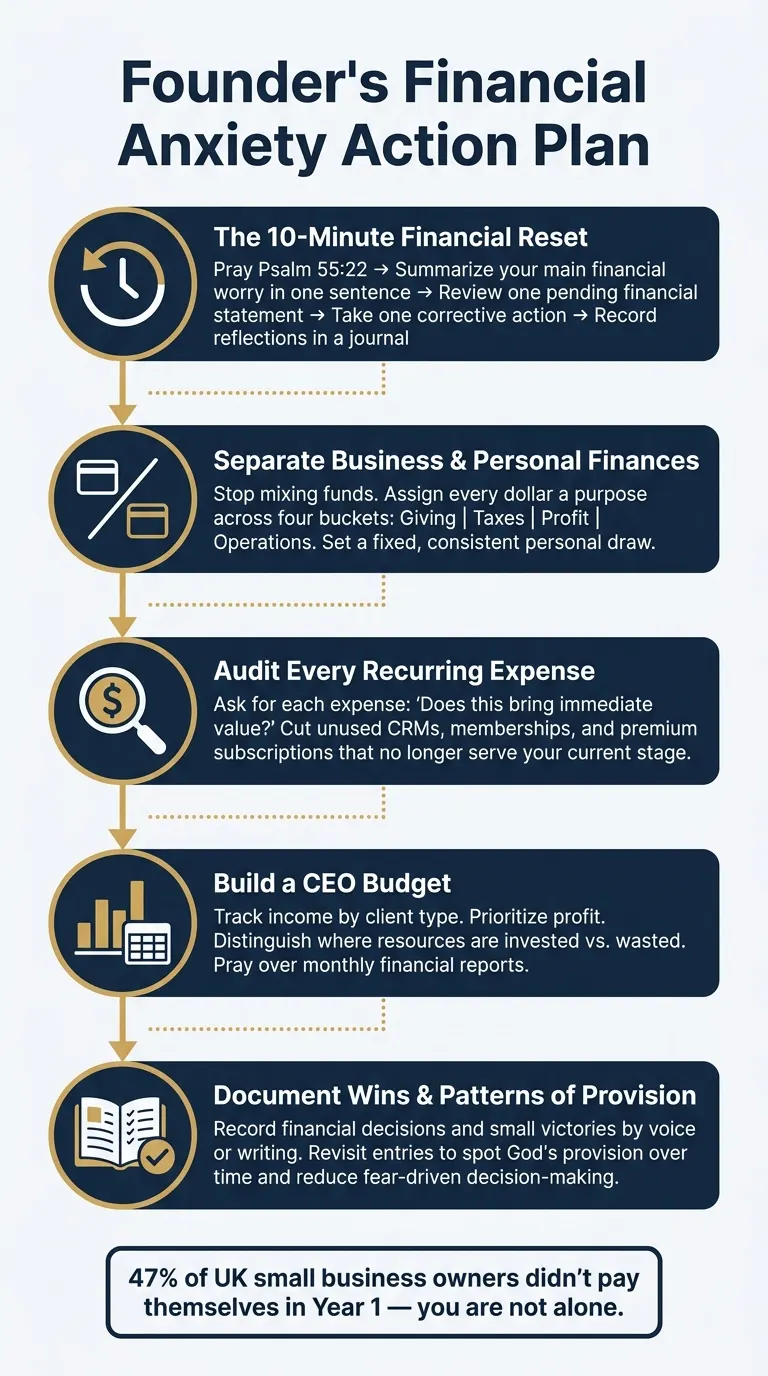
Founder’s Financial Anxiety Action Plan: 5 Practical Steps
Faith is powerful, but it needs to be paired with action. Once you’ve embraced the truth that your worth isn’t tied to your income, it’s time to get practical and assess your financial situation.
Taking an Honest Look at Your Numbers
Proverbs 27:23 offers wise advice:
"Be sure you know the condition of your flocks, give careful attention to your herds."
For founders, your "flocks" include your cash balance, burn rate, and runway. Ignoring these numbers only postpones the inevitable. A helpful starting point is what some call the 10-Minute Financial Reset. Here’s how it works: begin by praying Psalm 55:22, then summarize your main financial worry in a single sentence. Next, review one pending financial statement and take one corrective action. Finally, record your reflections in Psalmlog. This process of speaking your concerns aloud and reflecting on scripture can provide clarity and direction.
Once you’ve taken stock of your finances, the next step is to create clear boundaries between personal and business funds.
Keeping Business and Personal Finances Separate
When money is tight, one of the smartest moves you can make is to stop mixing personal and business finances. Combining the two makes it harder to gauge the health of your business.
The solution lies in creating structure. Assign every dollar a purpose – divide funds into categories like giving, taxes, profit, and operational costs. Then, establish a consistent personal draw. A fixed, predictable draw provides more stability than irregular transfers, especially when cash flow is uncertain. As Luke 16:10 reminds us:
"Whoever can be trusted with very little can also be trusted with much…"
Treating your business finances as a spiritual discipline, rather than just a bookkeeping task, can prevent emotional spending and encourage strategic decisions. This clarity lays the foundation for a lean and intentional financial plan.
Building a Lean Financial Plan
Trusting God doesn’t mean avoiding responsibility – it means acting wisely. Start by reviewing every recurring expense. Ask yourself, "Does this expense bring immediate value?" Tools like expensive CRMs, unused memberships, or premium subscriptions may no longer serve your current needs and could be quietly draining your resources.
Next, create a plan that functions like a CEO Budget. Track income by client type, prioritize profit, and evaluate where your resources are being invested versus wasted. Jesus himself highlighted the importance of planning in Luke 14:28:
"For which of you, desiring to build a tower, does not first sit down and count the cost, whether he has enough to complete it?"
Set aside time each month to pray over your financial reports and seek guidance on what to cut back and where to invest. Document these decisions in Psalmlog – not just as a record, but as an act of stewardship. Looking back on these entries can help you spot patterns of provision that might otherwise go unnoticed during tough times.
Protecting Relationships and Building Spiritual Habits
Keeping Your Home Relationships Healthy
Financial stress doesn’t just stay at work – it finds its way home, often straining the relationships that matter most. When founders are in survival mode, they can become irritable, withdrawn, or emotionally distant with their families.
To ease these tensions, try separating real, pressing financial obligations from the "what ifs" that fuel unnecessary worry. This distinction can make family discussions feel less daunting and more constructive.
"Money stress hits your sense of security… It can also trigger shame, especially if you feel like you should be doing better." – Coffee with my Father
Start by identifying your top three money-related fears. For example, you might say, "I’m afraid I’ll disappoint my family." Bring these fears to prayer, and then use them as a basis for open, honest conversations with your loved ones. Another helpful practice? Keep a running list of small blessings – a discounted bill, a kind word from a client, or an unexpected meal. This simple habit can shift your perspective from scarcity to gratitude.
These steps not only strengthen your family relationships but also provide a foundation for the spiritual habits that follow.
Daily and Weekly Spiritual Practices
When it comes to managing financial anxiety, consistent spiritual habits are often more effective than dramatic gestures. One simple yet powerful practice is the breath prayer: as you inhale, focus on a truth like "Lord, You are my provider", and as you exhale, release a specific worry such as "I release this debt to You".
For daily encouragement, post a meaningful scripture on your bathroom mirror. Verses like Philippians 4:19 or Matthew 6:33 can serve as anchors, helping you combat financial fear and memorize scripture. For deeper reflection, try using Psalmlog’s voice journaling feature to speak your worries aloud. Hearing your concerns paired with scripture can bring clarity and peace.
"Anxiety is often fear turned toward the future without God in the picture." – Edward T. Welch, Author and Counselor
At the end of each week, take time to list five ways God provided for you. This practice not only builds your spiritual strength but also sharpens your ability to see provision, even in tight circumstances.
These habits don’t just reduce anxiety – they prepare you to approach major business decisions with a clearer, calmer mindset.
Making Big Decisions: Pivot, Pause, or Press On
Financial pressure can tempt you to make rash, fear-driven decisions – slashing prices, downsizing your team, or even giving up on your business entirely. Instead, these spiritual and relational practices can help you slow down and think clearly before taking action.
When faced with a big decision, take a moment to assess whether your choice reflects faith or fear. Ask yourself: Is my desire to push forward driven by obedience, or am I clinging to my business as part of my identity? As Timothy Keller wisely said:
"Trust God, and then work, plan, and be wise as if it all depends on you – while knowing in your heart it all depends on Him." – Timothy Keller
A practical way to ground yourself is by reviewing your List of Victories – a record of moments when God showed up in your business. If you don’t have one, start today. Use tools like Psalmlog to record these moments by voice, and revisit them when considering a pivot or pause. Proverbs 15:22 reminds us that "plans succeed through many advisers", so reach out to a mentor, church elder, or financially savvy friend for guidance.
The goal isn’t to achieve absolute certainty but to take the next faithful step, grounded in peace rather than panic.
Conclusion: Trust God and Take the Next Step
One of the hardest parts of being a founder is facing the challenge of not paying yourself – both financially and emotionally. Yet, through it all, God’s faithfulness remains constant. A key perspective shift can make all the difference: understanding that you are a steward, not an owner. Moving from "this is all on me" to "God owns this, and I manage it" changes how you view your bank account, communicate with your loved ones, and make decisions under pressure. As Randy Alcorn wisely said:
"Giving is the only antidote to materialism. It’s a joyful declaration that God owns it all and our hearts belong to Him."
This mindset lays the foundation for taking practical action.
Faithful stewardship means implementing sound financial habits – reviewing your finances, keeping funds organized, and planning wisely for leaner times. Biblical examples, like Joseph storing grain during years of abundance, remind us that careful planning isn’t a lack of trust; it’s a thoughtful response to God’s provision. When stress clouds your vision of how far God has already carried you, faith-based journaling tools like Psalmlog can help. Use it to voice your concerns, celebrate small wins, and revisit scripture that strengthens you when the numbers don’t add up.
"We all need to set up some way to remind ourselves that God has done good things for our entrepreneurial journey in the past, and he is taking care of our needs today." – Daily Godpreneur
You don’t need a perfect plan or a steady paycheck to move forward. Take the next step in faith, trusting that God will guide you along the way.
FAQs
How do I choose a safe founder salary when cash is tight?
When setting your salary, begin with a practical plan that aligns with your company’s cash flow and your personal financial needs. Take time to model various financial scenarios to ensure your compensation remains manageable over time. For guidance, consider seeking spiritual clarity through prayer or journaling – this can help center your decisions around faith and purpose. If circumstances require a pay reduction, create a structured, time-limited plan with clear milestones for reassessment, trusting that your needs will be met as you move forward.
What should I do first if I’m behind on rent, taxes, or payroll?
Start by taking an honest look at your finances to get a clear picture of where you are. Proverbs 27:23 reminds us to "know well the condition of your flocks", which can be applied to understanding your resources today. Begin by mapping out your income and expenses – this step creates a foundation for informed decisions.
From there, consider practical actions like trimming unnecessary expenses or consulting a financial professional for guidance. Pair these efforts with prayer, bringing your concerns to God. This combination can help you move from a place of worry to one of trust and confidence.
How can I tell if a big business decision is faith-led or fear-led?
Faith-driven decisions are shaped by prayer, trust in God, and a focus on stewardship, while fear-driven choices often arise from panic or an over-reliance on oneself. When making faith-led decisions, people tend to seek God’s guidance, uphold integrity even when it’s inconvenient, consult wise and trusted mentors, and focus on deliberate, thoughtful actions in the present. On the other hand, fear-driven decisions are usually impulsive and fueled by anxiety. A good indicator? Faith-based choices are often accompanied by a sense of peace, whereas fear-driven ones usually leave you feeling unsettled.