
Close a Business with Dignity & Faith
Legal, financial, emotional, and spiritual steps to responsibly close your business while processing grief and finding peace.
Closing a business is deeply emotional, blending financial, personal, and spiritual challenges. It’s not just about logistics – it’s about navigating grief, redefining identity, and finding peace. This guide offers practical steps to handle closure responsibly while processing the emotional weight with faith-based tools like Scripture, prayer, and voice journaling.
Key Takeaways:
- Emotional Impact: Grief often mirrors stages like denial and acceptance. Tools like the C.A.R.E. model (Cry out, Articulate, Request, Express trust) help process emotions.
- Practical Steps: Address legal, financial, and employee obligations. Notify stakeholders in a clear, respectful order.
- Spiritual Guidance: Use Scripture and prayer to find comfort. Apps like Psalmlog provide personalized reflections and support.
- Closure and Healing: Symbolic acts and reflection help mark the end of this chapter while preparing for what’s next.
This isn’t just about shutting down – it’s about doing so with integrity, honoring your journey, and trusting in a greater plan.
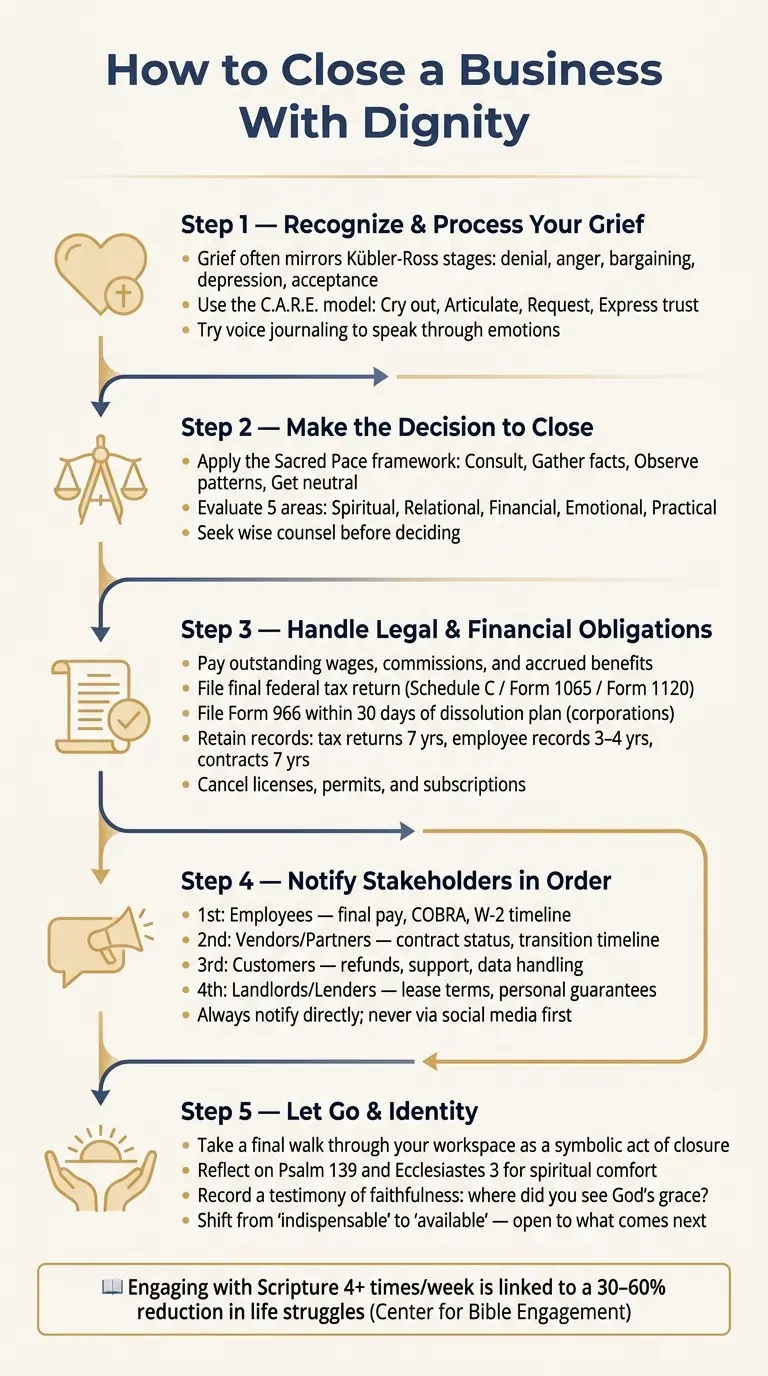
How to Close a Business With Dignity: A Step-by-Step Guide
Recognizing and Processing Your Grief
Common Emotional Reactions to Business Closure
Closing a business can stir up a whirlwind of emotions – shame, relief, anger, confusion, and sadness, all at once. Research from a 2021 study in the Journal of Business Venturing Insights examined the experiences of 40 small business owners and found that grief in this situation often mirrors the Kübler-Ross stages: denial, anger, bargaining, depression, and acceptance. However, these stages don’t always follow a straight path. Owners might revisit earlier stages or skip some entirely.
Denial often shows up as hyper-focus on logistics, as if handling the practical side of things can somehow reverse the situation. Bargaining might take the form of desperate negotiations that create the illusion of progress but don’t change the outcome.
"The owner isn’t just a creator. They become the entity. And the entity becomes them." – Peter S. Bergeron, Founder, Wrestling Against Time
When your business feels like an extension of yourself, its closure can shake your entire sense of identity. This isn’t about weakness – it’s a deep, soul-level struggle, raising tough questions about purpose and even faith in God’s presence during such loss.
How to Bring Your Grief Before God
The Bible doesn’t shy away from grief. In fact, nearly one-third of the Psalms are laments – raw, honest cries from people in pain. This biblical tradition provides a way to express sorrow while holding onto God’s character, even in the darkest moments. Lament keeps the conversation with God open, creating space for healing.
One way to approach this is through the C.A.R.E. model:
- Cry out: Turn to God, even if He feels far away, and acknowledge His presence.
- Articulate: Be specific about your pain. Don’t just say, “The business failed.” Name the real losses – like letting go of employees, losing a long-cherished dream, or facing financial uncertainty.
- Request: Ask God for something concrete, whether it’s strength to get through the day, clarity for your next steps, or simply rest.
- Express trust: Even if your feelings haven’t caught up, remind yourself of what you know to be true about God.
This isn’t a rigid process but a way to stay connected to God, even when silence feels tempting. Speaking your emotions out loud can often bring clarity and help you move toward healing.
Using Voice Journaling to Heal
Finding ways to express grief is essential, but when emotions are raw, writing can feel like too much. That’s where voice journaling comes in. Speaking your thoughts out loud can cut through the mental fog, offering clarity and relief. Tools like Psalmlog are designed for moments like these. With this app, you can record entries ranging from 30 seconds to 10 minutes, and it responds with a six-point reflection rooted in Scripture. These reflections include a Bible verse, an interpretation, encouragement, a prayer, and a suggested next step – all tailored to your own words.
If you’re not sure where to start, consider these prompts for your voice entries:
- What happened today?
- What emotions am I feeling?
- Where did I sense God’s presence?
- What Scriptures come to mind?
These questions don’t require polished answers – just honesty. Over time, reviewing your entries can help you see patterns in your grief and glimpses of God’s faithfulness, even during tough times.
"Lament is not the opposite of trust. It’s one of its most courageous forms." – Tim Harris, Practical Theologian
For ongoing support, Psalmlog’s Faith Builder plan ($19.99/month, or $14.99/month billed annually) offers 300 voice minutes per month and grief-focused templates. If you’re looking for deeper insights, the Shepherd plan ($34.99/month, or $24.99/month billed annually) includes AI memory that tracks your entries over 3–6 months, allowing you to trace God’s hand in your journey, even when it felt hidden.
Making the Decision to Close
Steps for Discernment: Biblical and Practical
Deciding to close a business is rarely a sudden realization. More often, it comes from a buildup of signs – financial, relational, and spiritual – that demand thoughtful attention.
A meaningful starting point can be found in James 1:5: "If any of you lacks wisdom, let him ask God, who gives generously to all without reproach, and it will be given him." This verse encourages seeking divine guidance through prayer before diving into analytics or consulting with others.
The Sacred Pace framework offers a practical way to navigate this decision-making process:
- Consult Jesus: Turn to prayer and Scripture to guide your direction.
- Gather the facts: Take an honest look at your financial health, team capacity, debt, and your own emotional state.
- Observe recurring challenges: Pay attention to persistent obstacles; they might be signs of a needed change.
- Get neutral: Pray for openness, ensuring you’re receptive to any outcome.
It’s crucial to remember that financial success doesn’t always equate to spiritual alignment. As Ildiko Ferenczi, co-host of the Pretty and Punk Podcast, wisely puts it:
"Provision and alignment are not the same thing. Money can flow where peace no longer lives."
These steps, combined with tools like voice journaling, can help you process emotions and document insights as you move toward clarity.
Using Psalmlog to Gain Clarity

When facing a significant decision, voice journaling can help cut through the noise in your mind. It allows you to reflect on both practical challenges and the spiritual comfort found in Scripture. This process can reveal patterns and bring clarity to your next steps.
With Psalmlog, you can record voice entries to document your fears, challenges, and any impressions of what God might be communicating. The app then provides a personalized six-point reflection based on your words, including a Bible verse, interpretation, encouragement, a prayer, and a suggested action.
For ongoing clarity, the Shepherd plan ($34.99/month, or $24.99/month billed annually) uses AI to track recurring themes over 3–6 months. Whether it’s persistent anxiety about your business or a growing sense of peace about closing, this tool helps you identify trends and make informed decisions.
A Decision-Making Checklist
Before finalizing your decision, use this checklist to ensure you’ve considered all aspects:
| Area | Question to Ask Yourself | What It May Signal |
|---|---|---|
| Spiritual | Do I feel at peace or unsettled when I imagine staying open? | A lack of peace may indicate misalignment (1 John 4:1). |
| Relational | Is the business affecting my marriage or family relationships? | Strain on family, a core priority, could be a warning. |
| Financial | Does my financial situation suggest a need for change? | Financial struggles may point to divine redirection. |
| Emotional | Am I pushing forward out of fear rather than faith? | Fear-based decisions often delay true relief. |
| Practical | Have I sought advice from trusted mentors? | Relying solely on personal judgment can cloud discernment; wise counsel adds clarity. |
"Wisdom does not chase every open door. It closes the ones God did not open." – Matthew T. Adams, Co-host, The Power of God’s Whisper Podcast
No single factor should dictate your decision. However, if multiple areas consistently point toward closure, it’s important to take that alignment seriously.
Closing Your Business the Right Way
Legal and Financial Responsibilities
When you decide to close your business, it’s essential to fulfill all legal and financial obligations to employees, creditors, and the government. This isn’t just about following the law – it’s about ending your business with integrity.
Start by addressing employee-related responsibilities. Pay any outstanding wages, commissions, and accrued benefits before your last day of operations. If your business employs 100 or more people, the Worker Adjustment and Retraining Notification (WARN) Act requires you to provide at least 60 days’ written notice of the closure. Failing to comply with this requirement could lead to serious legal repercussions.
On the tax front, you’ll need to file a final federal return and check the "Final Return" box on the appropriate form: Schedule C for sole proprietors, Form 1065 for partnerships, or Form 1120/1120-S for corporations. Corporations must also file Form 966 within 30 days of adopting a dissolution plan. To officially close your IRS business account, send a written letter to the IRS at their Cincinnati, OH 45999 address. Include your legal business name, EIN, address, and the reason for closing.
Don’t forget to cancel any licenses, permits, trade names, and recurring subscriptions to avoid unnecessary fees. Joe Mills, Partner at Aldridge Borden, emphasizes the importance of this step:
"It’s crucial to settle any financial obligations before closing the business… This protects remaining assets from false claims and protects your financial reputation as a business owner."
Lastly, keep your business records for the recommended time periods:
| Document Type | Retention Period |
|---|---|
| Tax returns and supporting documents | 7 years |
| Employment and payroll records | 4 years |
| Asset records | 7 years after disposal |
| Contracts and legal agreements | 7 years after the contract ends |
| Employee records | 3 years after their last day |
Once these legal and financial matters are resolved, you can focus on creating a clear timeline for the remaining steps in the closure process.
Building a Closure Timeline
A well-structured timeline can keep your business closure organized and manageable. When filing legal and financial documents, use the MM/DD/YYYY format (e.g., 05/23/2026) to meet U.S. standards.
Decide on a wind-down approach that suits your situation. A gradual closure allows time to collect receivables and fulfill orders, while an immediate shutdown requires swift asset liquidation and creditor notifications. Neither option is inherently better – what’s important is that your timeline reflects the specific needs of your business.
Before announcing the closure, make an effort to collect any outstanding invoices. Once stakeholders know about the closure, recovering unpaid invoices can become much harder. Notify stakeholders in a logical order: start with employees, then move on to suppliers and creditors, followed by customers, and finally the public.
Using Psalmlog to Work Through Ethical Tradeoffs
Closing a business involves more than just logistics – it also comes with tough ethical decisions. Tools like Psalmlog can help you reflect on these challenges and make thoughtful choices.
For example, what should you prioritize if funds are limited – paying severance to loyal employees or settling a critical debt like a bank loan? Should you honor a long-time supplier relationship, or focus on meeting your financial obligations? These dilemmas don’t always have clear answers.
This is where Psalmlog’s voice journaling feature can be invaluable. By talking through your ethical challenges, the app helps you reflect on competing obligations. Its six-point reflection process includes Scripture, interpretation, encouragement, a prayer, and suggested actions. Themes like justice, stewardship, and mercy often emerge, offering guidance rooted in biblical principles.
The Faith Builder plan ($19.99/month) provides 300 minutes of recording time each month, giving you plenty of space to document your closure journey. Over time, these entries can become a meaningful record of how you navigated difficult decisions, offering a sense of peace even after your business has closed.
Telling People You Are Closing
Preparing for Hard Conversations
Sharing the news that your business is closing is one of the most challenging steps in the process. It’s important to prepare both mentally and emotionally before having these conversations. A guiding principle can be found in Colossians 4:6: "Let your conversation be always full of grace, seasoned with salt, so that you may know how to answer everyone." Approach these discussions with honesty and compassion, delivering the facts without overexplaining.
Start by drafting your main message ahead of time. Keep it straightforward: what is closing, when it will happen, and how it affects the person you’re addressing. Avoid over-apologizing – people need clarity first, followed by the opportunity to react.
As RootedGood wisely notes:
"To listen to [voices of grief] is not a distraction from the work of ending well; it is the work. It’s how we let grief do its work in us."
What to Say to Each Group
The order in which you notify people is just as important as the message itself. Employees should be your top priority since their livelihoods, benefits, and routines are directly impacted. Inform them as early as possible and be prepared to answer questions about final paychecks, COBRA health insurance continuation, and when they can expect their W-2 forms. Some states even require same-day payment upon termination, so it’s crucial to understand and communicate these details clearly. Also, let them know who will be managing payroll records going forward.
After employees, reach out to vendors and partners, especially those involved in ongoing contracts or projects. Give them enough notice to make alternative arrangements. Next, inform customers, explaining how they can access support, request refunds for unfulfilled orders, or transfer their data to another provider. Finally, contact landlords and lenders early in the process to review lease agreements and address any personal guarantees before they become urgent.
| Stakeholder Group | Notify When | Key Message Focus |
|---|---|---|
| Employees | First | Final pay, benefits, and next steps |
| Partners/Vendors | Second | Contract status and transition timeline |
| Customers | Third | Refunds, support, and data handling |
| Landlords/Lenders | Early phase | Lease terms and financial obligations |
Tailoring your message to each group ensures that their specific concerns are addressed, helping to maintain trust and mutual respect.
Choosing the Right Way to Communicate
Selecting the appropriate communication method is essential. For employees, in-person meetings or live video calls are best. These approaches show respect and emphasize that their contribution mattered. If you’re dealing with a larger team, consider hosting a town hall meeting to deliver the news consistently to everyone, reducing misinformation and confusion. Always follow up with a written summary to ensure clarity.
For vendors and customers, a personal phone call followed by a formal letter or email strikes the right balance. The call demonstrates care, while the written follow-up provides a clear record of the conversation.
Above all, ensure people hear the news directly from you. No one should learn about the closure through social media or secondhand sources. As RootedGood puts it:
"Every signature, every goodbye, every final key turned in the lock can become a quiet act of faith."
The way you communicate reflects your values. By approaching these conversations with honesty and care, you can leave others feeling respected, even in difficult circumstances. This thoughtful communication helps lay the groundwork for moving forward with integrity and faith.
Letting Go and Rebuilding Your Identity in Christ
Acts of Closure: Symbolic and Practical
Closing your business is more than just shutting down operations – it’s a moment of closure that’s both symbolic and practical. Start by taking a final walk through your workspace, whether it’s an office, storefront, or home studio. This simple act helps you consciously mark the end of this chapter. Then, tackle the remaining administrative tasks with care. Treat these tasks as your final act of responsibility, ensuring you leave things in order and honor the trust others placed in you. Once the practical steps are complete, you can begin focusing on the emotional and spiritual healing that follows.
Finding Healing Through Scripture and Prayer
Even after closure, feelings of grief can linger. Studies suggest that the emotional toll of closing a business can be as profound as other significant personal losses. During this time, turning to Scripture can provide comfort and strength. Psalm 139 reminds us of God’s unchanging presence, no matter our circumstances, while Ecclesiastes 3 offers reassurance that there is “a time to uproot,” framing closure as part of a greater divine plan.
To process these emotions, consider voice journaling as a healing tool. With the Psalmlog app, you can simply speak your thoughts and emotions without worrying about structure. The app responds with a relevant Bible verse, a reflection, an encouraging message, a prayer, and even a practical next step to help guide you through the healing process. You can start with the free tier or opt for the Faith Builder plan at $19.99/month (or $14.99/month when billed annually), which includes 300 voice minutes per month.
"Release is not the end of your story. It may be the moment your faith finally becomes uncomplicated." – Matt Davis, President, Ministry Transitions
As you lean into Scripture and prayer, take time to notice how God’s faithfulness has been present throughout this journey.
Reflecting on God’s Faithfulness Through It All
Reflection isn’t about dwelling on regrets; it’s about recognizing growth and seeing how God’s grace has carried you through. Consider recording a brief testimony of faithfulness to capture these moments. Ask yourself: Where did I see God’s grace during this season? What patterns in my character or decisions have emerged? What might God be preparing me for next?
Your business may have been a mirror, reflecting parts of yourself and your journey. Now, the call is to shift from being indispensable to being available. This means moving from driving a vision at all costs to being open to God’s leading in every season. Think of biblical examples like Moses, who never entered the Promised Land, or David, who gathered resources for a temple he wouldn’t build. Both are remembered not as failures but as faithful stewards of their time. Your story is no different.
Conclusion: Moving Forward with Peace
Closing a business is one of the toughest challenges anyone can face – not just in terms of logistics, but on a deeply personal and emotional level. You’ve worked through grief, made difficult choices, tackled legal and financial hurdles, and had those heart-wrenching conversations. All the while, you’ve begun the journey of emotional healing and rediscovering who you are beyond the enterprise you poured so much into.
At the core of this process is trust – not just a vague concept, but the kind that Matt Davis, President of Ministry Transitions, describes as a deliberate act of "opening your hands" to God, surrendering the things you hold most dear.
"Trust that God cares more about His Church [or work] than you ever could. Trust that obedience is not measured by how long you stay, but by how well you listen." – Matt Davis, President, Ministry Transitions
Interestingly, research from the Center for Bible Engagement shows that engaging with Scripture at least four times a week is linked to a 30–60% reduction in life struggles. This highlights the value of developing a consistent spiritual practice, not as an obligation, but as a source of strength. Tools like the Psalmlog app are designed to help establish this rhythm. On days when you feel lost for words, you can speak your thoughts into the app and receive a Scripture-based response, a reflection, and a practical step forward.
The app offers two subscription plans: the Faith Builder plan at $19.99/month (or $14.99/month with annual billing) includes 300 voice minutes per month. The Shepherd plan, priced at $34.99/month (or $24.99/month annually), provides unlimited voice minutes and up to six months of AI memory, allowing the app to track your journey over time.
Closing a business doesn’t mean the end of your story. It might just be the moment when your path begins to unfold into something greater than you ever imagined.
FAQs
How do I know it’s time to close my business?
Knowing when it’s time to close your business is never easy, but there are clear signs that can help you make this tough decision. Persistent financial challenges, like constant cash flow problems or overwhelming debt, are often strong indicators. A shrinking market demand for your products or services can also signal trouble. Other red flags might include losing key team members or facing personal struggles, such as burnout or health concerns. Spotting these warning signs early gives you the chance to exit gracefully while staying true to your values.
What should I do first to shut down legally and ethically?
The first step in legally and ethically shutting down your business is making the formal decision to dissolve it. For corporations and LLCs, this typically involves a documented vote or resolution by the owners or board members. Once that decision is made, you’ll need to file the necessary dissolution paperwork with your state’s Secretary of State.
It’s a good idea to consult both an attorney and an accountant during this process. They can help ensure you address all the legal and tax responsibilities tied to closing your business. This can save you from potential headaches down the road.
How can I grieve this loss without losing my faith?
Grieving the loss of a business while holding onto faith means bringing your struggles to God with honesty and trust. Share your pain through heartfelt prayer or by journaling your thoughts, confident that God sees and understands your sorrow. Scriptures such as Psalm 34:18 ("The Lord is close to the brokenhearted and saves those who are crushed in spirit") and Revelation 21:4 ("He will wipe every tear from their eyes. There will be no more death or mourning or crying or pain") offer comfort and hope during this difficult time. Allow yourself to lament – it’s a natural part of faith. Lean on these biblical truths to process your emotions and stay rooted in God’s unwavering promises.