
How to Deal with Grief and Loss: A Biblical Perspective
Grief is a natural response, not weak faith: use lament, Scripture, prayer, and eternal hope to turn sorrow into deeper trust in God.
Grief is a natural response to loss, not a sign of weak faith. The Bible acknowledges pain and offers practical steps to navigate it while deepening your relationship with God. Here’s what you’ll learn:
- Lament as a Healing Tool: Express your pain honestly to God, following the Psalms’ example.
- Using Scripture for Comfort: Memorize verses like Psalm 34:18 and meditate on promises of hope.
- Jesus’ Teachings on Mourning: Find reassurance in passages like Matthew 5:4 and John 14:27.
- Eternal Hope: Focus on the promise of resurrection and restoration in Revelation 21:4.
Practical tools, such as journaling and structured prayer, can help turn sorrow into trust and hope. Grief doesn’t end quickly, but God’s presence provides strength and healing along the way.
Biblical Advice for Loss, Grief and Overcoming Sadness
Acknowledging Your Grief: The Practice of Lament
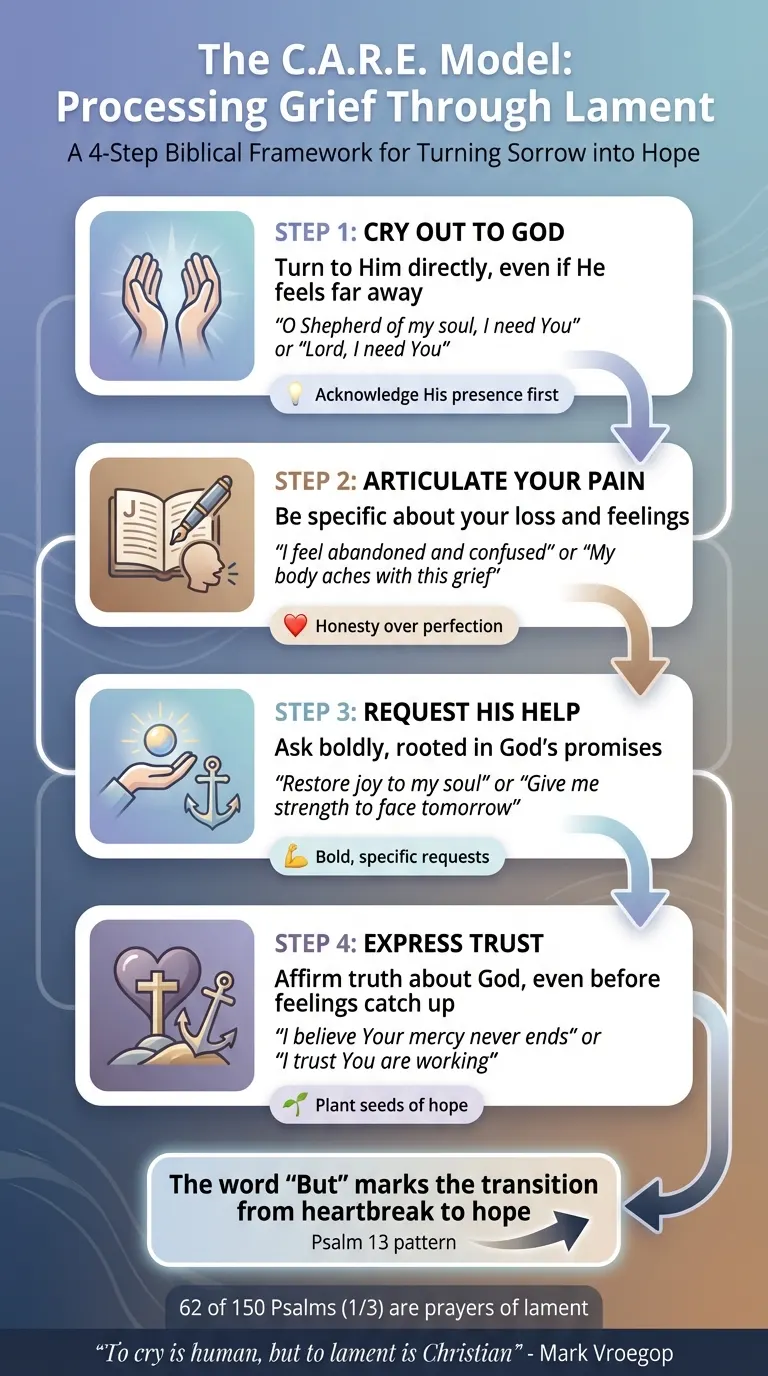
The C.A.R.E. Model: A Biblical Framework for Processing Grief Through Lament
Many Christians wrestle with the idea that showing raw emotions like pain, anger, or despair might reflect a lack of faith. But the Bible paints a different picture. Lament is a prayer birthed from pain, designed to guide us back to trust. It’s not about faithless complaining – it’s about bringing your honest feelings to a God who is relational and able to handle your deepest emotions.
Did you know that about one-third of the Psalms are prayers of lament? Sixty-two of them, to be exact. There’s even an entire book, Lamentations, dedicated to voicing anguish before God. Walter Brueggemann, a theologian, calls lament "the telling of all our secrets to God – the hidden, dark, painful, needy secrets that we prefer not to have or acknowledge".
Think of lament as a way to reconnect spiritually. When grief leaves you feeling isolated, lament shifts your focus back to God, creating a bridge from despair to connection. The key difference between lament and grumbling lies in their direction: lament cries to God, trusting His character, while grumbling complains about God, rooted in dissatisfaction. Even Jesus modeled lament – whether in the Garden of Gethsemane (Luke 22:44) or on the cross when He cried, "My God, my God, why have you forsaken me?" (Matthew 27:46).
This honest expression of pain opens the door to practices that turn sorrow into a deeper relationship with God.
Using Psalms to Process Your Grief
The Psalms provide a framework for expressing emotions that often feel overwhelming. They give us words when we can’t find our own. For example, Psalm 147:3 reminds us that God "heals the brokenhearted" and "binds up their wounds." Similarly, Psalm 30:5 offers hope: "Weeping may remain for a night, but rejoicing comes in the morning". These verses show that while grief is real and deep, healing is also possible.
Lament Psalms often follow a specific pattern: they start with a complaint that voices the pain, move to a petition asking for God’s help, and end with a declaration of trust. Take Psalm 13 as an example. It begins with raw questions: "How long, O Lord? Will you forget me forever?" Then it shifts to a bold request: "Look on me and answer, Lord my God." Finally, it pivots with the word "But": "But I trust in your unfailing love; my heart rejoices in your salvation." That small but powerful word – "But" – marks the transition from heartbreak to hope, without dismissing the sorrow. You can even make these Psalms personal by replacing general phrases with the details of your own struggles.
Understanding how Psalms structure emotion lays the groundwork for bringing lament into your daily life.
How to Practice Lament
The C.A.R.E. Model offers a simple way to incorporate lament into your spiritual life:
- Cry out to God. Start by turning to Him directly, even if He feels far away. Use titles like "O Shepherd of my soul" or simply say, "Lord, I need You." Acknowledging His presence is the first step.
- Articulate your pain. Be specific about your loss and how it makes you feel. Instead of saying, "I’m struggling", try something like, "I feel abandoned and confused", or "My body aches with this grief."
- Request His help. Ask boldly for what you need, rooted in God’s promises. For example, you might pray, "Restore joy to my soul", or "Give me strength to face tomorrow."
- Express trust. End by affirming a truth about God, even if your feelings haven’t caught up yet. Write or say phrases like, "I believe Your mercy never ends", or "I trust You are working, even when I can’t see it." This step plants the seeds of hope.
Voice journaling can be a helpful way to practice lament. Find a quiet, private space – like your car or a secluded room – and speak your lament aloud. Pouring out your heart audibly can lighten the emotional load and prepare you for Scripture reading or reflection. Alternatively, you can write your lament using the C.A.R.E. structure, creating a "spiritual altar" that helps you move from sorrow to hope.
You can also use this approach in smaller, everyday struggles – like a tough day at work or a minor disappointment – to prepare your heart for life’s bigger challenges. As Mark Vroegop puts it, "To cry is human, but to lament is Christian". This practice encourages you to bring your whole self – grief, doubts, and all – into God’s presence, trusting that He will meet you there. Combining this model with voice journaling deepens your connection to God’s Word and helps transform sorrow into hope.
Relying on God’s Presence and Promises
When grief feels like too much to bear, the Bible offers more than comfort – it reassures you of God’s constant presence. Isaiah 41:10 highlights this beautifully: "Do not fear, for I am with you; do not be dismayed, for I am your God". Notice the personal connection in "I am your God", a reminder that He is intimately involved in your struggles. The verse continues with a promise of strength: "I will uphold you with my victorious right hand."
Psalm 23:4 provides a different perspective on loss, describing it as a valley you pass through, not a place where you remain. "Even though I walk through the valley of the shadow of death, I will fear no evil, for You are with me". This verse assures you that even in life’s darkest moments, God walks beside you, guiding you forward. The darkness is temporary, and you’re not navigating it alone.
1 Peter 5:7 offers another layer of comfort: "Cast all your anxiety on him because he cares for you". This verse invites you to actively hand over your worries – whether it’s fear about the future, financial pressures, or the weight of new responsibilities – to God. Anne Peterson, an author and speaker, puts it this way:
"When you start to feel anxious, this is a perfect verse for you… picture yourself handing that care into the large hands of God".
This isn’t about ignoring your pain but recognizing that God is big enough to carry what you can’t.
Charles Spurgeon captures this sentiment perfectly:
"A Jesus who never wept could never wipe away my tears".
Jesus exemplified this in John 11:35, when He wept at Lazarus’s death, showing that God steps into your pain, not away from it. Timothy Keller adds:
"You don’t really know Jesus is all you need until Jesus is all you have".
When everything else feels stripped away, God’s presence becomes more than an idea – it becomes something you can lean on. With this assurance, you can take steps like memorizing scripture and meditating on His promises to strengthen your heart during grief.
Memorizing Scriptures for Hope
Memorizing scripture equips you with truth you can rely on when you’re too weary to search for comfort. Verses like Psalm 73:26 – "God is the strength of my heart" – can become anchors in moments of despair. Recite them aloud during quiet moments, letting the words remind you of God’s nearness.
Choose verses that resonate with your specific grief. If you’re mourning a loved one, Psalm 23:4 and 1 Thessalonians 4:13-18 can provide solace. For emotional struggles or relational loss, 1 Peter 5:7 and Psalm 28:7 offer reassurance. Those dealing with chronic pain might find comfort in Psalm 102 and 2 Corinthians 12:7-10. And for anxiety about the future, Isaiah 41:10 and Philippians 4:6-7 bring peace. The goal isn’t to collect verses but to internalize them so deeply that they become your instinctive response when pain overwhelms you.
Another helpful practice is using "breath prayers" to integrate scripture into your daily life. For example, while walking, inhale and think, "I cast my cares on You", and exhale with, "because You care for me", based on 1 Peter 5:7. Keeping printed verses in visible places – like your bathroom mirror, car, or bedside – ensures these promises are always within reach. These small practices naturally lead to deeper reflection and meditation on God’s promises.
Meditation and Reflection Exercises
Meditation on God’s promises allows you to fill your mind with truth. Begin by focusing on God’s closeness. Slowly read Psalm 34:18 and pray it back to Him: "Lord, You say You are near to the brokenhearted. I need to feel that nearness today." This practice anchors your soul during difficult times. For deeper understanding, explore the context of these passages in your Bible.
The C.A.R.E. framework can guide your meditation. Start by crying out to God, even if He feels far away: "O Shepherd of my soul, I need You." Articulate your pain honestly: "Lord, I feel forgotten and alone." Request His help: "Give me the strength to face this day." Finally, express trust in His character: "But I trust in Your steadfast love." This process helps shift your focus from raw grief to remembering God’s faithfulness, even when immediate relief feels distant.
A visual meditation exercise can also be powerful. While reciting John 10:27-29, close your eyes and imagine yourself walking through a peaceful pasture with Jesus, the Good Shepherd. Picture His hand guiding you and His voice calling your name. During intense waves of grief, whisper short phrases from scripture like "beauty instead of ashes" or "oil of joy instead of mourning" from Isaiah 61:3. These simple declarations remind you that God is at work, even when His plans aren’t yet visible.
Billy Graham offers this encouragement:
"Even if others don’t understand your grief, God does – and He wants to assure you of His constant love and presence".
Meditation isn’t about forcing yourself to feel better; it’s about training your heart to recognize God’s faithfulness in the midst of pain. Write down specific worries – financial struggles, relational tensions, health fears – and pray over them, acknowledging that God is "Jehovah Jireh" (the Lord will provide). Then, consciously release those concerns to Him, as Psalm 55:22 urges: "Cast your burden on the Lord, and He will sustain you." This act of surrender allows God to carry the weight when it feels too heavy for you alone.
Finding Comfort in Jesus’ Teachings
Jesus’ teachings offer a profound sense of comfort, especially during moments of deep sorrow. In Matthew 5:4, He says, "Blessed are those who mourn, for they will be comforted". The word "blessed" (makarios) conveys a joy rooted in God’s favor, a joy that isn’t tied to circumstances but to His presence. Mourning, described by the Greek word pentheo, refers to a grief so intense it brings uncontrollable tears. Jesus acknowledges the depth of such pain, reminding us that mourning is not a sign of weakness or lack of faith – it’s a step toward healing.
In John 14:27, Jesus offers another layer of reassurance: "Peace I leave with you; my peace I give you. I do not give to you as the world gives". This peace doesn’t mean a life free of trouble; rather, it’s about God’s steadying presence during the storm. Unlike temporary comforts, His peace is a lasting anchor for the soul. Becky, a Christian life coach, captures this beautifully:
"There are not enough bubble baths in the world to bring me the peace I need right now".
The Holy Spirit, as your Helper, provides strength and personal guidance when your own abilities fall short.
In Matthew 11:28-30, Jesus gives a heartfelt invitation: "Come to me, all who are weary and burdened, and I will give you rest." Dwight L. Moody reflects on the personal nature of this relationship:
"A rule I have had for years is to treat the Lord Jesus Christ as a personal friend. His is not a creed, a mere doctrine, but it is He Himself we have".
The imagery of the yoke here suggests walking alongside Jesus, allowing Him to carry the weight of your grief. Adrian Rogers explains the word "comfort" as being filled not with mere sympathy, but with strength:
"The word comfort is not a word filled with sympathy, but with strength: com- (with) fort (strength). Think of the word ‘fortify.’ God says, ‘I will put my strength in you’".
Understanding the Beatitudes
Jesus’ Beatitudes, particularly Matthew 5:4, redefine how grief is perceived. Mourning, He teaches, is not a flaw but a state that brings divine blessing. The promise "they will be comforted" is a guarantee of God’s presence. This comfort unfolds in three ways: God’s immediate closeness to the brokenhearted, the ongoing support of the Holy Spirit and a faith community, and the ultimate promise of a world free from pain and death. Pastor H.B. Charles Jr. puts it this way:
"The church cannot legitimately say that those who join us have cried their last tears. The church can say that those who join us will not weep alone".
Allow yourself to feel the depth of your sorrow. Take a moment – free from distractions – to ask God what burdens you’ve been holding back from addressing. Don’t suppress your feelings or pretend everything is fine. As John W. Ritenbaugh notes:
"The mourning that Jesus teaches is a major spiritual component of godly repentance that leads to or helps to produce the abundant life".
Grieving in isolation can deepen the pain. Seek out a trusted pastor, church member, or a ministry like GriefShare, where you can share your experiences without fear of judgment. Speak your pain aloud or write it down – God values honesty over a façade of perfection.
Reflection Prompts for Processing Emotions
These prompts can guide you in aligning your emotions with Jesus’ teachings. Spend some quiet time journaling or praying through each one, allowing the Holy Spirit to direct your thoughts. Start by asking: "God, what am I carrying right now that I haven’t let myself truly feel or express to You?". This question helps you identify hidden burdens – whether financial, emotional, or relational – that you might be avoiding.
Next, reflect on: "Where in my current struggle (financial, physical, or emotional) do I most need to experience Your nearness as the ‘Man of Sorrows’?". Jesus, who understands suffering intimately, can meet you in those specific areas of need. Then, consider: "How does the promise of ultimate comfort in Revelation 21:4 change how I view my current tears?". This shifts your focus from immediate pain to the eternal hope that God will one day wipe away every tear. Finally, ask: "Who is one trusted person I can bring into my sorrow this week to remind me that comfort is coming?". Sharing grief with someone lightens its weight and reflects Jesus’ teaching that we are not meant to mourn alone.
Write down your thoughts, especially where you feel most troubled or unsettled. Identify where you long for Jesus’ patience and tenderness. Turn John 14:27 into a personal prayer, sharing your fears while embracing the peace Jesus offers. Ask the Holy Spirit to reveal your next step in processing your loss – whether it’s apologizing, setting a boundary, or choosing forgiveness. Speak to Jesus as you would a close friend, sharing the details of your grief openly. Follow His example in Gethsemane by surrendering to God’s will, saying, "Not my will, but Thine, be done", to align your heart with His perspective.
Holding onto Eternal Hope: Resurrection and Restoration
When grief feels all-consuming, the Bible offers a perspective that reshapes how we process pain. Revelation 21:4 paints a picture of a future where God Himself will wipe away every tear, and death, mourning, crying, and pain will be no more. This promise reminds us that the suffering we experience now is not permanent. Timothy Keller, pastor and author, describes it powerfully:
"The Biblical view of things is resurrection – not a future that is just a consolation for the life we never had but a restoration of the life you always wanted. This means that every horrible thing that ever happened will not only be undone and repaired but will in some way make the eventual glory and joy even greater".
This kind of hope encourages us to document our journey from sorrow to restoration.
1 Thessalonians 4:13-18 offers further comfort, explaining the sequence of Christ’s return: the dead in Christ will rise first, and then living believers will join them to meet the Lord. This passage highlights the difference between grieving with hope and the despair of those who see no future beyond their loss. Randy Alcorn, founder of Eternal Perspective Ministries, captures this beautifully:
"For Christians, death is not a wall but a doorway. Death is not a last good-bye but a ‘See you later’".
Your current pain is part of a season, not the entirety of your life. When grief feels unbearable, shift your focus to the promises of the New Earth – a place without disease, separation, or sorrow, where reunions with loved ones will take place in perfected bodies. David Jeremiah, founder of Turning Point Ministries, offers this perspective:
"When we view today through the grid of eternity, the sting of grief is dulled by His power and love".
Journaling About Eternal Hope
Just as lamenting brings us closer to God, journaling about eternal hope helps anchor us in the promise of resurrection. Using the familiar C.A.R.E. approach, you can navigate sorrow and move toward hope.
Reframe your "what ifs" into "faithful what-nows" by focusing on God’s sovereignty and the assurance of resurrection. For instance, instead of asking, "What if I never see them again?" ask, "What now – how does the promise of reunion in 1 Thessalonians 4:17 shape how I live today?" Reflect on Job 19:25-27, where Job speaks of his "Redeemer" who will stand on the earth and the promise of seeing God in his own flesh.
Engage in a "Weaving" exercise by identifying moments of God’s grace within your pain, seeing your current struggles as part of a larger, redemptive story. Arnie Cole, CEO of Back to the Bible, explains this balance:
"Christian hope doesn’t cancel grief. It gives it a place to land".
Understanding God’s Plan for Perspective
As you reflect on eternal hope, consider how God’s overarching plan redefines your suffering. Christ’s resurrection as the "firstfruits" is proof that those who belong to Him will also rise, turning abstract hope into a concrete promise. Your loved one who died in Christ isn’t lost – they are with Jesus, awaiting the day of reunion when you’ll both stand in His presence forever.
Randy Alcorn underscores this perspective:
"Grieving as if we have no hope is the wrong way to grieve. And grieving while embracing Christ’s rock-solid promise of His second coming and our resurrection… is the right way to grieve".
Use Romans 8:18 to compare your current suffering with the "glory that is to be revealed". The Bible provides 62 Psalms of Lament – 45 individual and 17 communal laments – creating a divine guide for expressing sorrow while moving toward hope. Match your specific loss to a Psalm of Lament, such as Psalm 22 or 88 for the death of a loved one, to give your grief a biblical voice. Sharing the promise of resurrection with others who are grieving not only comforts them but also strengthens your own hope.
Tools for Biblical Grief Support
Psalmlog takes the timeless practice of biblical lament and adapts it into a modern voice journaling app, helping individuals process grief through Scripture. When words fail during moments of deep sorrow, this tool provides a practical way to express emotions authentically. With Psalmlog’s voice journaling feature, you can engage in the art of lament – speaking raw, honest feelings to God, much like the Psalms model. This method allows you to bypass the challenge of writing through tears and instead focus on authentic communication.
The app uses the C.A.R.E. framework – Cry out, Articulate, Request, and Express Trust – to guide users in channeling their emotions toward God rather than internalizing despair. Practical theologian Tim Harris offers this perspective:
"Trust is turning to God with what is real, not just what is pretty. Lament is not the opposite of trust. It’s one of its most courageous forms".
How to Use Psalmlog for Voice Journaling
To begin, open the app and tap the voice recording button. Start your entry by addressing God directly, which fosters a personal connection. You might say, "O Shepherd of my soul" or simply, "God, I need You". Then, speak openly about your pain. The Bible encourages this kind of honesty – after all, 62 of the Psalms are laments.
As you record, you can tag specific Psalms that align with your struggles. For example:
- If you’re grieving the loss of a loved one, Psalms 6, 22, or 31 may resonate.
- For chronic illness, Psalms 6, 38, or 102 can offer comfort.
- When dealing with betrayal or conflict, turn to Psalms 41 or 55.
- If financial insecurity is weighing on you, Psalms 56 or 127 can help.
The app also includes sentiment analysis to track your emotional journey, capturing the shift from lament to praise – a hallmark of biblical lament. After recording, you can explore structured Scripture plans tailored to your healing process.
Building a 7-Day Scripture Plan for Grief
Psalmlog provides personalized insights to help you create a week-long Scripture plan that aligns with your unique grief journey. After analyzing your voice entries, the app suggests passages that address your specific emotional needs.
Your 7-day plan can follow the five key elements of biblical lament: addressing God, expressing grief, asking for help, stating trust, and offering praise. Here’s an example:
- Day 1: Cry out to God (Psalm 13: "How long, O Lord? Will you forget me?")
- Day 2: Articulate your pain (Psalm 88’s raw honesty)
- Days 3–4: Request God’s help (Psalm 102: "Hear my prayer, O Lord")
- Days 5–6: Express trust (Psalm 31: "Into your hand I commit my spirit")
- Day 7: Offer praise (Psalm 42: "Why are you cast down, O my soul?").
For those seeking deeper engagement, the Faith Builder plan ($19.99/month USD) offers 300 minutes of recording time each month, along with personalized 6-point AI journal insights. Its calendar feature allows you to reflect on your journey, seeing how God has carried you through hardship and turned your lament into a testimony of hope.
Conclusion: Healing Through Faith
Grief isn’t something to solve – it’s a journey to walk, and you don’t walk it alone. The Bible doesn’t promise instant relief from pain, but it does assure you of God’s constant presence. As Psalm 34:18 says, "The LORD is close to the brokenhearted and saves those who are crushed in spirit."
In your sorrow, God meets you with comfort that transforms mourning into an opportunity for deeper trust. The practices mentioned earlier – biblical lament, meditating on Scripture, leaning on community, and holding onto eternal hope – are pathways to experiencing God’s presence even in the midst of loss. By using the C.A.R.E. model, you follow the example of the Psalms, where nearly a third reflect the raw honesty of grief. Journaling your pain or sharing it with others can help ease the burden that feels overwhelming.
Practical theologian Tim Harris captures this beautifully:
"Lament is not a detour but a path through grief into deeper trust."
Bringing your emotions to God – whether through voice journaling, breath prayers, or reflecting on Scripture – takes courage and faith. This is the essence of Christian grief: facing the reality of loss while refusing to let despair define the story.
Healing is rooted in both the comfort God offers now and the eternal promise of restoration. Moving forward doesn’t mean forgetting; it means letting God carry you through the valley. Revelation 21:4 paints this picture of hope: "He will wipe every tear from their eyes. There will be no more death or mourning or crying or pain, for the old order of things has passed away." Your grief can become a testimony – a story of how God met you in your darkest moments and upheld you with His promises.
Take hold of this promise of present comfort and eternal hope. Start small – choose one practice from this article. Maybe it’s recording your first voice journal, memorizing a verse, or calling a trusted friend. Whatever step you take, know that God is near, ready to guide you from sorrow into the hope that only He can provide.
FAQs
How is lament different from complaining?
Lament is a type of prayer found in the Bible that conveys deep sorrow and pain, yet still acknowledges trust in God. Unlike complaining – which often stems from doubt or bitterness and questions God’s goodness – lament provides a way for believers to face grief honestly while holding onto their faith. It’s a heartfelt and faithful way to respond to suffering.
What if God feels silent during grief?
When grief makes it feel like God is silent, it can be an incredibly tough experience. However, the Bible reassures us that silence doesn’t mean God has abandoned us – it can be a moment to grow in faith. Take Hannah, for example. She continued to trust in God even when He felt far away. We’re reminded in Scripture: “I will never leave you nor forsake you” (Hebrews 13:5). In these moments, lean into prayer and Scripture, holding onto His promises, even when your feelings suggest otherwise.
How do I start a simple C.A.R.E. lament prayer?
To create a simple C.A.R.E. lament prayer, start by opening your heart and sharing your pain with God, following the structure found in biblical laments. Begin by acknowledging your struggles and expressing your distress. Then, move into pleading for His help, being honest about your needs and desires. Gradually shift toward rejoicing in His faithfulness, and finally, express your trust in His love and salvation. Psalm 13 is a helpful example, as it transitions from deep sorrow to a confident trust in God’s enduring care.