
Bible on Tattoos: Christian Guidance
The Bible names one Old Testament verse on tattoos; Christians must decide by motive, conscience, and witness—not a blanket ban.
Short answer: the Bible gives one direct Old Testament verse on tattoo marks, and the New Testament gives no direct command about tattoos. So for most Christians, the issue is not a flat yes-or-no rule. It comes down to context, motive, conscience, and witness.
Here’s the plain takeaway:
- Leviticus 19:28 is the main verse people quote.
- That verse sits in Israel’s holiness laws and is tied to mourning for the dead and body marking.
- The New Testament says 0 direct words against tattoos.
- Christians split into 2 main views:
- The ban still applies
- The command was tied to ancient pagan practice
- Because of that, many believers treat tattoos as a Romans 14 conscience issue.
- The main test is simple: Would this tattoo honor Christ, and can I do it in faith?
A few key facts help frame the issue fast:
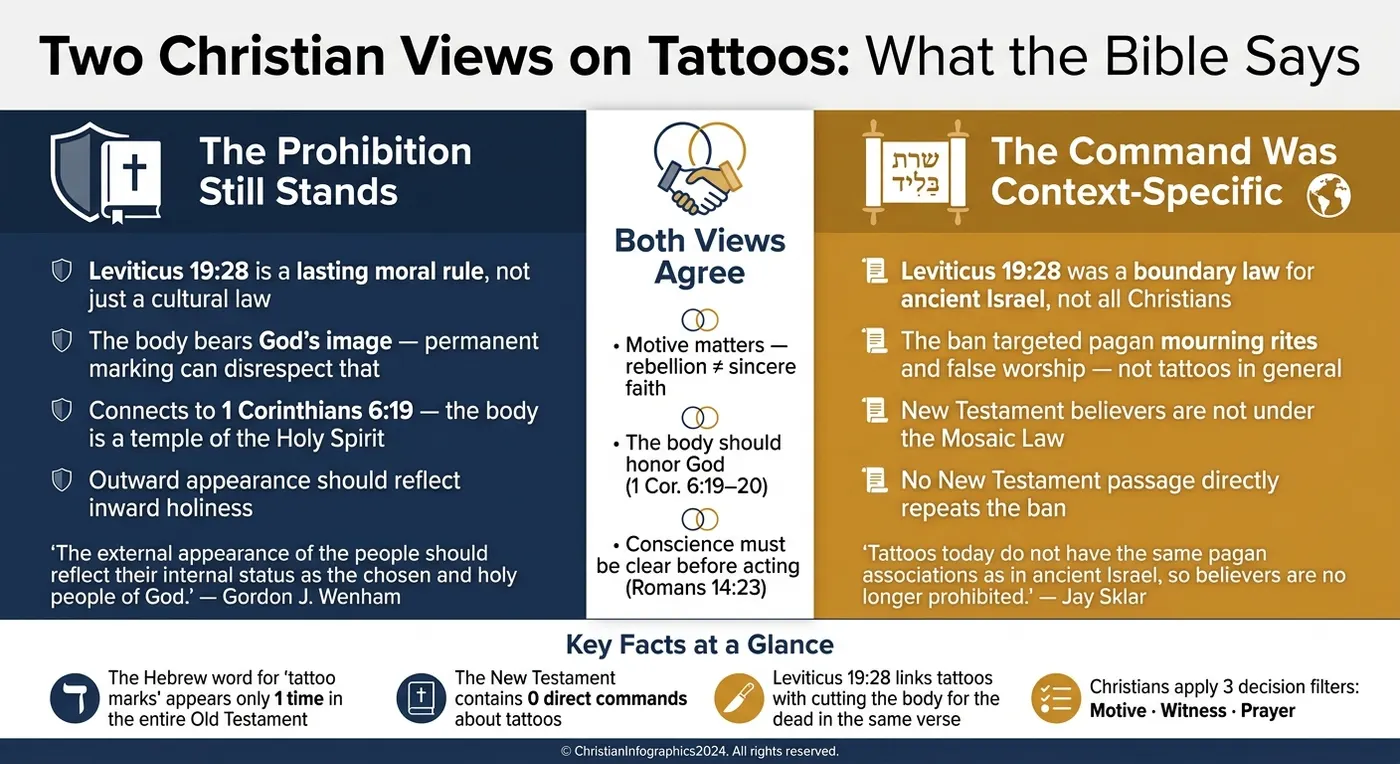
- The Hebrew word often translated as “tattoo marks” appears only 1 time in the Old Testament.
- Leviticus 19:28 links tattoos with cutting the body for the dead in the same sentence.
- The article points to 3 decision filters: motive, witness, and prayer.
If you want the whole issue in one line, here it is: the Bible does not give Christians a blanket New Testament ban on tattoos, but it does call you to make the choice with a clear conscience, clean motives, and care for other people.
Are Tattoos a Sin? What the Bible REALLY Says About Tattoos
What the Bible Directly Says About Tattoos
Only one Bible verse speaks about tattoo marks in a direct way, and the New Testament does not give a direct rule about tattoos. So if you want to understand this topic, the setting of that Old Testament command matters.
Leviticus 19:28 in Plain Language
The verse reads:
"You shall not make any cuts on your body for the dead or tattoo yourselves: I am the LORD." – Leviticus 19:28
This verse links two actions together: cutting or gashing the body for the dead and placing tattoo marks on the body. Both are forbidden in the same line. The Hebrew term translated as tattoo marks is qaʿăqaʿ, and it shows up only once in the entire Hebrew Bible, which is part of why scholars disagree on its exact sense. When a word appears only once, pinning down its meaning gets tricky. That helps explain why Christians still disagree about whether this command applies in the same way today.
Where Leviticus 19:28 Fits in Israel’s Holiness Laws
This verse appears in what theologians call the Holiness Code (Leviticus 17–26), a set of laws built around moral commands and laws meant to mark Israel off from other nations. As Gordon J. Wenham notes:
"The external appearance of the people should reflect their internal status as the chosen and holy people of God."
In that setting, the ban was meant to set Israelites apart from nearby Canaanite and Egyptian peoples, where body markings were often linked to mourning rites, pagan worship, or slavery.
No Direct New Testament Command on Tattoos
The New Testament does not directly command, forbid, or allow tattoos. As one theology professor notes:
"The New Testament says much about sexual immorality, idolatry, greed… yet it says nothing directly about tattooing as a sin Christians must avoid."
The next section looks at why Leviticus 19:28 was given and how Christians interpret the Old Testament laws today.
Why Leviticus 19:28 Was Given and How Christians Read It Today
The Ancient Pagan Practices Behind the Command
Leviticus 19:28 didn’t appear out of nowhere. It came from a world where Israel’s neighbors, especially the Canaanites and Egyptians, used body cutting and marking in mourning rites and acts of worship.
These marks weren’t just personal style choices. They often pointed to grief, ritual devotion, or both. Body marking could also signal social status. Tattoos and brands were used to mark slaves with the name of an owner or to show that a worshipper belonged to a certain deity. As Mark W. Chavalas explains:
"Tattooing, an insignia of ownership, was perhaps condemned in Leviticus because it reminded them [the Israelites] of their past… No longer considered slaves, the Israelites now were prohibited to mark their bodies with permanent signs of servitude."
That setting matters. Once you see the link to mourning rites, idol worship, and slavery, it’s easier to understand why Christians don’t all read this command the same way today.
The View That the Prohibition Still Stands
Some Christians take Leviticus 19:28 as a lasting moral rule, not just a law tied to ancient customs. In this reading, people bear God’s image, so permanent body marking can disrespect that image. Gordon J. Wenham argues that the outward appearance of God’s people should match their inward standing as his chosen and holy people.
People in this camp often connect Leviticus 19:28 with 1 Corinthians 6:19, where the body is called a temple of the Holy Spirit. For them, the point isn’t only what tattoos meant in the ancient Near East. It’s also what Christians should do with their bodies now.
Still, not everyone reads those passages that way. Other Christians look at the same texts and see a rule tied to Israel’s past setting, not a blanket ban for all believers.
The View That the Command Was Context-Specific
Many scholars and pastors read Leviticus 19:28 as a boundary law for ancient Israel. In their view, it was meant to keep Israel separate from pagan mourning rites and false worship, not to ban all tattoos for Christians in every time and place. Jay Sklar explains:
"Tattoos today – at least in Western cultures – do not have the same pagan associations as they did in ancient Israel, so believers are no longer prohibited from getting them."
This reading still keeps holiness front and center. But instead of focusing on skin alone, it puts more weight on motive, meaning, and conscience.
That’s why the debate keeps going. One side sees a lasting moral rule. The other sees a command aimed at a specific setting. And that split leads straight into the next issue: are tattoos sinful for Christians today?
Are Tattoos Sinful for Christians Today?
What Does the Bible Say About Tattoos? Two Christian Views Compared
Once you look at the key texts and the main ways Christians read them, the next step gets practical: when does a tattoo cross the line into sin?
For many Christians, tattoos are not automatically sinful. But that doesn’t mean every tattoo is wise. The motive behind it, the message it carries, and the state of a person’s conscience can all change the picture. That’s why conscience matters more than catchy slogans.
Why Many Christians Treat Tattoos as a Conscience Issue
Because the New Testament does not give a direct command about tattoos, many believers treat this as a conscience issue. If your conscience feels unsettled, it’s better to step back and not do it.
"The issue is more nuanced than a simple rule."
That approach fits how many Christians handle matters where Scripture does not give a plain yes-or-no command. In that kind of case, the heart behind the choice matters a lot.
Arguments for Christian Freedom and Arguments for Caution
Those who argue for Christian freedom point out that New Testament believers are not under the Mosaic Law, and no New Testament passage directly repeats the ban. Those who urge caution point to 1 Corinthians 6:19–20, which still tells believers to honor God with their bodies.
Both sides, though, tend to agree on one big point: motive matters a lot. A tattoo chosen out of rebellion or pride is not the same as one chosen in faith as a testimony. So the main issue is not just Can I do this? It’s whether this choice is being made wisely before God.
How to Make a Wise Christian Decision About Getting a Tattoo
Since this issue often comes down to conscience, it helps to run the decision through three last filters: motive, witness, and prayer.
Check Your Motive, Message, and Conscience Before God
Start with the plain question: Why do you want this? Look at what’s driving the choice. Is it rebellion, vanity, pride, or a sincere desire to honor God? Ask who is shaping your thinking. Ask whether the message and imagery fit your faith. Ask whether, years from now, you could still say it was a wise choice. If it does not feel like faith, stop there.
The main issue is not just the ink. It’s the heart behind it.
If you cannot do this in faith, don’t move forward. Romans 14 treats acting against conscience as sinful. And because tattoos are permanent and removal is expensive, this is one decision worth slowing down for.
Consider Your Witness, Family Concerns, and Church Unity
Something that feels private can still affect other people. A tattoo may communicate part of your testimony, but it can also bring friction at work, in your family, or in your church.
On a more personal level, if you’re a minor, getting a tattoo against your parents’ wishes is sinful rebellion. If you’re an adult, the concerns of a spouse, parents, or church leadership still matter and should be weighed with care, especially if the choice would needlessly wound someone else’s conscience. The heart of the question is simple: does this show love and humility, or self-will?
Use Prayer and Voice Journaling with Psalmlog to Think It Through

If the decision still feels unclear, slow down and pray through it out loud. Tattoos are permanent, so this calls for more than a fast gut check.
Psalmlog is a voice-first app built for this kind of reflection. You can use Psalmlog to speak your thoughts aloud, review Scripture, and pay attention to whether peace or pressure is driving the decision.
Conclusion: What the Bible Calls Christians to Do on This Issue
Scripture gives us one direct text on tattoos and no New Testament command. So the issue isn’t that the Bible says nothing. It’s that Christians have to use wisdom where Scripture leaves room for conscience. In plain terms, tattoos fit in the category of wisdom and conscience, not a blanket ban.
That doesn’t mean anything goes. The earlier call to be set apart and to honor the body still matters. So the main question is not whether tattoos are always forbidden. It’s whether this tattoo, in this situation, would honor Christ.
That brings the issue back to the place where biblical discernment usually lands: faith, not impulse. Act from faith, not pressure. Be honest about your motives. Seek counsel from mature believers. Then make the choice that best honors Christ.
As Romans 14:23 puts it plainly: "Whatever is not of faith is sin." That standard rules out both bad motives and blanket judgment.
FAQs
Can Christians get tattoos?
The Bible does not give a blanket command either for or against tattoos.
Leviticus 19:28 does forbid them. But many scholars and theologians read that law as part of the Mosaic covenant, aimed at pagan mourning rituals and idolatrous practices, not as a direct rule Christians must follow today.
And the New Testament never treats tattoos as a moral issue in themselves. Because of that, many Christians view tattoos as a matter of personal conscience and Christian liberty.
That doesn’t mean the choice is casual. A believer should look at their motives, seek wisdom, honor God, and take care not to cause someone else to stumble.
Does Leviticus 19:28 still apply today?
Not directly for Christians. Many scholars view Leviticus 19:28 as part of the Old Testament laws that set Israel apart from pagan mourning rituals and idol worship.
Under the new covenant, believers are not under the Mosaic law. At the same time, the deeper point still matters: holiness and honoring God with one’s body. That makes this a matter for prayerful, personal thought rather than a simple rule to apply across the board.
How do I know if getting a tattoo is wise?
Don’t stop at asking whether it’s allowed. Ask whether it glorifies God.
Take an honest look at your motives. Are they coming from faith, or from rebellion, pride, or pressure to fit in with the world?
It also helps to think through the bigger picture:
- Does it honor your body?
- Could it affect your Christian witness?
- Might it cause someone else to stumble?
- How will you feel about its permanence later?
- Could it affect future job options?
- What do mature believers or your parents have to say about it?
If your conscience feels unsettled, don’t rush. Wait, pray, and ask God for wisdom.