
Ten Commandments in Plain Language
A plain-English guide to the Ten Commandments: what they mean for the heart, how they shape life, and a simple Psalmlog journaling plan.
The Ten Commandments are not a ladder to earn God’s favor. They show how rescued people are meant to live. In this guide, I would boil the whole article down to two big ideas: love God first and love people well. That is the heart of all 10 commandments.
Here’s the plain-English version:
- Commands 1–4 deal with God:
- Put God first
- Don’t replace Him with idols
- Don’t misuse His name
- Rest and trust Him
- Commands 5–10 deal with people:
- Honor parents
- Don’t murder
- Don’t commit adultery
- Don’t steal
- Don’t lie about others
- Don’t covet
The article also makes one point very clear: obedience is more than outward behavior. Jesus shows that anger, lust, envy, gossip, and selfish ambition matter too. In other words, the commandments reach the heart, not just actions.
A few facts help frame this:
- The Ten Commandments appear in 2 places: Exodus 20:2–17 and Deuteronomy 5:6–21
- They are often grouped into 2 parts:
- First 4: duty toward God
- Last 6: duty toward neighbor
- The article gives 1 simple journaling plan:
- Read
- Restate
- Answer
- Record a prayer
If I were giving the fastest possible summary, it would be this: the commandments expose what rules your heart, how you treat people, and where you need grace. The Psalmlog angle is simple too: use each command as a daily or weekly heart check, then watch for repeated sins like anxiety, contempt, lust, dishonesty, or envy.
This gives you a short map for the full article below.
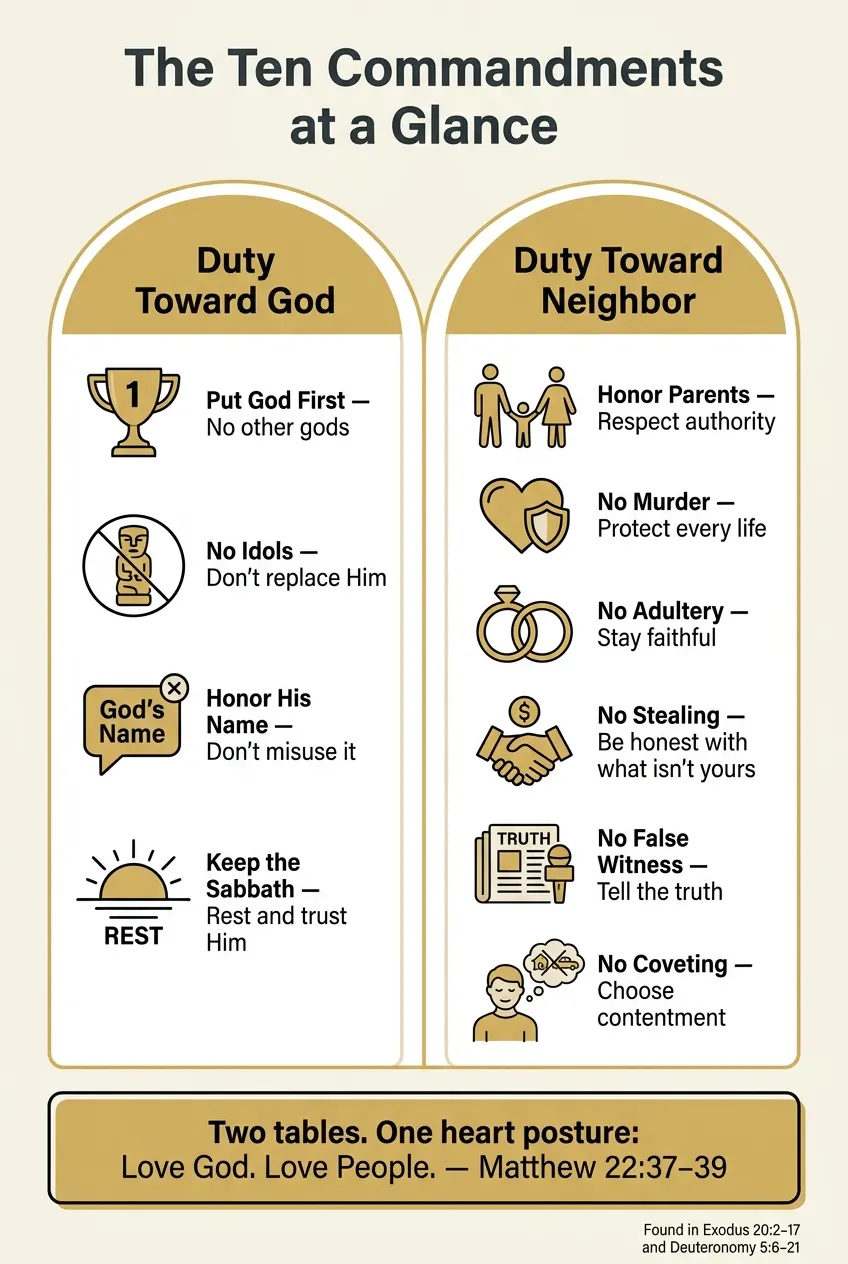
The Ten Commandments: Two Tables at a Glance
The 10 Commandments Explained (Why They Still Matter Today)
Quick Comparison
| Section | Main Focus | Plain meaning |
|---|---|---|
| 1–4 | Love for God | Worship Him rightly, speak of Him rightly, trust Him enough to rest |
| 5–10 | Love for people | Show honor, protect life, stay faithful, tell the truth, and be content |
| Psalmlog use | Self-examination | Journal one command at a time, name your struggle, and pray about it |
2. Commandments 1–4: What Faithfulness to God Looks Like
The first four commandments deal with your relationship with God. They shape how Christians worship, speak, and rest.
No Other Gods and No Idols (Commandments 1 and 2)
The first commandment is direct: God comes first – before career, money, popularity, or comfort. The second presses even further: don’t swap Him out for something you’ve made or imagined. Put together, these commands expose split loyalty.
Modern idolatry usually doesn’t look like bowing to a golden statue. It can look more ordinary than that. A job, appearance, bank account, or phone can start to carry more weight than God if they become the center of your identity.
"What dominates your thoughts, your goals, your conversation? What is the first love of your life? That is your god." – Pastor Colin Smith, Senior Pastor of The Orchard
The second commandment also warns against remaking God into a version that feels safer, easier, or more convenient. One simple test is to follow your time, money, and attention. They tend to show what you trust most.
Once worship is in the right place, speech and rest come into view.
Honor God’s Name and Keep the Sabbath (Commandments 3 and 4)
The third commandment goes beyond avoiding profanity. It means bearing God’s name in a way that lines up with who He is. So when someone says, “God told me to do this” to push a personal agenda, or sings worship songs while mentally planning lunch, that falls under this warning.
"Carrying God’s name ‘in vain’ means using it in a way that doesn’t line up with who he is, breaking his commands while appealing to his name. It twists God’s reputation into something false." – BibleProject
Using faith language to promote yourself or pressure other people is also a misuse of God’s name.
The fourth commandment – keeping the Sabbath – pushes against a world obsessed with productivity. In Exodus, rest is tied to creation, when God rested on the seventh day. In Deuteronomy, it is tied to redemption, when Israel was rescued from Pharaoh’s endless demands for more bricks. Both point at the same false idea: that your worth comes from your output.
One practical way to live this out is simple: set aside one day each week with no work email and no social media. Treat that day as an act of trust, not a performance.
These four commands lay the groundwork for the next six, which turn to how love for God shapes love for people.
3. Commandments 5–10: What Love for Neighbor Looks Like
The last six commandments turn outward. They deal with how you treat other people, and they show what love for neighbor looks like. Jesus summed up this part of God’s law in that simple phrase: love your neighbor. These commands make that love concrete in daily life.
Honor, Life, and Faithfulness in Relationships (Commandments 5–7)
The fifth commandment – honor your father and mother – is the first commandment tied to a promise: long life and stability in the land. That detail isn’t small. It shows that family sits near the center of a healthy society. In daily life, this means respect, gratitude, and care for parents and elders across the whole span of their lives, including helping them as they age.
The sixth commandment reaches further than many people think. Do not murder doesn’t stop at physical violence. Jesus made clear that anger, contempt, and insulting speech also break this command. Road rage, online vitriol, and character assassination are plain modern examples. You may never harm someone with your hands, but what about with your words?
The seventh commandment – do not commit adultery – guards the covenant of marriage and sexual integrity. It also reaches lustful thoughts, pornography, and emotional affairs. Faithfulness starts in the mind. Once a person is treated like an object instead of a whole human being, love has already begun to erode.
Honesty, Truth, and Contentment (Commandments 8–10)
The eighth commandment – do not steal – covers more than shoplifting. Digital piracy, padding an expense report, and wasting company time all fit here. In each case, you’re taking what isn’t yours. Beneath that is a heart that must learn to trust God for provision and handle what it has with honesty.
The ninth commandment calls for truth in speech everywhere, not just in court. Passing along an unverified rumor on social media, stretching a story to make yourself look better, or gossiping about a coworker all break this command. A simple filter can help before you speak or share:
- Is this verified?
- Is it true?
The tenth commandment goes after desire, not just behavior. Do not covet speaks to the resentment that treats another person’s blessings like a personal offense. It’s the root that can grow into theft, dishonesty, and broken relationships.
"Covetousness is a lack of contentment… it is at the heart of all the brokenness in society." – Mike Leake, Lead Pastor, Calvary of Neosho
Social media comparison, lifestyle envy, and greed shaped by consumer culture are exactly the kind of soil where coveting grows fast.
Comparison Table: Each Commandment, the Sin It Forbids, and a Psalmlog Reflection Angle

Here is a quick summary of each command and the heart posture it calls for.
| Commandment | Sin It Forbids | Inward Posture God Wants | Psalmlog Reflection Angle |
|---|---|---|---|
| 5. Honor Parents | Disrespect, neglect of elders, or rebellion | Gratitude and respect for authority | Reflect on how you spoke to or about your parents or elders today |
| 6. No Murder | Physical killing, hatred, contempt, and dehumanizing speech | Valuing every life as made in God’s image | Did you assassinate someone’s character in your mind or online? |
| 7. No Adultery | Lust, pornography, and emotional infidelity | Purity of heart and relational faithfulness | What pulled your heart toward lust today? |
| 8. No Stealing | Digital piracy, fraud, and wasting company time | Stewardship and honest integrity | Were you honest with your time and work today? |
| 9. No False Witness | Gossip, slander, and spreading rumors | Commitment to truth and transparency | Did you repeat something unverified or exaggerate the truth about someone? |
| 10. No Coveting | Envy, social comparison, and greed fed by consumer culture | Contentment and trust in God’s provision | What did you see today that stirred envy or discontent? |
Psalmlog’s voice journaling fits this kind of self-examination well. Saying out loud what happened can bring resentment, comparison, and half-truths into the open. Over time, those patterns start to show the heart issues these commandments were meant to expose. That’s often where honest confession and repentance begin.
Next, use these reflections in a simple 10-day or 10-week journaling plan.
4. How to Reflect on the Ten Commandments With Psalmlog
Psalmlog can help you turn each commandment into a short, honest heart check by connecting Bible verses to your daily reflections. Use the summary table above as a simple guide for each entry. The goal is to work through one commandment at a time and let it search your heart. This is not about piling on guilt. It’s about seeing clearly and praying honestly.
A 10-Day or 10-Week Journaling Plan
You can take a 10-day plan or a 10-week plan. With the 10-day plan, you move through one commandment each day. With the 10-week plan, you stay with one commandment for a full week, which gives life time to happen before you record your reflection.
Each Psalmlog voice entry can follow the same four-part format:
- The Command – say it in plain words.
- The Difficulty – name the main struggle.
- The Example – point to one moment from the past 24 hours when that struggle showed up.
- The Prayer – ask for grace to change.
Start with commandments 1–4, then move to 5–10. That split matches the shape of the commandments themselves: your relationship with God first, then the way you treat other people.
Using Psalmlog Insights to Spot Repeated Struggles
One journal entry shows a moment. A pattern shows your heart. After a few entries, Psalmlog’s personal insights dashboard can show which commands keep coming back. That happens through pattern tracking, not just because you labeled entries a certain way.
For example, if restlessness or anxiety keeps surfacing, that can point to the 4th Commandment – a pace of life that doesn’t trust God to provide when work stops. If contempt or hatred keeps showing up, that often falls into 6th Commandment territory. You can also tag entries with the commandment you’re reflecting on, such as #Commandment10. Then the dashboard can show which areas of obedience feel hardest over time.
"The commandments are like a tutor, a coach, or a mentor… the commandments will show you where you need to go (the kind of life that God calls you to live), and then it will walk you to Christ." – Pastor Colin Smith, Senior Pastor, The Orchard
Let those patterns shape your prayers. When one area keeps surfacing, pray there with honesty and focus.
5. Conclusion: What the Ten Commandments Ask of Christians Today
Once you see each commandment lived out, the big point comes into focus: the Ten Commandments are not a scorecard for earning God’s approval. They are God’s way of shaping the lives of people He has already rescued.
These commands go past outward actions. They show us what God is like, and they also show us how much we need grace. They bring both behavior and motive into the light.
The tenth commandment makes that plain. It reaches into the hidden place of desire, where no one else can see.
That is where Psalmlog can help. It helps you name one struggle, reflect on one moment, and notice repeating patterns. That’s often where growth begins.
The Ten Commandments call Christians to obey with gratitude, honesty, and a steady dependence on grace.
FAQs
Do Christians still need to follow the Ten Commandments today?
Yes. Most Christian traditions teach that the Ten Commandments still apply today as the moral core of God’s law.
They don’t earn salvation, but they still guide Christian living. Why? Because they reflect God’s character and His design for love, freedom, and life in community. Jesus sums them up in two big ideas: loving God and loving your neighbor.
How do the Ten Commandments reveal heart sins?
The Ten Commandments expose heart sins by going past outward behavior and getting to the motives behind it. They’re not just a set of external rules. They show what’s running your inner life: your thoughts, your aims, and your deepest loyalties.
Take idolatry. It shows up when things like money, fame, or power start to matter more than God. Coveting does something similar. It brings hidden jealousy and discontent into the open. In that sense, the commandments act like a mirror. They show whether your devotion is centered on God or pulled toward worldly things.
How can I apply a commandment to daily life?
Live out a commandment in daily life by treating it as a path toward freedom and wisdom, not just a rule that says “don’t.”
For example, you can keep the fourth commandment by setting aside regular time for rest, prayer, reflection, and time with the people you love. You can also live out the first commandment by bringing God into your choices and starting your day with prayer.