
Decision Fatigue for Solopreneurs
Simplify solopreneur decisions with Scripture-based nonnegotiables, decision filters, prayer, voice journaling, and routines.
Feeling drained by constant decisions? Solopreneurs face decision fatigue daily – juggling tasks like strategy, marketing, and finances. This mental exhaustion can lead to poor choices and burnout. Here’s how to simplify your decision-making process and regain clarity:
- Set nonnegotiables: Use clear principles rooted in Scripture (e.g., Proverbs 16:3) to guide decisions automatically.
- Use decision filters: Evaluate choices with tools like the Peace Filter (Philippians 4:6–7) or Stewardship Filter (Matthew 25:14–30).
- Pray and pause: Seek wisdom (James 1:5) and take time before acting on major decisions.
- Voice journal: Record thoughts to uncover patterns and reduce mental clutter.
- Streamline routines: Automate small decisions and batch tasks to conserve energy.
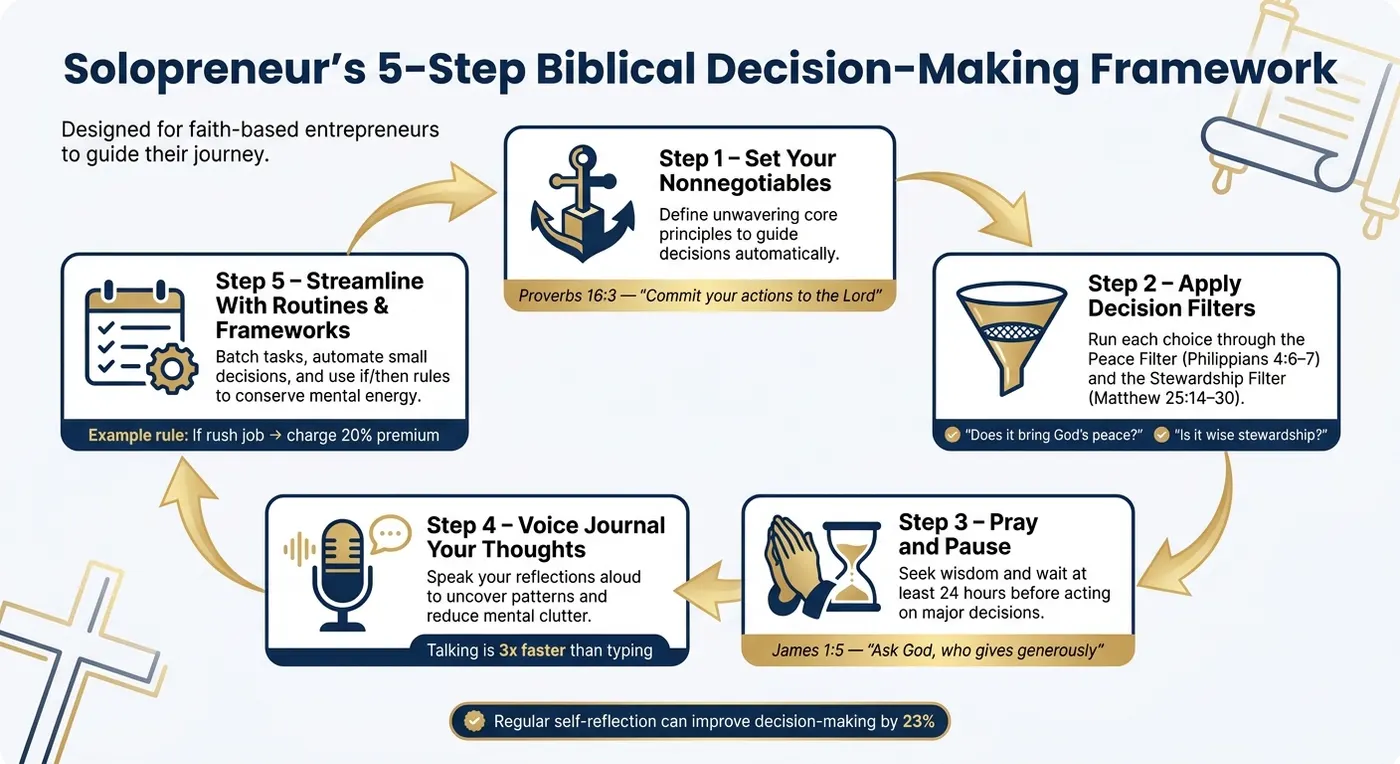
Solopreneur’s 5-Step Biblical Decision-Making Framework
Making Decisions From a Biblical Foundation
Running a business on your own means every decision ultimately rests on your shoulders. While that can feel overwhelming, Scripture offers not only comfort but also a reliable framework to help you approach decisions with greater clarity and confidence.
Setting Nonnegotiables With Scripture
One way to cut down on decision fatigue is to establish clear, unwavering principles. By rooting your core values in Scripture, you create a dependable guide for your choices.
Proverbs 16:3 provides this reassurance: "Commit your actions to the Lord and your plans will succeed."
Take Stefanie Gass, founder of Stefanie Gass LLC, as an example. She built a 7-figure business by setting a nonnegotiable boundary: no social media for lead generation. Even though it went against industry norms, she followed her prayer-led conviction to focus solely on podcasting. The result? A top 20 podcast and a thriving business – all while working less than 20 hours a week.
"The answer to most every problem and decision in your business comes straight from the Word of God." – Stefanie Gass, CEO of Stefanie Gass LLC
Your nonnegotiables might look different. Maybe it’s a commitment to honest marketing, inspired by Proverbs 11:3, or adopting a financial framework like the 10/10/80 rule (10% tithe, 10% savings, 80% for operations). It could even be something as simple as setting a firm boundary for work hours. The key is to define these principles prayerfully, anchor them in Scripture, and let them guide your smaller, everyday decisions automatically.
With these principles in place, you’ll find it easier to navigate choices with a clear sense of direction.
Building Simple Scripture-Based Decision Filters
Once your nonnegotiables are established, you need a practical way to evaluate decisions as they arise. A Scripture-based decision filter can serve as a consistent tool to assess your options before taking action.
Here are two filters you can incorporate into your decision-making process:
- The Peace Filter (Philippians 4:6–7): Does the decision bring a sense of God’s peace? If you feel uneasy, it’s worth pausing to reflect further.
- The Stewardship Filter (Matthew 25:14–30): Does the decision align with wise stewardship of the resources God has entrusted to you? Proverbs 21:5 offers a helpful reminder: "Good planning and hard work lead to prosperity, but hasty shortcuts lead to poverty."
A helpful exercise is the "Corner Office" visualization. Before making a big decision, imagine sitting down with God as your CEO and asking for His approval. This simple pause can help interrupt impulsive choices.
Between 2018 and 2025, Stefanie Gass transitioned from a high-stress, hustle-focused approach to a God-led strategy by using filters like these. This shift allowed her to build a community of more than 12,000 kingdom entrepreneurs and achieve a top 20 podcast ranking – not by chasing every opportunity, but by carefully filtering them through prayer and Scripture.
Once a decision passes these filters, prayer becomes the next step to refine your path.
Praying Through Decisions
Prayer takes the weight of decision-making off your shoulders and places it in God’s hands. By pausing to name the decision and seek His wisdom, you tap into the promise of James 1:5: "If any of you lacks wisdom, you should ask God, who gives generously to all without finding fault, and it will be given to you."
"Running a kingdom business is the same – no matter how long you’ve been in business… if you’re not doing this with God as your CEO and partner, it will be hard. And you may even end up shipwrecked." – Stefanie Gass, Founder, Stefanie Gass LLC
The challenge often lies in waiting. For action-oriented entrepreneurs, holding back from immediate action can feel unnatural. But even a 24-hour pause can help you avoid impulsive decisions that might lead to bigger issues down the road. Consider connecting voice journaling with Scripture during this time to document your prayers and insights. This practice not only helps you process your thoughts but also strengthens your decision-making – a topic we’ll dive into further in the next section.
How Voice Journaling Clears Mental Clutter
Using a Scripture-based approach, voice journaling helps you capture and clarify your thoughts before distractions take over. Once you’ve prayed about a decision, the next step is to record what comes to mind. Voice journaling becomes more than a spiritual exercise – it’s a practical tool you can use daily.
Why Voice Journaling Works
Speaking your thoughts aloud forces you to articulate them clearly, often uncovering hidden assumptions you might not notice otherwise. For solopreneurs, who often lack someone to bounce ideas off, voice journaling can fill that gap. Plus, it’s incredibly efficient – talking is over three times faster than typing. For example, saying something like, “I’m feeling anxious about this pricing decision,” can help you determine whether your hesitation is rooted in fear or a calculated risk.
How to Start a Voice Journaling Practice
Psalmlog is specifically designed for faith-centered, voice-first journaling. You simply speak your thoughts, whether briefly or in depth, and the app transcribes everything locally on your device. The audio is deleted immediately, leaving only the text transcript.
In about 60 seconds, Psalmlog provides a six-part pastoral response: a relevant Bible verse, a reflection, encouragement, a prayer, a practical action step, and a personal connection to your entry. If your thoughts feel scattered, the Faith Builder plan ($19.99/month or $14.99/month billed annually) includes over 20 templates tailored to life situations like career decisions, financial concerns, or work-life balance. With these tools, you can turn your reflections into clear, actionable insights.
Turning Journal Entries Into Decisions
The power of voice journaling lies in transforming your reflections into concrete decisions. After each session, focus on the practical action step provided in the response – it’s designed to help you move forward. Reviewing your transcripts weekly can uncover patterns, such as recurring fears, unresolved questions, or a consistent sense of peace about a choice. These insights, guided by your core values, provide clarity for future decisions.
To refine your process, consider a post-decision review. Reflect briefly on what worked, what didn’t, and what you might adjust next time. This practice not only creates a record of your decisions but also helps reduce second-guessing, which can drain your energy weeks later. By combining regular reflection with biblical principles, you strengthen both your spiritual and practical decision-making.
"I used to spend 2–3 hours searching for relevant Scripture when facing big decisions. Psalmlog gives me biblical answers in minutes, right when I need them." – Sarah M., marketing executive
The goal isn’t to achieve perfection – it’s to gain clarity. And when reflection becomes a regular habit, that clarity builds over time.
Daily Routines That Cut Down on Decision Overload
Once you’ve established a voice journaling habit, the next step is structuring your day to lighten the mental load of constant decision-making. The aim isn’t to eliminate choices but to reduce the effort your brain spends on them. These routines build on your journaling practice, helping you navigate each day with greater clarity and focus.
Building Simple Daily Routines
Psychologists have found that the more choices you make in a day, the harder each subsequent decision becomes. This phenomenon often leads to impulsive actions or complete inaction. A consistent daily routine can help break that cycle. By setting a fixed wake-up time, sticking to a simple breakfast, and starting work at the same time every day, you can put smaller decisions on autopilot, saving your mental energy for higher-stakes tasks.
"By sticking to a regimen, less-important tasks can go on autopilot." – Escalon
This isn’t just practical – it can also feel deeply grounding. A structured routine reflects the biblical emphasis on rest and focus. Starting your day with prayer or a brief Psalmlog entry connects your routine to a deeper purpose, making it more than just a checklist.
Batching Decisions to Reduce Mental Load
Switching between different tasks – like emails, invoicing, and strategic planning – is one of the biggest drains on mental energy. This constant context switching saps focus and leaves you feeling depleted. Batching tasks into dedicated blocks of time can help. For example, set aside specific times for client emails, designate one day for invoicing, and reserve a focused weekly session for content planning.
This rhythm mirrors the way Jesus balanced periods of intense work with intentional rest and reflection. It’s not about being inefficient – it’s about working smarter.
When you combine a streamlined daily routine with task batching, you create a foundation for even more effective decision-making tools.
Creating Personal Decision Frameworks
A personal decision framework simplifies recurring choices by turning them into predefined rules. Identify the decisions that drain you the most – whether it’s choosing clients, determining pricing, or defining project scopes – and create clear if/then rules to handle them. Reviewing your Psalmlog transcripts monthly can also help you spot patterns and refine these rules.
Here are some ideas to get started:
- Foundational Decisions: Establish fixed work hours and core services to avoid daily debates.
- Decision Templates: Use if/then rules for predictable scenarios (e.g., "If a client requests a rush job, then I will charge a 20% premium").
- Batching: Group similar tasks into specific time blocks to avoid the fatigue of constant task-switching.
- 24-Hour Rule: Delay decisions involving over $100 or requiring more than five hours of work by 24 hours to prevent impulsive choices.
- Decision Journal: Write down your reasoning for key decisions and review it monthly to identify trends and improve your process.
You can also align these frameworks with your faith. For instance, create a rule like, "If a project requires working on my Sabbath, I will decline or reschedule." This not only simplifies decision-making but also removes guilt and doubt by staying true to your values.
"Each decision, no matter how small or seemingly insignificant, chips away at your mental energy, leaving you drained and exhausted by the time afternoon rolls around." – RedBlink
Start with one recurring decision that drains your energy, create a straightforward rule for it, and stick to that rule for a week. Gradually add more rules over time. These small, consistent steps can help you build habits that significantly reduce decision fatigue.
Staying Clear Through Reflection and Trust in God
Your routines and decision-making frameworks thrive when paired with consistent reflection and reliance on God. Taking time to evaluate and adjust ensures your systems stay effective. Let’s look at how scripture-based reflection and discernment can sharpen your decisions.
Weekly Check-Ins for Spiritual and Emotional Health
Set aside five minutes each week to review your decisions and spot patterns. Studies show that regular self-reflection can improve decision-making by 23%. Use insights from your voice journal to identify recurring "decision danger zones" – those moments or emotional states when your judgment tends to falter. For many solo entrepreneurs, this might happen after 3:00 PM or during weeks packed with deadlines.
Ask yourself three straightforward questions during these check-ins:
- What decision am I most proud of?
- What would I do differently?
- What patterns am I noticing?
"If you get tired, learn to rest, not to quit." – Abhimanyu Bhargava, Health Coach and Solopreneur
Balancing Data With Spiritual Discernment
While measurable results are important, don’t overlook subtle cues – like a sense of unease about a client or unexpected peace about a risk. These feelings aren’t random; they’re another form of data. Proverbs 3:5–6 reminds us to balance logical analysis with trust in God’s guidance.
Jessica DeYoung, founder of Grace Unworthy Ministries, explains this balance beautifully:
"The clarity grows not from cleverness alone but from a heart that seeks God first and asks, ‘What does love require here?’"
When the numbers point in one direction but something feels off, take time to sit with that tension. Often, it’s a signal worth exploring before making a final decision.
Accepting Limits and Trusting God With Outcomes
Even the most well-thought-out frameworks can’t guarantee outcomes. That’s where trust in God comes in. Tools like Psalmlog’s sentiment analysis and personal insights dashboard can help you recognize when you’re carrying too much emotionally or spiritually. Let go of what’s weighing you down and trust God to handle what’s beyond your control. Do your best – and leave the rest to Him.
FAQs
How do I pick my nonnegotiables?
To figure out your nonnegotiables, start by pinpointing the core values and priorities that truly matter to you. These should align with your purpose and spiritual beliefs. Zero in on the tasks and commitments that are essential for both your business and personal well-being. Drawing on biblical wisdom and taking time for spiritual reflection can help ensure these priorities support your bigger purpose. This approach can lighten mental overload and keep you grounded in the face of endless decisions.
What if I don’t feel “peace” about any option?
If none of the options bring you a sense of calm, it might be a good idea to pause and take some time to pray for direction. Reflecting on scripture can also provide insight and reassurance. The Bible often emphasizes trusting in divine guidance, even when things feel uncertain. Waiting for that inner peace can help you make decisions with greater clarity and confidence.
How can I use voice journaling to decide faster?
Voice journaling simplifies decision-making by allowing you to vocalize your thoughts. The app transcribes what you say and provides a six-point pastoral response, complete with relevant Scripture, reflections, encouragement, and a clear action step. This approach cuts down on overthinking and decision fatigue, offering spiritual clarity in just about 60 seconds – no lengthy writing required.