
Bible Verses for Military Families' Strength
Seven Bible verses offering courage, peace, and spiritual resilience for service members and families during deployment.
Deployment is tough – for service members and their families. Separation, worry, and the challenges of daily life can feel overwhelming. Faith, however, offers strength and comfort during these moments. This article highlights 7 Bible verses to help military families find courage, peace, and resilience. Here’s a quick overview:
- Joshua 1:9: Encourages strength and courage, reminding families that God is always with them.
- Psalm 46:1: Declares God as a refuge and source of strength in times of trouble.
- Isaiah 41:10: Promises God’s unwavering support and strength during hard times.
- Deuteronomy 31:6: Assures that God will never leave or forsake you, even in isolation.
- Psalm 91:14: Highlights divine protection for those who trust in God.
- Ephesians 6:11: Describes the "armor of God" to face life’s challenges with faith.
- Psalm 73:26: Reminds us that God’s strength sustains us when we feel weak.
Each verse offers practical ways to stay spiritually grounded – whether through prayer, memorization, or sharing these promises with loved ones. Let these scriptures guide you through the trials of deployment, providing hope and strength when you need it most.
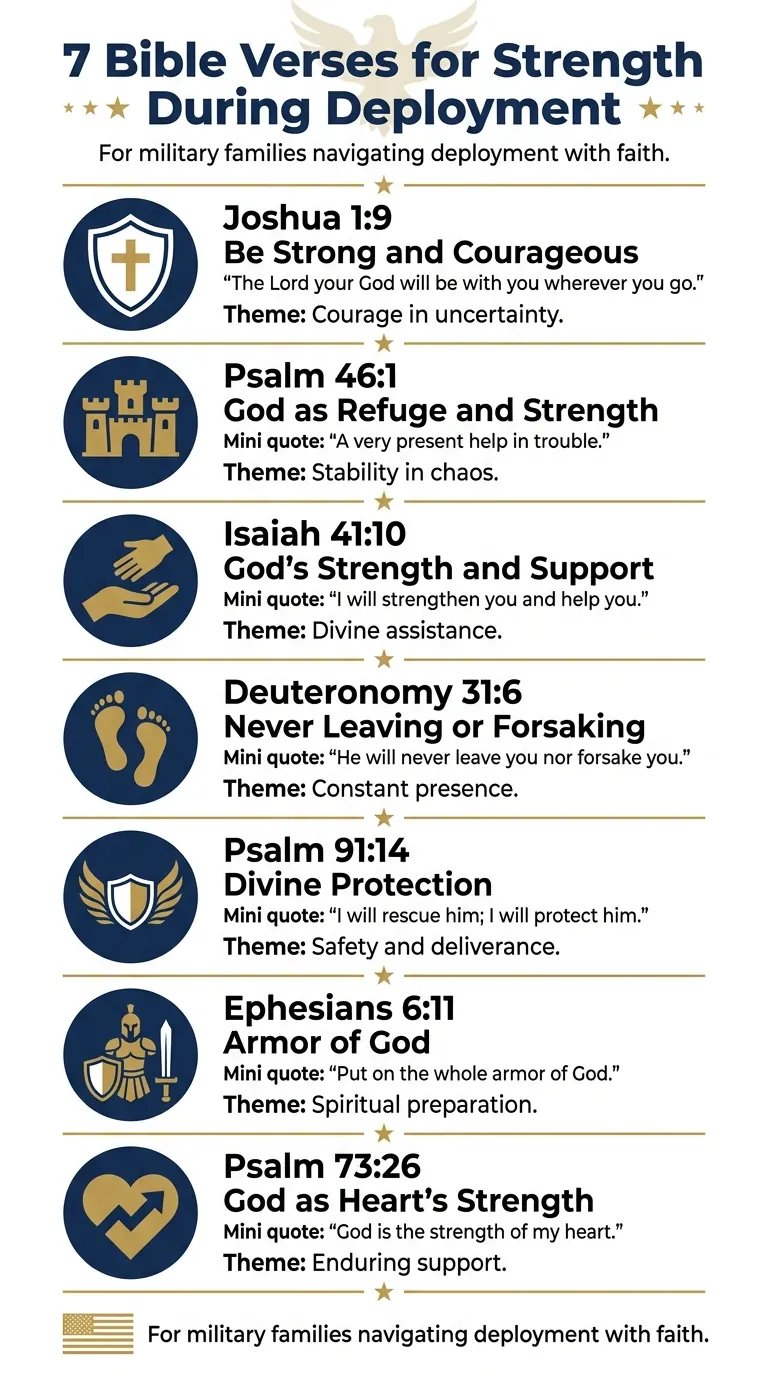
7 Bible Verses for Military Families During Deployment
1. Joshua 1:9 – Be Strong and Courageous
"Have I not commanded you? Be strong and courageous. Do not be afraid; do not be discouraged, for the Lord your God will be with you wherever you go." – Joshua 1:9 (NIV)
This verse was originally spoken to Joshua as he prepared to lead the Israelites into unknown and possibly dangerous territory during a time of great transition. It’s a powerful reminder, especially for military families, who often face their own uncertainties during deployment.
The verse encourages action despite fear. It’s a call to stand firm, leaning on faith and God’s strength rather than relying solely on your own. For those at home, this might mean tackling everyday responsibilities – like managing a household, raising children, or making tough decisions – even when worry about a loved one’s safety feels overwhelming.
The heart of the message is the promise: God is "with you wherever you go." This applies equally to the service member deployed far from home and to the family member holding things together on the home front.
John Gill, in his Exposition of the Bible, reflects on this idea, noting that believers shouldn’t be discouraged by their perceived inadequacies, as "it was enough that the divine Presence was promised him."
To keep this verse close during deployment, consider creative ways to incorporate it into daily life. Write it on sticky notes and place them around your home, include it in care packages for your deployed loved one, or use the phrase "wherever you go" as a simple breath prayer. Ask God for the strength to handle the challenges of solo parenting and the courage to face each day with faith. By taking small, intentional steps, you can trust that God is guiding you through this season.
Up next, explore another verse that offers comfort and strength during the trials of deployment.
2. Psalm 46:1 – God as Refuge and Strength
"God is our refuge and strength, a very present help in trouble." – Psalm 46:1 (ESV)
Psalm 46:1 offers a steadying truth during the uncertainties of deployment. The chapter paints a vivid picture of chaos – mountains crumbling, roaring waters – reflecting the emotional storms families often face during these times. In the midst of it all, this verse calls you to find stability in God’s unwavering presence.
A refuge is more than just a shelter; it’s a place where danger cannot reach. For military families, this verse reminds you that true safety isn’t tied to changing circumstances but to God’s constant care. Whether you’re far from home or managing life alone, God hears your prayers and remains close.
The phrase "very present help" is especially comforting. It tells us that God isn’t a distant figure watching from afar. Instead, He is actively present in our struggles. As WatermarkWaves explains:
Being a present help does not always mean immediate removal of trouble. Instead, it means God walks with His people through it.
This reassurance doesn’t promise an instant fix for your challenges but guarantees that you’re never walking through them alone.
Consider memorizing this verse to bring peace during anxious moments. When plans fall apart or separation feels overwhelming, choose prayer over panic. Let go of the need to control everything and trust God’s timing. You could even turn this verse into a prayer, asking Him for the strength and comfort you need in moments of fear or loneliness.
Next, we’ll explore how God’s promise to uphold you can provide hope and resilience during even the hardest days apart.
3. Isaiah 41:10 – God’s Strength and Support
"So do not fear, for I am with you; do not be dismayed, for I am your God. I will strengthen you and help you; I will uphold you with my righteous right hand." – Isaiah 41:10 (NIV)
Isaiah 41:10 resonates deeply with the challenges faced by military families. Though originally directed to the Israelites during their exile, its message parallels the feelings of separation and uncertainty that military families often endure. At its heart, the verse offers a powerful assurance: "I am your God." This intimate declaration signifies a bond where your burdens are shared with Him. It’s not just a comforting statement – it’s a source of strength for navigating daily struggles.
The phrase "Do not be dismayed" is a reminder to resist feelings of panic or being overwhelmed. Whether it’s managing a household solo, making tough decisions without your partner, or lying awake consumed by worry for their safety, these words encourage calm in the face of chaos.
What makes this verse especially impactful is the promise of resilience. The Hebrew word for "strengthen" (amats) conveys the idea of being made courageous and steadfast. Bible scholar Anurag Rao explains:
"God’s strengthening empowers you to endure and persevere through challenges."
This strength might reveal itself as emotional steadiness during setbacks, mental clarity when decisions weigh heavy, or even physical energy when resources feel stretched thin.
The promise to "uphold" is equally profound. It suggests that God sustains you when you feel like you’ve reached your limit. As Faithful Canvas describes it, "The word uphold carries the sense of keeping you from collapse – holding you so you won’t fall". When you feel on the verge of breaking, imagine His "righteous right hand" holding you steady, ensuring you don’t falter.
To bring this verse into your daily life, consider speaking words of faith over your emotions. When anxiety starts to creep in, say out loud: "You are my God." This simple declaration can reaffirm your sense of security and identity. Additionally, bring your specific concerns – whether they involve childcare, home repairs, or financial decisions – to Him, trusting that no detail is too small for His care.
These reassurances lay a foundation for exploring more of God’s unwavering support in the challenges ahead.
4. Deuteronomy 31:6 – Never Leaving or Forsaking
"Be strong and courageous. Do not be afraid or terrified because of them, for the Lord your God goes with you; he will never leave you nor forsake you." – Deuteronomy 31:6 (NIV)
Deployment often brings feelings of isolation – whether you’re serving far from home or holding things together on the homefront. In this verse, God’s promise highlights His constant presence, offering reassurance during those lonely moments. The phrase "the Lord your God goes with you" is particularly striking. The original Hebrew, hōlēḵ ʿimḵem, emphasizes an ongoing, active companionship.
This verse shifts the idea of courage. It’s not about being fearless on your own but about drawing strength from your relationship with God. It encourages decisive action and steadfastness, even in the face of separation and uncertainty.
The promise that God will "never leave nor forsake" comes from ancient covenant language. Originally meant for the Israelites as they faced the unknown, it now provides comfort to military families dealing with the challenges of deployment, frequent moves, or reintegration. Just as the Israelites faced unfamiliar lands, families today can rest in the knowledge that they are never alone – every step is shared with a faithful God.
In practical terms, this verse can guide how we face daily struggles. For example, you could turn it into a meaningful family moment: say to your kids, "Be strong and courageous!" and let them respond, "For the Lord our God goes with us!" Another idea is to keep a small card with Deuteronomy 31:6 written on it. Pull it out during moments of anxiety, and speak the verse aloud as a reminder of God’s promise.
This truth turns isolation into a source of shared strength and unwavering courage.
5. Psalm 91:14 – Divine Protection for the Devoted
"Because he loves me", says the Lord, "I will rescue him; I will protect him, for he acknowledges my name." – Psalm 91:14 (NIV)
This verse offers a powerful reminder to military families who worry about their loved ones’ safety during deployment. God’s promise here is deeply personal and rooted in relationship – protection is tied to love for Him and acknowledgment of His name. For families and service members, this verse can transform fear into a reason to pray with confidence. It provides both historical significance and practical application.
Known as the "Soldier’s Psalm", this passage has been a source of comfort for U.S. troops since World War II and continues to be recommended by military chaplains. In 2015, U.S. Army Sgt. Ryan Pitts shared how Psalm 91:14 sustained him during a grueling 100-minute firefight where nine of his comrades lost their lives. He prayed this verse in the midst of the battle, later crediting it with giving him the strength to endure. Pitts reflected on its impact in a 2016 Military.com interview.
Using this verse as part of daily prayers can strengthen its meaning in your life. Families can pray it specifically for their deployed loved ones, saying: “Lord, [service member’s name] has set their love upon You; deliver and protect them as promised in Psalm 91:14.” Some families even write it in prayer journals to track their petitions and answers or send laminated cards with the verse to their loved ones overseas. These small but meaningful acts help reinforce faith and bring comfort in tough times.
The phrase "acknowledges my name" emphasizes trust and public faith. For military families, this might mean staying committed to spiritual practices, like attending chaplain services or joining faith-based support groups, even under the stress of deployment. When both the deployed service member and their family lean on this promise together, it creates a shared spiritual strength that endures beyond the challenges of separation.
6. Ephesians 6:11 – Armor of God Against Adversity
"Finally, be strong in the Lord and in the strength of his might. Put on the whole armor of God, that you may be able to stand against the schemes of the devil." – Ephesians 6:10-11 (ESV)
Ephesians 6:11 uses the imagery of armor to illustrate how God’s spiritual protection shields hearts and minds from fear and discouragement. Similar to the encouragement found in Joshua 1:9 and Isaiah 41:10, this verse prepares believers to face spiritual challenges with strength and assurance. For military families, this "armor" offers a proactive way to handle the daily uncertainties and difficulties they encounter.
This spiritual armor consists of six key elements: the belt of truth, the breastplate of righteousness, the shoes of the gospel of peace, the shield of faith, the helmet of salvation, and the sword of the Spirit, which represents God’s Word. Together, these pieces empower believers to stand firm against spiritual struggles.
Olivia Clarke, Founder of Bible Inspire, emphasizes how the shield of faith is particularly effective in deflecting fears and doubts:
"Satan hurls thoughts, feelings, imaginations, fears, and lies as fiery darts. Faith turns them back."
For example, when fear creeps in about the safety of a loved one, the shield of faith helps stop those anxious thoughts from spiraling into overwhelming panic.
Putting on this armor isn’t a passive act – it requires daily commitment. Clarke explains:
"The instruction to ‘put on’ this armor mirrors the daily, intentional act of getting dressed. This requires deliberate, consistent daily action."
Start each day by grounding yourself in Scripture to secure the belt of truth. When guilt or doubt arises, lean on Christ’s righteousness to stay steady. Memorizing verses can also provide quick reassurance in moments of need. This daily practice ensures that military families are spiritually prepared to face the challenges that come with deployment and service.
Additionally, the idea of soldiers linking their shields together for strength offers a powerful reminder of the importance of community. Military families can draw on their spiritual community for support – whether through chaplain services, faith-based groups, or simply connecting with other military spouses. Together, they form a stronger defense against the uncertainties and hardships of deployment.
With this spiritual armor firmly in place, the next scripture continues to provide encouragement and guidance for navigating the complexities of military life.
7. Psalm 73:26 – God as Heart’s Strength
"My flesh and my heart may fail, but God is the strength of my heart and my portion forever." – Psalm 73:26
This verse offers a powerful reminder for anyone facing the challenges of deployment: when our personal strength falters, God’s strength remains steadfast.
Deployment often takes a toll on military families, both physically and emotionally. Exhaustion from sleepless nights, illnesses, or constant worry can wear down the body, while anxiety and discouragement weigh heavily on the heart. Psalm 73:26 doesn’t dismiss these struggles – it acknowledges them as part of life’s hardships. This validation can be a source of comfort, reminding families that feeling weary doesn’t mean failure.
The verse shifts the focus from human limitations to God’s unwavering strength. The Hebrew word for "strength" conveys the idea of a secure refuge, a place to turn when everything else feels uncertain. Meanwhile, the term "portion" reflects the concept of inheritance, a lasting share that cannot be taken away. For military families navigating temporary and unpredictable circumstances, this is a reassurance that God’s support is enduring and dependable.
When you feel overwhelmed, take a moment to recognize your limitations and turn to God. Saying, "God is the strength of my heart", can be a grounding affirmation during moments of fatigue or stress. Starting each day by inviting His presence can help you stay centered, and even small gestures – like leaning back in your chair – can serve as a physical reminder to rest in His strength.
Consider using creative prayer journal ideas to document instances of unexpected peace, courage, or clarity. These moments are tangible evidence of how God’s strength can shine through our weakness, offering encouragement for the days ahead.
Conclusion
Deployment presents military families with physical, emotional, and spiritual hurdles. The seven Bible verses shared in this article directly address these challenges, offering comfort and reassurance that God is present through times of separation, fear, and uncertainty. From Joshua’s encouragement to be strong and courageous to the protective promises found in Psalm 91, these passages provide a steady source of strength for those facing overwhelming circumstances.
As Corine Williams, Ph.D., Clinical Psychologist, puts it:
One way to offer comfort and inspiration is to use scripture, which can provide a sense of hope and purpose even in the darkest of times.
These scriptures act as a spiritual compass, helping you stay focused on God amidst the trials of deployment. Whether you’re the one deployed or the loved one waiting at home, these verses can guide you through daily struggles, reminding you that no distance can separate you from God’s love.
To make these verses a part of your daily life, consider personalizing them, setting reminders to reflect on them, or journaling your thoughts and prayers. Small, consistent practices like these can help you draw on God’s strength when your own feels depleted.
Incorporating technology can also enhance these spiritual practices. For instance, Psalmlog offers tools designed to support your faith journey. Its voice journaling feature allows you to share your struggles and receive personalized Scriptures in return. With a tagging and insights dashboard, you can track God’s promises as you navigate deployment. The Faith Builder plan ($19.99/month) includes 300 minutes of recording time each month and access to all Bible translations, giving you a private and meaningful way to document God’s faithfulness.
These verses are a starting point – return to them whenever anxiety, loneliness, or doubt creep in. They serve as a source of armor, refuge, and strength for military families. In every challenge, let these scriptures ground your faith and remind you that God is always near.
FAQs
How can I use these verses when anxiety hits?
When you’re feeling anxious, certain Bible verses can provide a sense of comfort and reassurance. Philippians 4:6-7 encourages you to bring your worries to God through prayer and gratitude, assuring that His peace will protect your heart and mind. Isaiah 41:10 offers a reminder of God’s constant presence, promising strength and support in times of need. Reflecting on or meditating on these passages can help redirect your thoughts from fear to trust, offering a sense of calm and spiritual renewal.
What are simple ways to help kids during deployment with Scripture?
Helping children navigate the challenges of deployment can feel overwhelming, but Scripture offers a source of comfort and strength. Sharing comforting Bible verses with children and explaining them in simple, age-appropriate ways can help them feel God’s presence and love, even in uncertain times.
Encourage children to pray or even memorize these verses. This gives them something they can hold onto when they’re feeling sad or scared. For example, verses like “Be strong and courageous. Do not be afraid; do not be discouraged, for the Lord your God will be with you wherever you go” (Joshua 1:9) can remind them that they are never alone.
You can also weave Scripture into daily routines to create a sense of stability. Whether it’s through bedtime prayers, family devotions, or simply reading a verse together before meals, these small moments can provide a steady source of reassurance and peace during the deployment period.
How do I stay spiritually consistent while deployed or alone at home?
To maintain spiritual steadiness, whether during deployment or at home, turn to Scripture for strength and anchor your hope in God. Romans 15:4-6 speaks of endurance and encouragement found in His Word, while Isaiah 40:31 assures us that placing hope in the Lord renews our strength.
Make it a habit to read and reflect on these verses, spend time in prayer, engage in worship, and rely on God’s steadfast truth. These practices can help sustain you through the challenges of separation and uncertainty.