
Entrepreneurial Doubt: Hidden Costs & Fixes
Hiding doubt drains leaders, hurts decisions and team trust; faith-based voice journaling and trusted community can restore clarity.
Entrepreneurs often hide their doubts behind a confident front, fearing vulnerability might be mistaken for weakness. This tendency stems from cultural pressures to appear decisive, fear of imposter syndrome, and the expectations of stakeholders. However, suppressing doubt can lead to emotional strain, spiritual disconnection, and poor business decisions.
Key takeaways:
- Hiding doubt drains energy: Maintaining a façade of certainty can lead to burnout and decision fatigue.
- Faith-driven leaders risk spiritual disconnect: Shifting from relying on God to self-reliance disrupts spiritual growth.
- Business impact: Unprocessed doubt affects clarity, team trust, and long-term strategy.
Solution: Entrepreneurs can process doubt through honesty, community, and tools like voice journaling. For faith-based leaders, tools such as Psalmlog help connect doubts with Scripture, offering actionable insights. Sharing struggles with trusted advisors and fostering open communication within teams can build resilience and clarity.
Doubt isn’t a weakness; it’s a signal for growth when addressed thoughtfully.
Why Entrepreneurs Hide Their Doubts
The Pressure to Always Look Confident
Startup culture places a strong emphasis on confidence. Entrepreneurs are expected to show up to every investor meeting, team discussion, and pitch with unwavering certainty. When funding and partnerships are at stake, even the slightest hesitation can be perceived as a weakness.
As executive coach Dina Denham Smith and entrepreneurship expert Neri Karra Sillaman explain:
"Building a business is often framed as a strategic or operational challenge… But at its core, entrepreneurship is a personal one."
The entrepreneurial world often showcases success stories – funding milestones, product launches, and growth metrics – while the doubts and struggles behind the scenes remain hidden. This creates a culture where admitting uncertainty feels almost taboo, fueling deeper fears and insecurities.
Fear, Imposter Syndrome, and Spiritual Doubt
For many entrepreneurs, the fear of revealing doubt stems from imposter syndrome. They worry that acknowledging uncertainty might validate their inner fears of inadequacy.
"Building a company will always test your confidence. Some days will stretch it; others will rattle it to the core. Self-doubt in those moments is not a sign you’re not cut out to lead."
For faith-driven entrepreneurs, this struggle can take on an additional layer. Doubts about purpose, calling, or spiritual guidance can shake their confidence even further. These spiritual uncertainties not only affect their sense of personal direction but can also undermine the trust that supports their faith-based approach to leadership.
The combination of internal fears and external pressures makes it even harder to be vulnerable.
Why Relationships Make It Harder
Entrepreneurs often feel the weight of expectations from those who rely on them – investors, employees, and business partners. These stakeholders depend on the founder’s ability to provide a clear and steady vision. As finance and tech expert Basesh U. Gala puts it:
"Clarity is the bedrock upon which every successful entrepreneurial journey is built… This clarity acts as your guiding star, keeping your business on course even in turbulent waters."
Because clarity is seen as essential for navigating challenges, entrepreneurs fear that showing vulnerability might be interpreted as instability. This concern can make it difficult to open up, even when they’re struggling. Without a mentor who understands both the professional and personal dimensions of entrepreneurship, many founders find themselves isolated. What might look like strength from the outside is often a mask for loneliness and self-doubt.
What Hiding Doubt Actually Costs You
The Emotional and Personal Toll
Keeping doubt under wraps comes with a price – and it’s anything but small.
Leadership psychologist Margie Ireland puts it bluntly:
"Energy spent maintaining the performance of certainty is energy not available for strategic thinking, genuine connection with your leadership team, or the kind of clear-eyed decision making your role actually demands."
When you’re constantly working to appear confident, your mental capacity takes a hit. This phenomenon, often referred to as the "Conviction Tax," is the emotional toll of projecting confidence while privately battling uncertainty. Over time, this hidden struggle can show up as irritability, a shorter fuse, and a fragile demeanor.
Ireland also cautions that suppressing doubt often backfires:
"Trying to suppress, escape, or control internal experiences… tends to increase distress over time, not reduce it. This can also lead to unhealthy coping skills such as alcohol, drugs, bad diet, working even longer hours."
This kind of internal strain doesn’t just sap your energy – it can also leave you feeling disconnected spiritually, especially if you’re someone who leans on faith.
How It Affects Your Spiritual Life
For entrepreneurs who draw strength from their faith, hiding doubt can have a deeper, often overlooked cost: a spiritual one.
When you present only a polished version of yourself to God, the raw, unresolved struggles stay buried. As writer and strategist Steve Mitchell explains:
"I gave God the acceptable version of what I was feeling because the unacceptable version went unanswered too many times. That isn’t faith. It isn’t even doubt. It’s resignation dressed up as acceptance."
Christian author Douglas Vandergraph takes it further, highlighting the spiritual disconnect that can arise:
"The business was never meant to be an offering constructed independently by human hands. It was always meant to be a partnership where the Creator Himself remains the true builder."
When you shoulder the burden of every outcome alone, you unintentionally shift from building with God to building for God. That subtle but powerful shift can drain you spiritually, no matter how impressive your business achievements look on the surface.
When emotional, spiritual, and personal challenges collide, the ripple effects inevitably reach your leadership and business decisions.
The Impact on Your Business
Hidden doubt doesn’t just take a toll on you – it can quietly undermine your business, too.
Psychologist Heather Bingham observed a business leader in 2026 who spread his energy thin, giving as much attention to trivial decisions (like office coffee selections) as he did to long-term strategies. Despite working from 5 a.m. to midnight, his five-year plan fell flat. This is a classic example of decision fatigue – a slow but steady drain on your ability to think clearly and prioritize effectively.
Lina Rugova of Emerge and Rise adds:
"Self-doubt can be a significant barrier to success, affecting decision-making, productivity, and overall well-being."
The effects don’t stop with you; they extend to your team. When your uncertainty leaks out as inconsistency or resistance to feedback, trust quietly erodes. Your team may not be able to articulate what’s wrong, but they’ll sense it. And in today’s business landscape, where 2026 data shows many small businesses lagging in AI adoption – not due to lack of resources but hesitation and doubt-driven delays – unprocessed doubt becomes more than a personal issue. It’s a competitive disadvantage.
What the Bible Says About Doubt
God Welcomes Honest Questions
The Bible presents doubt not as a failure, but as a starting point for deeper understanding. In the New Testament, the Greek words for doubt – diakrino and distazo – describe hesitation or a divided mind rather than a moral flaw. Take John the Baptist, for example. While imprisoned, he questioned whether Jesus was truly the Messiah. Instead of rebuking John, Jesus pointed to His miracles as evidence of His mission. Similarly, when Thomas needed a direct encounter to overcome his doubts, Jesus met him in that moment. This led Thomas to proclaim, "My Lord and my God".
As Dan Veeneman puts it:
"God is not threatened by our uncertainty. He does not turn away when we waver."
The Psalms also reflect this openness to honest questioning. About one-third of them are laments – raw, heartfelt cries of grief and confusion directed to God. For example, David’s repeated question in Psalm 13, "How long, O Lord?" wasn’t an expression of weak faith but a sign of hope, trusting that God would eventually bring resolution. This biblical pattern of welcoming vulnerability lays a foundation for faith that thrives even amid uncertainty.
Humility Over Self-Reliance
The Bible also challenges the tendency to rely solely on our own understanding. In Psalm 73, Asaph almost gave up on his faith when confronted with the world’s injustices. His perspective shifted only when he "entered the sanctuary of God", where he found reassurance in God’s enduring presence. This shift highlights an important truth: trying to resolve doubt without turning to God often leads to frustration.
"Doubt that moves toward God, demanding to be resolved through encounter and Scripture, becomes a forge. Doubt that turns inward and feeds on itself becomes erosion."
One way to confront doubt is by naming it. Writing down specific questions can transform vague uncertainties into clear concerns, creating space for deeper engagement with God.
The Role of Community and Confession
Isolation often amplifies doubt, making it harder to process. The Bible emphasizes the importance of sharing struggles with others. James 5:16 encourages believers to "confess your sins to each other and pray for each other so that you may be healed", while Galatians 6:2 reminds us to "bear one another’s burdens". These verses highlight the healing power of community. Similarly, Jude 1:22 advises, "Be merciful to those who doubt", underscoring the importance of compassion and support.
Elyse Fitzpatrick sheds light on this dynamic:
"As long as we keep doubt secret, it has more power in our lives than it needs to."
Sharing doubts isn’t about seeking validation or dismissal but about finding people who can hold your questions and gently guide you back to God’s truth. In this way, community not only eases emotional strain but also encourages spiritual growth. This principle mirrors the value of trusted peers in other areas of life, such as navigating challenges in work or personal endeavors.
Using Voice Journaling to Work Through Doubt
Why Voice Journaling Works for Busy Entrepreneurs
Entrepreneurs often find themselves juggling countless responsibilities, leaving little room for traditional journaling. Doubts creep in during the most hectic moments – on the drive to a meeting, after a tough conversation, or while pacing after a hard decision. Voice journaling fits into these busy lives effortlessly because all it takes is your voice and a few minutes.
The beauty of speaking your thoughts aloud is that it skips over the self-censorship that happens when you write. Typing often leads to editing or softening your words, but when you speak, the unfiltered truth tends to come out. As one Business Founder at Innovate & Thrive shared:
"My contemplative practice gives me that crucial pause between receiving alarming news and responding to it. In that space, I can discern which reactions come from fear versus wisdom."
This pause – between feeling doubt and reacting to it – is where voice journaling shines. It creates a space to process uncertainty in a way that aligns with faith and clarity.
How to Journal Through Doubt as a Christian
Voice journaling isn’t about delivering a polished prayer; it’s about confronting your doubts as they arise. The goal is honesty, not perfection. Steve Mitchell found that speaking his doubts aloud broke the cycle of resignation and turned those feelings into opportunities for faith.
His method was simple: state your specific doubt aloud – whether it’s “I feel like my efforts aren’t making a difference” or “I feel like I’m falling behind.” Then, connect that doubt to a passage of Scripture and commit to one action that reflects trust instead of fear. The Songs of Ascents (Psalms 120–134) are particularly helpful here. These Psalms, once sung by pilgrims ascending to Jerusalem, offer a relatable model for entrepreneurs striving toward their own goals. As Mitchell emphasized:
"The psalmist doesn’t reframe his pain. He names it, directly, to God, and then he keeps walking. That’s the model."
This approach encourages honesty while also offering a path forward rooted in faith.
How Psalmlog Supports This Process

Psalmlog takes the benefits of voice journaling a step further by turning your spoken reflections into actionable guidance. By simply speaking as though you’re confiding in a trusted pastor, the app processes your thoughts and, within 60 seconds, provides a six-part response: Scripture, reflection, encouragement, prayer, action, and connection.
Unlike a basic search engine, Psalmlog’s AI digs into the context of your entry to suggest verses you might not have considered. For entrepreneurs wrestling with doubt, this tailored guidance helps shift uncertainty into purposeful action.
Your audio is transcribed locally, and only an encrypted transcript is stored, ensuring privacy. The Faith Builder plan costs $19.99/month (or $14.99/month when billed annually) and includes 300 minutes of recording time – perfect for daily reflections.
From Fear to Action: Rewiring Your Entrepreneur Mind | Jon Acuff | FDE Podcast Ep. 346
Making Doubt Processing Part of Your Daily Life
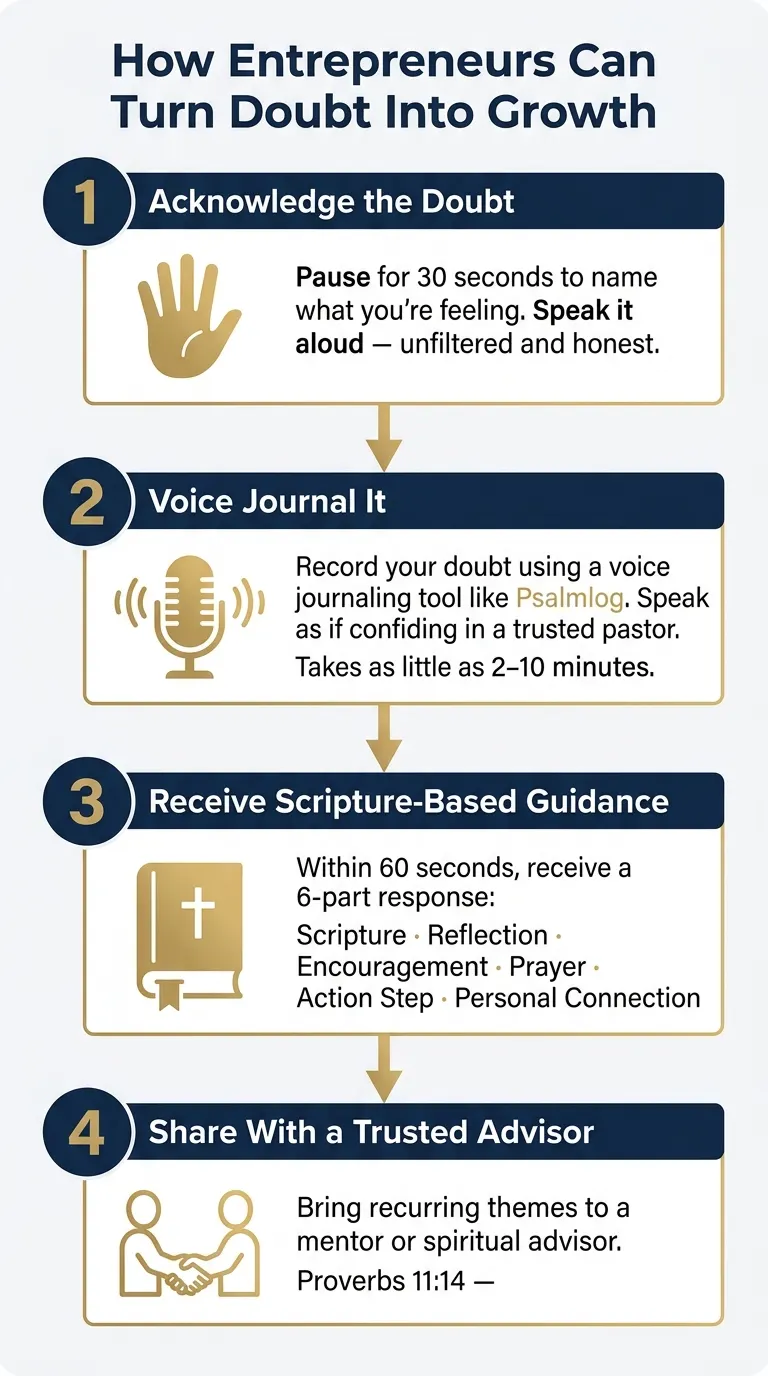
How Entrepreneurs Can Turn Doubt Into Growth: A 4-Step Framework
Building a Simple Daily Rhythm
Turning doubt into something productive doesn’t have to take much time. Even a quick 30-second pause to acknowledge what you’re feeling can make a difference. On tougher days, spending up to 10 minutes to work through a decision can help bring clarity.
Voice journaling can be a powerful tool for this. By using moments that might otherwise go to waste – like during a drive, a walk, or late at night – you can speak your thoughts into Psalmlog. In just about a minute, you’ll receive a structured response that includes a key verse, a reflection, encouragement, a prayer, a practical action step, and a personal connection. This process helps shift you from simply worrying to taking meaningful action.
While creating a daily rhythm of reflection lays a strong foundation, sharing recurring themes with a trusted advisor can bring even deeper understanding.
Bringing Trusted Advisors Into the Process
Sometimes, we need someone else to help us see what we might overlook. Sharing patterns you’ve noticed in your reflections with a mentor or spiritual advisor can uncover blind spots. You don’t need to share every journal entry – just the recurring themes. For instance, if Psalmlog keeps surfacing insights about fear of failure or indecision, discussing these with someone who knows you well can lead to deeper guidance. A good mentor won’t just agree with you – they’ll help you see what you might be missing.
Instead of turning to the endless opinions online, focus on a small group of trusted, spiritually mature voices. Proverbs 11:14 (ESV) offers wisdom on this: "Where there is no guidance, a people falls, but in an abundance of counselors there is safety."
"Maturity lies in inviting voices that challenge and protect you, not just echo your agreement." – Matthew T. Adams and Michelle Adams, My Reasons To Believe
Leading with Honesty and Faith
Once you’ve done the personal and communal work of processing doubt, your own transparency can set the tone for your team. Basesh U. Gala, entrepreneur and founder, emphasizes the importance of clear communication:
"Effective communication is the bridge that connects all aspects of your business. It’s vital for conveying your vision, aligning your team, and building relationships… Clear, transparent, and empathetic communication builds trust and fosters collaboration."
You don’t need to share every uncertainty with your team, but showing that doubt is a normal part of the process – and that it doesn’t stop progress – creates a culture of openness. This kind of environment encourages team members to voice concerns early, preventing small issues from becoming big problems. It all starts with doing the internal work yourself, so when you speak, you lead from a place of clarity, not fear.
Conclusion: Turning Doubt Into Growth
Doubt doesn’t have to hold leaders back. In fact, when approached thoughtfully, it can drive entrepreneurs to gain clarity and grow stronger.
As Matt Patrick, Founder of Patrick Accounting, explains:
"What feels like a ‘normal part of running a business’ is often the most expensive problem in your business. And recognition is the first step."
This recognition – clear, honest, and specific – is where transformation begins. On a personal level, it means confronting fears with faith instead of shouldering them alone. Professionally, it’s about shifting from reactive decisions to intentional ones, rooted in understanding. For instance, unresolved financial confusion can cost businesses between $25,000 and $75,000 annually, according to research.
Practical steps can help turn doubt into a catalyst for growth. These include taking time for daily reflection, seeking advice from trusted voices, and openly addressing doubts instead of suppressing them. Tools like Psalmlog offer a simple way to start: a quick voice journal can transform a brief thought into Scripture-based guidance – a verse, a prayer, and an actionable step. While it doesn’t replace the deeper work of faith, it makes it easier to begin.
As Dina Denham Smith and Neri Karra Sillaman put it: "Self-doubt in those moments is not a sign you’re not cut out to lead. It’s what happens when you’re creating something new." This perspective shifts doubt from being a setback to a sign of progress, reminding leaders that growth often comes from stepping out in faith and embracing the stretch.
FAQs
How do I tell the difference between healthy doubt and fear?
The main distinction comes down to their impact. Healthy doubt sparks reflection and encourages growth. It pushes you to ask thoughtful questions, leading to deeper insights and smarter choices. Fear, however, tends to freeze you in place. It often stems from doubt but spirals into negativity, creating beliefs that hold you back. To tell them apart, consider this: Does your questioning lead to productive thinking, or does it leave you stuck in worry?
What’s a simple way to share doubt without losing credibility?
To express doubt while maintaining credibility, it’s important to be upfront about your uncertainties but present them as personal thoughts rather than definitive statements. Share your feelings – like fears or hesitations – while keeping your focus on your role and responsibilities. This method fosters trust by demonstrating honesty and self-awareness, allowing you to connect with others without letting your doubts affect your actions or weaken your reliability.
How can I use voice journaling to connect doubt with Scripture?
Voice journaling gives you the chance to voice your doubts, struggles, or questions out loud, creating space for Scripture to connect with your specific situation. By being honest and open in your reflections, you can consider how biblical teachings relate to what you’re facing. This practice deepens your relationship with God’s Word, much like the Psalms, where raw emotions and heartfelt questions are brought to God without holding back.