
Marriage & Business: Protect Your Relationship
Building a business often costs marriages more than money—without boundaries, faith, and honest habits, relationships quietly erode.
Running a business can quietly harm your marriage if you’re not careful. Entrepreneurs often face long hours, financial stress, and emotional distance from their partners. Studies show that entrepreneurs divorce at rates 5 to 10 times higher than the general population. For Christian couples, this strain can also weaken spiritual bonds, putting their covenant at risk.
Key Takeaways:
- Common Challenges: Missed family time, financial uncertainty, and lack of emotional connection.
- Root Causes: Overwork, blurred boundaries, and spiritual drift.
- Solutions:
- Set boundaries (e.g., no work during meals).
- Share faith practices (e.g., morning prayers).
- Use tools like Psalmlog for emotional clarity and spiritual guidance.
Bottom line: A thriving marriage isn’t just compatible with business success – it strengthens it. Prioritize your relationship to protect both your personal and professional life.
197: When Marriage & Business Collide: The Hidden Problem Destroying Founder Couples
Understanding the Marriage Tax: Common Challenges
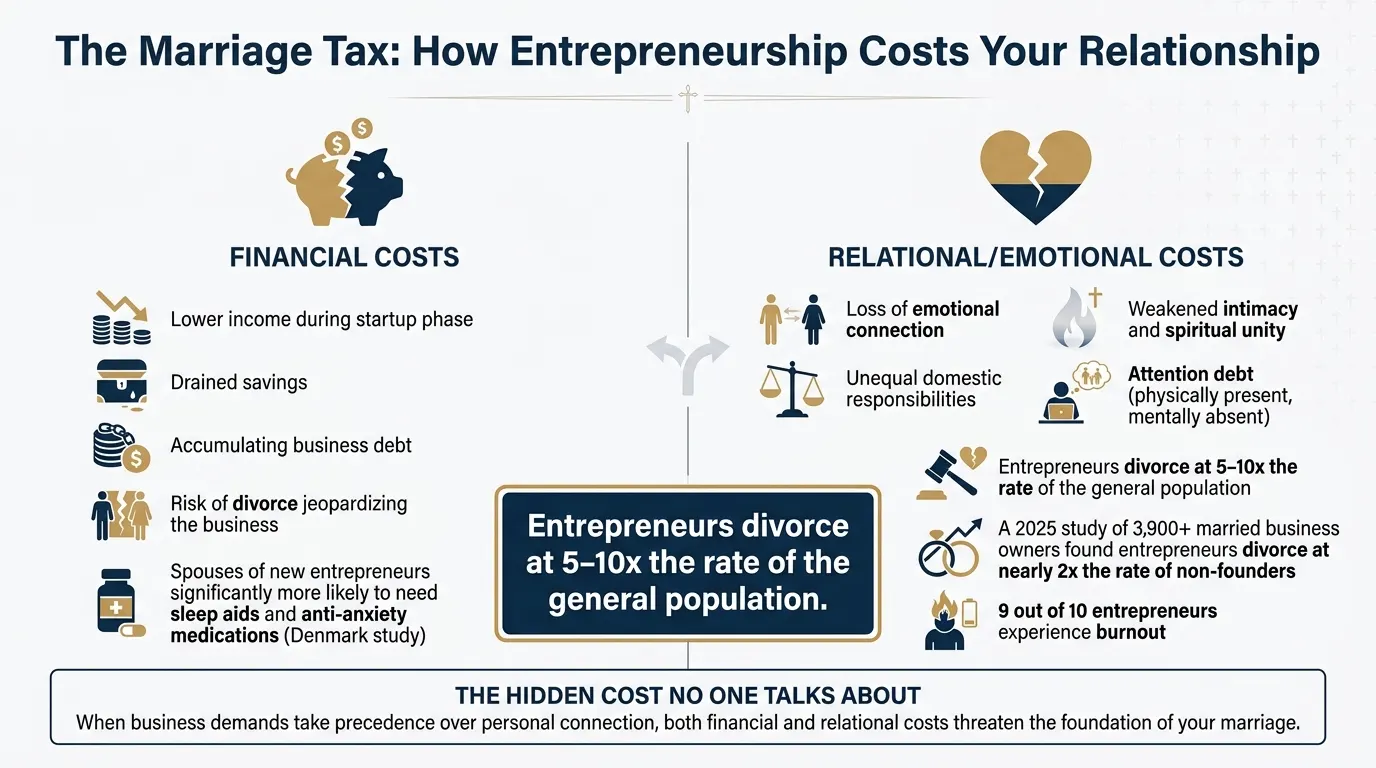
The Marriage Tax: Relational vs. Financial Costs for Entrepreneur Couples
Key Stressors in Entrepreneurial Marriages
Running a business can create unique pressures on a marriage. Entrepreneurs often work long hours, including nights and weekends, leaving their spouse to handle the bulk of childcare, household responsibilities, and emotional labor. Over time, this uneven distribution of duties can lead to resentment.
Financial challenges are another common hurdle. Early-stage businesses typically produce less income than a steady salary, which can heighten stress over mortgages, bills, and other financial obligations. For example, a study in Denmark revealed that spouses of new entrepreneurs were significantly more likely to require sleep aids and anti-anxiety medications during the first two years of the business’s operation.
At home, the fast-paced decision-making style required in business can clash with the emotional support a spouse needs. When one partner expresses frustration, they may be seeking empathy rather than a quick fix.
"In business, problems are meant to be solved. But in relationships, emotions are meant to be understood." – Amanda Severson, LMFT
These stressors don’t just disrupt daily life – they can also weaken the emotional and spiritual foundation of a marriage.
How Strain Shows Up in Christian Marriages
Relational strain doesn’t happen overnight; it builds gradually. Conversations about logistics and responsibilities often replace deeper, more meaningful connections, which can erode the spiritual bond that many Christian couples see as central to their marriage.
For Christian couples, the demands of running a business can intrude on the time and space meant for shared faith and intimacy. This shift can leave one partner feeling more like a supporting character than an equal part of the relationship.
"The business becomes an uninvited third party in the relationship. One wife confided that she actually feels jealous of the business… it gets more attention than I do." – Sabrina Starling, PhD
The signs of strain can be subtle: conversations that end in silence after a disagreement about the business, avoidance of certain financial decisions to prevent conflict, or realizing that personal, meaningful discussions have become rare. These challenges highlight the need to address both the emotional and financial tolls of entrepreneurship, as explored in the next section.
The Relational Marriage Tax vs. the Financial One
In U.S. tax law, the "marriage tax" refers to the higher tax burden some couples face when filing jointly compared to filing as individuals. But the relational counterpart is far more personal – and far less quantifiable.
The financial strain is more visible: lower income during the startup phase, drained savings, accumulating business debt, and the potential for a divorce to jeopardize the business itself. On the other hand, the relational toll includes the loss of emotional connection, unequal domestic responsibilities, and a weakening of intimacy and spiritual unity. When business demands take precedence over personal connection, both financial and relational costs can threaten the very foundation of a marriage.
"You’re not just risking a relationship. You’re risking an entire shared world… You can’t build a thriving business on top of a breaking relationship." – Sharon Pope, Master Life Coach
Root Causes of Relational Strain in Entrepreneurial Couples
Blurred Boundaries and Overwork

Owning a business often means the line between work and home life becomes almost invisible. Think about those late-night emails or urgent client calls interrupting dinner – work tends to seep into personal time. This phenomenon, known as the spillover-and-crossover effect, highlights how stress from running a business not only affects the entrepreneur’s mood and energy but also trickles into their partner’s well-being. This can leave both feeling less satisfied with life overall.
Adding to this is what experts call "attention debt." Picture an entrepreneur sitting at the dinner table, physically present but mentally juggling payroll concerns or planning a big pitch. Over time, the partner might start expecting only physical presence, realizing emotional connection is often missing. As counselor Christie Orosz explains:
"When business demands everything, your marriage shouldn’t be left with nothing." – Christie Orosz, LPCC-S, Married Life Counseling
A 2025 study involving over 3,900 married business owners revealed a sobering statistic: entrepreneurs divorce at nearly twice the rate of non-founders in the same age group. Chronic overwork and attention debt were flagged as the leading culprits.
While blurred boundaries erode emotional closeness, financial challenges often add another layer of stress.
Financial Pressure and Uneven Burdens
Entrepreneurship’s unpredictable income stream can amplify marital tension. Fixed expenses – like rent, groceries, and utility bills – don’t pause during slower business months, creating a lingering sense of financial uncertainty that takes a toll on emotional health at home.
This strain isn’t always shared equally. A long-term study of 628 British couples (1991–2022) found that partners of new entrepreneurs experienced a notable decline in mental health compared to those whose spouses moved into salaried positions. Gender dynamics also play a role: when men start businesses, their partners often shoulder more household responsibilities. By contrast, women entrepreneurs frequently juggle both their business demands and their existing domestic roles.
"For every entrepreneur who makes that leap, there’s often a spouse or partner who may not have chosen the startup life but is about to live it anyway." – Kanwal Bokhari et al., The Conversation
This unspoken shift in workload, often happening without discussion, can build resentment over time. Financial stress, combined with these imbalances, lays the groundwork for deeper emotional and even spiritual disconnect.
Spiritual Drift During Busy Seasons
Periods of rapid business growth can push shared spiritual practices – like morning prayers or attending Sunday services – off the priority list. Dr. Sabrina Starling refers to this as the "leftovers" effect: when the business takes the lion’s share of time and energy, the relationship is left with whatever scraps remain. With burnout affecting 9 out of 10 entrepreneurs, there’s often little left to nurture a marriage, whether spiritually or emotionally.
For Christian couples, this drift carries even more weight. When shared faith practices fade, they lose the spiritual foundation that often strengthens their marriage’s purpose and resilience. Without these practices, the deeper, sacred connection that underpins their relationship can weaken, placing their covenant at risk.
Biblical Solutions to Protect Your Marriage
Biblical principles offer enduring guidance to navigate the challenges entrepreneurial couples face, such as blurred boundaries, financial pressures, and spiritual drift. These principles provide a framework for safeguarding both your marriage and your faith.
Marriage as a Covenant, Not a Project
One of the most crucial mindset shifts for entrepreneurial couples is understanding that marriage isn’t just another project to manage – it’s a covenant to cherish and protect. From the very beginning, Scripture describes marriage as a sacred bond: "Therefore a man shall leave his father and his mother and hold fast to his wife, and they shall become one flesh" (Genesis 2:24). The phrase "hold fast" emphasizes intentional, ongoing commitment – something far deeper than simply coexisting between work calls and meetings.
Pastor Greg Wagoner underscores this perspective:
"Marriage is not merely a social arrangement or a personal preference. It is a sacred institution designed to put the love of Christ on display."
In the face of business pressures, it’s easy to treat your spouse like a business partner, focusing only on shared tasks or goals. But a covenantal view of marriage calls for more: mutual sacrifice, daily faithfulness, and love that reflects Christ. Dave Jenkins, Executive Director of Servants of Grace Ministries, explains:
"Faithfulness in small things such as a gentle word, a patient response, a quiet act of service, and a consistent prayer does more to shape a marriage than occasional displays of romance."
When business success starts to overshadow your marital covenant, it risks becoming an idol. Colossians 1:16-17 reminds us that Christ is the one in whom "all things hold together". Keeping this covenantal mindset also helps couples establish boundaries that protect their relationship and spiritual health.
Setting Clear Boundaries and Rhythms
Boundaries aren’t about limiting freedom – they’re about safeguarding what matters most. Henry Cloud and John Townsend, authors of the Boundaries series, explain:
"Boundaries define us. They define what is me and what is not me. A boundary shows me where I end and where someone else begins, leading me to a sense of ownership."
For entrepreneurial couples, this might mean setting firm limits to preserve family time and emotional energy. Practical steps include:
- Blocking family time on a shared calendar before scheduling work commitments.
- Establishing no-phone zones during meals.
- Using techniques like “Focused 15” (15-minute work sprints) to prevent tasks from spilling into evenings.
Psalm 16:6 beautifully captures the purpose of boundaries: "The boundary lines have fallen for me in pleasant places; indeed, I have a beautiful inheritance." Boundaries are not restrictive – they’re protective, keeping your priorities intact.
Here’s how biblical principles can guide specific boundaries:
| Boundary Type | Scripture Anchor | Practical Application |
|---|---|---|
| Responsibility | Galatians 6:5 | Each spouse manages their own work-related stress. |
| Tolerance | Proverbs 25:28 | Avoid business discussions after 8:00 PM. |
| Permission | 1 Timothy 5:8 | Allow 30 minutes of quiet time after work to reset. |
| Spiritual Unity | John 15:4-5 | Begin the day with a shared morning prayer. |
With these boundaries in place, couples can better protect their relationship and focus on shared spiritual growth.
Practicing Shared Spiritual Disciplines
In busy seasons, shared spiritual practices often fall by the wayside. But these routines are foundational for a strong, unified marriage. Nicole Pinkston, an author and speaker on Kingdom marriage, explains:
"A Kingdom marriage is not two half‑people merging into one blurry, undefined blob. A Kingdom marriage is two whole, God‑formed individuals becoming one unified force."
Building unity starts with small, consistent habits. Even a two-minute prayer together each day can shift the spiritual tone of your home. Adding a weekly Scripture check-in – asking questions like "How is your heart?" or "What do you need more of this week?" – keeps the connection strong amidst the demands of work.
Ephesians 5:15-16 challenges believers to "look carefully then how you walk… making the best use of the time". For entrepreneurial couples, this means letting values, not busyness, shape the schedule. Starting and ending the day with prayer as a couple frames your work within God’s purpose, ensuring it doesn’t consume your entire life.
Using Voice Journaling and Psalmlog to Support Your Marriage

The spiritual disciplines and boundaries mentioned earlier need a practical way to stick – something simple that helps you process emotions before they impact your marriage. This is where voice journaling comes into play. It complements those practices by offering a way to manage emotions before they spill over into your relationship.
Why Voice Journaling Helps Marriages
Voice journaling is a great fit for busy lives, especially for entrepreneurs who rarely have time to sit and write. Whether during a commute, a quick walk, or just before bed, these small windows of time are perfect for speaking your thoughts. Plus, speaking is much faster than typing – about 150 words per minute compared to 40 on a phone. This speed is especially helpful when emotions run high after a tough client call or a stressful financial discussion.
Talking through your emotions can help you make sense of them:
"Vocalizing problems helps externalize them. Hearing yourself say, ‘I feel overwhelmed because…’ often brings immediate clarity that thinking in loops does not." – Reflection.app
By naming your feelings before a tough conversation with your spouse, you’re more likely to approach the discussion calmly rather than reacting in the heat of the moment.
How Psalmlog Features Support Entrepreneurial Couples
Psalmlog is a voice-first journaling app built with Christian values, making it a natural addition to your spiritual routine. This app doesn’t just record your voice; it actively engages with what you share. Based on your voice entries, Psalmlog offers a six-point pastoral reflection, including a Bible passage, explanation, prayer, encouragement, and practical steps to address the emotional or financial challenges you’re facing. This kind of immediate guidance reinforces the spiritual unity that strengthens marriages.
What sets Psalmlog apart is its ability to tailor content to your emotions. For example, if you’re feeling financial anxiety, it surfaces Scripture and insights that directly address those concerns. The Faith Builder plan ($19.99/month) offers 300 minutes of voice journaling each month, along with over 20 templates designed to tackle challenges like marital stress, career changes, and financial worries.
Additionally, the app’s insights dashboard helps you identify recurring themes in your entries. This can help you and your spouse notice patterns early, giving you a chance to address them before they grow into larger issues.
Adding Psalmlog to Your Daily and Weekly Routine
Incorporating Psalmlog into your routine can strengthen both your personal reflection and your connection as a couple. One practical habit is to use it during moments of stress – before reacting, record your frustrations. Within minutes, you’ll receive Scripture and encouragement to help you approach the situation with patience and understanding.
For a weekly practice, you and your spouse can review each other’s insights dashboards together. This isn’t about analyzing but about creating space to ask, “What’s been weighing on you this week?” It’s a low-pressure way to check in and foster honest conversations. If you’re curious but not ready to commit, Psalmlog offers 3 free lifetime entries on its website to help you explore its features before subscribing.
Conclusion: Putting Your Marriage Before Business Success
Running a business comes with its share of challenges, but no level of success can compensate for the loss of a strong marriage. Michael Hyatt, author and former CEO, put it perfectly:
"If you win at work but lose at home, you’ve still lost."
The "marriage tax" is real – it can show up in missed family moments, growing frustrations, financial stress, or even emotional distance. But here’s the good news: it doesn’t have to be this way. Couples who protect their marriages while building businesses aren’t necessarily working fewer hours – they’re working smarter. They create clear boundaries, maintain shared spiritual practices, and prioritize open communication.
This idea is at the heart of everything discussed earlier. A thriving marriage isn’t an obstacle to your business – it’s the bedrock that supports its longevity. Research shows that high-conflict households drain mental energy and weaken decision-making abilities, which are critical for any entrepreneur. In contrast, a healthy, supportive marriage sharpens your focus and improves your well-being.
The strategies shared – like setting "no-fly zones", holding weekly check-ins, observing a shared Sabbath, or using tools like Psalmlog for emotional clarity – don’t require perfection, just consistency. Start small, focusing on the most pressing need, and build from there. These habits not only protect your marriage but also give you the clarity and strength to pursue your business goals with integrity.
FAQs
How do we set work boundaries without hurting the business?
Setting boundaries is essential when balancing work and personal life, especially in shared endeavors. One way to achieve this is by establishing rituals that clearly separate the two. For example, create work-free zones in your home where business discussions are off-limits, or set specific times dedicated to personal activities.
Use time blocking to allocate specific periods for work tasks and relationship-focused activities. This helps ensure neither area dominates the other. Additionally, practice mindful communication – address concerns about boundaries in a respectful and open way to avoid misunderstandings.
If work occasionally spills into personal time, agree on limits and establish respectful protocols. This way, you can maintain harmony in your relationship while ensuring the business stays on track.
What are early warning signs our marriage is drifting spiritually?
Feeling spiritually distant in a marriage can show up in several ways. You might notice a sense of disconnection, emotional gaps between you and your partner, or a lack of shared spiritual activities. These challenges often arise from everyday stress, fatigue, or even differing paths in faith. When left unaddressed, they can create confusion and weaken trust in the relationship. Tackling these concerns early on is key to rebuilding your bond and fostering a sense of togetherness.
How can we use Psalmlog together without oversharing?
To make the most of Psalmlog without oversharing, aim for honest communication and establish clear boundaries. Focus on sharing thoughts that encourage spiritual growth and reflect on Scripture, keeping conversations respectful and uplifting. Approach discussions with a mindset geared toward resolving issues rather than reacting emotionally. Choose topics that promote unity and harmony, creating a space where both transparency and privacy are valued. This approach can deepen your spiritual connection while nurturing your relationship.