
How to Lead a Small Group That Goes Deeper Than Surface-Level Answers
Make your small group go deeper by guiding (not teaching), building trust, asking open-ended questions, pausing for reflection, and applying Scripture to life.
Most small groups struggle to move beyond surface-level discussions. While these groups are meant to foster meaningful relationships and spiritual growth, they often fall short, leaving members with facts but no real transformation. The key to deeper engagement lies in creating a safe space, asking the right questions, and guiding discussions toward personal and actionable insights.
Here’s how to make your small group more impactful:
- Shift from teaching to guiding. Let the group explore together by listening more and talking less (70/30 rule).
- Encourage vulnerability. Share your own struggles to set the tone for openness.
- Ask better questions. Use open-ended prompts like, "When have you experienced God’s faithfulness unexpectedly?"
- Pause for silence. Give members 15–20 seconds to reflect before answering.
- Build trust. Establish confidentiality and discourage unsolicited advice.
- Connect Scripture to daily life. Focus on passages that address universal experiences and use simple methods like observation, interpretation, and application.
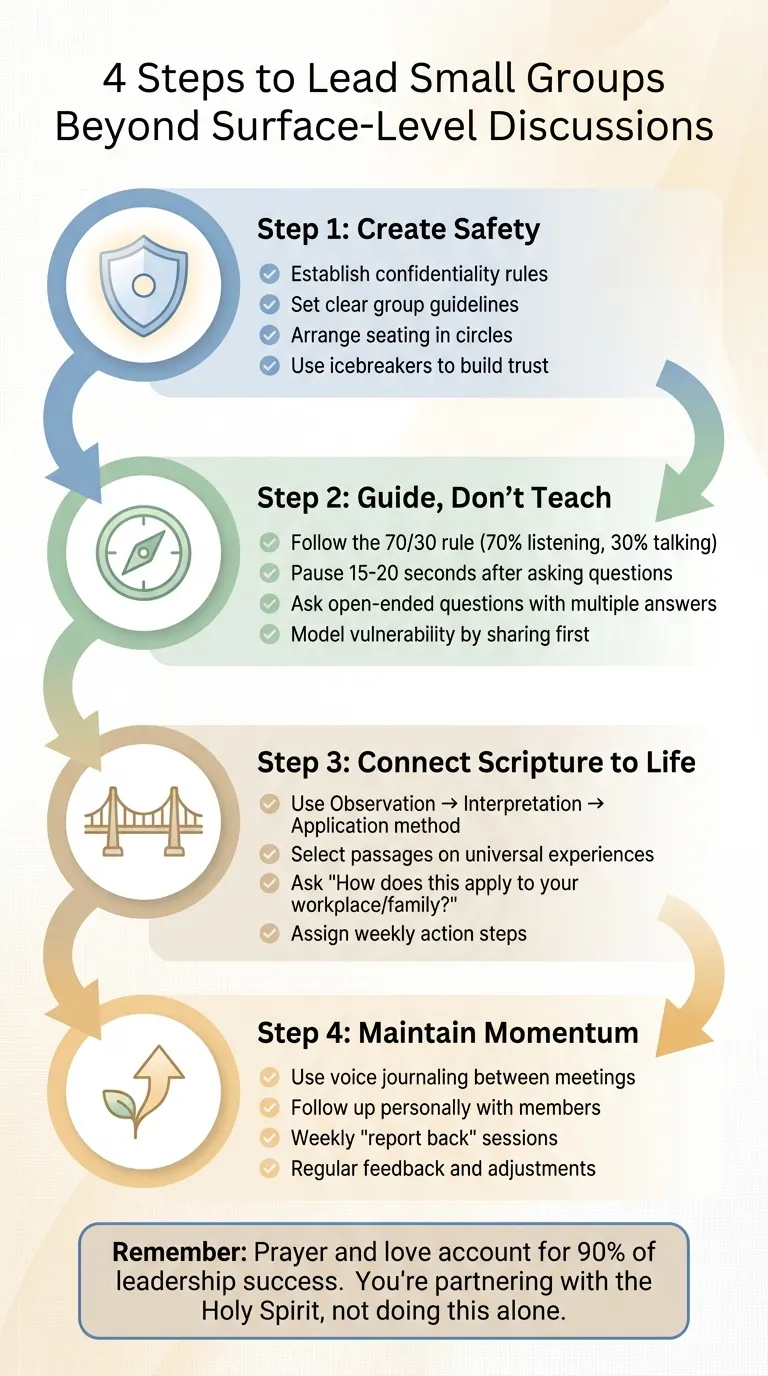
4-Step Framework for Leading Deeper Small Group Discussions
How to Be a Great Small Group Leader: 5 Keys to Leading a Successful Small Group
Core Principles for Leading Deeper Conversations
Creating meaningful connections in group discussions requires moving beyond surface-level exchanges to foster transformative dialogue.
Lead as a Guide, Not a Teacher
The way you lead a group can make all the difference. Are you delivering information, or are you facilitating a deeper, shared experience? Andrew S. Mason, Small Groups Pastor at Real Life Church, captures this perfectly:
"Guiding group discussion is more of a dance than a military march. You’re not commanding attention and straining toward a precise outcome".
Rather than focusing on teaching, aim to guide the conversation. Spiritual growth flourishes when the group collaborates and explores together, rather than simply absorbing facts. A well-posed question can spark rich discussions – your role is to step back and let the group take the lead.
To strike the right balance, try the 70/30 rule: talk for 30% of the time and listen for 70%. After asking a question, pause for 15–20 seconds to give people time to think and respond. When someone shares, acknowledge their input with phrases like, "Thanks for sharing that", or, "What I hear you saying is…" – this helps create a welcoming and safe environment.
While guiding the dialogue is essential, the real transformation comes from a deeper source.
Rely on the Holy Spirit
You’re not responsible for creating growth – your role is to make space for it. As Sam O’Neal, author and editor, explains:
"Work with the Holy Spirit to help your group members become more like Christ".
The Holy Spirit is the driving force behind transformation. Your job is to facilitate practices like prayer, lectio divina, and confession, which encourage members to move beyond surface-level conversations. For example, Phil Collins, Ph.D., from Taylor University‘s Center for Scripture Engagement, suggests having members select and pray over Bible verses that resonate with their personal struggles, then support each other throughout the week.
This approach involves asking questions that touch on deeper, heart-level issues. Vulnerability is key – start by sharing your own struggles and demonstrating reliance on God’s grace. When you model this openness, it invites others to do the same. Remember, you’re not leading alone. You’re partnering with the Holy Spirit to guide the group toward healing and growth.
As you nurture spiritual sensitivity, it’s important to recognize the cultural challenges that can hinder deeper discussions.
Understand Group Barriers in U.S. Culture
Certain aspects of American culture can make it harder to foster deep, meaningful conversations. For instance, efficiency culture often leads people to view meetings as a waste of time unless there’s a clear, tangible outcome. Individualism and privacy can make participants hesitant to share openly, while conflict avoidance often causes groups to shy away from addressing differing perspectives.
The traditional U.S. education system adds another layer to this challenge. Cherese Childers-McKee, Associate Teaching Professor at Northeastern University, points out:
"Traditional teaching strategies emphasize the teacher-student dynamic: The teacher is the expert… while the student receives the knowledge. This teaching method is outdated".
To overcome these obstacles, focus on facilitative leadership. Set clear group guidelines that encourage open dialogue, protect diverse ideas, and keep discussions centered on issues rather than individuals. Additionally, understand that participants may need time to transition out of their busy routines before they’re ready to engage deeply.
One practical tool is the five-second rule, recommended by Sam Townsend, Senior High Ministry Pastor at Calvary Church:
"Two seconds of silence can seem like an eternity. A good practice is to ask a question and then mentally count to five".
This simple pause can ease the tension and encourage people to speak up, even in a culture where silence often feels uncomfortable.
Build a Safe Environment for Sharing
Understanding U.S. cultural barriers is just the starting point. Creating a space where people feel safe to share openly is what truly drives meaningful conversations. Without this sense of security, discussions often get stuck in polite, surface-level exchanges.
Set Clear Group Guidelines
Start by establishing clear boundaries. One essential rule is: "What is said in the group stays in the group". This promise of confidentiality helps participants feel secure. Beyond that, set expectations to avoid common pitfalls – discourage "fixing" others’ problems, giving unsolicited advice, or speaking for others. Instead, encourage members to use "I" statements and share from their own experiences.
Active listening plays a big role here. Maintain eye contact, nod, and use affirming phrases like, "Thanks for sharing". Begin meetings with low-stakes icebreakers to help participants ease into the conversation. This gradual approach allows people to feel comfortable before tackling deeper, more vulnerable topics. These practices form the groundwork for trust, which can be further reinforced by thoughtful physical arrangements.
Create a Comfortable Physical Space
The setting you create matters more than you might think. Arrange seating in a circle so everyone can see and connect with one another – circles encourage engagement, while rows can feel impersonal. Joy, the founder of Tools for Mentoring, emphasizes that small touches like offering snacks or drinks can help ease initial discomfort. A simple cup of coffee or a few light refreshments can help participants transition from a busy day into a more reflective state of mind.
Greet each person warmly when they arrive to show they’re valued. Respect their time by starting and ending meetings as scheduled – this builds trust and shows consideration. You might even rotate responsibilities, like bringing snacks or hosting, to give everyone a sense of ownership and make the space feel more personal. Once the physical environment is welcoming, turn your attention to managing group dynamics.
Handle Different Personalities and Topics
Balancing personalities is crucial for maintaining an open and inclusive atmosphere. If someone dominates the discussion, gently remind the group to share the floor. In cases where it’s necessary, address the individual privately to avoid embarrassment. On the flip side, encourage quieter members to share their thoughts to ensure everyone’s voice is heard.
When conversations veer off track, use polite transition phrases like, "Let’s hold onto that for now, but I’d love to hear more from you after the meeting". If someone offers unhelpful advice or makes an inappropriate comment, step in to remind the group of the safety guidelines. Follow up with the individual privately to explain how their behavior affects the group’s dynamic. Corrections like these are best handled one-on-one, ensuring the group remains a safe and respectful space.
Methods for Moving Beyond Surface-Level Answers
Once you’ve created a safe and welcoming environment, the next step is to guide discussions beyond surface-level answers. This approach encourages deeper, more meaningful conversations that lead to genuine spiritual growth. Below are some practical techniques to help spark thoughtful and personal sharing.
Ask Open-Ended and Follow-Up Questions
The quality of your questions often dictates the depth of the discussion. Open-ended questions, especially those with multiple possible answers, can encourage broader participation. For example, instead of asking "Is God faithful?" – which typically invites a single, predictable response – try asking, "When have you experienced God’s faithfulness in an unexpected way?" Such questions invite participants to reflect and share personal experiences.
Melissa Kruger, Vice President of Discipleship Programming at The Gospel Coalition, puts it this way:
"If you can think of multiple answers to your own question, then most likely your group will be able to as well".
Another great strategy is to use "Houston, We Have a Problem" questions, which address common misunderstandings and invite the group to explore solutions. Similarly, "Achilles Heel" questions tackle the more challenging aspects of a topic that people might usually avoid.
Follow-up questions are just as important. When someone gives a vague or hesitant response, gently probe further with phrases like "Can you tell me more about that?" or "What do you mean by that?". Pay attention to words or phrases that seem emotionally charged, and ask for clarification to uncover deeper meaning. Dan Brown, designer and author, highlights the impact of this approach:
"Nothing builds trust faster than heartfelt interest in what another person is saying".
When someone shares something meaningful, try restating their point, such as "So you felt abandoned because your prayer wasn’t answered?" This not only shows you’re listening but also encourages them to reflect further. To set the tone for openness, consider answering tough questions yourself first. Your vulnerability can inspire others to share more honestly.
Progress from Understanding to Action
The structure of your discussion plays a big role in fostering transformation. A well-planned conversation often follows a natural progression, starting with lighter topics and gradually diving deeper. Begin with Connection questions to build rapport, like "What’s your favorite comfort food?". Then, move on to Dissection questions that focus on the text itself, such as "What does this passage say about mercy?". From there, use Reflection questions to tie the topic to personal experiences through scripture reflection, like "When have you felt most accepted?". Finally, wrap up with Inspection questions that encourage action, such as "What is one habit you want to change based on this?".
This step-by-step approach helps participants ease into deeper discussions. Andrew S. Mason, Small Groups Pastor at Real Life Church, explains:
"The nutrients for spiritual growth are found more in the group synergy than the group study".
The ultimate goal isn’t just understanding Scripture – it’s applying it in ways that lead to real change.
Embrace Silence and Let People Think
Silence can be a powerful tool in discussions, even if it feels uncomfortable at first. When you ask a challenging question, give participants 15–20 seconds to process their thoughts before speaking again. This pause allows for deeper reflection. Andrew S. Mason emphasizes the importance of these moments:
"Quiet pauses feel like a vacuum that must be filled. In reality, those pauses are essential for quality interaction".
If you find the silence awkward, try looking away briefly instead of staring directly at the group. You can also ease the tension by saying, "Take 15–20 seconds to think about that before you answer." If the silence stretches on, consider rephrasing the question rather than rushing to fill the gap. It’s important to remember that silence often signals deep thought, not disinterest. This approach is especially beneficial for introverts, who may need more time to process their responses before speaking.
Connect Scripture to Everyday Life
Bible study becomes truly meaningful when participants see how ancient texts speak directly to their daily lives. Without this connection, Scripture can feel interesting but detached. As a leader, your mission is to bridge that gap, helping your group see how the Bible’s teachings can transform everyday routines. This connection paves the way for practical application and deeper engagement during discussions.
Select Scripture That Sparks Reflection
Certain passages naturally encourage deeper thought and conversation. Stories, Psalms, and the teachings of Jesus often resonate more personally than genealogies or ceremonial laws. When selecting a passage, think about the questions someone new to faith might ask. Viewing Scripture through fresh eyes can ignite genuine curiosity.
Start your study with a simple question: "What stands out to you?" This question has no wrong answer and often reveals where God is already working in someone’s life. Jim Egli, Leadership & Missions Pastor at Vineyard Church, emphasizes the importance of focus:
"The most common mistake that group leaders at a small group Bible study make is to ask too many questions. If you ask too many questions, you don’t delve deeply into any of them."
Choose passages that touch on universal human experiences – like fear, hope, loss, or forgiveness – so participants can immediately relate to the text.
Use Simple Bible Study Methods
After selecting reflective passages, guide your group through straightforward study methods. The inductive Bible study method is a great choice, with its three phases: Observation, Interpretation, and Application. This approach helps participants move from understanding the text to applying it in their lives.
- Observation: Encourage participants to paraphrase verses to confirm their understanding.
- Interpretation: Ask questions like, "What do you think the author is really trying to say?" Explore elements such as commands to follow, promises to claim, sins to avoid, or examples to emulate.
- Application: Use the SHARP framework to craft questions that lead to meaningful change. SHARP stands for Specific (clear actions), Honor Scripture (faithful to the text), Accountability (shared with others), Risky (requiring reliance on God), and Prayerful (seeking divine guidance).
Sally Ivaska, author and small group trainer, explains the leader’s role in this phase:
"Your job as a Christian is to obey; your job as a leader is to move the group toward obedience."
Apply Biblical Principles to Everyday Challenges
Once your group understands the passage, focus on translating its principles into real-world actions. While Scripture’s truths are timeless, their application often looks different today. Help your group reflect on how these truths intersect with modern life by asking questions like, "How does this apply to your family or workplace?"
Make it practical. For example, if the passage discusses generosity, explore Bible study tools and practical resources like budgeting apps, setting up automatic donations, or deciding how to respond when someone asks for financial help. If the topic is conflict resolution, relate it to real-life scenarios like tough conversations with teenagers, workplace disagreements, or tensions with neighbors. End with a specific challenge: "What action will you take this week?"
Start each meeting by sharing moments where participants applied biblical principles in their lives. This practice reinforces the idea that transformation happens in everyday moments, not just during study sessions. Additionally, encourage participants to handwrite notes during the study – it’s a simple way to deepen understanding and retention.
Use Psalmlog and Voice Journaling for Deeper Engagement

It’s easy for momentum and insights from group sessions to fade during the week. But with the right digital tools, participants can stay connected to Scripture and continue their spiritual growth in meaningful ways. By incorporating tools like Psalmlog and voice journaling, group members can deepen their reflections and keep the conversation going long after the meeting ends.
How Voice Journaling Enhances Reflection
Speaking reflections out loud has a way of engaging the heart in ways silent reading often doesn’t. It helps bridge the gap between biblical knowledge and real-life application, encouraging participants to turn understanding into action. By vocalizing thoughts, individuals can better distinguish between internal reflections and external emotions, gaining clarity on what truly drives their behavior.
Encourage members to use their phones to record personal reflections before tackling group discussion questions. This process gives them the “space to process” their struggles or insights, often leading to a deeper understanding of their own thoughts. Hearing their own voice articulate an issue or realization can spark clarity, making their contributions to group discussions richer and more meaningful.
Key Psalmlog Features for Group Growth
Psalmlog’s voice-first approach is ideal for those who find writing challenging. Members can naturally speak their prayers, questions, and insights – just as they would in conversation. The app’s Scripture tagging feature allows users to link specific Bible passages to their personal experiences, creating a deeper connection to the Word. Meanwhile, the personalized insights dashboard tracks spiritual progress, helping members see how intentional they’ve been in their journey.
This dashboard also highlights patterns in engagement, like when participants are most likely to reflect or which topics resonate deeply. By offering structured reflection, Psalmlog helps users discern God’s voice amid the noise of daily life.
Adding Psalmlog to Your Group Routine
To get started, assign weekly reflection tasks using voice journaling prompts. Ask members to focus on a short Scripture passage and record their thoughts to share at the next meeting. As small-group leader Justin Marr explains:
"They’ll learn more than is possible to glean in a single hour-long meeting. These nuggets of knowledge will stick with them and contribute to their overall spiritual development".
Use these reflections to follow up personally with members. For example, if someone mentions a tough meeting in their journal, send a quick text letting them know you’re praying for them. This type of thoughtful follow-up builds trust and reminds members that spiritual growth is an everyday journey, not just something for group settings.
Finally, incorporate a weekly "report back" where members can share key insights from their reflections. This practice keeps the group connected throughout the week and reinforces the idea that applying Scripture to daily life is an ongoing process. By weaving these tools into your routine, you’ll help members take ownership of their spiritual growth and deepen their engagement with both Scripture and each other.
Structure Your Small Group Meeting for Depth
Having a clear structure in place helps create meaningful connections and keeps the focus on spiritual growth. A well-rounded meeting can be built around four main elements: Connection (building relationships), Bible Discussion (applying Scripture to life), Prayer & Worship (fostering spiritual closeness), and Mission (an outward focus on serving others). This approach not only encourages studying Scripture but also emphasizes living it out in daily life.
Sample Meeting Schedule
For a 90-minute meeting, you can follow this simple flow:
- 20 minutes of connection time: This is the perfect moment to catch up, share life updates, enjoy snacks, and do icebreakers that help everyone transition from the busyness of their day.
- 30 minutes of Bible discussion: Focus on a short Scripture passage and use open-ended questions that encourage reflection and practical action.
- 15–25 minutes of prayer and worship: Create space for members to pray for one another, share needs, and minister to each other.
- Wrap up with mission-focused activities if there’s time.
Andrew S. Mason, Small Groups Pastor at Real Life Church, puts it this way:
"The nutrients for spiritual growth are found more in the group synergy than the group study".
And here’s a tip: when asking a deep or challenging question, give the group 15–20 seconds of silence to think. Resist the urge to fill the quiet – it can lead to richer conversations.
Adjust the Format for Different Groups
Every group is unique, so don’t hesitate to tweak this structure to suit your members. For brand-new groups, spend more time on connection to build trust before diving into deeper discussions. Established groups, on the other hand, might occasionally dedicate an entire meeting to one element, like a prayer walk or a social gathering.
Mixed-gender groups often benefit from structured discussion questions to keep conversations balanced, while single-gender groups may naturally dive into more personal sharing. As trust grows, you can assign roles like discussion leader or prayer coordinator to increase engagement and ownership.
Flexibility is key. If someone in the group has an urgent need, don’t hesitate to set aside the planned agenda to focus on their situation. These small adjustments can help your group thrive as relationships deepen.
Get Feedback and Make Improvements
To keep your group dynamic and avoid getting stuck in a routine, make regular evaluations part of your process. A structured approach not only keeps discussions on track but also strengthens connections. Try a two-step feedback process: first, gather input from individuals, then discuss it as a group. Instead of squeezing this into the last few minutes of a meeting, set aside a dedicated session for feedback.
Ask questions that focus on personal growth, such as, "How has being part of this group impacted your life this year?" or "Are we studying the Bible just to learn facts, or are we applying it?".
Having a co-leader observe group dynamics can also be a game-changer. They can provide real-time feedback on how well the meeting flows and suggest ways to improve. As Allen Kleine Deters from CRC Network points out:
"Churches who are serious about their ministry effectiveness value evaluation and honest criticism".
If you delegate leadership roles, follow up within a week to review how it went. Discuss what worked well and where there’s room for growth. This not only helps the group but also builds confidence in future leaders.
Conclusion
Leading a small group effectively isn’t about knowing everything – it’s about encouraging spiritual growth. Start with prayer, as it forms the foundation of impactful leadership. Voice journaling can deepen your prayer life by helping you track growth and integrate Scripture into your daily conversations with God. In fact, prayer and love account for 90% of leadership success. Take time to pray for each member by name and let the Holy Spirit guide your actions.
Once you’ve established this spiritual base, add practical strategies to your toolkit. Use the 70/30 rule to balance listening and speaking, ask open-ended follow-up questions to spark deeper conversations, and embrace 15–20 seconds of silence to allow for thoughtful reflection.
Transparency is another key to building trust. Be the first to answer vulnerable questions, showing the group it’s a safe and confidential space. Your willingness to be open sets the tone for others. As Carter Moss, Adult Ministry Catalyst, wisely puts it:
"We don’t have to have all of the right answers… We are simply creating an environment for community and life change to happen".
To keep the momentum going between meetings, consider using Psalmlog. This voice journaling tool allows members to privately reflect, connect Scripture to their daily lives, and bring richer insights to group discussions. It’s a great way to complement the in-person strategies and deepen the group’s spiritual journey.
FAQs
How can I help my small group open up and share more deeply?
Creating an environment where your small group feels comfortable sharing begins with trust. Start each meeting with a lighthearted, personal icebreaker. Try something like, “What’s a favorite memory from your childhood?” or “What’s a recent challenge you’ve faced?” These simple questions help members connect on a personal level, creating the groundwork for more meaningful conversations.
As trust grows, guide the group with open-ended questions that invite deeper reflection and storytelling. For example, ask, “What has God been teaching you recently?” or “How does this scripture relate to what you’re going through right now?” If someone shares a prayer request or a personal struggle, follow up with gentle questions like, “How has this shaped your perspective or faith?” Being vulnerable yourself is just as important – share your own experiences, challenges, or lessons to set the tone for openness.
Make time for prayer and reflection during your meetings. Encourage members to pray for each other’s needs and even offer brief, personal prayers aloud. When people see their honesty met with kindness and support, they’ll feel more comfortable sharing in the future. With consistency, these practices will nurture a sense of authenticity and create deeper connections within your group.
What are some open-ended questions to encourage deeper group discussions?
Open-ended questions are an excellent way to spark meaningful discussions, as they encourage participants to reflect and share their personal thoughts. Here are a few examples:
- “What do you think this passage means for us today?” This invites interpretation and allows for multiple perspectives without a single ‘right’ answer.
- “What stood out to you in this verse, and why?” This question encourages participants to share their personal observations and feelings.
- “How can this truth help with a challenge you’re currently facing?” This connects the discussion to real-life situations, making it more relatable and practical.
To keep the conversation engaging, consider gentle follow-up prompts like “Can you explain that further?” or “What makes you feel that way?” These questions dig deeper into participants’ thoughts and emotions, enriching the dialogue and fostering a more thoughtful exchange.
How can I manage dominant personalities in a small group discussion?
Managing dominant personalities in a small group is about creating balance, not stifling anyone’s voice. Start by laying the groundwork with clear expectations – let everyone know that the goal is a collaborative and meaningful discussion where all participants will have a chance to share. Use open-ended, thoughtful questions like “What does this passage reveal to you?” instead of prompts that might lead to long-winded opinions.
If someone starts to take over the conversation, gently step in. Acknowledge their input by summarizing their point to show they’ve been heard, then guide the discussion back to others. For example, you could say, “That’s an interesting perspective. Sarah, what are your thoughts on this?” A round-robin approach can also help ensure everyone gets a turn to speak, creating a more inclusive atmosphere.
To keep things fair and organized, you might introduce time limits for responses or use a tool like a “talking stick” to give each person a clear opportunity to contribute. The key is to create an environment where quieter members feel comfortable sharing and no one feels pressured to dominate. This way, the conversation remains balanced, engaging, and productive for everyone involved.